


 |
市場調查報告書
商品編碼
2065561
ERP升級與遷移服務:市場佔有率分析、產業趨勢與統計數據以及成長預測(2026-2031年)Enterprise Resource Planning Upgrade And Migration Services - Market Share Analysis, Industry Trends & Statistics, Growth Forecasts (2026 - 2031) |
||||||

※ 本網頁內容可能與最新版本有所差異。詳細情況請與我們聯繫。
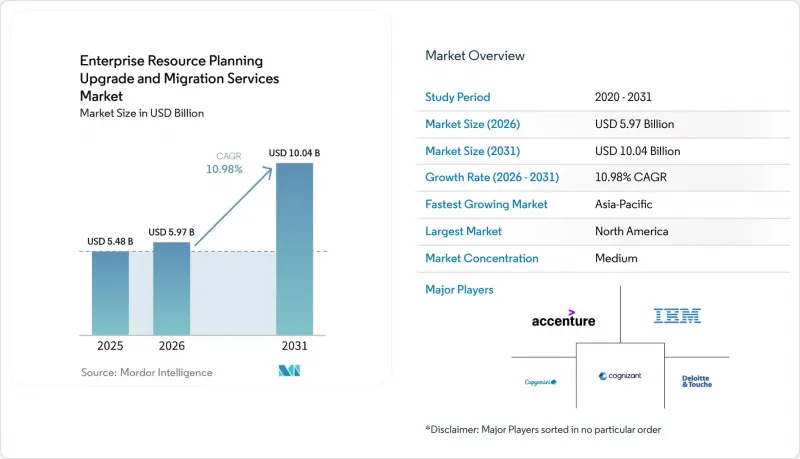
根據 Mordor Intelligence 預測,ERP 升級和遷移服務市場規模預計將在 2025 年達到 54.8 億美元,2026 年達到 59.7 億美元,到 2031 年達到 100.4 億美元,2026 年至 2031 年的複合年成長率為 10.98%。
本報告按部署模式(本地部署、雲端部署、混合部署)、組織規模(中小企業、大型企業)、產業(製造業、銀行業、金融服務和保險業 (BFSI)、醫療保健業、IT 和電信業、政府和公共部門等)以及地區進行細分。市場預測以美元 (USD) 為單位。
全球ERP升級及遷移服務市場趨勢及洞察
後疫情時代對數位化韌性的需求日益成長。
2020年至2023年間,經歷過供應鏈中斷和長期遠距辦公的企業得出結論:本地部署的ERP系統缺乏快速重新配置所需的柔軟性。隨著韌性成為迫切需求,雲端採用正在加速,預計到2024年,70.4%的部署將基於雲端。製造企業正在將物聯網感測器整合到S/4HANA中,以預測維護需求;零售商正在利用即時庫存分析來減少20-30%的缺貨率。金融機構正在將流動性儀錶板遷移到與付款閘道無縫整合的雲端原生核心系統。北美和歐洲在雲端採用方面處於領先地位,但隨著政府獎勵計劃抵消基礎設施成本,亞太地區正在縮小差距。
向雲端優先ERP架構的轉變正在加速。
考慮到硬體升級、資料庫授權和內部人事費用,五年內雲端ERP的總擁有成本 (TCO) 比同等規模的本地部署環境低30-40%。中小企業也表現出濃厚的興趣,70%的企業傾向於選擇雲端解決方案,預計到2025年,Odoo等平台每月將新增13,000名客戶。混合架構在風險規避型產業仍然普遍存在,但主要用作遷移階段的架構。亞太地區的成長勢頭得益於Oracle斥資80億美元擴建資料中心,該擴建工程保證了日本用戶10毫秒以下的延遲。諸如GDPR和PDPL等資料主權法規使得受監管工作負載必須使用國內雲端區域,這進一步推動了這一長期遷移趨勢。
大規模升級改造需要大量初始資本投入。
專案預算仍集中在初期階段。中型遷移專案的成本在 15 萬美元到 75 萬美元之間,而企業級專案的成本可能超過 5,000 萬美元。與資料品質和自訂程式碼相關的意外成本超支可能使總成本增加高達 30%。中小企業透過選擇分階段部署和利用價格低於 5 萬美元的模組化雲端套件來降低成本。外匯波動以及非洲和南美洲有限的資金籌措選擇進一步限制了部署。其他合規性相關功能(例如符合 GDPR 和 HIPAA 標準的託管)會佔用預算的 10% 到 15%。
細分市場分析
到2025年,雲端採用將佔ERP升級和遷移服務市場佔有率的51%,預計到2031年,該細分市場將以18.4%的複合年成長率成長,成為ERP升級和遷移服務市場的結構性成長引擎。訂閱式定價模式無需對資料中心進行資本投資,供應商的季度發布取代了高成本的版本升級項目,從而將支出轉移到更高價值的增強功能上。中小企業正在採用可在六個月內運作的純雲端套件,而大型企業通常先使用基礎設施即服務(IaaS)進行“遷移”,然後再重構為雲端原生設計。
混合模式為規避風險的組織遷移到雲端提供了一座橋樑,它保留了核心財務系統在本地部署,同時將分析和人力資源管理 (HCM) 模組遷移到雲端。雖然這種雙狀態架構會使資料同步更加複雜,並增加 10-15% 的支援成本,但它仍然優於破壞性的「徹底替換」方法。目前,在國防和關鍵基礎設施等領域,本地部署環境是舊有系統的遺留產物,在這些領域,延遲和系統自主性比經濟因素更為重要。在 ERP 升級和遷移服務市場,能夠提供零停機遷移工具和自動化回歸測試以確保切換期間運作的供應商仍然備受青睞。
區域分析
北美地區在2025年繼續佔據34.5%的收入佔有率,這得益於其龐大的傳統SAP和Oracle系統以及成熟的諮詢生態系統。這一成長主要受以下因素推動:SAP ECC支持將於2027年終止、製造業回流計畫以及醫療產業的重組。在加拿大和墨西哥,與美墨加協定(USMCA)供應鏈相關的需求正在成長,尤其是在汽車和農產品企業領域。
亞太地區預計將成為成長最快的地區,到2031年複合年成長率將達到13.9%,主要得益於「數位印度」、「中國製造2025」以及日本「數位花園城市國家」計畫等措施。日本的「數位花園Oracle國家」計畫旨在津貼地方政府向雲端ERP遷移。 Oracle承諾在日本投資80億美元用於基礎建設,SAP與NTT Data Fujitsu的合作也確保了本地資料駐留,這是日本隱私法規的先決條件。雖然中國國有企業出於主權原因通常選擇國內供應商,但跨國公司則依賴SAP和Oracle來實現其全球流程的標準化。
歐洲的發展趨勢受GDPR、MiFID II以及醫療設備法規的影響,這些法規都建議使用合規模板。德國在中型製造企業的支出方面領先,其次是英國和法國。在中東,沙烏地阿拉伯和阿拉伯聯合大公國等國正大規模投資ERP現代化,以降低對石油的依賴。 PDPL的資料本地化法規也促進了本地雲端區域的發展。非洲和南美洲雖然規模較小,但在金融科技和農業領域,由於寬頻普及率的提高和超大規模定價的競爭,它們正在跳過本地部署階段,直接採用「行動優先」的雲端ERP。
其他好處:
- Excel格式的市場預測(ME)表
- 3個月的分析師支持
目錄
第1章:引言
- 研究假設和市場定義
- 調查範圍
第2章:調查方法
第3章執行摘要
第4章 市場狀況
- 市場概覽
- 市場促進因素
- 對產業特定ERP模組的需求日益成長
- 加速推動「雲端優先」數位轉型策略
- 中小企業中基於訂閱的ERP套件採用率的擴大
- 實施後對超護理服務的需求(一個研究不足的領域)
- 向可組合 ERP 架構的過渡(這一趨勢尚未引起太多關注)。
- 低程式碼平台在客製化工作流程中的應用日益廣泛(一個被忽視的趨勢)
- 市場限制因素
- 高昂的轉換成本阻礙了供應商轉換。
- 認證ERP功能顧問短缺
- 人們越來越關注資料居住要求的合規性問題(未公開的問題)。
- 遺留客製化導致的技術債(常常被忽視)
- 產業價值鏈分析
- 監理情勢
- 技術展望
- 宏觀經濟因素對市場的影響
- 波特五力分析
第5章 市場規模與成長預測
- 部署模式
- 現場
- 雲
- 混合
- 按公司規模
- 大公司
- 小型企業
- 按最終用途行業分類
- 製造業
- 零售與電子商務
- 銀行、金融服務和保險(BFSI)
- 衛生保健
- IT/通訊
- 政府/公共部門
- 其他
- 按地區
- 北美洲
- 美國
- 加拿大
- 墨西哥
- 南美洲
- 巴西
- 阿根廷
- 其他南美國家
- 歐洲
- 德國
- 英國
- 法國
- 義大利
- 西班牙
- 俄羅斯
- 其他歐洲國家
- 亞太地區
- 中國
- 印度
- 日本
- 韓國
- 澳洲
- 其他亞太國家
- 中東
- 沙烏地阿拉伯
- 阿拉伯聯合大公國
- 土耳其
- 其他中東國家
- 非洲
- 南非
- 奈及利亞
- 肯亞
- 其他非洲國家
- 北美洲
第6章 競爭情勢
- 市場集中度
- 策略趨勢
- 市佔率分析
- 公司簡介
- Accenture plc
- Deloitte Touche Tohmatsu Limited
- Capgemini SE
- Tata Consultancy Services Limited
- Infosys Limited
- International Business Machines Corporation
- Cognizant Technology Solutions Corporation
- Wipro Limited
- HCL Technologies Limited
- Atos SE
- DXC Technology Company
- Tech Mahindra Limited
- NTT DATA Corporation
- CGI Inc.
- Larsen and Toubro Infotech Ltd(LTI Mindtree)
- EPAM Systems Inc.
- Rackspace Technology Inc.
- Hitachi Consulting Co., Ltd.
- Syntax Systems Ltd.
- Vision33 Inc.
第7章 市場機會與未來展望
According to Mordor Intelligence, the eRP upgrade and migration services market size is projected to be USD 5.48 billion in 2025, USD 5.97 billion in 2026, and reach USD 10.04 billion by 2031, growing at a CAGR of 10.98% from 2026 to 2031.
This report is Segmented by Deployment Model (On-Premises, Cloud-Based, and Hybrid), Organization Size (Small and Medium Enterprises and Large Enterprises), Industry Vertical (Manufacturing, Banking, Financial Services and Insurance (BFSI), Healthcare, IT and Telecom, Government and Public Sector, and More), and Geography. Market Forecasts are in Value (USD).
Global Enterprise Resource Planning Upgrade And Migration Services Market Trends and Insights
Rising Demand for Post-Pandemic Digital Resilience
Organizations that endured supply-chain shocks and prolonged remote work between 2020 and 2023 concluded that on-premises ERP lacked the elasticity required for rapid reconfiguration. The imperative for resilience is accelerating cloud uptake, with 70.4% of deployments already cloud-based by 2024. Manufacturing firms are embedding IoT sensors in S/4HANA to predict maintenance needs, while retailers use real-time stock analytics to cut stockouts by 20-30%. Financial institutions are shifting liquidity dashboards to cloud-native cores that integrate seamlessly with payment gateways. North America and Europe lead adoption, yet Asia-Pacific is closing the gap as government incentive programs offset infrastructure costs.
Accelerated Shift to Cloud-First ERP Architectures
Cloud ERP's five-year total cost of ownership is 30-40% lower than comparable on-premises estates when hardware refreshes, database licenses, and internal labor are factored in. SME enthusiasm is high, 70% prefer cloud solutions, and platforms such as Odoo added 13,000 clients per month in 2025. Hybrid designs persist in risk-averse sectors but mainly serve as transition architectures. Asia-Pacific momentum is underpinned by a USD 8 billion Oracle data-center buildout in Japan that guarantees sub-10-millisecond latency for domestic users. Data-sovereignty statutes like GDPR and PDPL make in-country cloud zones a prerequisite for regulated workloads, reinforcing the long-term shift.
High Upfront Capital Expenditure for Large-Scale Upgrades
Project budgets remain front-loaded: midsized migrations cost USD 150,000-USD 750,000 and enterprise programs can exceed USD 50 million. Hidden overruns in data quality and custom code can inflate totals by 30%. SMEs mitigate shock with phased rollouts or modular cloud suites starting below USD 50,000. Currency volatility and limited financing options in Africa and South America further constrain uptake. Compliance add-ons-GDPR hosting, HIPAA controls-consume an extra 10-15% of budgets.
Other drivers and restraints analyzed in the detailed report include:
- Vendor-Induced End-of-Support Deadlines
- Increasing Adoption of Industry-Specific ERP Templates
- Shortage of Certified ERP Migration Specialists
For complete list of drivers and restraints, kindly check the Table Of Contents.
Segment Analysis
Cloud deployments captured 51% of the ERP upgrade and migration services market share in 2025, and this segment is advancing at a 18.4% CAGR through 2031, making it the structural growth engine of the ERP upgrade and migration services market. Subscription pricing removes data-center capital outlays, and quarterly vendor releases replace costly version-upgrade projects, shifting spend toward value-added extensions. SMEs embrace pure-cloud suites that go live within six months, while large enterprises often start with infrastructure-as-a-service "lift and shift" moves before refactoring to cloud-native designs.
Hybrid models bridge risk-averse organizations to the cloud, keeping finance cores on-premises while offloading analytics or HCM modules. This dual-state architecture complicates data synchronization and raises support costs by 10-15%, but remains preferable to disruptive rip-and-replace tactics. On-premises estates now represent legacy holdouts in sectors such as defense and critical infrastructure, where latency or sovereignty overrides economics. The ERP upgrade and migration services market continues to reward vendors that provide zero-downtime migration tooling and automated regression testing that protect production uptime during cutovers.
Geography Analysis
North America retained 34.5% of 2025 revenue thanks to the world's densest population of legacy SAP and Oracle estates and a mature consulting ecosystem. Growth is propelled by the approaching 2027 SAP ECC deadline, reshoring initiatives in manufacturing, and healthcare consolidation. Canada and Mexico add incremental demand tied to USMCA supply chains, particularly in automotive and agribusiness.
Asia-Pacific is the fastest-growing region at 13.9% CAGR through 2031, driven by Digital India, Made in China 2025, and Japan's Digital Garden City Nation funding that subsidizes municipal cloud ERP upgrades. Oracle's USD 8 billion infrastructure pledge in Japan and SAP partnerships with NTT Data and Fujitsu ensure local data residency, a prerequisite under Japan's privacy statutes. Although state-owned Chinese firms often select domestic vendors for sovereignty reasons, multinationals rely on SAP and Oracle for harmonized global processes.
Europe's trajectory is shaped by GDPR, MiFID II, and medical-device regulations that favor compliance-ready templates. Germany leads spend among Mittelstand manufacturers, followed by the United Kingdom and France. The Middle East, led by Saudi Arabia and the United Arab Emirates, channels oil-diversification funds into large-scale ERP modernization; PDPL data-localization rules stimulate local cloud zones. Africa and South America, though smaller, are leapfrogging on-premises stages by adopting mobile-first cloud ERP in fintech and agriculture, aided by improving broadband coverage and competitive hyperscale pricing.
- Accenture plc
- Deloitte Touche Tohmatsu Limited
- Capgemini SE
- Tata Consultancy Services Limited
- Infosys Limited
- International Business Machines Corporation
- Cognizant Technology Solutions Corporation
- Wipro Limited
- HCL Technologies Limited
- Atos SE
- DXC Technology Company
- Tech Mahindra Limited
- NTT DATA Corporation
- CGI Inc.
- Larsen and Toubro Infotech Ltd (LTI Mindtree)
- EPAM Systems Inc.
- Rackspace Technology Inc.
- Hitachi Consulting Co., Ltd.
- Syntax Systems Ltd.
- Vision33 Inc.
Additional Benefits:
- The market estimate (ME) sheet in Excel format
- 3 months of analyst support
TABLE OF CONTENTS
1 INTRODUCTION
- 1.1 Study Assumptions and Market Definition
- 1.2 Scope of the Study
2 RESEARCH METHODOLOGY
3 EXECUTIVE SUMMARY
4 MARKET LANDSCAPE
- 4.1 Market Overview
- 4.2 Market Drivers
- 4.2.1 Rising Demand for Industry-Specific ERP Modules
- 4.2.2 Acceleration of Cloud-First Digital Transformation Strategies
- 4.2.3 Growing SME Adoption of Subscription-Based ERP Suites
- 4.2.4 Demand for Post-Implementation Hyper-Care Services (Under-the-Radar)
- 4.2.5 Shift Toward Composable ERP Architecture (Under-the-Radar)
- 4.2.6 Increasing Use of Low-Code Platforms for Tailored Workflows (Under-the-Radar)
- 4.3 Market Restraints
- 4.3.1 High Switching Costs Limiting Vendor Migration
- 4.3.2 Shortage of Certified ERP Functional Consultants
- 4.3.3 Rising Concerns Around Data Residency Compliance (Under-the-Radar)
- 4.3.4 Technical Debt From Legacy Customizations (Under-the-Radar)
- 4.4 Industry Value Chain Analysis
- 4.5 Regulatory Landscape
- 4.6 Technological Outlook
- 4.7 Impact of Macroeconomic Factors on the Market
- 4.8 Porter's Five Forces Analysis
- 4.8.1 Threat of New Entrants
- 4.8.2 Bargaining Power of Suppliers
- 4.8.3 Bargaining Power of Buyers
- 4.8.4 Threat of Substitutes
- 4.8.5 Competitive Rivalry
5 MARKET SIZE AND GROWTH FORECASTS (VALUE)
- 5.1 By Deployment Mode
- 5.1.1 On-Premise
- 5.1.2 Cloud
- 5.1.3 Hybrid
- 5.2 By Enterprise Size
- 5.2.1 Large Enterprises
- 5.2.2 Small and Medium Enterprises
- 5.3 By End-Use Industry
- 5.3.1 Manufacturing
- 5.3.2 Retail and E-Commerce
- 5.3.3 Banking, Financial Services and Insurance (BFSI)
- 5.3.4 Healthcare
- 5.3.5 Information Technology and Telecom
- 5.3.6 Government and Public Sector
- 5.3.7 Other End-Use Industries
- 5.4 By Geography
- 5.4.1 North America
- 5.4.1.1 United States
- 5.4.1.2 Canada
- 5.4.1.3 Mexico
- 5.4.2 South America
- 5.4.2.1 Brazil
- 5.4.2.2 Argentina
- 5.4.2.3 Rest of South America
- 5.4.3 Europe
- 5.4.3.1 Germany
- 5.4.3.2 United Kingdom
- 5.4.3.3 France
- 5.4.3.4 Italy
- 5.4.3.5 Spain
- 5.4.3.6 Russia
- 5.4.3.7 Rest of Europe
- 5.4.4 Asia-Pacific
- 5.4.4.1 China
- 5.4.4.2 India
- 5.4.4.3 Japan
- 5.4.4.4 South Korea
- 5.4.4.5 Australia
- 5.4.4.6 Rest of Asia-Pacific
- 5.4.5 Middle East
- 5.4.5.1 Saudi Arabia
- 5.4.5.2 United Arab Emirates
- 5.4.5.3 Turkey
- 5.4.5.4 Rest of Middle East
- 5.4.6 Africa
- 5.4.6.1 South Africa
- 5.4.6.2 Nigeria
- 5.4.6.3 Kenya
- 5.4.6.4 Rest of Africa
- 5.4.1 North America
6 COMPETITIVE LANDSCAPE
- 6.1 Market Concentration
- 6.2 Strategic Moves
- 6.3 Market Share Analysis
- 6.4 Company Profiles (includes Global Level Overview, Market Level Overview, Core Segments, Financials as available, Strategic Information, Market Rank/Share, Products and Services, Recent Developments)
- 6.4.1 Accenture plc
- 6.4.2 Deloitte Touche Tohmatsu Limited
- 6.4.3 Capgemini SE
- 6.4.4 Tata Consultancy Services Limited
- 6.4.5 Infosys Limited
- 6.4.6 International Business Machines Corporation
- 6.4.7 Cognizant Technology Solutions Corporation
- 6.4.8 Wipro Limited
- 6.4.9 HCL Technologies Limited
- 6.4.10 Atos SE
- 6.4.11 DXC Technology Company
- 6.4.12 Tech Mahindra Limited
- 6.4.13 NTT DATA Corporation
- 6.4.14 CGI Inc.
- 6.4.15 Larsen and Toubro Infotech Ltd (LTI Mindtree)
- 6.4.16 EPAM Systems Inc.
- 6.4.17 Rackspace Technology Inc.
- 6.4.18 Hitachi Consulting Co., Ltd.
- 6.4.19 Syntax Systems Ltd.
- 6.4.20 Vision33 Inc.
7 MARKET OPPORTUNITIES AND FUTURE OUTLOOK
- 7.1 White-Space and Unmet-Need Assessment

 全球雲端遷移軟體市場規模、佔有率、趨勢和成長分析報告(2026-2034)
 持續智慧市場-2026-2032年全球市場預測
 雲端遷移服務市場機會、成長要素、產業趨勢分析及 2026-2035 年預測。雲端遷移服務市場:依服務類型、服務供應商、遷移策略、資料類型、企業規模、部署模式和產業分類-2026-2032年全球市場預測
 雲端遷移服務市場規模、佔有率、趨勢和預測:按服務類型、企業規模、部署模式、應用程式、產業和地區分類,2026-2034 年
 雲端遷移服務市場:按元件、部署類型、企業規模、最終用戶產業和地區分類全球雲端辦公室遷移工具市場規模、佔有率、趨勢和成長分析報告(2026-2034年)
 2026年全球雲端遷移服務市場報告
 雲端遷移服務市場分析及預測(至 2035 年):按類型、產品、服務、技術、元件、應用、部署、最終用戶、解決方案和模式分類
 雲端遷移服務:市場佔有率分析、產業趨勢與統計、成長預測(2026-2031)