


 |
市場調查報告書
商品編碼
2121546
乳酸:市場佔有率分析、產業趨勢與統計、成長預測(2026-2031)Lactic Acid - Market Share Analysis, Industry Trends & Statistics, Growth Forecasts (2026 - 2031) |
||||||

※ 本網頁內容可能與最新版本有所差異。詳細情況請與我們聯繫。
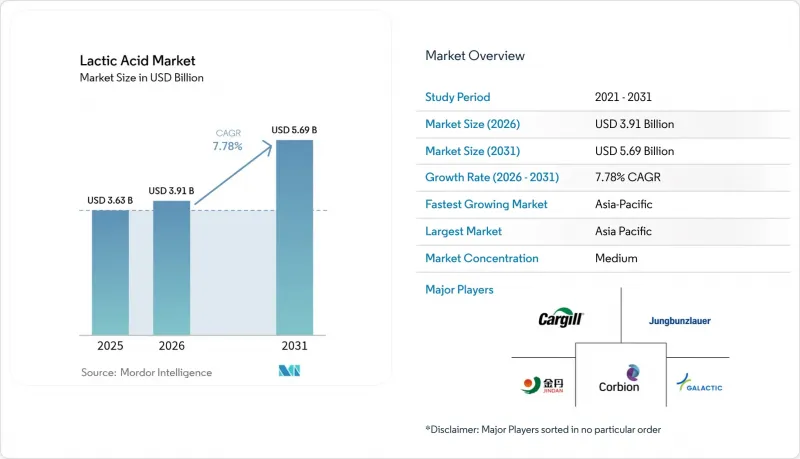
據 Mordor Intelligence 稱,2025 年乳酸市值為 36.3 億美元,預計到 2031 年將從 2026 年的 39.1 億美元成長至 56.9 億美元,預測期(2026-2031 年)複合年成長率為 7.78%。
本報告按原料(天然和合成)、形態(液體和固體)、等級(食品級、工業級等)、應用(食品飲料、個人護理和化妝品等)以及地區(北美、歐洲、亞太、南美、中東和非洲)進行細分。市場規模和預測均以美元計價。
全球乳酸市場趨勢與洞察
PLA(聚乳酸)推動了生物分解性塑膠。
乳酸從食品添加劑向聚合物前驅物的轉變正在推動市場顯著成長,其中聚乳酸 (PLA) 的應用對整體市場複合年成長率 (CAGR) 的貢獻尤為顯著。 NatureWorks 在泰國投資 6 億美元興建的工廠計劃於 2025 年投入商業運營,該工廠將乳酸生產、丙交酯合成和 PLA 聚合整合於同一設施內,清晰地展現了這一轉變。這種一體化模式旨在最佳化生產效率並降低營運成本。歐盟的《一次性塑膠指令》強制要求在某些包裝應用中使用可生物分解的替代品,這正在促進市場成長,並建立法律規範。阿拉伯聯合大公國生物技術公司 (Emirates Biotech) 計劃在阿拉伯聯合大公國建造的工廠預計將成為全球最大的 PLA 工廠,這表明中東地區對該市場的投資正在增加,並凸顯了該地區對永續材料生產的重視。隨著 PLA 技術擴展到 3D 列印耗材和醫療設備領域,其市場潛力正在不斷成長,為製造業和醫療保健產業提供創新解決方案。聚左旋乳酸( PLA)已獲美國食品藥物管理局(FDA)批准用於臉部脂肪減少療法,證明了其在高附加價值醫療應用中的多功能性和安全性。有利的法律規範、持續的技術進步和不斷提升的生產能力共同推動PLA成為2030年前乳酸市場成長的關鍵驅動力,從而改變產業格局,並為永續材料解決方案創造新的機會。
用作食品和飲料中的防腐劑和調味劑
食品飲料產業仍然是乳酸最大的終端市場,消費者對潔淨標示產品和天然防腐劑的需求不斷成長,推動了乳酸市場的發展。美國食品藥物管理局(FDA)將乳酸認定為「公認安全(GRAS)」物質,並將其監管範圍限定於良好生產規範(GMP),這為食品生產商提供了關於產品配方、安全合規和品管措施的全面監管指導。美國農業部的一項研究證實了乳酸在降低家禽產品中沙門氏菌含量方面的有效性,在對照試驗中證明了其病原體減少率,並將其應用範圍擴展到傳統乳製品發酵過程之外。乳酸的抗菌特性已在各種食品基質中得到廣泛證實,尤其是在肉類和家禽加工環境中。歐洲食品安全局(EFSA)建議使用2%至5%的乳酸濃度對牛肉胴體進行消毒,這進一步強化了乳酸在食品安全規程、微生物控制策略和整體肉類加工衛生標準中的作用。在植物來源乳製品替代品領域,生產者正利用特定的乳酸菌菌株來減少異味、增強營養吸收並改善質地,從而透過增強感官特性、功能優勢和延長保存期限來創造產品差異化的機會。乳酸在植物來源乳製品替代品中的應用也顯示出在蛋白質穩定性和風味增強方面具有良好的效果,尤其是在優格和起司替代品等發酵產品中。
工業用清潔劑
生產成本顯著限制了市場成長,尤其影響了乳酸在價格敏感型工業應用領域的競爭力。雖然發酵生產流程具有環境優勢,但與合成化學生產方法相比,它需要對專用生物反應器、先進分離設備和複雜的純化系統進行大量資本投資。 Corbion 在 2024 年資本市場報告中重點介紹了為應對持續的成本競爭力挑戰而進行的全面營運效率提升和策略業務重組。目前的成本結構顯著影響了乳酸在通用應用領域的市場,因為在這些領域,乳酸直接與合成防腐劑和酸味劑競爭,儘管其具有卓越的環境效益和永續性,但在價格敏感型細分市場中的市場滲透率仍然有限。高昂的生產成本影響著從原料採購到最終產品分銷的整個價值鏈,這給那些力求在保證產品品質和永續性標準的同時保持價格競爭力的製造商帶來了進一步的挑戰。
細分市場分析
截至2025年,天然發酵將佔據乳酸市場87.62%的佔有率,預計到2031年將以8.21%的複合年成長率成長。消費者對生物基產品的偏好源於對永續生產方式日益成長的認知以及對環境問題的關注。支持天然來源酸(尤其是在食品和飲料應用領域)的食品安全法規進一步強化了這種生產方式的優勢。合成生產主要以石油基中間體為原料,用於成本至關重要的特定產業,例如化學品製造和工業應用領域。
天然發酵技術的進步包括多基材處理(可同時發酵不同的原料)、基因編輯乳酸菌菌株(可提高轉化效率)以及原位產物去除技術(可提高產量)。利用果蔬廢棄物和木質纖維素殘渣的成功示範計畫表明,該技術具有大規模生產的潛力,且不會與糧食作物爭奪資源。這些替代原料來源包括農業殘餘物、食品加工廢棄物和林產品。原料多樣化有助於保護乳酸市場免受糧食價格波動的影響,同時促進循環經濟的概念。
預計到2025年,液態乳酸將佔總銷售額的64.10%,這主要得益於其與食品、製藥和就地清洗(CIP)應用中直接泵送系統的兼容性。液態乳酸之所以能維持市場主導地位,是因為大多數工業的生物反應器和下游灌裝設施都是專門針對液體處理作業進行設計和最佳化。整個產業對液體處理系統的大規模基礎設施投資進一步鞏固了這一優勢。固體乳酸市場正以8.53%的複合年成長率成長,這主要得益於其在動物飼料預混合料和個人保健產品乾粉混合物中的應用日益廣泛,尤其是在儲存和運輸條件要求較高的地區。此外,消費者對保存期限更長的產品以及在散裝生產過程中易於操作的需求不斷成長,也推動了這一成長。
近年來,噴霧乾燥和結晶製程的技術進步使生產商能夠在保持產品高純度的同時顯著降低運輸重量。這些改進包括最佳化粒徑分佈和增強水分控制系統。在多家生產工廠進行的試點研究表明,結合薄膜技術和蒸發製程的新型混合系統可將能耗降低10%以上。這些效率的提升正在逐步縮小傳統上液態和固體乳酸之間的價格差距,使固體乳酸在各種應用領域更具競爭力。此外,專用包裝解決方案的開發和儲存穩定性的提高進一步增強了固體乳酸在新興市場的吸引力。
區域分析
預計亞太地區在2025年將佔據30.72%的市場佔有率,並在2031年之前以8.95%的複合年成長率成長。該地區憑藉在泰國、中國和印度的一體化生產設施保持著競爭優勢,這些設施受益於甘蔗和玉米等原料的易得性以及每噸產品較低的資本投資要求。 NatureWorks位於泰國的工廠正是這一區域策略的體現,它結合了當地原料的供應、規模經濟以及接近性出口港口的戰略優勢。此外,國內對一次性餐飲服務產品的需求不斷成長以及對可堆肥購物袋的監管要求也進一步推動了市場成長。
北美憑藉其成熟的玉米濕磨基礎設施、先進的生物製程技術和清晰的法規結構,保持著市場地位。該地區專注於醫療、個人護理和食品安全領域的高價值應用。儘管來自亞洲的PLA包裝材料進口量不斷增加,但由於企業傾向於本地採購以減少範圍3排放,北美市場仍保持穩定。
歐洲市場成長主要受一次性塑膠指令的推動,該指令鼓勵製造商採用可堆肥替代品。像 Galactic 和 Jungbunzlauer 這樣的公司已經適應了監管要求,並在製藥和化妝品行業中建立了穩固的地位。儘管農產品價格波動影響了可堆肥替代品的採用率,但「綠色新政」計劃仍在持續推動對本地發酵設施的投資。
其他好處:
- Excel格式的市場預測(ME)表
- 3個月的分析師支持
目錄
第1章:引言
- 研究假設和市場定義
- 調查範圍
第2章:調查方法
第3章執行摘要
第4章 市場狀況
- 市場概覽
- 市場促進因素
- 擴大在生物分解性塑膠(特別是聚乳酸)生產的應用。
- 食品飲料業對乳酸作為防腐劑和增味劑的需求激增。
- 擴大用途,用於藥物製劑和作為輔料。
- 在個人保健產品和化妝品製造領域中得到更廣泛的應用。
- 工業清潔應用需求不斷成長
- 在飼料生產中增加使用
- 市場限制因素
- 與傳統替代品相比,乳酸的生產成本更高。
- 原物料價格波動,尤其是玉米和甘蔗的價格波動。
- 合成替代品帶來的競爭
- 由於產品的化學性質,在儲存和運輸方面存在挑戰。
- 供應鏈分析
- 監理展望
- 波特五力模型
第5章 市場規模與成長預測
- 來源
- 自然的
- 合成
- 按形式
- 液體
- 固體的
- 按年級
- 食品級
- 工業級
- 醫藥級
- 化妝品級
- 透過使用
- 食品/飲料
- 肉類、雞肉、魚貝類
- 乳製品
- 麵包店
- 糖果糕餅
- 飲料
- 其他食品和飲料用途
- 聚乳酸(PLA)和生質塑膠
- 個人護理化妝品
- 藥品和醫療保健
- 工業和化學過程
- 食品/飲料
- 按地區
- 北美洲
- 美國
- 加拿大
- 墨西哥
- 其他北美國家
- 歐洲
- 英國
- 德國
- 法國
- 義大利
- 西班牙
- 俄羅斯
- 其他歐洲國家
- 亞太地區
- 中國
- 印度
- 日本
- 澳洲
- 其他亞太國家
- 南美洲
- 巴西
- 阿根廷
- 其他南美國家
- 中東和非洲
- 沙烏地阿拉伯
- 南非
- 其他中東和非洲國家
- 北美洲
第6章 競爭情勢
- 市場集中度
- 策略趨勢
- 市場排名分析
- 公司簡介
- Corbion NV
- Cargill Incorporated
- Galactic SA
- Henan Jindan Lactic Acid Technology Co. Ltd.
- Jungbunzlauer Suisse AG
- Musashino Chemical Laboratory, Ltd.
- Futerro SA
- BBCA Biochemical
- Shandong Baisheng Biotech
- Cellulac Ltd.
- NatureWorks LLC
- Zhengzhou Tianrun
- Anhui COFCO Biochemical
- Qingdao Abel Technology
- TotalEnergies Corbion
- Zhejiang Huakang Pharmaceutical Co.
- Synbra Technology
- Henan Shenzhou Biochem
- Sulzer Chemtech
- Wei Mon Industry Co.(Unitika PLA JV)
第7章 市場機會與未來展望
According to Mordor Intelligence, the lactic acid market size was valued at USD 3.63 billion in 2025 and estimated to grow from USD 3.91 billion in 2026 to reach USD 5.69 billion by 2031, at a CAGR of 7.78% during the forecast period (2026-2031).
This report is Segmented by Source (Natural and Synthetic), Form (Liquid and Solid), Grade (Food Grade, Industrial Grade, and More), Application (Food and Beverages, Personal Care and Cosmetics, and More), and Geography (North America, Europe, Asia-Pacific, South America, and Middle East and Africa). The Market Size and Forecasts are Provided in Terms of Value (USD).
Global Lactic Acid Market Trends and Insights
PLA-driven Demand for Biodegradable Plastics
The evolution of lactic acid from a food additive to a polymer precursor is driving significant market growth, with Polylactic Acid (PLA) applications contributing to the overall market CAGR. NatureWorks' USD 600 million facility in Thailand, scheduled for commercial operation by 2025, demonstrates this transition by combining lactic acid production, lactide synthesis, and PLA polymerization in a single facility. The facility's integrated approach aims to optimize production efficiency and reduce operational costs. The European Union's Single-Use Plastics Directive supports market growth by requiring biodegradable alternatives for specific packaging applications, creating a regulatory framework that favors PLA adoption. The planned Emirates Biotech facility in the UAE, set to become the world's largest PLA plant, indicates increasing Middle Eastern investment in this market and highlights the region's commitment to sustainable materials production. The expansion of PLA technology into 3D printing filaments and medical devices has broadened its market potential, offering innovative solutions for manufacturing and healthcare applications. FDA approval of poly-L-lactic acid for facial fat loss treatment demonstrates its versatility and safety profile in high-value medical segments. The combination of supportive regulatory frameworks, continuous technological progress, and increased manufacturing capacity establishes PLA as the main driver of lactic acid market growth through 2030, reshaping the industry landscape and creating new opportunities for sustainable material solutions.
Food and Beverage Preservative and Flavor Uses
The food and beverage sector remains the largest end-market for lactic acid, with growth supported by increasing demand for clean-label products and natural preservation methods. The FDA's designation of lactic acid as Generally Recognized as Safe (GRAS), with restrictions limited to good manufacturing practices, provides food manufacturers with comprehensive regulatory guidance for product formulation, safety compliance, and quality control measures. USDA research confirms lactic acid's effectiveness in reducing Salmonella in poultry applications, demonstrating pathogen reduction rates in controlled studies and expanding its use beyond traditional dairy fermentation processes.The antimicrobial properties of lactic acid have been extensively documented across various food matrices, showing particular efficacy in meat and poultry processing environments. The European Food Safety Authority encourages lactic acid concentrations of 2-5% for beef carcass decontamination, strengthening its role in food safety protocols, microbial control strategies, and overall meat processing hygiene standards. In the plant-based dairy segment, manufacturers utilize specific lactic acid bacteria strains to reduce off-flavors, enhance nutrient absorption, and improve texture profiles, creating product differentiation opportunities through improved organoleptic properties, functional benefits, and extended shelf life. The application of lactic acid in plant-based dairy alternatives has also shown promising results in protein stabilization and flavor development, particularly in fermented products like yogurt alternatives and cheese substitutes.
Industrial Cleaning Formulations
Production costs significantly constrain market growth, particularly affecting lactic acid's competitiveness in price-sensitive industrial applications. The fermentation-based production process requires substantial capital investment in specialized bioreactors, advanced separation equipment, and complex purification systems compared to synthetic chemical routes, despite its environmental advantages. Corbion's 2024 capital market presentation emphasizes comprehensive operational efficiency improvements and strategic restructuring initiatives to address persistent cost competitiveness challenges. The current cost structure substantially impacts commodity applications where lactic acid directly competes with synthetic preservatives and acidulants, limiting market penetration in price-sensitive segments despite its superior environmental benefits and sustainable characteristics. The high production costs affect the entire value chain, from raw material procurement to final product distribution, creating additional challenges for manufacturers seeking to maintain competitive pricing while ensuring product quality and sustainability standards.
Other drivers and restraints analyzed in the detailed report include:
- Pharmaceutical Formulations and Excipients
- Personal Care and Cosmetics Expansion
- Raw-material Price Volatility
For complete list of drivers and restraints, kindly check the Table Of Contents.
Segment Analysis
Natural fermentation accounts for 87.62% of the lactic acid market share in 2025 and is expected to grow at an 8.21% CAGR through 2031. Consumer preference for bio-based products stems from increasing awareness of sustainable production methods and environmental concerns. Food safety regulations supporting naturally derived acids, particularly in food and beverage applications, further reinforce the dominance of this production method. Synthetic production, primarily from petroleum intermediates, serves specific industrial segments where cost is the primary consideration, such as in chemical manufacturing and industrial applications.
Technological advancements in natural fermentation include multi-substrate processing, which allows for simultaneous fermentation of different raw materials, gene-edited Lactobacillus strains that improve conversion efficiency, and in situ product removal techniques that increase production yields. The successful implementation of demonstration projects using fruit waste and lignocellulosic residues indicates the potential for scaled production without competing with food crops. These alternative feedstock sources include agricultural residues, food processing waste, and forestry byproducts. This feedstock diversification helps protect the lactic acid market against fluctuations in grain prices while promoting circular economy principles.
Liquid lactic acid held a 64.10% revenue share in 2025, due to its compatibility with direct pumping systems in food, pharmaceutical, and clean-in-place (CIP) applications. This form maintains its market dominance because most industrial bioreactors and downstream filling equipment are specifically designed and optimized for liquid handling operations. The extensive infrastructure investment in liquid handling systems across industries further reinforces this dominance. The solid form segment is growing at an 8.53% CAGR, driven by increased adoption in animal feed premixes and dry-blend personal care products, particularly in regions with challenging storage and transportation conditions. The growth is also supported by the rising demand for extended shelf-life products and easier handling in bulk manufacturing processes.
Recent technological advancements in spray drying and crystallization processes enable manufacturers to maintain high product purity levels while significantly reducing shipping weights. These improvements include optimized particle size distribution and enhanced moisture control systems. New hybrid systems combining membrane technology and evaporation processes reduce energy consumption by more than 10%, according to pilot studies conducted across multiple production facilities. These efficiency improvements are gradually reducing the historical price difference between liquid and solid forms, making solid lactic acid increasingly competitive in various applications. The development of specialized packaging solutions and improved storage stability has further enhanced the appeal of solid lactic acid in emerging markets.
Complete Report Scope:
- By Source
- Natural
- Synthetic
- By Form
- Liquid
- Solid
- By Grade
- Food Grade
- Industrial Grade
- Pharmaceutical Grade
- Cosmetic Grade
- By Application
- Food and Beverages
- Meat, Poultry and Seafood
- Dairy Products
- Bakery
- Confectionery
- Beverages
- Others Food and Beverage Applications
- Polylactic Acid (PLA) and Bioplastics
- Personal Care and Cosmetics
- Pharmaceutical and Healthcare
- Industrial and Chemical Processing
- Food and Beverages
- By Geography
- North America
- United States
- Canada
- Mexico
- Rest of North America
- Europe
- United Kingdom
- Germany
- France
- Italy
- Spain
- Russia
- Rest of Europe
- Asia-Pacific
- China
- India
- Japan
- Australia
- Rest of Asia-Pacific
- South America
- Brazil
- Argentina
- Rest of South America
- Middle East and Africa
- Saudi Arabia
- South Africa
- Rest of Middle East and Africa
- North America
Geography Analysis
Asia-Pacific held a 30.72% market share in 2025 and is expected to grow at a 8.95% CAGR through 2031. The region maintains a competitive advantage through integrated manufacturing facilities in Thailand, China, and India, which benefit from readily available sugarcane and corn feedstock, along with lower capital expenditure requirements per installed ton. NatureWorks' Thailand facility exemplifies this regional strategy by combining local feedstock availability, economies of scale, and strategic proximity to export ports. The market growth is further supported by increasing domestic demand for disposable food service items and regulatory requirements for compostable shopping bags.
North America maintains its market position through established corn-wet-milling infrastructure, sophisticated bioprocessing capabilities, and well-defined regulatory frameworks. The region focuses on high-value applications in medical, personal care, and food safety sectors. Despite increased PLA packaging imports from Asia, the North American market remains stable due to corporate preferences for local sourcing to reduce scope 3 emissions.
Europe's market growth is primarily driven by the Single-Use Plastics Directive, which encourages manufacturers to adopt compostable alternatives. Companies like Galactic and Jungbunzlauer have adapted to regulatory requirements, establishing strong positions in pharmaceutical and cosmetic applications. While agricultural price fluctuations affect adoption rates, Green Deal initiatives continue to support investments in regional fermentation facilities.
- Corbion N.V.
- Cargill Incorporated
- Galactic S.A.
- Henan Jindan Lactic Acid Technology Co. Ltd.
- Jungbunzlauer Suisse AG
- Musashino Chemical Laboratory, Ltd.
- Futerro S.A.
- BBCA Biochemical
- Shandong Baisheng Biotech
- Cellulac Ltd.
- NatureWorks LLC
- Zhengzhou Tianrun
- Anhui COFCO Biochemical
- Qingdao Abel Technology
- TotalEnergies Corbion
- Zhejiang Huakang Pharmaceutical Co.
- Synbra Technology
- Henan Shenzhou Biochem
- Sulzer Chemtech
- Wei Mon Industry Co. (Unitika PLA JV)
Additional Benefits:
- The market estimate (ME) sheet in Excel format
- 3 months of analyst support
TABLE OF CONTENTS
1 INTRODUCTION
- 1.1 Study Assumptions and Market Definition
- 1.2 Scope of the Study
2 RESEARCH METHODOLOGY
3 EXECUTIVE SUMMARY
4 MARKET LANDSCAPE
- 4.1 Market Overview
- 4.2 Market Drivers
- 4.2.1 Expanding applications in biodegradable plastics production, particularly PLA (Polylactic Acid)
- 4.2.2 Surging Demand from the Food and Beverage Industry for Lactic Acid as a Preservative and Flavor Enhancer
- 4.2.3 Expanding use in pharmaceutical applications for drug formulation and as an excipient
- 4.2.4 Growing adoption in personal care products and cosmetics manufacturing
- 4.2.5 Escalating demand in industrial cleaning applications
- 4.2.6 Rising usage in animal feed production
- 4.3 Market Restraints
- 4.3.1 High production costs of lactic acid compared to conventional alternatives
- 4.3.2 Fluctuating raw material prices, particularly for corn and sugarcane
- 4.3.3 Competition from synthetic alternatives
- 4.3.4 Storage and transportation challenges due to the product's chemical properties
- 4.4 Supply-Chain Analysis
- 4.5 Regulatory Outlook
- 4.6 Porter's Five Forces
- 4.6.1 Threat of New Entrants
- 4.6.2 Bargaining Power of Buyers/Consumers
- 4.6.3 Bargaining Power of Suppliers
- 4.6.4 Threat of Substitute Products
- 4.6.5 Intensity of Competitive Rivalry
5 MARKET SIZE AND GROWTH FORECASTS (VALUE)
- 5.1 By Source
- 5.1.1 Natural
- 5.1.2 Synthetic
- 5.2 By Form
- 5.2.1 Liquid
- 5.2.2 Solid
- 5.3 By Grade
- 5.3.1 Food Grade
- 5.3.2 Industrial Grade
- 5.3.3 Pharmaceutical Grade
- 5.3.4 Cosmetic Grade
- 5.4 By Application
- 5.4.1 Food and Beverages
- 5.4.1.1 Meat, Poultry and Seafood
- 5.4.1.2 Dairy Products
- 5.4.1.3 Bakery
- 5.4.1.4 Confectionery
- 5.4.1.5 Beverages
- 5.4.1.6 Others Food and Beverage Applications
- 5.4.2 Polylactic Acid (PLA) and Bioplastics
- 5.4.3 Personal Care and Cosmetics
- 5.4.4 Pharmaceutical and Healthcare
- 5.4.5 Industrial and Chemical Processing
- 5.4.1 Food and Beverages
- 5.5 By Geography
- 5.5.1 North America
- 5.5.1.1 United States
- 5.5.1.2 Canada
- 5.5.1.3 Mexico
- 5.5.1.4 Rest of North America
- 5.5.2 Europe
- 5.5.2.1 United Kingdom
- 5.5.2.2 Germany
- 5.5.2.3 France
- 5.5.2.4 Italy
- 5.5.2.5 Spain
- 5.5.2.6 Russia
- 5.5.2.7 Rest of Europe
- 5.5.3 Asia-Pacific
- 5.5.3.1 China
- 5.5.3.2 India
- 5.5.3.3 Japan
- 5.5.3.4 Australia
- 5.5.3.5 Rest of Asia-Pacific
- 5.5.4 South America
- 5.5.4.1 Brazil
- 5.5.4.2 Argentina
- 5.5.4.3 Rest of South America
- 5.5.5 Middle East and Africa
- 5.5.5.1 Saudi Arabia
- 5.5.5.2 South Africa
- 5.5.5.3 Rest of Middle East and Africa
- 5.5.1 North America
6 COMPETITIVE LANDSCAPE
- 6.1 Market Concentration
- 6.2 Strategic Moves
- 6.3 Market Ranking Analysis
- 6.4 Company Profiles (includes Global level Overview, Market level overview, Core Segments, Financials as available, Strategic Information, Market Rank/Share for key companies, Products and Services, and Recent Developments)
- 6.4.1 Corbion N.V.
- 6.4.2 Cargill Incorporated
- 6.4.3 Galactic S.A.
- 6.4.4 Henan Jindan Lactic Acid Technology Co. Ltd.
- 6.4.5 Jungbunzlauer Suisse AG
- 6.4.6 Musashino Chemical Laboratory, Ltd.
- 6.4.7 Futerro S.A.
- 6.4.8 BBCA Biochemical
- 6.4.9 Shandong Baisheng Biotech
- 6.4.10 Cellulac Ltd.
- 6.4.11 NatureWorks LLC
- 6.4.12 Zhengzhou Tianrun
- 6.4.13 Anhui COFCO Biochemical
- 6.4.14 Qingdao Abel Technology
- 6.4.15 TotalEnergies Corbion
- 6.4.16 Zhejiang Huakang Pharmaceutical Co.
- 6.4.17 Synbra Technology
- 6.4.18 Henan Shenzhou Biochem
- 6.4.19 Sulzer Chemtech
- 6.4.20 Wei Mon Industry Co. (Unitika PLA JV)
7 MARKET OPPORTUNITIES AND FUTURE OUTLOOK

 乳酸和聚乳酸市場報告:趨勢、預測和競爭分析(至2035年)
 南美洲乳酸市場:市場佔有率分析、產業趨勢與統計及成長預測(2026-2031)
 乳酸市場-2026-2032年全球市場預測
 乳酸市場規模、佔有率和趨勢分析報告:按原料、應用、地區和細分市場預測(2026-2033 年)包封乳酸:市場佔有率分析、產業趨勢與統計、成長預測(2026-2031)
 乳酸和聚乳酸市場規模、佔有率和成長分析:按產品類型、原料、應用、最終用途產業、形態、製造技術和地區分類-2026-2033年產業預測
 乳酸市場:依原料、應用和地區分類
 全球聚乳酸市場規模、佔有率、趨勢和成長分析報告(2026-2034年)乳酸市場規模、佔有率、成長及全球產業分析:按類型、應用和地區的洞察,2026-2034年的預測乳酸全球市場規模、佔有率、趨勢和成長分析報告(2026-2034)