


 |
市場調查報告書
商品編碼
2098523
包封乳酸:市場佔有率分析、產業趨勢與統計、成長預測(2026-2031)Encapsulated Lactic Acid - Market Share Analysis, Industry Trends & Statistics, Growth Forecasts (2026 - 2031) |
||||||

※ 本網頁內容可能與最新版本有所差異。詳細情況請與我們聯繫。
根據 Mordor Intelligence 預測,到 2025 年,封裝乳酸市場規模將達到 13.8 億美元,到 2026 年將達到 14.5 億美元,到 2031 年將達到 20.1 億美元,2026 年至 2031 年的複合年成長率為 6.72%。
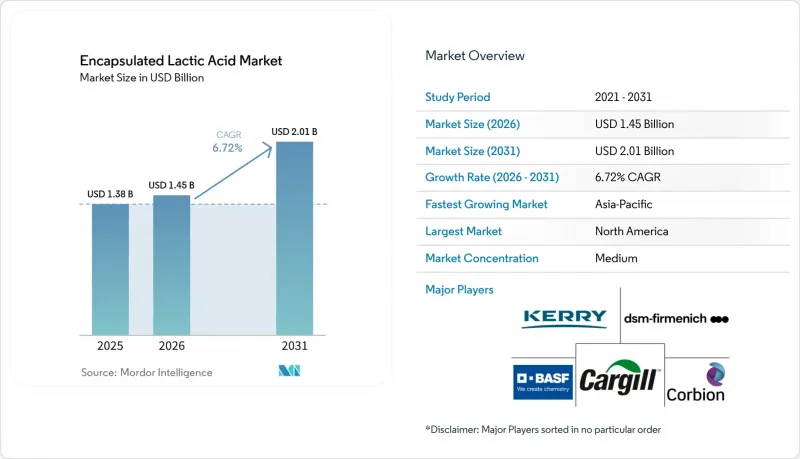
本報告按形態(粉末、液體、顆粒)、原料(植物來源和動物來源)、應用領域(食品飲料、藥品、化妝品和個人護理用品、動物飼料及其他)以及地區(北美、歐洲、亞太、南美以及中東和非洲)進行細分。市場預測以美元計價。
全球包封乳酸市場趨勢及洞察
對營養保健品和膳食補充劑的需求正在重新定義膠囊劑的經濟效益。
膠囊化乳酸鹽市場正受惠於營養保健品(機能性食品)需求的成長。這是因為膳食補充劑品牌需要能夠保護敏感活性成分並增強其功效的遞送系統。乳酸鹽在美國已被認定為GRAS(公認安全物質),這為產品開發商在食品和膳食補充劑應用方面提供了更清晰的監管途徑。隨著益生菌補充劑的普及,對能夠保護成分通過胃部並在消化循環後期釋放的包衣的需求日益成長。 Corbion公司於2025年宣布,將把其藥用級乳酸鈉和生物醫用聚合物技術擴展到營養保健品遞送系統領域。這顯示膳食補充劑和藥品之間的供應需求重疊度越來越高。這提升了能夠滿足藥用級L(+)純度要求並服務於更廣泛的膠囊化乳酸鹽市場的供應商的價值。因此,高階膳食補充劑領域正在形成一種利潤結構,而通用食品級供應商難以進入這一領域。
封裝技術的進步降低了特殊劑型產品的進入門檻。
包覆乳酸市場仍然依賴噴霧乾燥技術,因為它仍然是生產穩定包覆粉末最具擴充性和成本效益的方法。目前,技術重點正轉向基於植物蛋白和多醣的雙層包覆系統和複合凝聚層。 2025年發表的一項研究表明,植物蛋白和多醣凝聚層不僅可以實現與合成聚合物系統相當的包覆性能,而且還能滿足純素標籤的要求。這項轉變對包覆乳酸市場意義重大,因為它為實現「潔淨標示」鋪平了道路,同時減少了對傳統包覆系統的依賴。 Bulkhem公司的BakeShure®、ConfecShure®和MeatShure®產品線展示了包覆化學的改變如何直接拓展目標應用並有助於維持利潤率。此外,包覆效率的提高和牆壁材料成本的降低使得特種級產品更容易應用於先前依賴標準粉末形式的領域。
高昂的封裝成本和複雜的製程限制了其在中端市場的滲透。
包埋乳酸市場持續面臨成本壓力。這是因為包埋過程會產生額外的成本,而許多散裝食品類別難以承受這些成本。在標準烘焙、乳製品和調味品應用領域,通用生產商通常會將包埋產品與遊離酸替代品進行直接比較。此外,緩釋產品的生產需要選擇包覆材料、控制包衣厚度、進行水分測試以及檢驗釋放速率。這些流程增加了南美洲、中東和非洲供應商的資本投資負擔和技術複雜性。 Valchem公司在紐約橘郡投資3,600萬美元新建微膠囊化工廠,凸顯了在維持包衣品質的同時降低單位成本所需的規模。因此,對於缺乏專業知識和資金來建立可重複緩釋系統的小規模生產商而言,進入包埋乳酸市場仍然充滿挑戰。
細分市場分析
2025年,粉狀乳酸仍將佔據包封乳酸市場41.27%的佔有率,在所有細分市場中保持領先地位。這一地位反映了烘焙、肉類加工和速食食品製造領域長期成熟的乾混工藝。此外,粉末易於計量,在常溫下穩定,並且與大規模生產線中使用的標準混合設備高度相容。這些特性確保包封乳酸市場繼續以能夠支持日常生產過程規模化和一致性的形式存在。噴霧乾燥仍然是粉末和顆粒狀乳酸的主要生產方法,因為它能夠在控制粒徑的同時實現大規模生產。
由於顆粒狀乳酸溶解速度慢,適合緩慢釋放酸,因此在包封乳酸市場中扮演著雖小但重要的角色。它們廣泛應用於糖果甜點(尤其是酸性糖果)和益生菌產品等需要延遲釋放特性的領域。此外,人們越來越關注將奈米包封技術與傳統噴霧乾燥相結合,以提高包封均勻性,同時又不影響工業級加工能力。根據MDPI.COM預測,液態包封乳酸的年複合成長率預計到2031年將達到8.02%,成為包封乳酸市場規模成長最快的形式。這一成長主要得益於即飲益生菌飲料、運動營養飲料和液體營養補充劑等對快速分散性要求較高的產品。
區域分析
北美仍將是包埋乳酸市場最大的區域市場,到2025年將佔40.21%的市佔率。乳酸在食品應用中被認定為GRAS(公認安全)物質,這降低了食品和膳食補充劑配方中的監管門檻,從而鞏固了其市場地位。此外,該地區蓬勃發展的加工肉品產業和成熟的膳食補充劑管道也為其提供了支持,這兩大因素共同支撐了對緩釋酸味劑的持續需求。 Balchem計劃在紐約橘郡投資3,600萬美元,將其微膠囊化產能提高一倍以上,這進一步增強了人們對國內市場持續需求的信心。歐洲佔據包埋乳酸市場第二大佔有率,主要得益於加工食品和潔淨標示重組產品對發酵衍生酸的需求。在Corbion的「BRIGHT 2030」策略中,潔淨標示防腐劑和生物醫用聚合物是其在歐洲和北美市場成長策略的核心。
亞太地區是包埋乳酸市場規模成長最快的地區,預計到2031年複合年成長率將達到7.62%。中國、印度、日本和東南亞食品加工業的擴張正在擴大該地區的需求基礎。中國仍然是該地區最大的各國市場,而印度則透過擴大營養保健品和藥品契約製造設施,其重要性日益提升。在日本,需求模式更加專業化,主要集中在酵素穩定和pH響應型機能性食品體系。 NatureWorks位於泰國那空沙旺府的全整合廠於2026年4月投產,年產能達7.5萬噸,進一步深化了乳酸、丙交酯和聚乳酸(PLA)的區域供應整合。
儘管南美洲、中東和非洲的乳酸包封市場規模仍然較小,但每個地區的需求模式都各有特色。巴西憑藉加工肉品的保鮮需求,成為南美市場的主要驅動力;而阿根廷則在乳製品相關應用領域佔據重要地位。全部區域普遍對價格較為敏感,因此消費者更傾向於選擇價格更具競爭力的粉末狀產品,而非昂貴的專用包覆系統。在中東和非洲,市場需求仍處於起步階段,主要集中在阿拉伯聯合大公國和南非,用於食品服務和製藥業的低溫運輸應用。
其他好處:
- Excel格式的市場預測(ME)表
- 3個月的分析師支持
目錄
第1章:引言
- 研究假設和市場定義
- 調查範圍
第2章:調查方法
第3章執行摘要
第4章 市場狀況
- 市場概覽
- 市場促進因素
- 擴展應用領域至營養保健品和膳食補充劑
- 乾粉混合物和速食產品的擴張
- 封裝技術的進步
- 對含有酸敏感成分的配方需求日益成長
- 機能性食品和益生菌產品形式的擴展
- 向永續和生物基配方過渡
- 市場限制因素
- 高昂的封裝成本和製程複雜性
- 適用於大規模生產的專用原料供應有限。
- 在低靈敏度應用中替代遊離乳酸
- 監管和穩定性檢驗的負擔
- 供應鏈分析
- 監理情勢
- 技術展望
- 波特五力模型
第5章 市場規模與成長預測
- 按形式
- 粉末
- 液體
- 顆粒
- 按原料
- 植物來源
- 動物源性
- 透過使用
- 食品/飲料
- 製藥
- 化妝品和個人護理
- 動物飼料
- 其他
- 按地區
- 北美洲
- 美國
- 加拿大
- 墨西哥
- 其他北美國家
- 歐洲
- 德國
- 英國
- 法國
- 義大利
- 西班牙
- 荷蘭
- 其他歐洲國家
- 亞太地區
- 中國
- 印度
- 日本
- 澳洲
- 其他亞太國家
- 南美洲
- 巴西
- 阿根廷
- 其他南美國家
- 中東和非洲
- 阿拉伯聯合大公國
- 南非
- 其他中東和非洲國家
- 北美洲
第6章 競爭情勢
- 市場集中度
- 策略趨勢
- 市場排名分析
- 公司簡介
- BASF SE
- Cargill, Incorporated
- Corbion NV
- DSM-Firmenich
- Kerry Group plc
- Ingredion Incorporated
- Tate and Lyle PLC
- Balchem Corporation
- Sensient Technologies Corporation
- NatureWorks LLC
- Futerro SA
- Galactique
- Galactic SA
- Henan Jindan Lactic Acid Technology Co., Ltd.
- Jungbunzlauer Suisse AG
- Archer Daniels Midland Company
- Roquette Freres
- DuPont de Nemours, Inc.
- Mitsubishi Chemical Group Corporation
- Dow Inc.
- Advanced Enzyme Technologies Ltd.
第7章 市場機會與未來展望
According to Mordor Intelligence, the encapsulated lactic acid market size is projected to be USD 1.38 billion in 2025, USD 1.45 billion in 2026, and reach USD 2.01 billion by 2031, growing at a CAGR of 6.72% from 2026 to 2031.
This report is Segmented by Form (Powder, Liquid, and Granules), Source (Plant-Based and Animal-Based), Application (Food and Beverages, Pharmaceuticals, Cosmetics and Personal Care, Animal Feed, and Others), and Geography (North America, Europe, Asia-Pacific, South America, and the Middle East and Africa). The Market Forecasts are Provided in Terms of Value (USD).
Global Encapsulated Lactic Acid Market Trends and Insights
Nutraceutical And Dietary Supplement Demand Redefines Encapsulation Economics
The encapsulated lactic acid market is benefiting from stronger nutraceutical demand because supplement brands need delivery systems that protect sensitive actives and improve ingredient performance. Lactic acid already has GRAS recognition in the United States, which gives product developers a clearer regulatory path in food and supplement applications. Probiotic supplement expansion is increasing demand for coatings that can protect ingredients during gastric transit and release them later in the digestive cycle. Corbion stated in 2025 that its pharmaceutical-grade sodium lactate and biomedical polymer capabilities are being extended into nutraceutical delivery systems, which shows tighter overlap between supplement and pharmaceutical supply requirements. This is raising the value of suppliers that can meet pharmaceutical-grade L(+) purity expectations while still serving the broader encapsulated lactic acid market. The result is a margin profile in premium supplements that commodity food-grade suppliers are less able to access.
Encapsulation Technology Advances Lower The Barrier To Specialty Formats
The encapsulated lactic acid market continues to rely on spray drying because it remains the most scalable and cost-effective way to produce stable encapsulated powders. The technology focus is now moving toward dual-coating systems and complex coacervation based on plant proteins and polysaccharides. Research published in 2025 showed that plant protein and polysaccharide coacervates can reach encapsulation performance close to synthetic polymer systems while also supporting vegan-label compatibility. For the encapsulated lactic acid market, that shift matters because it creates a cleaner-label route that also reduces dependence on older coating systems. Balchem's BakeShure(R), ConfecShure(R), and MeatShure(R) lines show how changes in coating chemistry can directly widen addressable applications and support margin defense. Better coating efficiency and lower wall-material cost are also making specialty grades more accessible in applications that once relied on standard powder formats.
High Encapsulation Cost And Process Complexity Limit Mid-Market Penetration
The encapsulated lactic acid market still faces cost pressure because encapsulation adds a premium that many bulk food categories cannot absorb easily. Commodity-oriented manufacturers in standard bakery, dairy, and seasoning applications often compare encapsulated formats directly with free acid alternatives. Controlled-release manufacturing also requires wall-material selection, coating thickness control, moisture testing, and release-rate validation. Those steps raise both capital needs and technical complexity for regional suppliers in South America and the Middle East and Africa. Balchem's USD 36 million investment in a new microencapsulation facility in Orange County, New York, highlights the scale required to reduce unit cost while maintaining coating quality. The encapsulated lactic acid market therefore remains harder to enter for smaller producers that lack both specialized personnel and the financial capacity to build repeatable controlled-release systems.
Other drivers and restraints analyzed in the detailed report include:
- Functional Foods And Probiotic Expansion Create A Compounding Demand Effect
- Bio-Based Sourcing Mandates Elevate Feedstock Origin As A Competitive Differentiator
- Feedstock Supply Concentration Creates A Structural Input Vulnerability
For complete list of drivers and restraints, kindly check the Table Of Contents.
Segment Analysis
Powder formats retained 41.27% of the encapsulated lactic acid market in 2025, which kept them in the lead across form segments. Their position reflects long-established dry-blend infrastructure in bakery, meat processing, and instant food production. Powder also remains easy to dose, stable under ambient conditions, and compatible with standard blending equipment used in large-volume processing lines. These traits keep the encapsulated lactic acid market anchored in formats that support scale and consistency across routine manufacturing runs. Spray drying remains the main production route for powder and granule formats because it can support high-volume output with controlled particle morphology.
Granules serve a narrower but important role in the encapsulated lactic acid market because they are better suited to slower dissolution and staged acid release. That makes them useful in confectionery applications, especially sour candy, and in probiotic systems that require delayed release behavior. The segment is also seeing interest in combining nanoencapsulation techniques with conventional spray drying to improve coating uniformity without losing industrial throughput. MDPI.COM Liquid is projected to grow at 8.02% CAGR through 2031, which makes it the fastest-growing form in the encapsulated lactic acid market size outlook. That growth is tied to ready-to-drink probiotic beverages, sports nutrition liquids, and liquid nutraceuticals where rapid dispersibility is essential.
Complete Report Scope:
- By Form
- Powder
- Liquid
- Granuels
- By Source
- Plant-Based
- Animal-Based
- By Application
- Food and Beverages
- Pharmaceuticals
- Cosmetics and Personal Care
- Animal Feed
- Others
- By Geography
- North America
- United States
- Canada
- Mexico
- Rest of North America
- Europe
- Germany
- United Kingdom
- France
- Italy
- Spain
- Netherlands
- Rest of Europe
- Asia-Pacific
- China
- India
- Japan
- Australia
- Rest of Asia-Pacific
- South America
- Brazil
- Argentina
- Rest of South America
- Middle East and Africa
- United Arab Emirates
- South Africa
- Rest of Middle East and Africa
- North America
Geography Analysis
North America remained the largest regional segment in the encapsulated lactic acid market at 40.21% in 2025. The United States supports that position because lactic acid has GRAS status for food applications, which lowers regulatory friction across food and supplement formulation. The region also benefits from strong processed meat activity and a mature nutraceutical channel, both of which support repeat demand for controlled-release acidulants. Balchem's USD 36 million investment in Orange County, New York, which is intended to more than double its microencapsulation capacity, reinforces confidence in sustained domestic demand. Europe held the second-largest position in the encapsulated lactic acid market, supported by demand for fermentation-derived acid systems in processed food and clean-label reformulation. Corbion's BRIGHT 2030 strategy also places clean-label preservation and biomedical polymers at the center of its growth agenda across European and North American channels.
Asia-Pacific is the fastest-growing region in the encapsulated lactic acid market size profile, with a projected CAGR of 7.62% through 2031. Food processing expansion across China, India, Japan, and Southeast Asia is broadening the regional demand base. China remains the largest country market in the region, while India is gaining importance through its expanding nutraceutical and pharmaceutical contract manufacturing base. Japan adds a more specialized demand pattern centered on enzyme-stabilized and pH-sensitive functional food systems. NatureWorks' fully integrated 75,000-ton facility in Nakhon Sawan, Thailand, opened in April 2026 and signaled deeper regional integration across lactic acid, lactide, and PLA supply.
South America and the Middle East and Africa remain smaller in the encapsulated lactic acid market, but each region has distinct demand patterns. Brazil anchors South America through processed meat preservation needs, while Argentina remains more visible in dairy-related use. Price sensitivity across the region favors cost-competitive powder formats over higher-priced specialty encapsulation systems. In the Middle East and Africa, demand is still at an early stage and remains concentrated in the UAE and South Africa across food service and pharmaceutical cold-chain applications.
- BASF SE
- Cargill, Incorporated
- Corbion N.V.
- DSM-Firmenich
- Kerry Group plc
- Ingredion Incorporated
- Tate and Lyle PLC
- Balchem Corporation
- Sensient Technologies Corporation
- NatureWorks LLC
- Futerro S.A.
- Galactique?
- Galactic S.A.
- Henan Jindan Lactic Acid Technology Co., Ltd.
- Jungbunzlauer Suisse AG
- Archer Daniels Midland Company
- Roquette Freres
- DuPont de Nemours, Inc.
- Mitsubishi Chemical Group Corporation
- Dow Inc.
- Advanced Enzyme Technologies Ltd.
Additional Benefits:
- The market estimate (ME) sheet in Excel format
- 3 months of analyst support
TABLE OF CONTENTS
1 INTRODUCTION
- 1.1 Study Assumptions and Market Definition
- 1.2 Scope of the Study
2 RESEARCH METHODOLOGY
3 EXECUTIVE SUMMARY
4 MARKET LANDSCAPE
- 4.1 Market Overview
- 4.2 Market Drivers
- 4.2.1 Increasing Application in Nutraceutical and Dietary Supplement Products
- 4.2.2 Expansion of Dry Mixes and Instant Food Products
- 4.2.3 Technological Advancements in Encapsulation Methods
- 4.2.4 Rising Demand for Acid-Sensitive Ingredient Formulations
- 4.2.5 Expansion of Functional Foods and Probiotic Formats
- 4.2.6 Shift to Sustainable and Bio-Based Formulations
- 4.3 Market Restraints
- 4.3.1 High Encapsulation Cost and Process Complexity
- 4.3.2 Limited Scale-Ready Supply of Specialized Feedstocks
- 4.3.3 Substitution by Free Lactic Acid in Low-Sensitivity Uses
- 4.3.4 Regulatory and Stability Validation Burden
- 4.4 Supply Chain Analysis
- 4.5 Regulatory Landscape
- 4.6 Technological Outlook
- 4.7 Porter's Five Forces
- 4.7.1 Bargaining Power of Suppliers
- 4.7.2 Bargaining Power of Buyers
- 4.7.3 Threat of New Entrants
- 4.7.4 Threat of Substitutes
- 4.7.5 Competitive Rivalry
5 MARKET SIZE AND GROWTH FORECASTS (VALUE)
- 5.1 By Form
- 5.1.1 Powder
- 5.1.2 Liquid
- 5.1.3 Granuels
- 5.2 By Source
- 5.2.1 Plant-Based
- 5.2.2 Animal-Based
- 5.3 By Application
- 5.3.1 Food and Beverages
- 5.3.2 Pharmaceuticals
- 5.3.3 Cosmetics and Personal Care
- 5.3.4 Animal Feed
- 5.3.5 Others
- 5.4 By Geography
- 5.4.1 North America
- 5.4.1.1 United States
- 5.4.1.2 Canada
- 5.4.1.3 Mexico
- 5.4.1.4 Rest of North America
- 5.4.2 Europe
- 5.4.2.1 Germany
- 5.4.2.2 United Kingdom
- 5.4.2.3 France
- 5.4.2.4 Italy
- 5.4.2.5 Spain
- 5.4.2.6 Netherlands
- 5.4.2.7 Rest of Europe
- 5.4.3 Asia-Pacific
- 5.4.3.1 China
- 5.4.3.2 India
- 5.4.3.3 Japan
- 5.4.3.4 Australia
- 5.4.3.5 Rest of Asia-Pacific
- 5.4.4 South America
- 5.4.4.1 Brazil
- 5.4.4.2 Argentina
- 5.4.4.3 Rest of South America
- 5.4.5 Middle East and Africa
- 5.4.5.1 United Arab Emirates
- 5.4.5.2 South Africa
- 5.4.5.3 Rest of Middle East and Africa
- 5.4.1 North America
6 COMPETITIVE LANDSCAPE
- 6.1 Market Concentration
- 6.2 Strategic Moves
- 6.3 Market Ranking Analysis
- 6.4 Company Profiles (Includes Global-level Overview, Market-level Overview, Core Segments, Financials, Strategic Info, Market Rank/Share, Products & Services, Recent Developments)
- 6.4.1 BASF SE
- 6.4.2 Cargill, Incorporated
- 6.4.3 Corbion N.V.
- 6.4.4 DSM-Firmenich
- 6.4.5 Kerry Group plc
- 6.4.6 Ingredion Incorporated
- 6.4.7 Tate and Lyle PLC
- 6.4.8 Balchem Corporation
- 6.4.9 Sensient Technologies Corporation
- 6.4.10 NatureWorks LLC
- 6.4.11 Futerro S.A.
- 6.4.12 Galactique?
- 6.4.13 Galactic S.A.
- 6.4.14 Henan Jindan Lactic Acid Technology Co., Ltd.
- 6.4.15 Jungbunzlauer Suisse AG
- 6.4.16 Archer Daniels Midland Company
- 6.4.17 Roquette Freres
- 6.4.18 DuPont de Nemours, Inc.
- 6.4.19 Mitsubishi Chemical Group Corporation
- 6.4.20 Dow Inc.
- 6.4.21 Advanced Enzyme Technologies Ltd.
7 MARKET OPPORTUNITIES AND FUTURE OUTLOOK

 乳酸和聚乳酸市場報告:趨勢、預測和競爭分析(至2035年)
 乳酸:市場佔有率分析、產業趨勢與統計、成長預測(2026-2031)南美洲乳酸市場:市場佔有率分析、產業趨勢與統計及成長預測(2026-2031)
 乳酸市場-2026-2032年全球市場預測
 乳酸市場規模、佔有率和趨勢分析報告:按原料、應用、地區和細分市場預測(2026-2033 年)
 乳酸和聚乳酸市場規模、佔有率和成長分析:按產品類型、原料、應用、最終用途產業、形態、製造技術和地區分類-2026-2033年產業預測
 乳酸市場:依原料、應用和地區分類
 全球聚乳酸市場規模、佔有率、趨勢和成長分析報告(2026-2034年)乳酸市場規模、佔有率、成長及全球產業分析:按類型、應用和地區的洞察,2026-2034年的預測乳酸全球市場規模、佔有率、趨勢和成長分析報告(2026-2034)