


 |
市場調查報告書
商品編碼
2120334
南美洲乳酸市場:市場佔有率分析、產業趨勢與統計及成長預測(2026-2031)South America Lactic Acid - Market Share Analysis, Industry Trends & Statistics, Growth Forecasts (2026 - 2031) |
||||||

※ 本網頁內容可能與最新版本有所差異。詳細情況請與我們聯繫。
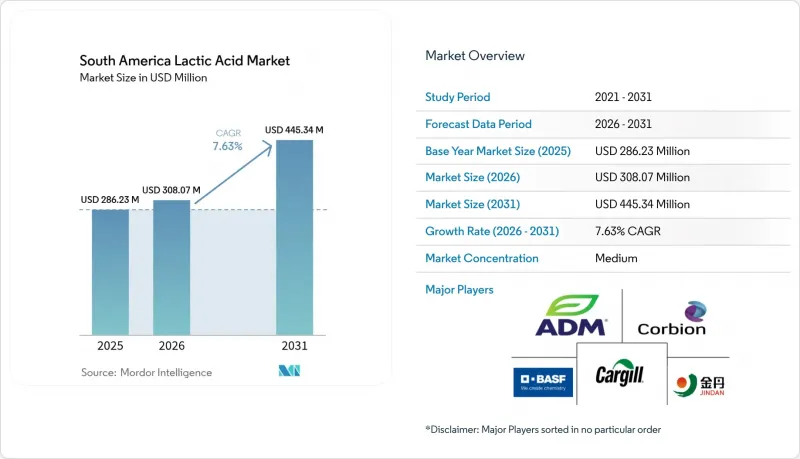
根據 Mordor Intelligence 預測,南美乳酸市場規模預計將從 2025 年的 2.8623 億美元成長到 2026 年的 3.0807 億美元,然後在 2031 年達到 4.4534 億美元,2026 年至 2031 年的複合年成長率為 7.63%。
本報告按原料(天然和合成)、形態(液體和固體)、等級(食品級、工業級、醫藥級、化妝品級)、應用(食品飲料、個人護理和化妝品、藥品、動物飼料、工業和化學加工)以及地區(巴西等)對行業進行細分。市場預測以美元計價。
南美洲乳酸市場趨勢與洞察
巴西植物來源食品加工業的發展正在推動天然酸味劑的需求。
巴西植物來源食品產業監管方面取得了顯著進展,預計將加速天然酸味劑在生產過程中的應用。巴西國家衛生監督局 (ANVISA) 和農業生產管理署 (MAPA) 等監管機構正積極致力於改善植物來源產品的監管架構。這些修訂旨在建立清晰的最低識別和品質標準,同時消除消費者的困惑。監管的轉變正在推動對天然防腐劑的標準化需求,而乳酸正成為主要解決方案。提案的法規要求使用清晰的標籤來區分植物來源和動物性產品,鼓勵製造商根據潔淨標示和永續性發展策略採用天然酸味劑。加工企業正在擴大乳酸的使用範圍,利用其在pH值控制和延長保存期限方面的優勢,將其應用於包括植物來源肉類替代品、乳製品替代品和發酵產品在內的各種產品中。該行業對創新的重視,尤其是在植物來源和潔淨標示產品的開發方面,進一步推動了對天然酸味劑的需求。這些成分不僅符合不斷變化的監管要求,也滿足了消費者對永續和透明產品配方日益成長的期望。由於天然酸味劑符合監管和市場趨勢,它們已成為巴西植物來源食品產業持續成長的關鍵要素。
烘焙業消費者越來越偏好選擇潔淨標示的防腐劑。
在南美洲,潔淨標示趨勢正在為烘焙產品的配方帶來顯著變化。這是因為消費者越來越重視清晰,並傾向於使用天然成分而不是合成替代品。有機酸,尤其是乳酸,因其雙重功能而成為關鍵成分。乳酸透過降低pH值和直接抗菌的雙重機制,有效抑制大腸桿菌和沙門氏菌等食源性致病菌,同時維持烘焙點心的感官品質。這種特性使得配方研發人員能夠在不降低食品安全標準的前提下,取代合成防腐劑。為了響應這一日益成長的需求,巴西烘焙師正在採用基於乳酸的解決方案,這些方案不僅能夠延長保存期限,而且符合潔淨標示的要求。除了防腐作用外,乳酸衍生物(例如PURACAL® PP)也被用於抑制丙烯醯胺的生成,丙烯醯胺是一種在烘焙過程中產生的有害化合物。這項附加功能凸顯了乳酸的多功能性,使其成為烘焙師的策略性成分。透過迎合消費者對天然成分的偏好並遵守嚴格的食品安全法規,乳酸在重塑南美麵包市場中發揮著至關重要的作用。
原料價格(玉米、甘蔗)的波動會影響生產利潤率。
由於受氣候和政策因素影響,農業市場波動性加劇,導致原物料價格不穩定,南美乳酸生產商的利潤率面臨巨大壓力。在巴西,甘蔗生產持續受到惡劣天氣的影響。儘管種植面積保持穩定,但預計2025/26年度的收成將比上一年下降2%。此降幅歸因於主要產區乾旱導致單產下降2.3%,進而推高了依賴甘蔗原料的生產商的原料成本。同時,玉米乙醇生產的快速擴張加劇了對玉米原料的競爭。預計2024/25年度巴西的玉米消費量將達到34.64億蒲式耳,屆時將有25家乙醇工廠運作中,與傳統的飼料和食品用途展開競爭。甘蔗供應減少和玉米需求增加的雙重挑戰,已將國內原料價格推至2022年以來的最高水準。為應對這些壓力,乳酸生產商正在最佳化原料籌資策略,並積極探索替代基材方案。在供應鏈中斷和投入成本不斷上漲日益影響的市場中,這些措施對於保持競爭力至關重要。
細分市場分析
到2025年,天然乳酸將佔據91.62%的市場佔有率,預計到2031年將以8.11%的複合年成長率穩定成長。這一成長主要得益於巴西豐富的農業原料和消費者對生物基成分日益成長的需求。巴西先進的甘蔗加工基礎設施能夠很好地適應生物化學產品的生產,使其在成本上比合成產品更具優勢。此外,巴西農業部為天然飼料成分制定的嚴格安全性和有效性標準也促進了天然乳酸在動物營養領域的應用。近期頒布的第15070/2024號法律對農業和畜牧業的微生物和生物技術產品設定了嚴格的品質標準,透過確保產品品質的穩定性和市場擴張,進一步鞏固了天然乳酸市場的地位。
此外,在政府推動生物基化學品生產以及潔淨標示食品中天然乳酸使用量不斷增加的措施的推動下,市場正經歷顯著成長。 2023年,巴西能源研究局報告稱,甘蔗加工量達到創紀錄的7.13億噸,主要得益於甘蔗和玉米乙醇的生產。這項成就確保了天然乳酸生產商穩定的原料供應。此外,隨著拉丁美洲開發銀行致力於永續和改善環境質量,在各種工業應用中優先使用天然化學品而非合成化學品的趨勢正在進一步加速發展。
預計到2025年,液態乳酸將佔據59.58%的顯著市場。這主要歸功於其在大規模食品加工中的高效運作以及與飲料配方無縫銜接的特性。液態乳酸易於操作和精確計量,這對於乳製品酸化、肉類保鮮和飲料pH值調節等應用至關重要。這些特性使得液態乳酸在南美洲龐大的食品加工業中不可或缺。此外,阿根廷嚴格的食品法規,特別是針對乳製品和食品添加劑所製定的具體標準,也促進了對液態酸味劑的標準化需求。這些酸味劑可以輕鬆整合到現有的加工系統中,進一步鞏固了其市場主導地位。
預計到2031年,粉末和顆粒劑市場將快速成長,年複合成長率(CAGR)將達到9.02%。這一成長主要得益於乾混應用和出口市場對保存期限長的配方需求不斷成長,以及濃縮型產品運輸成本的降低。此外,工業應用,特別是水處理領域的應用,也推動了該市場的發展。世界銀行強調了拉丁美洲污水基礎設施建設的迫切需求,並估計2010年至2030年間,該地區需要800億美元用於污水基礎設施建設,330億美元用於污水處理。這些投資為工業水處理製程中對粉末劑的需求成長創造了機會。此外,粉末劑在動物飼料產業也發展迅猛,其乾混優勢和較長的保存期限為生產營運帶來了顯著效益。這些特性對於服務該地區日益成長的畜牧業的飼料生產商而言尤為重要,從而進一步推動了該市場的擴張。
其他好處:
- Excel格式的市場預測(ME)表
- 3個月的分析師支持
目錄
第1章:引言
- 研究假設和市場定義
- 調查範圍
第2章:調查方法
第3章執行摘要
第4章 市場狀況
- 市場概覽
- 市場促進因素
- 巴西植物來源食品加工業的發展正在推動天然酸味劑的需求。
- 烘焙業消費者越來越偏好選擇「潔淨標示」防腐劑。
- 巴西政府對甘蔗衍生生化產品生產的獎勵措施
- 為了應對抗生素禁用,乳酸作為牲畜飼料酸化劑的使用正在增加。
- 在皮膚科外用製劑中使用乳酸的製藥公司
- 南美洲都市區市場對發酵乳替代品的需求日益成長
- 市場限制因素
- 原料價格(玉米、甘蔗)的波動正在影響生產利潤率。
- 巴西以外地區食品級發酵基礎設施供應有限。
- 在安地斯國家,嚴格的廢水處理標準導致營運成本增加。
- 來自亞洲的廉價進口酸味劑(如檸檬酸)的競爭。
- 供應鏈分析
- 監理展望
- 波特五力模型
第5章 市場規模與成長預測
- 按原料
- 自然的
- 合成
- 按形式
- 液體
- 固體(粉末/顆粒)
- 按年級
- 食品級
- 工業級
- 醫藥級
- 化妝品級
- 透過使用
- 食品/飲料
- 麵包店
- 糖果糕餅
- 乳製品
- 肉類、雞肉、魚貝類
- 飲料
- 其他食品和飲料用途
- 個人護理化妝品
- 製藥
- 動物飼料
- 工業和化學加工
- 食品/飲料
- 按地區
- 巴西
- 阿根廷
- 哥倫比亞
- 智利
- 秘魯
- 其他南美國家
第6章 競爭情勢
- 市場集中度
- 策略趨勢
- 市場排名分析
- 公司簡介
- Corbion NV
- Cargill, Incorporated
- BASF SE
- Archer-Daniels-Midland Company
- Galactic Holdings, Inc
- Henan Jindan Lactic Acid Co., Ltd.
- Jungbunzlauer Suisse AG, Basel
- Arshine Food Additives Co., Ltd.
- Cellulac plc,
- Brenntag AG
- Dsm-Firmenich AG
- Futerro SA
- Univar Solutions LLC.
- Shenzhen Esun Industrial Co., Ltd.
- BBCA Group Corporation
- International Flavors & Fragrances(Danisco)
- Natureworks LLC
- Musashino Chemical Laboratory, Ltd.
- DuPont de Nemours, Inc.
- Tokyo Chemical Industry Co., Ltd.
第7章 市場機會與未來展望
According to Mordor Intelligence, the South America lactic acid market size is expected to grow from USD 286.23 million in 2025 to USD 308.07 million in 2026 and is forecast to reach USD 445.34 million by 2031 at 7.63% CAGR over 2026-2031.
This report Segments the Industry by Source (Natural and Synthetic); Form (Liquid and Solid); Grade (Food Grade, Industrial Grade, Pharmaceutical Grade, and Cosmetic Grade); and Application (Food and Beverages, Personal Care and Cosmetics, Pharmaceutical, Animal Feed, and Industrial and Chemical Processing), and Geography (Brazil and More). The Market Forecasts are Provided in Terms of Value (USD).
South America Lactic Acid Market Trends and Insights
Growth of plant-based food processing in brazil boosting demand for natural acidulants
Brazil's plant-based food sector is witnessing significant regulatory advancements, which are expected to drive the adoption of natural acidulants in manufacturing processes. Regulatory bodies such as ANVISA and MAPA are actively refining their frameworks for plant-based products. These updates aim to eliminate consumer confusion while establishing clear minimum identity and quality standards. This regulatory shift is fostering a standardized demand for natural preservatives, with lactic acid emerging as a key solution. The proposed regulations mandate clear labeling to distinguish plant-based products from animal-based ones, encouraging manufacturers to adopt natural acidulants that align with clean-label and sustainability-focused strategies. Processing facilities are increasingly integrating lactic acid into their operations, leveraging its benefits for pH control and shelf-life extension across various applications, including plant-based meat alternatives, dairy substitutes, and fermented products. The sector's emphasis on innovation, particularly in developing plant-based and clean-label offerings, is further fueling the demand for natural acidulants. These ingredients not only comply with evolving regulatory requirements but also meet growing consumer expectations for sustainable and transparent product formulations. This dual alignment with regulatory and market trends positions natural acidulants as essential components in the continued growth of Brazil's plant-based food sector.
Rising consumer preference for clean-label preservatives in bakery segment
The clean-label movement is driving significant changes in South American bakery formulations as consumers increasingly demand transparency and natural ingredients over synthetic alternatives. Organic acids, particularly lactic acid, are emerging as key components due to their dual functionality. Lactic acid effectively combats foodborne pathogens such as E. coli and Salmonella through its dual mechanism of pH reduction and direct antimicrobial action, all while maintaining the sensory quality of baked goods. This capability enables formulators to replace synthetic preservatives without compromising food safety standards. In response to this growing demand, Brazilian bakery manufacturers are adopting lactic acid-based solutions that not only extend shelf life but also align with clean-label claims. Beyond preservation, lactic acid derivatives, such as PURACAL(R) PP, are being utilized to reduce acrylamide formation-a harmful compound generated during baking processes. This additional functionality highlights the versatility of lactic acid, making it a strategic ingredient for bakery manufacturers. By addressing consumer preferences for natural ingredients and adhering to stringent food safety regulations, lactic acid is playing a pivotal role in reshaping the bakery market in South America.
Volatility in feedstock (corn, sugarcane) prices impacting production margins
South American lactic acid producers are facing significant margin pressures due to feedstock price instability, driven by heightened volatility in agricultural commodity markets influenced by climate and policy factors. In Brazil, sugarcane production remains under strain from adverse weather conditions. The 2025/26 harvest is projected to decline by 2% compared to the previous season, despite a stable cultivation area. This decline is attributed to a 2.3% drop in productivity caused by drought conditions in key producing regions, which is driving up feedstock costs for manufacturers reliant on sugarcane-derived substrates. Simultaneously, the rapid expansion of corn ethanol production is intensifying competition for corn feedstocks. Brazil's corn consumption is expected to reach 3,464 million bushels in 2024/25, as 25 operational ethanol plants compete with traditional feed and food applications. This dual challenge of reduced sugarcane availability and heightened corn demand has pushed domestic feedstock prices to their highest levels since 2022. To navigate these pressures, lactic acid producers are optimizing their feedstock sourcing strategies and actively exploring alternative substrate options. These measures are critical for maintaining competitive positioning in a market increasingly shaped by supply chain disruptions and rising input costs.
Other drivers and restraints analyzed in the detailed report include:
- Government incentives for sugarcane bio-based chemicals production in brazil
- Increasing utilization of lactic acid in livestock feed acidifiers to combat antibiotic ban
- Limited availability of food-grade fermentation infrastructure outside brazil
For complete list of drivers and restraints, kindly check the Table Of Contents.
Segment Analysis
In 2025, natural lactic acid commands a dominant 91.62% market share and is set to expand at a robust CAGR of 8.11% through 2031. This growth is largely driven by Brazil's rich agricultural feedstock and a rising consumer appetite for bio-based ingredients. Brazil's sophisticated sugarcane processing infrastructure, easily adaptable for biochemical production, provides a notable cost edge over synthetic counterparts. Furthermore, the Brazilian Ministry of Agriculture's stringent safety and efficacy standards for natural feed ingredients bolster the adoption of naturally derived lactic acid in animal nutrition. The recent enactment of Law #15,070/2024 further fortifies the natural segment, instituting rigorous quality benchmarks for microbial and biotechnological products in agriculture and livestock, thereby ensuring product consistency and market expansion.
Moreover, bolstered by government initiatives championing bio-based chemical production and the surging use of natural lactic acid in clean-label food products, the market is witnessing significant growth. In 2023, Brazil's Energy Research Office highlighted a record sugarcane processing volume of 713 million tons, buoyed by both sugarcane and corn-based ethanol production. This achievement guarantees a reliable feedstock supply for natural lactic acid producers. Additionally, the Development Bank of Latin America's commitment to sustainable development and enhancing environmental quality further propels the preference for natural chemicals over synthetic ones across diverse industrial applications.
In 2025, liquid lactic acid secures a significant 59.58% share of the market, driven by its operational efficiency in large-scale food processing and its seamless incorporation into beverage formulations. The liquid form offers ease of handling and precise dosing, which are critical for applications such as dairy acidification, meat preservation, and beverage pH control. These attributes make it indispensable in South America's expansive food processing industry. Additionally, Argentina's stringent food code, which outlines specific standards for dairy products and food additives, has fostered a standardized demand for liquid acidulants. These acidulants integrate effortlessly into existing processing systems, further solidifying their market dominance.
The powder and granules segment is poised for rapid growth, with a projected CAGR of 9.02% through 2031. This growth is fueled by the increasing preference for shelf-stable formulations in dry mix applications and export markets, where concentrated forms reduce transportation costs. The segment also benefits from industrial applications, particularly in water treatment. The World Bank has highlighted the need for significant investments in Latin America's wastewater infrastructure, estimating USD 80 billion for sewerage and USD 33 billion for wastewater treatment between 2010 and 2030. These investments create opportunities for powder forms in industrial water treatment processes. Moreover, the powder segment is gaining traction in the animal feed industry, where its dry mixing capabilities and extended shelf life provide operational advantages. These features are particularly valuable for feed manufacturers catering to the region's growing livestock sector, further driving the segment's expansion.
Complete Report Scope:
- By Source
- Natural
- Synthetic
- By Form
- Liquid
- Solid (Powder/Granules)
- By Grade
- Food Grade
- Industrial Grade
- Pharmaceutical Grade
- Cosmetic Grade
- By Application
- Food and Beverages
- Bakery
- Confectionery
- Dairy Products
- Meat, Poultry and, Seafood
- Beverages
- Other Food and Beverage Applications
- Personal Care and Cosmetics
- Pharmaceutical
- Animal Feed
- Industrial and Chemical Processing
- Food and Beverages
- By Geography
- Brazil
- Argentina
- Colombia
- Chile
- Peru
- Rest of South America
List of Companies Covered in this Report:
- Corbion NV
- Cargill, Incorporated
- BASF SE
- Archer-Daniels-Midland Company
- Galactic Holdings, Inc
- Henan Jindan Lactic Acid Co., Ltd.
- Jungbunzlauer Suisse AG, Basel
- Arshine Food Additives Co., Ltd.
- Cellulac plc,
- Brenntag AG
- Dsm-Firmenich AG
- Futerro SA
- Univar Solutions LLC.
- Shenzhen Esun Industrial Co., Ltd.
- BBCA Group Corporation
- International Flavors & Fragrances (Danisco)
- Natureworks LLC
- Musashino Chemical Laboratory, Ltd.
- DuPont de Nemours, Inc.
- Tokyo Chemical Industry Co., Ltd.
Additional Benefits:
- The market estimate (ME) sheet in Excel format
- 3 months of analyst support
TABLE OF CONTENTS
1 INTRODUCTION
- 1.1 Study Assumptions and Market Definition
- 1.2 Scope of the Study
2 RESEARCH METHODOLOGY
3 EXECUTIVE SUMMARY
4 MARKET LANDSCAPE
- 4.1 Market Overview
- 4.2 Market Drivers
- 4.2.1 Growth of plant-based food processing in brazil boosting demand for natural acidulants
- 4.2.2 Rising consumer preference for clean-label preservatives in bakery segment
- 4.2.3 Government incentives for sugarcane bio-based chemicals production in brazil
- 4.2.4 Increasing utilization of lactic acid in livestock feed acidifiers to combat antibiotic ban
- 4.2.5 Pharmaceutical companies adopting lactic acid for topical drug formulations in dermatology
- 4.2.6 Rising demand for fermented dairy alternatives in urban south american markets
- 4.3 Market Restraints
- 4.3.1 Volatility in feedstock (corn, sugarcane) prices impacting production margins
- 4.3.2 Limited availability of food-grade fermentation infrastructure outside brazil
- 4.3.3 Stringent effluent disposal norms increasing operating costs in andean countries
- 4.3.4 Competition from cheaper imported acidulants such as citric acid from asia
- 4.4 Supply-Chain Analysis
- 4.5 Regulatory Outlook
- 4.6 Porter's Five Forces
- 4.6.1 Threat of New Entrants
- 4.6.2 Bargaining Power of Buyers/Consumers
- 4.6.3 Bargaining Power of Suppliers
- 4.6.4 Threat of Substitute Products
- 4.6.5 Intensity of Competitive Rivalry
5 MARKET SIZE AND GROWTH FORECASTS (VALUE)
- 5.1 By Source
- 5.1.1 Natural
- 5.1.2 Synthetic
- 5.2 By Form
- 5.2.1 Liquid
- 5.2.2 Solid (Powder/Granules)
- 5.3 By Grade
- 5.3.1 Food Grade
- 5.3.2 Industrial Grade
- 5.3.3 Pharmaceutical Grade
- 5.3.4 Cosmetic Grade
- 5.4 By Application
- 5.4.1 Food and Beverages
- 5.4.1.1 Bakery
- 5.4.1.2 Confectionery
- 5.4.1.3 Dairy Products
- 5.4.1.4 Meat, Poultry and, Seafood
- 5.4.1.5 Beverages
- 5.4.1.6 Other Food and Beverage Applications
- 5.4.2 Personal Care and Cosmetics
- 5.4.3 Pharmaceutical
- 5.4.4 Animal Feed
- 5.4.5 Industrial and Chemical Processing
- 5.4.1 Food and Beverages
- 5.5 By Geography
- 5.5.1 Brazil
- 5.5.2 Argentina
- 5.5.3 Colombia
- 5.5.4 Chile
- 5.5.5 Peru
- 5.5.6 Rest of South America
6 COMPETITIVE LANDSCAPE
- 6.1 Market Concentration
- 6.2 Strategic Moves
- 6.3 Market Ranking Analysis
- 6.4 Company Profiles (includes Global level Overview, Market level overview, Core Segments, Financials as available, Strategic Information, Market Rank/Share for key companies, Products and Services, and Recent Developments)
- 6.4.1 Corbion NV
- 6.4.2 Cargill, Incorporated
- 6.4.3 BASF SE
- 6.4.4 Archer-Daniels-Midland Company
- 6.4.5 Galactic Holdings, Inc
- 6.4.6 Henan Jindan Lactic Acid Co., Ltd.
- 6.4.7 Jungbunzlauer Suisse AG, Basel
- 6.4.8 Arshine Food Additives Co., Ltd.
- 6.4.9 Cellulac plc,
- 6.4.10 Brenntag AG
- 6.4.11 Dsm-Firmenich AG
- 6.4.12 Futerro SA
- 6.4.13 Univar Solutions LLC.
- 6.4.14 Shenzhen Esun Industrial Co., Ltd.
- 6.4.15 BBCA Group Corporation
- 6.4.16 International Flavors & Fragrances (Danisco)
- 6.4.17 Natureworks LLC
- 6.4.18 Musashino Chemical Laboratory, Ltd.
- 6.4.19 DuPont de Nemours, Inc.
- 6.4.20 Tokyo Chemical Industry Co., Ltd.
7 MARKET OPPORTUNITIES AND FUTURE OUTLOOK

 乳酸和聚乳酸市場報告:趨勢、預測和競爭分析(至2035年)
 乳酸:市場佔有率分析、產業趨勢與統計、成長預測(2026-2031)
 乳酸市場-2026-2032年全球市場預測
 乳酸市場規模、佔有率和趨勢分析報告:按原料、應用、地區和細分市場預測(2026-2033 年)包封乳酸:市場佔有率分析、產業趨勢與統計、成長預測(2026-2031)
 乳酸和聚乳酸市場規模、佔有率和成長分析:按產品類型、原料、應用、最終用途產業、形態、製造技術和地區分類-2026-2033年產業預測
 乳酸市場:依原料、應用和地區分類
 全球聚乳酸市場規模、佔有率、趨勢和成長分析報告(2026-2034年)乳酸市場規模、佔有率、成長及全球產業分析:按類型、應用和地區的洞察,2026-2034年的預測乳酸全球市場規模、佔有率、趨勢和成長分析報告(2026-2034)