


 |
市場調查報告書
商品編碼
2121533
北美服務機器人:市佔率分析、產業趨勢與統計及成長預測(2026-2031 年)North America Service Robots - Market Share Analysis, Industry Trends & Statistics, Growth Forecasts (2026 - 2031) |
||||||

※ 本網頁內容可能與最新版本有所差異。詳細情況請與我們聯繫。
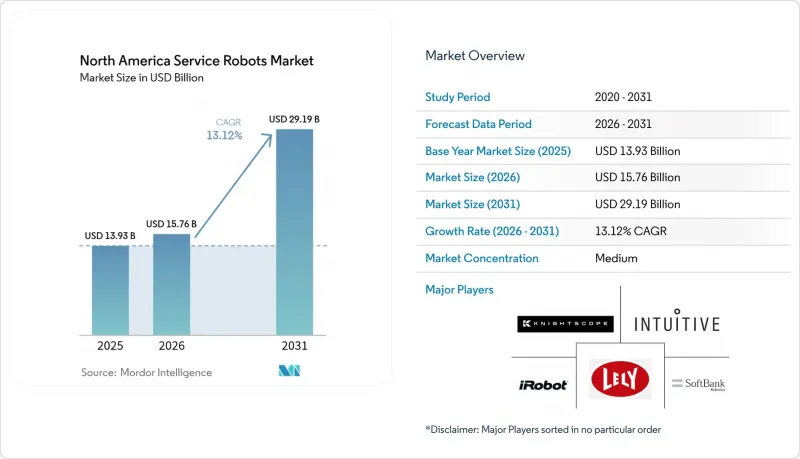
據 Mordor Intelligence 稱,2025 年北美服務機器人市場價值 139.3 億美元,預計將從 2026 年的 157.6 億美元成長到 2031 年的 291.9 億美元。
預測期(2026-2031 年)的複合年成長率預計為 13.12%。
本報告按機器人類型(例如,商用服務機器人、自主移動機器人)、應用領域(例如,物流和倉儲自動化、醫療保健和醫療輔助)、環境(例如,地面機器人、空中服務機器人)、組件(硬體、軟體、服務)和地區進行細分。市場預測以價值(美元)表示。
北美服務機器人市場趨勢及洞察
人事費用上升正在加速自動化技術的普及。
預計到2024年底,倉庫和醫院的工資將年增6.8%,這將對物流公司和醫療保健提供者的利潤率帶來壓力。自動駕駛平台的投資回收期已縮短至18個月,是2022年的一半,加速了各種規模設施採用機器人的進程。亞馬遜的Proteus機器人已在美國350個履約中心減少了40%的人工托盤搬運,證明了其對中型企業的經濟效益。據Locus Robotics公司稱,2024年訂單的訂單中有68%來自員工人數少於500人的公司,這證實了機器人正在向中小企業滲透。安大略省的倉庫也面臨類似的薪資成長,堆高機司機的時薪上漲了22%,這使得自動導引運輸車(AGV)從投資報酬率的角度來看更具吸引力。
人工智慧 (AI) 和機器視覺的進展
基於變壓器的視覺模型已將導航誤差率降低至0.5%以下,即使在擁擠的道路上也能安全行駛。谷歌DeepMind的RT-2架構實現了6000個物體的零樣本操作,並顯著縮短了特定任務的訓練時間。 Diligent Robotics的Moxi利用這些技術進步,在2024年前無需重寫任何代碼即可在美國140家醫院部署。約翰迪爾的「Blue River See and Spray」系統透過在8000台曳引機上減少77%的除草劑用量,展示了人工智慧在戶外應用的效用。競爭優勢正從機械公差轉向能夠提供持續模型更新的資料管道。
前期資本投入負擔沉重。
倉庫機器人的價格在 3.5 萬美元到 7.5 萬美元之間,而手術系統的平均價格高達 250 萬美元,這對許多小規模機構來說太昂貴。 2024 年的一項調查發現,43% 的農村醫院的資本預算低於採用機器人的閾值。 「機器人即服務 (RaaS)」模式將支出轉化為營運成本,但其對可預測工作負載的依賴限制了其在物流以外領域的應用。農業平台的價格在 25 萬美元到 50 萬美元之間,除非補貼計畫能夠覆蓋高達 50% 的成本,否則只有超過 2000 英畝的農場才能負擔得起。因此,資金障礙抑制了需求,尤其是在資源有限的農村農民。
細分市場分析
預計到2025年,專業系統將佔總銷售額的61.74%,主要成長動力來自外科手術、防禦和診斷機器人。儘管價格昂貴,醫院仍採用達文西手術系統,以享有聯邦醫療保險(Medicare)的等額報銷。然而,北美服務機器人市場正轉向大規模自主移動機器人,這是成長最快的類別,複合年成長率(CAGR)高達13.95%。 Locus Robotics公司預計到2024年,其機器人部署量將超過4萬台,覆蓋300個地點,這得益於其訂閱定價模式,該模式降低了資本支出。像iRobot的Roomba這樣的個人機器人市場已接近飽和,在美國的家庭滲透率已達18%。隨著人工智慧技術的進步,營運商轉向全自動解決方案,半自動機器人的市場佔有率正在下降。斑馬公司的「FetchCore」集中管理著來自不同供應商的500個工廠的機器人,這表明,統籌多供應商車隊的軟體生態系統現在已成為決定競爭優勢的關鍵因素。
自主機器人叢集透過實現全天候運作且無需額外人員,正在重塑成本結構。機器人叢集的運轉率超過 98%,這項可靠性閾值正促使中型倉庫完全跳過人工操作,轉而採用自主系統。供應商也在銷售能夠識別瓶頸並預測維護需求的分析功能,這進一步降低了軟體切換的成本。隨著自主移動系統在北美服務機器人市場的規模化發展,機器人領域的專家領導力不僅取決於硬體,還取決於流程核准和營運數據的整合。
到2025年,物流和倉儲自動化將佔北美服務機器人市場29.21%的佔有率。主要電商業者的採用率超過60%,顯示市場已趨於成熟。成長重心正轉向配送和最後一公里服務,預計複合年成長率將達到14.12%。在美國,僅有100個城市部署了人行道配送車隊,這意味著市場仍有巨大的成長空間。醫療領域的應用案例正在穩步擴展,Aethon公司的TUG機器人已被400家醫院用於運輸藥品和床單。在農業領域,精準噴灑和自動擠奶有望提高產量,但由於各州津貼政策不盡相同,這些技術的普及受到限制。保安機器人正在停車場和校園巡邏,但由於人們對公共監控的擔憂,其普及速度緩慢。應用案例的多元化正在擴大北美服務機器人市場的整體潛在規模,並使收入來源擺脫對傳統倉儲業務的依賴。
配送機器人的長期成長取決於相關法規的頒布,這些法規將明確通行權和責任歸屬。車隊密度的提高也將促進軟體收入的持續成長。相較之下,倉儲領域的進一步成長目前源自於機械手臂、自動化立體倉庫(ASRS)和自主移動機器人(AMR)在統一編配下的整合,企業客戶正在尋求獨立於供應商的平台。因此,應用的多樣性,以及法規驅動的需求激增與穩定成長的平衡,支撐了北美服務機器人產業的前景。
其他好處:
- Excel格式的市場預測(ME)表
- 3個月的分析師支持
目錄
第1章:引言
- 研究假設和市場定義
- 調查範圍
第2章:調查方法
第3章執行摘要
第4章 市場狀況
- 市場概覽
- 市場促進因素
- 人事費用上升正在加速自動化技術的普及。
- 人工智慧和機器視覺的進展
- 疫情後對非接觸式服務的需求增加
- 人口老化正在推動對醫療服務機器人的需求。
- 美國各州針對農業機器人技術的獎勵計劃
- 促進人機協作的倉庫安全法規
- 市場限制因素
- 需要大量的初始資金投入。
- 人機互動中安全性和責任性的擔憂
- 引入服務型機器人的保險覆蓋範圍的限制
- 農村缺乏熟練的機器人維修技術人員
- 產業價值鏈分析
- 監理情勢
- 技術展望
- 宏觀經濟因素的影響
- 波特五力分析
第5章 市場規模與成長預測
- 按機器人類型
- 商用服務機器人
- 個人與家庭服務機器人
- 自主移動機器人
- 半自動自主服務機器人
- 透過使用
- 物流和倉儲自動化
- 醫療保健和醫療支持
- 農業和農場工作
- 國防/公共安全
- 配送和最後一公里服務
- 透過環境
- 地面機器人
- 空中服務機器人
- 海洋服務機器人
- 按組件
- 硬體
- 軟體
- 服務
- 按地區
- 美國
- 加拿大
- 墨西哥
第6章 競爭情勢
- 市場集中度
- 策略趨勢
- 市佔率分析
- 公司簡介
- iRobot Corporation
- Intuitive Surgical Inc.
- SoftBank Robotics Group Corp.
- Fetch Robotics Inc.
- Lely Holding SA RL
- Knightscope Inc.
- Blue River Technology Inc.
- Savioke Inc.
- Starship Technologies Holdings Inc.
- Blue Ocean Robotics ApS
- Diligent Robotics Inc.
- Locus Robotics Corp.
- Clearpath Robotics Inc.
- Autonomous Solutions Inc.
- Miso Robotics Inc.
- Bear Robotics Inc.
- Neato Robotics Inc.
- Aethon Inc.
- Aerobotix Inc.
- Eco Robotics SA
第7章 市場機會與未來展望
According to Mordor Intelligence, the North America service robots market size was valued at USD 13.93 billion in 2025 and estimated to grow from USD 15.76 billion in 2026 to reach USD 29.19 billion by 2031, at a CAGR of 13.12% during the forecast period (2026-2031).
This report is Segmented by Robot Type (Professional Service Robots, Autonomous Mobile Robots, and More), Application (Logistics and Warehouse Automation, Healthcare and Medical Assistance, and More), Environment (Ground-Based Robots, Aerial Service Robots, and More), Component (Hardware, Software, Services), and Geography. The Market Forecasts are Provided in Terms of Value (USD).
North America Service Robots Market Trends and Insights
Rising Labor Costs Accelerating Automation Adoption
Warehouse and hospital wages climbed 6.8% year over year by late 2024, shrinking margins for logistics operators and healthcare providers. Autonomous mobile platforms now pay back in 18 months, half the 2022 period, prompting widespread fleet roll-outs in facilities of every size. Amazon's Proteus robots eliminated 40% of manual pallet moves across 350 U.S. fulfillment centers, validating the economics for mid-market adopters. Locus Robotics reported that 68% of its 2024 wins were firms with fewer than 500 employees, confirming penetration into small enterprises. Similar wage spikes in Ontario warehouses raised hourly forklift pay 22%, tipping return-on-investment math toward autonomous guided vehicles.
Advances in Artificial Intelligence and Machine Vision
Transformer-based vision models are reducing navigation error rates below 0.5%, allowing safe travel in crowded corridors. Google DeepMind's RT-2 architecture demonstrated zero-shot manipulation of 6,000 objects, slashing task-specific training time. Diligent Robotics' Moxi leveraged these gains to serve 140 U.S. hospitals in 2024 without line-of-code reprogramming. John Deere's Blue River See and Spray reduced herbicide use by 77% across 8,000 tractors, demonstrating the utility of AI outdoors. Competitive advantage is shifting from mechanical tolerances to data pipelines that provide continuous model updates.
High Initial Capital Investment Requirements
Warehouse robots cost USD 35,000-75,000 per unit, while surgical systems average USD 2.5 million; prices are too steep for many small organizations. Forty-three percent of rural hospitals reported capital budgets below robotics thresholds in a 2024 survey. Robot-as-a-service models shift spending to operating expenses but still depend on predictable throughput, limiting their appeal outside logistics. Agricultural platforms priced at USD 250,000-500,000 remain viable only for farms exceeding 2,000 acres, unless subsidy programs defray up to 50% of the costs. Capital hurdles, therefore, temper demand, especially among resource-constrained rural operators.
Other drivers and restraints analyzed in the detailed report include:
- Growing Demand for Contactless Services Post-Pandemic
- Aging Population Driving Healthcare Service Robots
- Safety and Liability Concerns in Human-Robot Interaction
For complete list of drivers and restraints, kindly check the Table Of Contents.
Segment Analysis
Professional systems accounted for 61.74% of 2025 revenue, driven by surgical, defense, and inspection robots. Despite high prices, hospitals added da Vinci systems to capitalize on Medicare reimbursement parity. However, the North America service robots market is shifting toward fleet-scale autonomous mobile robots, the fastest-growing category at a 13.95% CAGR. Locus Robotics' installed base surpassed 40,000 units across 300 sites in 2024, driven by subscription pricing that reduces capital expenses. Personal robots such as iRobot's Roomba face saturation with 18% U.S. household penetration. Semi-autonomous models are losing ground as AI gains push operators toward fully unmanned solutions. Software ecosystems that orchestrate multi-vendor fleets now define competitive advantage, as evidenced by Zebra's FetchCore, which manages mixed robots across 500 facilities.
Autonomous fleets reshape cost structures by enabling 24-hour utilization without incremental labor. Fleet uptime exceeds 98%, a reliability threshold that convinces mid-market warehouses to leapfrog manual mechanization entirely. Vendors also sell usage analytics that identify bottlenecks and predict maintenance, entrenching software switching costs. As the North America service robots market size for autonomous mobile systems rises, professional robot leadership will hinge on procedural clearances and peri-operative data integration rather than hardware alone.
Logistics and warehouse automation accounted for a 29.21% share of the North America service robots market in 2025. Penetration among large e-commerce operators exceeded 60%, signaling maturity. Growth is shifting towards delivery and last-mile services, projected to achieve a 14.12% CAGR. Only 100 U.S. municipalities host sidewalk delivery fleets, leaving a substantial runway. Healthcare applications continue to expand steadily, with Aethon's TUG in 400 hospitals, moving medicines and linens. Agricultural use cases unlock yield gains via precision spraying and autonomous milking, but depend on uneven state credits. Security robots patrol parking lots and campuses, yet public surveillance scrutiny moderates' adoption speed. The dispersion of use cases expands the total addressable North America service robots market size while diversifying revenue beyond traditional warehouses.
Long-term growth in delivery robotics hinges on ordinances that clarify right-of-way and liability. Fleet density also lifts software recurring revenue. By contrast, incremental warehouse gains now come from integrating articulated arms, ASRS, and AMRs under unified orchestration, an area where enterprise customers demand vendor-agnostic platforms. Application diversity, therefore, balances rapid, regulation-led spikes with steady, incremental growth streams, underpinning the North America service robots industry outlook.
Complete Report Scope:
- By Robot Type
- Professional Service Robots
- Personal and Domestic Service Robots
- Autonomous Mobile Robots
- Semi-Autonomous Service Robots
- By Application
- Logistics and Warehouse Automation
- Healthcare and Medical Assistance
- Agriculture and Farming
- Defense and Public Safety
- Delivery and Last-Mile Services
- By Environment
- Ground-Based Robots
- Aerial Service Robots
- Marine Service Robots
- By Component
- Hardware
- Software
- Services
- By Geography
- United States
- Canada
- Mexico
List of Companies Covered in this Report:
- iRobot Corporation
- Intuitive Surgical Inc.
- SoftBank Robotics Group Corp.
- Fetch Robotics Inc.
- Lely Holding S.A R.L.
- Knightscope Inc.
- Blue River Technology Inc.
- Savioke Inc.
- Starship Technologies Holdings Inc.
- Blue Ocean Robotics ApS
- Diligent Robotics Inc.
- Locus Robotics Corp.
- Clearpath Robotics Inc.
- Autonomous Solutions Inc.
- Miso Robotics Inc.
- Bear Robotics Inc.
- Neato Robotics Inc.
- Aethon Inc.
- Aerobotix Inc.
- Eco Robotics SA
Additional Benefits:
- The market estimate (ME) sheet in Excel format
- 3 months of analyst support
TABLE OF CONTENTS
1 INTRODUCTION
- 1.1 Study Assumptions and Market Definition
- 1.2 Scope of the Study
2 RESEARCH METHODOLOGY
3 EXECUTIVE SUMMARY
4 MARKET LANDSCAPE
- 4.1 Market Overview
- 4.2 Market Drivers
- 4.2.1 Rising Labor Costs Accelerating Automation Adoption
- 4.2.2 Advances in Artificial Intelligence and Machine Vision
- 4.2.3 Growing Demand for Contactless Services Post-Pandemic
- 4.2.4 Aging Population Driving Healthcare Service Robots
- 4.2.5 State-Level Incentive Programs for Agricultural Robotics in the United States
- 4.2.6 Warehouse Safety Regulations Favoring Human-Robot Collaboration
- 4.3 Market Restraints
- 4.3.1 High Initial Capital Investment Requirements
- 4.3.2 Safety and Liability Concerns in Human-Robot Interaction
- 4.3.3 Limited Insurance Underwriting Framework for Service Robot Deployment
- 4.3.4 Skilled Robot Maintenance Technician Shortage in Rural Areas
- 4.4 Industry Value Chain Analysis
- 4.5 Regulatory Landscape
- 4.6 Technological Outlook
- 4.7 Impact of Macroeconomic Factors
- 4.8 Porter's Five Forces Analysis
- 4.8.1 Threat of New Entrants
- 4.8.2 Bargaining Power of Suppliers
- 4.8.3 Bargaining Power of Buyers
- 4.8.4 Threat of Substitutes
- 4.8.5 Competitive Rivalry
5 MARKET SIZE AND GROWTH FORECASTS (VALUE)
- 5.1 By Robot Type
- 5.1.1 Professional Service Robots
- 5.1.2 Personal and Domestic Service Robots
- 5.1.3 Autonomous Mobile Robots
- 5.1.4 Semi-Autonomous Service Robots
- 5.2 By Application
- 5.2.1 Logistics and Warehouse Automation
- 5.2.2 Healthcare and Medical Assistance
- 5.2.3 Agriculture and Farming
- 5.2.4 Defense and Public Safety
- 5.2.5 Delivery and Last-Mile Services
- 5.3 By Environment
- 5.3.1 Ground-Based Robots
- 5.3.2 Aerial Service Robots
- 5.3.3 Marine Service Robots
- 5.4 By Component
- 5.4.1 Hardware
- 5.4.2 Software
- 5.4.3 Services
- 5.5 By Geography
- 5.5.1 United States
- 5.5.2 Canada
- 5.5.3 Mexico
6 COMPETITIVE LANDSCAPE
- 6.1 Market Concentration
- 6.2 Strategic Moves
- 6.3 Market Share Analysis
- 6.4 Company Profiles (includes Global Level Overview, Market Level Overview, Core Segments, Financials as Available, Strategic Information, Market Rank/Share for Key Companies, Products and Services, and Recent Developments)
- 6.4.1 iRobot Corporation
- 6.4.2 Intuitive Surgical Inc.
- 6.4.3 SoftBank Robotics Group Corp.
- 6.4.4 Fetch Robotics Inc.
- 6.4.5 Lely Holding S.A R.L.
- 6.4.6 Knightscope Inc.
- 6.4.7 Blue River Technology Inc.
- 6.4.8 Savioke Inc.
- 6.4.9 Starship Technologies Holdings Inc.
- 6.4.10 Blue Ocean Robotics ApS
- 6.4.11 Diligent Robotics Inc.
- 6.4.12 Locus Robotics Corp.
- 6.4.13 Clearpath Robotics Inc.
- 6.4.14 Autonomous Solutions Inc.
- 6.4.15 Miso Robotics Inc.
- 6.4.16 Bear Robotics Inc.
- 6.4.17 Neato Robotics Inc.
- 6.4.18 Aethon Inc.
- 6.4.19 Aerobotix Inc.
- 6.4.20 Eco Robotics SA
7 MARKET OPPORTUNITIES AND FUTURE OUTLOOK
- 7.1 White-Space and Unmet-Need Assessment

 分子機器人市場:依產品類型、應用、組件、最終用戶、國家及地區分類-全球產業分析、市場規模、市場佔有率及2026年至2033年預測
 揀選包裝機器人市場規模、佔有率和成長分析:按機器人類型、負載能力、應用、最終用戶、自動化程度和地區分類-2026-2033年產業預測
 機器人驅動裝置市場 - 全球市場預測(2026-2032)
 亞太地區服務機器人:市場佔有率分析、產業趨勢與統計及成長預測(2026-2031)
 全球取放機器人市場規模、佔有率、趨勢和成長分析報告(2026-2034)歐洲服務機器人:市場佔有率分析、產業趨勢與統計及成長預測(2026-2031 年)
 服務機器人市場預測至2034年:按組件、類型、應用、最終用戶和地區分類的全球分析
 2026-2030年全球開放式計算專案(OCP)機架市場鑄造鍛造機器人市場:按類型、組件、機器人類型、應用和最終用戶產業分類-2026-2032年全球市場預測
 2026年全球商業服務管理市場報告