


 |
市場調查報告書
商品編碼
2113599
亞太地區服務機器人:市場佔有率分析、產業趨勢與統計及成長預測(2026-2031)Asia-Pacific Service Robots - Market Share Analysis, Industry Trends & Statistics, Growth Forecasts (2026 - 2031) |
||||||

※ 本網頁內容可能與最新版本有所差異。詳細情況請與我們聯繫。
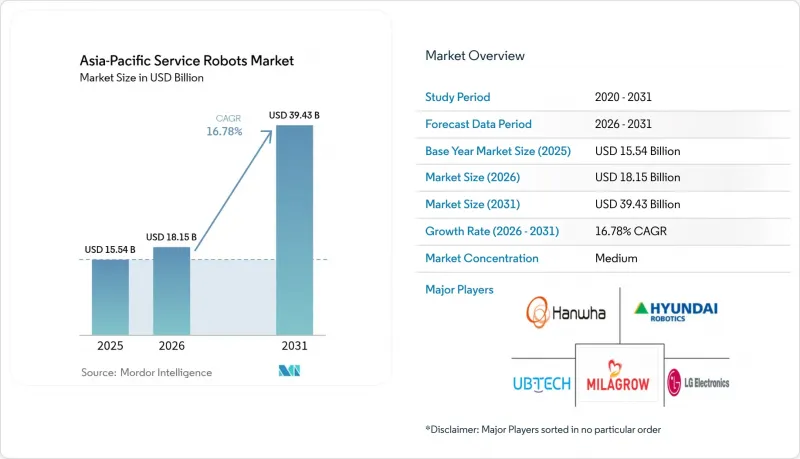
亞太地區服務機器人市場預計到 2026 年將達到 181.5 億美元,高於 2025 年的 155.4 億美元,預計到 2031 年將達到 394.3 億美元。
預計2026年至2031年複合年成長率將達16.78%。
本報告按機器人類型(商用機器人、個人機器人)、應用領域(軍事和國防、農業、建築和採礦等)、組件(硬體、軟體、服務)、運作環境(地面、空中、海上)、移動方式(移動機器人、固定機器人)以及國家/地區進行分類。市場預測以美元(USD)為單位。
亞太地區服務機器人市場趨勢與洞察
電子商務的快速發展正在推動物流領域對自主移動機器人(AMR)的需求。
隨著亞洲線上零售交易量的成長,倉儲業者正大力推廣自主移動機器人(AMR),以縮短履約時間並緩解人手不足。由於當地加班限制導致司機短缺,中國供應商Syrius Robotics計劃每年向其日本基地運送3,000台AMR。這相當於目前出貨量的十倍。 Libiao Robotics的在地化生產進一步表明,近岸生產可以有效避免供應鏈摩擦和進口關稅。 AMR的平均投資回收期不到2.5年,即使對於中型經銷商,也正成為可行的選擇。因此,監管政策的變化正在推動市場需求,使AMR成為亞太服務機器人市場不可或缺的基礎設施。
與人口老化相關的醫療需求
到2025年,日本65歲及以上人口的比例將達到27.3%,因此,醫院和養老院正在引入機器人進行病人轉移、更換尿布和藥物管理等工作。早稻田大學的護理機器人「AIREC」展現了超越簡單監護的先進輔助功能。機器人的引入降低了員工離職率,使員工能夠專注於需要人工干預的任務。此外,自動送餐服務每年為每個機構節省了9,596歐元(約10,356美元)。中國制定的護理機器人國際新標準為國內供應商在全球應用領域佔據主導奠定了基礎,加速了亞太地區服務機器人市場在醫療領域的價值創造。
高昂的實施和整合成本
儘管硬體價格持續下降(預計到2025年,人形機器人的平均價格將達到2萬至3萬美元),但包括設施維修和員工培訓在內的總部署成本通常是購買價格的兩到三倍。對許多中小企業而言,資金限制正在減緩亞太地區服務機器人市場的普及。目前,機器人即服務(RaaS)供應商提供的訂閱模式包含維護和更新,以幫助客戶避免龐大的前期投入。
細分市場分析
2025年,商用機器人將佔據亞太地區服務機器人市場68.35%的佔有率,成為銷售額的主力。這一主導地位得益於其顯著的投資報酬率(ROI)。自主移動機器人(AMR)的引入將使揀貨時間縮短50%,而電動外骨骼機器人則有助於減少職場。在全通路零售和當日達配送需求的推動下,物流系統仍是利潤最高的細分市場。醫療機器人價格較高,主要用於外科手術和醫院物流,而外骨骼機器人則用於解決組裝上的重物搬運和疲勞問題。客戶服務機器人為飯店業提供門房服務,但由於文化接受度和語言差異,其普及應用仍面臨挑戰。
個人機器人市場正快速擴張,預計2031年將以18.02%的複合年成長率成長。家用清潔機器人是推動出貨量成長的主要動力,例如,儘管利潤率面臨壓力,科沃斯(Ecovacs)在2024年仍實現了165.4億元人民幣(約23億美元)的銷售額。隨著人口老化帶來的成長,老年護理機器人和穿戴式輔助設備有望成為下一個成長點。寵物主題機器人和STEM教育套件等娛樂型機器人則構成了這個細分市場的尾部,推動了亞太地區服務型機器人市場的長尾銷售。
2025年,硬體銷售額佔總銷售額的63.20%。由於扭矩密度增加,致動器仍然是最昂貴的組件,而感測器融合技術正在推高LiDAR和深度攝影機的平均售價(ASP)。受機器人需求的推動,Johnson Electric在亞洲的運動系統銷售額實現了兩位數成長。
軟體已鞏固其作為價值創造驅動力的地位,預計到2031年將實現18.70%的複合年成長率。雲端連接的編配、感知演算法和車隊管理儀錶板正在將硬體轉變為高度適應性的解決方案。OMRON的目標是到2027年將數據解決方案銷售額擴大到1,000億日圓(約6.82億美元),這標誌著其從供應商向平台編排者的轉型。服務與維護、分析和培訓正在亞太服務機器人市場持續創造收入。
其他好處:
- Excel格式的市場預測(ME)表
- 3個月的分析師支持
目錄
第1章:引言
- 研究假設和市場定義
- 調查範圍
第2章:調查方法
第3章執行摘要
第4章 市場狀況
- 市場概覽
- 市場促進因素
- 電子商務的成長正在推動物流領域的自主行動化。
- 與人口老化相關的醫療需求
- 政府激勵措施和「亞太」計劃
- 透過5G和人工智慧的融合實現遠端自動駕駛
- 用於電動車電池生產線的人形機器人
- 用於老舊資產的基礎設施巡檢機器人
- 市場限制因素
- 高昂的實施和整合成本
- 安全標準/認證體系的碎片化
- 資料隱私和網路安全問題
- 導入精密執行器和感測器的依賴項
- 產業價值鏈分析
- 技術展望
- 監理情勢
- 波特五力分析
- 市場宏觀經濟趨勢的評估
第5章 市場規模與成長預測
- 按機器人類型
- 商用機器人
- 在物流系統中
- 醫療機器人
- 動力人類體外骨骼
- 公關機器人
- 個人機器人
- 家用
- 娛樂
- 為老年人和身心障礙者提供支持
- 商用機器人
- 透過使用
- 軍事/國防
- 農業、建築業、礦業
- 運輸/物流
- 衛生保健
- 政府
- 其他用途
- 按組件
- 硬體
- 執行器
- 感應器
- 控制器
- 軟體
- 服務
- 硬體
- 透過商業環境
- 地面以上
- 航空
- 海上
- 透過移動性
- 移動機器人
- 固定機器人
- 國家
- 中國
- 印度
- 日本
- 韓國
- 其他亞太國家
第6章 競爭情勢
- 市場集中度
- 策略趨勢
- 市佔率分析
- 公司簡介
- UBTECH Robotics Inc.
- Ecovacs Robotics Co. Ltd.
- SIASUN Robot and Automation Co. Ltd.
- LG Electronics Inc.
- SoftBank Robotics Corp.
- Omron Corp.
- Hyundai Robotics Co. Ltd.
- Panasonic Holdings-Robotics BU
- DJI Innovations
- Geek+Robotics Co. Ltd.
- Milagrow HumanTech
- Reeman Intelligent Tech
- Rainbow Robotics Co. Ltd.
- Roborock Technology Co. Ltd.
- UB-Tech(Shanghai)Intelligent
- Yamaha Motor-Robotics BU
- Doosan Robotics Inc.
- Hanwha Robotics
- Keenon Robotics
- TMi Robotics(TMiRob)
第7章 市場機會與未來展望
According to Mordor Intelligence, Asia Pacific service robots market size market size in 2026 is estimated at USD 18.15 billion, growing from 2025 value of USD 15.54 billion with 2031 projections showing USD 39.43 billion, growing at 16.78% CAGR over 2026-2031.
This report is Segmented by Robots Type (Professional Robots, and Personal Robots), Application (Military and Defense, Agriculture, Construction and Mining, and More), Component (Hardware, Software, and Services), Operating Environment (Ground, Aerial, and Marine), Mobility (Mobile Robots, and Stationary Robots), and Country. The Market Forecasts are Provided in Terms of Value (USD).
Asia-Pacific Service Robots Market Trends and Insights
E-commerce boom driving logistics AMRs
Rising online retail volumes across Asia have pushed warehouse operators toward autonomous mobile robots (AMRs) that shrink fulfillment times and mitigate labor shortages. Chinese vendor Syrius Robotics plans to ship 3,000 AMRs annually to Japanese sites-10 times its current run-rate-as local overtime caps restrict driver availability. Localized manufacturing by Libiao Robotics further illustrates how near-shore production sidesteps supply-chain friction and import duties. Payback periods now average under 2.5 years, making AMRs a viable option for mid-sized distributors. Regulatory changes therefore act as a demand catalyst, turning AMRs into essential infrastructure within the Asia Pacific Service Robots Market.
Aging-population healthcare demand
Japan's share of citizens aged 65+ reached 27.3% in 2025, prompting hospitals and care homes to deploy robots for patient lifting, diaper changing and medication logistics. The AIREC caregiving robot from Waseda University showcases advanced physical assistance that surpasses basic monitoring. Robot integration has cut staff turnover and freed personnel for empathy-intensive tasks, while automated meal transport yields EUR 9,596 (USD 10,356) in annual savings per clinic. China's new international standard for elderly-care robots positions domestic suppliers for leadership in global applications, accelerating the Asia-Pacific service robots market toward healthcare value creation.
High installation and integration cost
Although hardware prices keep falling-the average humanoid is projected to reach USD 20,000-30,000 in 2025-total integration outlays often run two to three times the purchase cost due to site retrofits and staff training. For many SMEs, capital constraints delay adoption in the Asia Pacific Service Robots market. RaaS vendors now offer subscription models covering maintenance and updates, helping customers bypass large upfront expense.
Other drivers and restraints analyzed in the detailed report include:
- Government incentives and Made-in-Asia Pacific programs
- 5G/AI convergence enabling remote autonomy
- Fragmented safety/certification regimes
For complete list of drivers and restraints, kindly check the Table Of Contents.
Segment Analysis
Professional robots generated the bulk of 2025 revenues, holding 68.35% of Asia Pacific Service Robots market share. Their leadership rests on tangible ROI: AMR fleets cut picking time by 50% while powered exoskeletons reduce workplace injuries. Logistics systems remain the highest-revenue subsegment, propelled by omnichannel retail and same-day delivery obligations. Medical robots command premium prices for surgical precision and hospital logistics, whereas exoskeletons address lifting and fatigue issues on assembly lines. Public-relation robots offer concierge services in hospitality but adoption is moderated by cultural acceptance and language nuance.
Personal robots are scaling quickly, posting a 18.02% CAGR forecast through 2031. Domestic cleaning units lead shipments, illustrated by Ecovacs hitting RMB 16.54 billion (USD 2.3 billion) in 2024 revenue despite margin pressure. Elderly-care companions and wearable assistance devices promise the next leg of growth as aging societies drive demand. Entertainment models-pet-inspired bots and STEM education kits-round out the segment, enhancing long-tail sales across the Asia Pacific Service Robots Market.
Hardware captured 63.20% of 2025 revenue. Actuators remain the costliest element as torque density advances, and sensor fusion raises ASPs for LiDAR and depth cameras. Johnson Electric reported double-digit Asian growth in motion systems linked to robotics demand.
Software is cementing its role as the value engine, set to post 18.70% CAGR to 2031. Cloud-connected orchestration, perception algorithms and fleet-management dashboards convert raw hardware into adaptable solutions. OMRON intends to surpass JPY 100 billion (USD 682 million) in data-solution sales by 2027, symbolizing the transition from product vendor to platform orchestrator. Services-maintenance, analytics, training-unlock recurring revenue in the Asia Pacific Service Robots market.
Complete Report Scope:
- By Robots Type
- Professional Robots
- Logistic Systems
- Medical Robots
- Powered Human Exoskeletons
- Public-Relation Robots
- Personal Robots
- Domestic
- Entertainment
- Elderly and Handicap Assistance
- Professional Robots
- By Application
- Military and Defense
- Agriculture, Construction and Mining
- Transportation and Logistics
- Healthcare
- Government
- Other Applications
- By Component
- Hardware
- Actuators
- Sensors
- Controllers
- Software
- Services
- Hardware
- By Operating Environment
- Ground
- Aerial
- Marine
- By Mobility
- Mobile Robots
- Stationary Robots
- By Country
- China
- India
- Japan
- South Korea
- Rest of Asia-Pacific
List of Companies Covered in this Report:
- UBTECH Robotics Inc.
- Ecovacs Robotics Co. Ltd.
- SIASUN Robot and Automation Co. Ltd.
- LG Electronics Inc.
- SoftBank Robotics Corp.
- Omron Corp.
- Hyundai Robotics Co. Ltd.
- Panasonic Holdings - Robotics BU
- DJI Innovations
- Geek+ Robotics Co. Ltd.
- Milagrow HumanTech
- Reeman Intelligent Tech
- Rainbow Robotics Co. Ltd.
- Roborock Technology Co. Ltd.
- UB-Tech (Shanghai) Intelligent
- Yamaha Motor - Robotics BU
- Doosan Robotics Inc.
- Hanwha Robotics
- Keenon Robotics
- TMi Robotics (TMiRob)
Additional Benefits:
- The market estimate (ME) sheet in Excel format
- 3 months of analyst support
TABLE OF CONTENTS
1 INTRODUCTION
- 1.1 Study Assumptions and Market Definition
- 1.2 Scope of the Study
2 RESEARCH METHODOLOGY
3 EXECUTIVE SUMMARY
4 MARKET LANDSCAPE
- 4.1 Market Overview
- 4.2 Market Drivers
- 4.2.1 E-commerce Doom Driving Logistics AMRs
- 4.2.2 Aging-population Healthcare Demand
- 4.2.3 Government Incentives and Made-in-Asia Pacific Programs
- 4.2.4 5G/AI Convergence Enabling Remote Autonomy
- 4.2.5 Humanoid Robots for EV-battery Lines
- 4.2.6 Infrastructure-inspection Robots for Aging Assets
- 4.3 Market Restraints
- 4.3.1 High Installation and Integration Cost
- 4.3.2 Fragmented Safety / Certification Regimes
- 4.3.3 Data-privacy and Cyber-security Concerns
- 4.3.4 Import Dependence on Precision Actuators and Sensors
- 4.4 Industry Value Chain Analysis
- 4.5 Technological Outlook
- 4.6 Regulatory Landscape
- 4.7 Porter's Five Forces Analysis
- 4.7.1 Bargaining Power of Suppliers
- 4.7.2 Bargaining Power of Consumers
- 4.7.3 Threat of New Entrants
- 4.7.4 Intensity of Competitive Rivalry
- 4.7.5 Threat of Substitutes
- 4.8 Assessment of Macro Economic Trends on the Market
5 MARKET SIZE AND GROWTH FORECASTS (VALUES)
- 5.1 By Robots Type
- 5.1.1 Professional Robots
- 5.1.1.1 Logistic Systems
- 5.1.1.2 Medical Robots
- 5.1.1.3 Powered Human Exoskeletons
- 5.1.1.4 Public-Relation Robots
- 5.1.2 Personal Robots
- 5.1.2.1 Domestic
- 5.1.2.2 Entertainment
- 5.1.2.3 Elderly and Handicap Assistance
- 5.1.1 Professional Robots
- 5.2 By Application
- 5.2.1 Military and Defense
- 5.2.2 Agriculture, Construction and Mining
- 5.2.3 Transportation and Logistics
- 5.2.4 Healthcare
- 5.2.5 Government
- 5.2.6 Other Applications
- 5.3 By Component
- 5.3.1 Hardware
- 5.3.1.1 Actuators
- 5.3.1.2 Sensors
- 5.3.1.3 Controllers
- 5.3.2 Software
- 5.3.3 Services
- 5.3.1 Hardware
- 5.4 By Operating Environment
- 5.4.1 Ground
- 5.4.2 Aerial
- 5.4.3 Marine
- 5.5 By Mobility
- 5.5.1 Mobile Robots
- 5.5.2 Stationary Robots
- 5.6 By Country
- 5.6.1 China
- 5.6.2 India
- 5.6.3 Japan
- 5.6.4 South Korea
- 5.6.5 Rest of Asia-Pacific
6 COMPETITIVE LANDSCAPE
- 6.1 Market Concentration
- 6.2 Strategic Moves
- 6.3 Market Share Analysis
- 6.4 Company Profiles (Includes Global-level Overview, Market-level Overview, Core Segments, Financials as available, Strategic Information, Market Rank/Share, Products and Services, Recent Developments)
- 6.4.1 UBTECH Robotics Inc.
- 6.4.2 Ecovacs Robotics Co. Ltd.
- 6.4.3 SIASUN Robot and Automation Co. Ltd.
- 6.4.4 LG Electronics Inc.
- 6.4.5 SoftBank Robotics Corp.
- 6.4.6 Omron Corp.
- 6.4.7 Hyundai Robotics Co. Ltd.
- 6.4.8 Panasonic Holdings - Robotics BU
- 6.4.9 DJI Innovations
- 6.4.10 Geek+ Robotics Co. Ltd.
- 6.4.11 Milagrow HumanTech
- 6.4.12 Reeman Intelligent Tech
- 6.4.13 Rainbow Robotics Co. Ltd.
- 6.4.14 Roborock Technology Co. Ltd.
- 6.4.15 UB-Tech (Shanghai) Intelligent
- 6.4.16 Yamaha Motor - Robotics BU
- 6.4.17 Doosan Robotics Inc.
- 6.4.18 Hanwha Robotics
- 6.4.19 Keenon Robotics
- 6.4.20 TMi Robotics (TMiRob)
7 MARKET OPPORTUNITIES AND FUTURE OUTLOOK
- 7.1 White-space and Unmet-Need Assessment

 分子機器人市場:依產品類型、應用、組件、最終用戶、國家及地區分類-全球產業分析、市場規模、市場佔有率及2026年至2033年預測
 揀選包裝機器人市場規模、佔有率和成長分析:按機器人類型、負載能力、應用、最終用戶、自動化程度和地區分類-2026-2033年產業預測
 機器人驅動裝置市場 - 全球市場預測(2026-2032)
 北美服務機器人:市佔率分析、產業趨勢與統計及成長預測(2026-2031 年)
 全球取放機器人市場規模、佔有率、趨勢和成長分析報告(2026-2034)歐洲服務機器人:市場佔有率分析、產業趨勢與統計及成長預測(2026-2031 年)
 服務機器人市場預測至2034年:按組件、類型、應用、最終用戶和地區分類的全球分析
 2026-2030年全球開放式計算專案(OCP)機架市場鑄造鍛造機器人市場:按類型、組件、機器人類型、應用和最終用戶產業分類-2026-2032年全球市場預測
 2026年全球商業服務管理市場報告