


 |
市場調查報告書
商品編碼
2120474
歐洲服務機器人:市場佔有率分析、產業趨勢與統計及成長預測(2026-2031 年)Europe Service Robots - Market Share Analysis, Industry Trends & Statistics, Growth Forecasts (2026 - 2031) |
||||||

※ 本網頁內容可能與最新版本有所差異。詳細情況請與我們聯繫。
根據 Mordor Intelligence 預測,歐洲服務機器人市場規模將從 2025 年的 140.4 億美元成長到 2026 年的 165.5 億美元,然後在 2031 年達到 376.1 億美元,2026 年至 2031 年的複合年成長率為 17.84%。
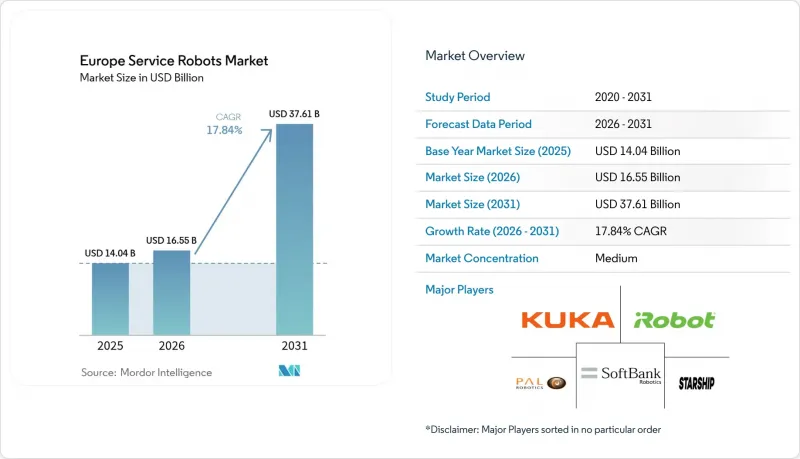
本報告按類型(個人機器人、專業機器人)、運作環境(航空航太、陸地及其他)、組件(感測器、執行器及其他)、最終用戶行業(軍事和國防、農業、建築和採礦及其他)以及國家進行細分。市場預測以美元(USD)計價。
歐洲服務機器人市場趨勢與洞察
對自主移動機器人(AMR)的需求源自於物流和食品履約產業的人手不足迅速加劇。
電子商務交易量持續超過倉庫可用勞動力,迫使第三方物流供應商積極採用自主移動機器人(AMR)。 DHL 預計到 2030 年,其 30% 的物料輸送設備將實現機器人化。豐田物料輸送歐洲公司也支持這一觀點,並指出全天候運作如今至關重要,而僅靠人工操作的工作流程在經濟上效率低下。德國系統整合商,例如 Movu Robotics,正在簽訂多站點契約,將存儲、揀選和托盤搬運模組整合到統一的自動化系統中,使零售商即使在季節性人手不足的情況下也能縮短訂單到出貨的周期。由於機器人租賃和機器人即服務(RaaS)等機制降低了中型企業的資產負債表風險,投資意願依然高漲。因此,歐洲服務機器人市場的自主機器人應用基礎設施結構穩固。
歐盟的「從農場到餐桌」補貼計畫正在加速農業機器人的普及。
歐盟委員會斥資3,000萬歐元(約3,290萬美元)的「農業食品技術體驗框架」(AgrifoodTEF)計劃,提供測試平台和諮詢服務,旨在加速農業機器人的認證,並將該計劃轉化為西班牙、法國和荷蘭農場的具體資本項目。根據一位西班牙葡萄園主介紹,電動履帶式除草機器人的能耗為1.42千瓦時/小時,與燃油曳引機相比,展現出經濟可行性。德國機器人協會指出,如果輕型田間機器人取代曳引機,土壤壓實和排放將顯著減少,為監管機構和投資者帶來可觀的環境效益。補貼政策持續到2027年,正在加速訂單成長,提振製造商的累積訂單前景,並推動歐洲服務機器人市場更重視戶外應用。
由於安全標準不一致,導致多國部署延誤。
從“機械指令”過渡到新的“機械法規”,以及同時推出的“人工智慧法”,造成了複雜的認證壁壘。製造商被迫進行重複的合格評定,導致研發週期延長,合規成本增加。即將修訂的ISO 13482標準進一步加劇了不確定性。此外,TUV認證的瓶頸也延緩了中小企業的產品上市時間。儘管歐盟計畫在2025年建立歐盟級服務台,但在此之前的不確定性抑制了擴大泛歐機器人規模的意願,減緩了原本應該強勁成長的歐洲服務機器人市場的發展勢頭。
細分市場分析
預計到2025年,商用機器人將佔歐洲服務機器人市場銷售額的62.35%,鞏固其作為該市場經濟支柱的地位。商用機器人主要應用於物流、醫療保健和農業領域,這些領域的投資回報迅速,因為人事費用降低和正常運作延長帶來了可量化的成本節約。隨著第三方物流公司和連鎖醫院的擴充計劃,歐洲服務機器人市場中商用平台的市場規模預計將持續成長。機器人即服務(RaaS)合約的出現也為此提供了支持,該合約將支出從資本支出(CapEx)轉移到了營運支出(OpEx)。庫卡以軟體為中心的策略表明,現有企業正在將增值分析功能整合到硬體中,這一趨勢正在增加企業客戶的轉換成本。
儘管個人機器人目前仍佔絕對佔有率的一小部分,但它們正迅速成為成長最快的細分市場,預計到2031年將以19.21%的複合年成長率成長。政府對居家養老的補貼、零件價格的下降以及雲端連接的改善,為行動助理處理日常瑣事和社交互動創造了有利的經濟環境。北歐國家的試驗計畫數據顯示,引入護理機器人可以在不影響患者療效的前提下,減少12%的看護者上門服務,從而減輕國家醫療保健預算的負擔。隨著社會接受度研究的深入,預計歐洲服務機器人市場的需求曲線將反映智慧型手機的普及週期,而非工業自動化的發展速度。
預計到2025年,地面機器人將佔銷售額的70.25%,反映出法規環境的成熟以及在結構化室內環境中已證實的投資回報率(ROI)。倉庫、醫院和飯店提供可控環境,在這些環境中,自主移動機器人(AMR)可以最大限度地降低風險,利用即時定位與地圖建構(SLAM)導航,並確保處理能力的可預測性提升。隨著零售商將現有設施(棕地)改造為自動化微型倉配中心,歐洲地面服務機器人市場規模持續擴大。
同時,受基礎設施巡檢和精密農業等應用場景的推動,空中平台正以20.97%的複合年成長率成長。超視距(BVLOS)飛行技術的放寬管制以及5G獨立組網的部署,確保了無人機在電力線、管道和農田上空進行例行巡檢所需的頻寬和監管透明度。一家德國公共產業估計,基於無人機的巡檢將減少15%的停電罰款,從總擁有成本(TCO)的角度來看,這是一個非常有說服力的例子。隨著基於風險的服務機器人評估(SORA)框架在成員國之間逐步統一,預計空中領域的業務量將在歐洲服務機器人市場佔據越來越大的佔有率。
其他福利
- Excel格式的市場預測(ME)表
- 3個月的分析師支持
目錄
第1章:引言
- 研究假設和市場定義
- 調查範圍
第2章:調查方法
第3章執行摘要
第4章 市場狀況
- 市場概覽
- 市場促進因素
- 對自主移動機器人(AMR)的需求源自於物流和食品履約產業的人手不足迅速加劇。
- 歐盟的「從農場到餐桌」補貼計畫正在加速農業機器人的普及。
- 透過醫院感染控制規程推廣UV-C消毒機器人的廣泛應用。
- 透過旨在為居家養老的老年人提供便利的政策,促進陪伴機器人在老年護理中的廣泛應用。
- 一家新創公司正在利用低成本的空間人工智慧晶片開發微型移動配送機器人。
- 計量收費的RaaS模式,方便中小企業使用。
- 市場限制因素
- 由於安全標準不一致,導致多國部署延誤。
- 歷史城區民眾對自動駕駛系統抱持深切懷疑態度。
- 認證服務機器人技術人員短缺
- 鋰離子電池供應波動導致零件成本上漲
- 價值供應鏈分析
- 監理情勢
- 技術展望
- 波特五力模型
第5章 市場規模與成長預測
- 按類型
- 個人機器人
- 家用
- 研究/教育
- 娛樂
- 專業機器人
- 領域(農業、林業)
- 國防與安全
- 醫療保健
- 用於物流/倉儲的自主移動機器人
- 其他
- 個人機器人
- 透過運作環境
- 航空(無人機/無人飛行器)
- 地面/陸地
- 海洋/水下
- 按組件
- 感應器
- 執行器
- 控制系統和邊緣人工智慧
- 軟體(導航、視覺、車隊管理)
- 電源系統(電池、燃料電池)
- 按最終用戶行業分類
- 軍事/國防
- 農業、建築業和採礦業
- 運輸/物流
- 醫療保健和生命科學
- 政府和地方政府服務
- 飯店和零售業
- 其他
- 國家
- 英國
- 德國
- 法國
- 義大利
- 西班牙
- 荷蘭
- 瑞典
- 丹麥
- 芬蘭
- 挪威
- 其他歐洲國家
第6章 競爭情勢
- 市場集中度
- 策略趨勢
- 市佔率分析
- 公司簡介
- KUKA AG
- iRobot Corporation
- SoftBank Robotics Group
- PAL Robotics
- Starship Technologies
- Amazon Robotics
- Northrop Grumman Corporation
- DJI
- Parrot SA
- Blue Ocean Robotics
- Boston Dynamics
- ANYbotics
- Lely Holding
- SeaRobotics Corporation
- GeckoSystems Corporation
- RedZone Robotics
- Dyson Ltd.
- Robotnik Automation
- Husqvarna Group
- Robobuilder Co. Ltd.
第7章 市場機會與未來展望
According to Mordor Intelligence, the Europe service robots market size is expected to grow from USD 14.04 billion in 2025 to USD 16.55 billion in 2026 and is forecast to reach USD 37.61 billion by 2031 at 17.84% CAGR over 2026-2031.
This report is Segmented by Type (Personal Robots, Professional Robots), Operating Environment (Aerial, Land, and More), Components (Sensors, Actuators, and More), End-User Industry (Military and Defense, Agriculture, Construction and Mining, and More), and by Country. The Market Forecasts are Provided in Terms of Value (USD).
Europe Service Robots Market Trends and Insights
Rapid Labour-Shortage-Driven Demand for AMRs in Logistics & Grocery Fulfilment
E-commerce volumes continue to outpace available warehouse labor, pushing third-party logistics providers toward aggressive adoption of autonomous mobile robots. DHL expects 30% of its material-handling assets to be robotic by 2030, a position echoed by Toyota Material Handling Europe, which confirms that 24/7 uptime imperatives are no longer negotiable and human-only workflows are uneconomical. German integrators such as Movu Robotics are securing multi-site contracts that bundle storage, picking, and pallet transport modules into unified automation stacks, allowing retailers to compress order-to-ship cycles even during seasonal labor crunches. Investment appetite remains strong as robotics leasing and robots-as-a-service arrangements lower balance-sheet risk for mid-sized operators. The result is a structurally higher baseline for autonomous deployments in the Europe service robots market.
EU "Farm to Fork" Subsidies Accelerating Agri-Robot Adoption
The European Commission's EUR 30 million (USD 32.9 million) AgrifoodTEF program offers test beds and advisory services that speed certification for agricultural robots, translating policy into tangible capital projects on Spanish, French, and Dutch farms. Vineyard operators in Spain report energy use of 1.42 kWh/h for electric tracked weed-removal robots, proving economic viability against fuel-powered tractors. Germany's robotics association notes measurable drops in soil compaction and emissions when lightweight field robots replace tractors, creating an environmental co-benefit that appeals to regulators and investors alike. Subsidy certainty through 2027 has pulled orders forward, lifting visibility in manufacturer order books and reinforcing the Europe service robots market's pivot toward outdoor applications.
Fragmented Safety Standards Delaying Multi-Country Roll-Outs
The transition from the Machinery Directive to the new Machinery Regulation and the simultaneous introduction of the AI Act create a patchwork of certification hurdles. Manufacturers must perform redundant conformity assessments that lengthen development cycles and increase compliance costs. ISO 13482's pending revision adds another moving target, while TUV-certification bottlenecks slow time-to-market for SMEs. An EU-level Service Desk is planned for 2025, yet the interim uncertainty curbs the scale-up ambitions of pan-European fleets, tempering the otherwise strong trajectory of the Europe service robots market
Other drivers and restraints analyzed in the detailed report include:
- Hospital Infection-Control Protocols Boosting UV-C Disinfection Robots
- Ageing-in-Place Policies Spurring Elder-Care Companion Robots
- Persistent Public Scepticism Over Autonomous Systems in Heritage City Centres
For complete list of drivers and restraints, kindly check the Table Of Contents.
Segment Analysis
Professional robots generated 62.35% of 2025 revenue, confirming their status as the economic backbone of the Europe service robots market. Uptake is concentrated in logistics, healthcare, and agriculture, where quantifiable savings on labor and uptime deliver rapid payback. The Europe service robots market size for professional platforms is forecast to expand in sync with fleet expansion programs at 3PLs and hospital chains, supported by robots-as-a-service contracts that shift spending from CapEx to OpEx. Software-centric moves by KUKA underline how incumbents are wrapping value-added analytics around hardware, a trend that reinforces switching costs for enterprise clients.
Personal robots remain a minority in absolute dollars yet emerge as the fastest-growing slice at 19.21% CAGR through 2031. Aging-in-place subsidies, falling component prices, and cloud connectivity create favorable economics for mobile assistants that handle routine chores and social interaction. Pilot data from Nordic programs confirm that care-robot usage cuts caregiver visits by 12% without compromising patient outcomes, offering fiscal relief for national health budgets. As social-acceptance studies progress, the Europe service robots market will likely witness a demand curve that mirrors the smartphone diffusion cycle rather than industrial automation pacing.
Ground robots captured 70.25% of 2025 sales, reflecting regulatory maturity and proven ROI in structured indoor settings. Warehouses, hospitals, and hotels provide controlled environments where AMRs can leverage SLAM navigation with limited risk, ensuring predictable throughput gains. The Europe service robots market size associated with ground deployments continues to grow as retailers convert brownfield sites into automated micro-fulfilment hubs.
Aerial platforms, however, post a 20.97% CAGR on the back of infrastructure inspection and precision-agriculture use cases. BVLOS exemptions and the rollout of 5G standalone networks furnish the bandwidth and regulatory clarity needed for routine unmanned flights over power lines, pipelines, and crop fields. German utilities estimate that drone-based inspections cut outage-related penalties by 15%, creating a compelling TCO narrative. As risk-based SORA frameworks harmonize across member states, aerial volumes are expected to carve out an increasingly material share of the Europe service robots market.
Complete Report Scope:
- By Type
- Personal Robots
- Domestic
- Research & Education
- Entertainment
- Professional Robots
- Field (Agriculture, Forestry)
- Defense and Security
- Medical and Healthcare
- Logistics and Warehouse AMRs
- Others
- Personal Robots
- By Operating Environment
- Aerial (UAV/Drone)
- Ground / Land
- Marine and Underwater
- By Component
- Sensors
- Actuators
- Control Systems and Edge AI
- Software (Navigation, Vision, Fleet-Mgmt)
- Power Systems (Batteries, Fuel-cells)
- By End-User Industry
- Military and Defense
- Agriculture, Construction & Mining
- Transportation and Logistics
- Healthcare and Life-Sciences
- Government and Municipal Services
- Hospitality and Retail
- Others
- By Country
- United Kingdom
- Germany
- France
- Italy
- Spain
- Netherlands
- Sweden
- Denmark
- Finland
- Norway
- Rest of Europe
List of Companies Covered in this Report:
- KUKA AG
- iRobot Corporation
- SoftBank Robotics Group
- PAL Robotics
- Starship Technologies
- Amazon Robotics
- Northrop Grumman Corporation
- DJI
- Parrot SA
- Blue Ocean Robotics
- Boston Dynamics
- ANYbotics
- Lely Holding
- SeaRobotics Corporation
- GeckoSystems Corporation
- RedZone Robotics
- Dyson Ltd.
- Robotnik Automation
- Husqvarna Group
- Robobuilder Co. Ltd.
Additional Benefits:
- The market estimate (ME) sheet in Excel format
- 3 months of analyst support
TABLE OF CONTENTS
1 INTRODUCTION
- 1.1 Study Assumptions and Market Definition
- 1.2 Scope of the Study
2 RESEARCH METHODOLOGY
3 EXECUTIVE SUMMARY
4 MARKET LANDSCAPE
- 4.1 Market Overview
- 4.2 Market Drivers
- 4.2.1 Rapid labour-shortage-driven demand for AMRs in logistics & grocery fulfilment
- 4.2.2 EU Farm to Fork subsidies accelerating agri-robot adoption
- 4.2.3 Hospital infection-control protocols boosting UV-C disinfection robots
- 4.2.4 Ageing-in-place policies spurring elder-care companion robots
- 4.2.5 Start-ups exploiting low-cost spatial-AI chips for micro-mobility delivery bots
- 4.2.6 Pay-per-use RaaS models unlocking SME affordability
- 4.3 Market Restraints
- 4.3.1 Fragmented safety standards delaying multi-country roll-outs
- 4.3.2 Persistent public scepticism over autonomous systems in heritage city centres
- 4.3.3 Shortage of certified service-robot technicians
- 4.3.4 Lithium-ion supply volatility inflating BoM costs
- 4.4 Value / Supply-Chain Analysis
- 4.5 Regulatory Landscape
- 4.6 Technological Outlook
- 4.7 Porters Five Forces
- 4.7.1 Threat of New Entrants
- 4.7.2 Bargaining Power of Buyers
- 4.7.3 Bargaining Power of Suppliers
- 4.7.4 Threat of Substitutes
- 4.7.5 Intensity of Rivalry
5 MARKET SIZE AND GROWTH FORECASTS (VALUE)
- 5.1 By Type
- 5.1.1 Personal Robots
- 5.1.1.1 Domestic
- 5.1.1.2 Research & Education
- 5.1.1.3 Entertainment
- 5.1.2 Professional Robots
- 5.1.2.1 Field (Agriculture, Forestry)
- 5.1.2.2 Defense and Security
- 5.1.2.3 Medical and Healthcare
- 5.1.2.4 Logistics and Warehouse AMRs
- 5.1.2.5 Others
- 5.1.1 Personal Robots
- 5.2 By Operating Environment
- 5.2.1 Aerial (UAV/Drone)
- 5.2.2 Ground / Land
- 5.2.3 Marine and Underwater
- 5.3 By Component
- 5.3.1 Sensors
- 5.3.2 Actuators
- 5.3.3 Control Systems and Edge AI
- 5.3.4 Software (Navigation, Vision, Fleet-Mgmt)
- 5.3.5 Power Systems (Batteries, Fuel-cells)
- 5.4 By End-User Industry
- 5.4.1 Military and Defense
- 5.4.2 Agriculture, Construction & Mining
- 5.4.3 Transportation and Logistics
- 5.4.4 Healthcare and Life-Sciences
- 5.4.5 Government and Municipal Services
- 5.4.6 Hospitality and Retail
- 5.4.7 Others
- 5.5 By Country
- 5.5.1 United Kingdom
- 5.5.2 Germany
- 5.5.3 France
- 5.5.4 Italy
- 5.5.5 Spain
- 5.5.6 Netherlands
- 5.5.7 Sweden
- 5.5.8 Denmark
- 5.5.9 Finland
- 5.5.10 Norway
- 5.5.11 Rest of Europe
6 COMPETITIVE LANDSCAPE
- 6.1 Market Concentration
- 6.2 Strategic Moves
- 6.3 Market Share Analysis
- 6.4 Company Profiles (includes Global-level Overview, Market-level Overview, Core Segments, Financials, Strategic Information, Market Rank/Share, Products & Services, Recent Developments)
- 6.4.1 KUKA AG
- 6.4.2 iRobot Corporation
- 6.4.3 SoftBank Robotics Group
- 6.4.4 PAL Robotics
- 6.4.5 Starship Technologies
- 6.4.6 Amazon Robotics
- 6.4.7 Northrop Grumman Corporation
- 6.4.8 DJI
- 6.4.9 Parrot SA
- 6.4.10 Blue Ocean Robotics
- 6.4.11 Boston Dynamics
- 6.4.12 ANYbotics
- 6.4.13 Lely Holding
- 6.4.14 SeaRobotics Corporation
- 6.4.15 GeckoSystems Corporation
- 6.4.16 RedZone Robotics
- 6.4.17 Dyson Ltd.
- 6.4.18 Robotnik Automation
- 6.4.19 Husqvarna Group
- 6.4.20 Robobuilder Co. Ltd.
7 MARKET OPPORTUNITIES AND FUTURE OUTLOOK
- 7.1 White-space and Unmet-Need Assessment

 分子機器人市場:依產品類型、應用、組件、最終用戶、國家及地區分類-全球產業分析、市場規模、市場佔有率及2026年至2033年預測
 揀選包裝機器人市場規模、佔有率和成長分析:按機器人類型、負載能力、應用、最終用戶、自動化程度和地區分類-2026-2033年產業預測
 機器人驅動裝置市場 - 全球市場預測(2026-2032)
 亞太地區服務機器人:市場佔有率分析、產業趨勢與統計及成長預測(2026-2031)北美服務機器人:市佔率分析、產業趨勢與統計及成長預測(2026-2031 年)
 全球取放機器人市場規模、佔有率、趨勢和成長分析報告(2026-2034)
 服務機器人市場預測至2034年:按組件、類型、應用、最終用戶和地區分類的全球分析
 2026-2030年全球開放式計算專案(OCP)機架市場鑄造鍛造機器人市場:按類型、組件、機器人類型、應用和最終用戶產業分類-2026-2032年全球市場預測
 2026年全球商業服務管理市場報告