


 |
市場調查報告書
商品編碼
2121526
歐洲建築資訊模型(BIM):市場佔有率分析、產業趨勢與統計、成長預測(2026-2031)Europe Building Information Modeling - Market Share Analysis, Industry Trends & Statistics, Growth Forecasts (2026 - 2031) |
||||||

※ 本網頁內容可能與最新版本有所差異。詳細情況請與我們聯繫。
據 Mordor Intelligence 稱,2025 年歐洲建築資訊模型 (BIM) 市場價值為 31.7 億美元,預計到 2031 年將從 2026 年的 35.7 億美元成長至 65.1 億美元,預測期(2026-2031 年)的複合年成長率為 12.74%。
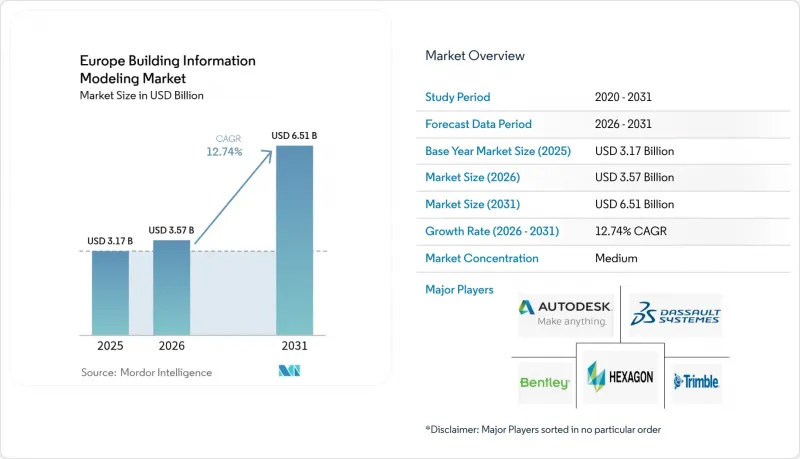
本報告按解決方案類型(軟體、服務)、部署方式(本地部署、雲端部署)、應用領域(商業、住宅、工業、基礎設施)、最終用戶(建築師/設計師、總承包商、專業承包商、設施所有者/營運商)和地區(英國、德國、法國等)進行細分。市場預測以美元計價。
歐洲BIM(建築資訊模型)市場的趨勢與洞察
政府強制推行BIM部署正在推動採購流程的變革。
歐盟公共採購指令強制要求公共部門業主交付符合BIM標準的成果,這改變了競標要求,並促進了所有27個成員國之間協調一致的數位化工作流程。英國自2016年起實施了二級強制BIM,德國自2020年起在其聯邦交通計畫中強制推行BIM。義大利的分階段政策將於2025年全面涵蓋超過100萬歐元的項目,並設定了明確的期限,以加快軟體採購、人員認證和流程重組。這些法規消除了軟體和服務供應商的准入壁壘,同時懲罰了拖延技能發展的承包商,從而有效地引導整個價值鏈在中期內實現數位成熟。
用於加速數位化進程的資金正在重新評估投資重點。
根據復甦與韌性基金(RRF),每個成員國必須將至少20%的撥款用於數位轉型,這使得建築業的數位化成為一項合格的支出。南歐和東歐獲得的撥款比例異常高,這為那些先前缺乏資源從2D工作流程轉型到數位工作流程的公司開闢了資金籌措管道。隨著獎勵策略將於2026年到期,許多公共工程承包商正在進行多年期BIM競標,並加快了初始投資,從而縮短了部署週期。即使刺激性資金逐步縮減,專案儲備也趨於正常化,能夠將雲端託管、用戶培訓和合規性審計整合到承包工程中的供應商仍然能夠滿足這一激增的需求。
高昂的部署成本阻礙了中小企業採用該技術。
一套完整的BIM套件每年每位用戶的成本可能超過1萬歐元,承包商還必須承擔工作站升級和數週培訓課程的費用,才能獲得必要的技能。這些支出仍然阻礙著佔歐洲供應鏈大多數的小規模專業公司參與。雖然有補貼,但複雜的申請流程和共同融資要求往往將小規模企業拒之門外。隨著大型承包商將對BIM交付物的需求向下傳遞到分包商層級,缺乏數位化能力的中小型企業面臨著被排除在盈利的專案之外的風險,這可能會在短期內減緩市場滲透的均勻性。
細分市場分析
到2025年,軟體解決方案將佔據歐洲BIM市場76.25%的佔有率,鞏固其在設計公司和建築商總部的基礎地位。然而,服務領域的成長速度正以13.05%的複合年成長率持續攀升,超過了授權應用軟體的成長速度,因為客戶和建築商都在尋求能夠將監管要求轉化為BIM實施計劃的專家合作夥伴。隨著合規性審計、變更管理和CDE管理變得日益必要,歐洲BIM市場的實施和諮詢服務規模預計將會擴大。年度訂閱中包含的嵌入式服務包正在模糊傳統的界限,促使供應商不僅扮演軟體供應商的角色,也扮演策略顧問的角色。
隨著專案日益複雜,跨境合作日益頻繁,對聯邦模型協調、干擾解決和資料管治等方面的文件需求也日益成長。服務公司正在提供ISO 19650認證、網路安全和生命週期資料移交的重要指導。隨著公共部門客戶將碳排放追蹤納入競標,精通環境數據整合的顧問公司正在從競爭對手中脫穎而出。因此,隨著供應商尋求下游收入,併購(例如Nemeček以32.77億美元收購服務型公司)預計將會持續進行。
2025年,本地部署將佔歐洲BIM市場57.45%的佔有率,尤其受到德國資料主權法規約束的企業青睞。然而,受疫情期間遠端協作催生的新型工作方式的推動,雲端環境預計將以13.30%的複合年成長率成長。靈活的訂閱計劃能夠最大限度地降低資本支出(CAPEX)並支援自動續訂,因此吸引了先前依賴入門級繪圖工具的小規模分包商。
諸如IFC 4.3和BCF 3.0等互通性框架正在促進資料交換,並降低對外部部署資料儲存的抵觸情緒。斯堪的納維亞半島和荷蘭的公共工程承包商已經強制要求使用基於雲端的通用資料環境(CDE),這正在加速部署。混合配置也日益受到關注,在這種配置中,敏感資料安全地儲存在本地伺服器上,而不太關鍵的任務則卸載到雲端進行分析。這種模式兼顧了合規性和生產力,為分散式供應鏈的普遍互聯鋪平了道路。
其他好處:
- Excel格式的市場預測(ME)表
- 3個月的分析師支持
目錄
第1章:引言
- 市場分析與定義的前提條件
- 分析範圍
第2章 分析方法
第3章執行摘要
第4章 市場狀況
- 市場概覽
- 市場促進因素
- 政府強制採用BIM(歐盟公共採購指令)
- 透過歐盟復甦與韌性基金提供資金,以促進數位轉型。
- 遷移到基於雲端的協作設計平台
- 歐盟綠色新政將BIM與生命週期碳排放報告連結起來
- 異地模組化建造的擴展需要利用 BIM 進行 DfMA(面向製造的設計)。
- 透過人工智慧驅動的衍生設計提高專案效率
- 市場限制因素
- 軟體和培訓的初始成本很高。
- 中小型承包商長期缺乏技能人才
- 歐洲各國BIM成熟度架構存在不一致
- 互通性標準差異以及對資料所有權的擔憂
- 產業生態系統分析
- 宏觀經濟因素的影響
- 技術展望
- 波特五力分析
第5章 市場規模與成長預測
- 按溶液類型
- 軟體
- 服務
- 透過部署方法
- 現場
- 雲
- 透過使用
- 商業的
- 住宅
- 產業
- 基礎設施
- 最終用戶
- 建築師和設計師
- 總承包商
- 專業承包商
- 設施所有者和運營商
- 國家
- 英國
- 德國
- 法國
- 義大利
- 西班牙
- 荷蘭
- 北歐國家(丹麥、瑞典、挪威、芬蘭)
- 其他歐洲國家
第6章 競爭情勢
- 市場集中度
- 策略趨勢
- 市佔率分析
- 公司簡介
- Autodesk, Inc.
- Bentley Systems, Incorporated
- Dassault Systemes SE
- Hexagon AB
- Trimble Inc.
- AVEVA Group plc
- Nemetschek SE
- Graphisoft SE
- Allplan GmbH
- RIB Software GmbH
- Topcon Corporation
- Asite Solutions Limited
- Dalux A/S
- PlanRadar GmbH
- Vectorworks, Inc.
- ACCA software SpA
- Catenda AS
- Procore Technologies, Inc.
- Buildots Ltd.
- Bimeye AB
第7章 市場機會與未來展望
According to Mordor Intelligence, the Europe building information modeling market size was valued at USD 3.17 billion in 2025 and estimated to grow from USD 3.57 billion in 2026 to reach USD 6.51 billion by 2031, at a CAGR of 12.74% during the forecast period (2026-2031).
This report is Segmented by Solution Type (Software, and Services), Deployment Type (On-Premise, and Cloud), Application (Commercial, Residential, Industrial, and Infrastructure), End-User (Architects and Designers, General Contractors, Specialty Sub-Contractors, and Facility Owners and Operators), and Geography (United Kingdom, Germany, France, and More). The Market Forecasts are Provided in Terms of Value (USD).
Europe Building Information Modeling Market Trends and Insights
Government-mandated BIM adoption drives procurement transformation
EU Public Procurement Directives oblige public sector owners to demand BIM-compliant deliverables, transforming tender requirements across 27 member states and promoting coordinated digital workflows. The United Kingdom has enforced a Level 2 mandate since 2016, while Germany requires BIM for federal transport schemes from 2020. Italy's phased policy reaches full coverage for projects above EUR 1 million by 2025, creating firm deadlines that accelerate software purchases, staff certification, and process reengineering. These rules lift entry barriers for software and service suppliers, but they also penalize contractors that defer upskilling, effectively pushing the entire value chain toward digital maturity over the medium term.
Accelerated digitization funding reshapes investment priorities
Under the Recovery and Resilience Facility, each member state must channel at least 20% of its allocation toward digital transition, and construction digitalization qualifies as an eligible spend. Southern and Eastern Europe receive a disproportionate share, unlocking capital for firms that historically lacked resources to migrate from 2D workflows. Because stimulus spending is time-bound to 2026, many public owners are issuing front-loaded, multi-year BIM tenders, thereby compressing deployment timelines. Vendors that can bundle cloud hosting, user training, and compliance audits within turnkey packages are capturing this surge, even as the pipeline may normalize once stimulus funds taper.
High implementation costs constrain SME adoption
Comprehensive BIM suites can cost more than EUR 10,000 per seat each year, and contractors must add workstation upgrades and multi-week training programs to achieve competence. These outlays deter smaller trade firms, which still form the bulk of Europe's supply chain. Although subsidies exist, complex application procedures and co-financing requirements often sideline the smallest entities. As larger contractors push BIM deliverables down the subcontracting pyramid, SMEs without digital capacity risk being disqualified from lucrative projects, slowing homogeneous market penetration in the short term.
Other drivers and restraints analyzed in the detailed report include:
- Shift to cloud-based collaborative design platforms
- EU Green Deal integrates carbon reporting with BIM workflows
- Persistent skills gap limits implementation effectiveness
For complete list of drivers and restraints, kindly check the Table Of Contents.
Segment Analysis
Software solutions captured 76.25% of Europe BIM market share in 2025, confirming their foundational status within design offices and contractor headquarters. However, the services segment is advancing at a 13.05% CAGR, outpacing licensed applications as owners and contractors seek expert partners who can translate regulatory mandates into BIM execution plans. The Europe BIM market size for implementation and consulting services is projected to widen as compliance auditing, change management, and CDE administration become recurring necessities. Embedded service packages attached to annual subscriptions blur boundaries, encouraging vendors to act as strategic advisors as well as software providers.
Rising project complexity and cross-border collaboration elevate demand for federated model coordination, clash resolution, and data governance documentation. Services firms offer essential guidance on ISO 19650 certification, cybersecurity, and lifecycle data handover. As public owners embed carbon tracking into tenders, consultants skilled in environmental data integration are differentiating themselves. Consequently, mergers and acquisitions such as Nemetschek's USD 3.277 billion service-oriented spree are likely to continue as vendors chase downstream revenue.
On-premise deployments controlled 57.45% of the Europe BIM market size in 2025, favored by companies wary of data sovereignty rules, particularly in Germany. Yet cloud environments are forecast to expand 13.30% CAGR, riding new work routines shaped by pandemic-era remote collaboration. Flexible subscription plans minimize capex and embed automatic updates, drawing small subcontractors who previously relied on entry-level drafting tools.
Interoperability frameworks such as IFC 4.3 and BCF 3.0 ease data exchange, increasing comfort with off-premise storage. Nordic and Dutch public owners already require cloud-based CDEs, accelerating adoption curves. Hybrid topologies are gaining traction: sensitive data are ring-fenced on local servers while non-critical tasks flow to cloud analytics. This model balances compliance with productivity, clearing a pathway for universal connectivity across scattered supply chains.
Complete Report Scope:
- By Solution Type
- Software
- Services
- By Deployment Type
- On-premise
- Cloud
- By Application
- Commercial
- Residential
- Industrial
- Infrastructure
- By End-user
- Architects and Designers
- General Contractors
- Specialty Sub-contractors
- Facility Owners and Operators
- By Country
- United Kingdom
- Germany
- France
- Italy
- Spain
- Netherlands
- Nordics (Denmark, Sweden, Norway, Finland)
- Rest of Europe
List of Companies Covered in this Report:
- Autodesk, Inc.
- Bentley Systems, Incorporated
- Dassault Systemes SE
- Hexagon AB
- Trimble Inc.
- AVEVA Group plc
- Nemetschek SE
- Graphisoft SE
- Allplan GmbH
- RIB Software GmbH
- Topcon Corporation
- Asite Solutions Limited
- Dalux A/S
- PlanRadar GmbH
- Vectorworks, Inc.
- ACCA software S.p.A.
- Catenda AS
- Procore Technologies, Inc.
- Buildots Ltd.
- Bimeye AB
Additional Benefits:
- The market estimate (ME) sheet in Excel format
- 3 months of analyst support
TABLE OF CONTENTS
1 INTRODUCTION
- 1.1 Study Assumptions and Market Definition
- 1.2 Scope of the Study
2 RESEARCH METHODOLOGY
3 EXECUTIVE SUMMARY
4 MARKET LANDSCAPE
- 4.1 Market Overview
- 4.2 Market Drivers
- 4.2.1 Government-mandated BIM adoption (EU Public Procurement Directives)
- 4.2.2 Accelerated digitalisation funding via EU Recovery and Resilience Facility
- 4.2.3 Shift to cloud-based collaborative design platforms
- 4.2.4 EU Green Deal linking BIM to lifecycle-carbon reporting
- 4.2.5 Growing offsite-modular construction requiring BIM-enabled DfMA
- 4.2.6 AI-driven generative design improving project efficiency
- 4.3 Market Restraints
- 4.3.1 High upfront software and training costs
- 4.3.2 Persistent skills gap among SME contractors
- 4.3.3 Inconsistent national BIM maturity frameworks across Europe
- 4.3.4 Fragmented interoperability standards and data ownership concerns
- 4.4 Industry Ecosystem Analysis
- 4.5 Impact of Macroeconomic Factors
- 4.6 Technological Outlook
- 4.7 Porter's Five Forces Analysis
- 4.7.1 Threat of New Entrants
- 4.7.2 Bargaining Power of Buyers
- 4.7.3 Bargaining Power of Suppliers
- 4.7.4 Threat of Substitute Products
- 4.7.5 Intensity of Competitive Rivalry
5 MARKET SIZE AND GROWTH FORECASTS (VALUE)
- 5.1 By Solution Type
- 5.1.1 Software
- 5.1.2 Services
- 5.2 By Deployment Type
- 5.2.1 On-premise
- 5.2.2 Cloud
- 5.3 By Application
- 5.3.1 Commercial
- 5.3.2 Residential
- 5.3.3 Industrial
- 5.3.4 Infrastructure
- 5.4 By End-user
- 5.4.1 Architects and Designers
- 5.4.2 General Contractors
- 5.4.3 Specialty Sub-contractors
- 5.4.4 Facility Owners and Operators
- 5.5 By Country
- 5.5.1 United Kingdom
- 5.5.2 Germany
- 5.5.3 France
- 5.5.4 Italy
- 5.5.5 Spain
- 5.5.6 Netherlands
- 5.5.7 Nordics (Denmark, Sweden, Norway, Finland)
- 5.5.8 Rest of Europe
6 COMPETITIVE LANDSCAPE
- 6.1 Market Concentration
- 6.2 Strategic Moves
- 6.3 Market Share Analysis
- 6.4 Company Profiles (includes Global level Overview, Market level overview, Core Segments, Financials as available, Strategic Information, Market Rank/Share for key companies, Products and Services, and Recent Developments)
- 6.4.1 Autodesk, Inc.
- 6.4.2 Bentley Systems, Incorporated
- 6.4.3 Dassault Systemes SE
- 6.4.4 Hexagon AB
- 6.4.5 Trimble Inc.
- 6.4.6 AVEVA Group plc
- 6.4.7 Nemetschek SE
- 6.4.8 Graphisoft SE
- 6.4.9 Allplan GmbH
- 6.4.10 RIB Software GmbH
- 6.4.11 Topcon Corporation
- 6.4.12 Asite Solutions Limited
- 6.4.13 Dalux A/S
- 6.4.14 PlanRadar GmbH
- 6.4.15 Vectorworks, Inc.
- 6.4.16 ACCA software S.p.A.
- 6.4.17 Catenda AS
- 6.4.18 Procore Technologies, Inc.
- 6.4.19 Buildots Ltd.
- 6.4.20 Bimeye AB
7 MARKET OPPORTUNITIES AND FUTURE OUTLOOK
- 7.1 White-space and Unmet-need Assessment

 建築資訊模型(BIM)市場報告:趨勢、預測與競爭分析(至2035年)
 5D建築資訊模型市場-2026-2032年全球市場預測
 北美BIM市場:市場佔有率分析、產業趨勢與統計及成長預測(2026-2031年)
 2026-2030年全球建築資訊模型(BIM)軟體市場建築資訊模型(BIM)市場:組件、專案規模、等級類型、定價模式、應用、最終用戶、專案類型、部署模式 - 2026-2032年全球預測
 建築資訊模型(BIM)市場規模、佔有率和成長分析:按組件、功能、企業類型、技術、部署模式、最終用戶和地區分類-2026年至2033年產業預測
 建築資訊模型(BIM)市場規模、佔有率、趨勢和預測:按產品類型、部署類型、應用、最終用途領域、最終用戶和地區分類(2026-2034 年)
 建築資訊模型(BIM)市場:按交付類型、應用、最終用戶和地區分類
 2026年全球建築資訊模型市場報告
 建築資訊模型(BIM)市場:依組件、部署類型、專案生命週期、建築類型、應用和最終用戶劃分 - 全球預測至2036年