


 |
市場調查報告書
商品編碼
2121366
北美BIM市場:市場佔有率分析、產業趨勢與統計及成長預測(2026-2031年)North America Building Information Modelling - Market Share Analysis, Industry Trends & Statistics, Growth Forecasts (2026 - 2031) |
||||||

※ 本網頁內容可能與最新版本有所差異。詳細情況請與我們聯繫。
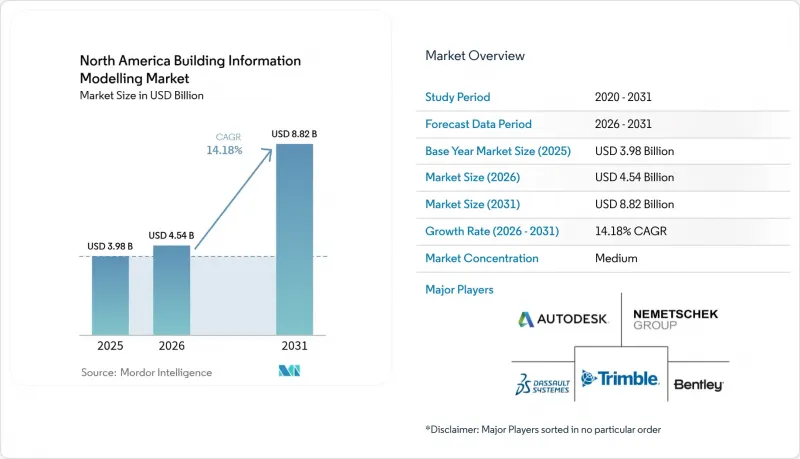
據 Mordor Intelligence 稱,2025 年北美 BIM 市值為 39.8 億美元,預計到 2031 年將達到 88.2 億美元,高於 2026 年的 45.4 億美元。
預測期(2026-2031 年)的複合年成長率預計為 14.18%。
本報告按組件(軟體和服務)、部署模式(本地部署和雲端部署)、應用領域(商業、住宅、工業和基礎設施)、專案生命週期階段(施工前/設計、施工和營運/維護)以及國家/地區(美國、加拿大和墨西哥)進行細分。市場預測以美元計價。
北美BIM市場趨勢與洞察
利用生成式人工智慧進行設計最佳化,可加速工作流程自動化。
整合到主流BIM工具中的生成式人工智慧功能可自動迭代結構和能源模型,從而將專案工期縮短高達30%。 Autodesk Forma和Graphisoft Archicad 28皆具備人工智慧驅動的文件功能,可加快建築規範的合規性,這一優勢深受85%尋求提升自身競爭力的墨西哥企業的青睞。機器學習技術現在可以分析歷史專案資料,從而推薦能夠提高能源強度的材料選擇。供應商正在採用雲端推理引擎,即使在小型筆記型電腦上也能實現強大的運算能力。早期採用者報告稱,由於在概念階段就進行了乾涉檢測,施工期間的資訊請求(RFI)數量有所減少。然而,企業需要預留額外的培訓時間才能充分利用這些優勢。
政府對BIM的強制性規定正在加速合規主導的BIM應用。
美國總務管理局 (GSA) 強制要求所有大型公共建築專案提交基於模型的方案,迫使承包商實施完整的 BIM 工作流程。加拿大的合作採購框架為超過 500 萬加元的專案設定了 BIM 交付物提交標準。雖然一些省份和地方政府提供諸如對已記錄的 BIM 實施計劃進行稅收抵免等補充措施,但由於各地區法規不一致,仍需進一步調整。在兩國均符合 ISO 19650 標準將有助於提高文件品質並加快許可核准速度。未能滿足不斷變化的要求的承包商可能面臨被排除在公共資助項目之外的風險,從而導致對合規性審計和模型檢驗服務的需求增加。
高昂的初始培訓成本和文化轉型相關的費用限制了中小企業的採用。
BIM工作站的成本可能高達1萬美元,而高階使用者培訓的費用可能超過每位員工5,000美元。小規模建築商往往無法負擔這些費用,導致這項技術在頂級建築商之外的普及速度緩慢。此外,由於每個專業都依賴熟悉的2D圖紙,因此對新工作流程的抗拒情緒仍然存在。當多個相關人員編輯共用模型時,就會出現與專業責任責任險相關的複雜問題,需要進行法律審查,從而導致耗時且耗力的流程。雖然政府津貼可以抵消部分成本,但許多中小企業仍然優先考慮短期現金流,而不是數位投資。
細分市場分析
到2025年,軟體將佔據北美BIM市場81.65%的佔有率,並已成為數位化施工工作流程的基礎。持續的功能升級,例如人工智慧驅動的干涉檢測,正在推動許可證續訂並維持訂閱的持續性。然而,由於實施的複雜性,企業傾向於將部署、整合和培訓外包,導致服務業的複合年成長率(CAGR)達到14.72%,超過了軟體產業。諮詢工作涵蓋從專案特定建模到製定公司級數位化藍圖的範圍,這表明僅靠技術本身無法提供完整的價值。
對客製化培訓計畫的需求凸顯了技能差距,而這些差距正在限制企業內部的能力。認證課程提供有關 ISO 19650 合規性、資料交換協議和通用資料環境 (CDE)管治的指導。隨著業主在本地部署和雲端解決方案之間遷移,維護合約也在不斷擴大,這需要獨立於供應商的專業知識來維護資料完整性。因此,授權仍然是北美 BIM 市場的基礎,而業務收益預計到 2031 年將縮小與軟體收入之間的差距。
即使到了2025年,主要建築承包商既定的IT政策仍然意味著本地部署系統在北美BIM市場中仍佔63.15%的佔有率。這種環境允許對高度敏感的知識產權進行直接管理,並與現有文件伺服器無縫整合。然而,在遠端協作需求不斷成長以及訂閱定價模式降低准入門檻的推動下,雲端平台正以15.32%的複合年成長率快速擴張。一種混合模式——即企業保留本地資料存儲,同時利用雲端引擎進行渲染和調整——正日益普及。
雲端供應商正著重強調零信任安全和區域資料中心,以解決業主方面的顧慮。即時模型協作使架構師、工程師和施工人員能夠共同創建文件,從而減少設計迭代次數,並最大限度地降低下游流程中的錯誤。柔軟性的支付方式對那些更注重營運成本而非資本投資的中小型企業來說極具吸引力。未來,維修成本實體伺服器及其管理人員的成本預計將推動企業進一步遷移到完全託管的環境。
其他好處:
- Excel格式的市場預測(ME)表
- 3個月的分析師支持
目錄
第1章:引言
- 研究假設和市場定義
- 調查範圍
第2章:調查方法
第3章執行摘要
第4章 市場狀況
- 市場概覽
- 市場促進因素
- 利用生成式人工智慧進行設計最佳化
- 美國和加拿大政府對BIM的強制規定和激勵措施
- 對旨在實現現有建築脫碳的維修需求日益成長。
- 雲端原生協作正在推動中小企業採用這項技術。
- 基於BIM的風險模型的保險費折扣
- 智慧城市與數位孿生投資的整合
- 市場限制因素
- 培訓和文化轉型的初期階段會產生大量費用。
- 美國各州建築規範存在差異
- 圍繞雲端BIM儲存庫的網路安全問題
- 多方相關利益者模式下的智慧財產權所有權糾紛
- 產業價值鏈分析
- 監理情勢
- 技術展望
- 波特五力分析
- 宏觀經濟因素的影響
第5章 市場規模與成長預測
- 按組件
- 軟體
- 設計創作
- 模型審查與調整
- 仿真與分析
- 專案管理
- 服務
- 諮詢
- 實施與整合
- 培訓和認證
- 支援與維護
- 軟體
- 部署模式
- 現場
- 雲
- 透過使用
- 商業的
- 辦公室
- 零售
- 衛生保健
- 教育
- 住宅
- 獨戶房屋住宅
- 多用戶住宅
- 產業
- 製造業
- 能源公用事業
- 基礎設施
- 運輸
- 公共安全和政府設施
- 商業的
- 專案生命週期階段
- 施工前/設計
- 建造
- 運作/維護
- 國家
- 美國
- 加拿大
- 墨西哥
第6章 競爭情勢
- 市場集中度
- 策略趨勢
- 市佔率分析
- 公司簡介
- Autodesk Inc.
- Bentley Systems Incorporated
- Trimble Inc.
- Nemetschek SE
- Dassault Systemes SE
- Hexagon AB
- Topcon Positioning Systems Inc.
- RIB Software GmbH
- Asite Solutions Ltd
- AVEVA Group plc
- Clearedge3D Inc.
- Bimeye AB
- Procore Technologies Inc.
- GRAPHISOFT SE
- Bluebeam Inc.
- Vectorworks Inc.
- Allplan GmbH
- GRAITEC Innovation SAS
- Tekla Corporation
- Innovaya LLC
- Beck Technology Ltd.
- Trimble Viewpoint Inc.
第7章 市場機會與未來展望
According to Mordor Intelligence, the North America building information modelling market size was valued at USD 3.98 billion in 2025 and estimated to grow from USD 4.54 billion in 2026 to reach USD 8.82 billion by 2031, at a CAGR of 14.18% during the forecast period (2026-2031).
This report is Segmented by Component (Software and Services), Deployment Mode (On-Premise and Cloud), Application (Commercial, Residential, Industrial, and Infrastructure), Project Lifecycle Phase (Pre-Construction/Design, Construction, and Operation and Maintenance), and Country (United States, Canada, and Mexico). The Market Forecasts are Provided in Terms of Value (USD).
North America Building Information Modelling Market Trends and Insights
Generative AI-Powered Design Optimization Accelerates Workflow Automation
Generative AI features embedded in leading BIM tools automatically iterate structural and energy models, cutting project delivery time by up to 30%. Autodesk Forma and Graphisoft Archicad 28 include AI-driven documentation that speeds code checks, a benefit appreciated by 85% of Mexican firms pursuing competitiveness. Machine learning now scans historic project data to recommend material choices that improve energy intensity. Vendors employ cloud inference engines so even small laptops can harness advanced computation. Early adopters report fewer RFIs during construction because clash detection is executed at the concept stage, although firms must budget additional training hours to realize these gains.
Government BIM Mandates Create Compliance-Driven Adoption
The U.S. General Services Administration requires model-based submissions for all major public builds, pushing contractors toward full BIM workflows. Canada's federal Collaborative Procurement framework sets BIM deliverable thresholds for projects above CAD 5 million. Several states and provinces supplement these rules with tax rebates on documented BIM execution plans, although inconsistent local codes still impose re-work. ISO 19650 alignment in both countries raises documentation quality and accelerates permit reviews. Contractors that cannot meet evolving mandates face exclusion from publicly financed opportunities, driving service demand for compliance audits and model validation.
High Upfront Training and Cultural Change Costs Constrain SME Adoption
A BIM workstation can cost USD 10,000, while advanced user training surpasses USD 5,000 per employee. Smaller contractors often lack reserves for such outlays, slowing technology penetration beyond tier-one builders. Resistance to new workflows also persists because trades rely on familiar 2D drawings. Professional indemnity complexities arise when multiple parties edit a shared model, prompting legal reviews that add time and expense. Public grants partially offset costs, but many SMEs still prioritize near-term cash flow over digital investment.
Other drivers and restraints analyzed in the detailed report include:
- Rising Retrofit Demand Drives Decarbonization-Focused Applications
- Cloud-Native Collaboration Democratizes SME Access
- Fragmented Building Codes Across United States Create Implementation Complexity
For complete list of drivers and restraints, kindly check the Table Of Contents.
Segment Analysis
Software retained 81.65% of the North America Building Information Modelling market share in 2025 and has historically underpinned digital construction workflows. Continuous upgrades, such as AI-driven clash detection, sustain license renewals and support subscriptions. However, services are outstripping software with a 14.72% CAGR because implementation complexity drives organizations to outsource deployment, integration, and training. Consulting engagements range from project-specific modeling to enterprise-wide digital roadmaps, highlighting that technology alone cannot deliver full value.
Demand for tailored education programs illustrates the skills gap that limits internal execution capacity. Certification courses teach ISO 19650 compliance, data exchange protocols, and common data environment governance. Maintenance contracts also expand as owners migrate between on-premise and cloud solutions, requiring vendor-agnostic expertise to preserve data integrity. Consequently, services revenue is projected to narrow the gap with software by 2031, even though licenses will remain the foundation of the North America Building Information Modelling market.
On-premise systems still commanded 63.15% of the North America Building Information Modelling market size in 2025 due to established IT policies at large contractors. These environments offer direct control over sensitive intellectual property and integrate smoothly with legacy file servers. Yet cloud platforms are expanding at a 15.32% CAGR, propelled by rising remote collaboration demands and subscription pricing that lowers entry barriers. The hybrid approach, in which companies retain vault storage on-site while using cloud engines for rendering and coordination, is gaining popularity.
Cloud vendors emphasize zero-trust security and regional data centers to address owner concerns. Real-time model federation lets architects, engineers, and builders co-author files, shortening design iterations and reducing errors downstream. Payment flexibility is a compelling draw for SMEs that prefer operating expenses over capital expenditure. Over time, the cost of maintaining physical servers and the talent to administer them is expected to propel further migration toward fully hosted environments.
Complete Report Scope:
- By Component
- Software
- Design Authoring
- Model Review and Coordination
- Simulation and Analysis
- Project Management
- Services
- Consulting
- Implementation and Integration
- Training and Certification
- Support and Maintenance
- Software
- By Deployment Mode
- On-Premise
- Cloud
- By Application
- Commercial
- Office
- Retail
- Healthcare
- Education
- Residential
- Single-Family
- Multi-Family
- Industrial
- Manufacturing
- Energy and Utilities
- Infrastructure
- Transportation
- Public Safety and Government Facilities
- Commercial
- By Project Lifecycle Phase
- Pre-Construction/Design
- Construction
- Operation and Maintenance
- By Country
- United States
- Canada
- Mexico
List of Companies Covered in this Report:
- Autodesk Inc.
- Bentley Systems Incorporated
- Trimble Inc.
- Nemetschek SE
- Dassault Systemes SE
- Hexagon AB
- Topcon Positioning Systems Inc.
- RIB Software GmbH
- Asite Solutions Ltd
- AVEVA Group plc
- Clearedge3D Inc.
- Bimeye AB
- Procore Technologies Inc.
- GRAPHISOFT SE
- Bluebeam Inc.
- Vectorworks Inc.
- Allplan GmbH
- GRAITEC Innovation SAS
- Tekla Corporation
- Innovaya LLC
- Beck Technology Ltd.
- Trimble Viewpoint Inc.
Additional Benefits:
- The market estimate (ME) sheet in Excel format
- 3 months of analyst support
TABLE OF CONTENTS
1 INTRODUCTION
- 1.1 Study Assumptions and Market Definition
- 1.2 Scope of the Study
2 RESEARCH METHODOLOGY
3 EXECUTIVE SUMMARY
4 MARKET LANDSCAPE
- 4.1 Market Overview
- 4.2 Market Drivers
- 4.2.1 Generative AI-Powered Design Optimisation
- 4.2.2 Government BIM Mandates and Incentives in the United States and Canada
- 4.2.3 Rising Retrofit Demand to Decarbonise Existing Building Stock
- 4.2.4 Cloud-Native Collaboration Boosting SME Adoption
- 4.2.5 Insurance Premium Discounts for BIM-Centric Risk Models
- 4.2.6 Digital-Twin Convergence With Smart-City Funding
- 4.3 Market Restraints
- 4.3.1 High Upfront Training and Cultural Change Costs
- 4.3.2 Fragmented Building Codes Across United States States
- 4.3.3 Cyber-Security Concerns Around Cloud BIM Repositories
- 4.3.4 IP Ownership Disputes in Multi-Stakeholder Models
- 4.4 Industry Value Chain Analysis
- 4.5 Regulatory Landscape
- 4.6 Technological Outlook
- 4.7 Porter's Five Forces Analysis
- 4.7.1 Bargaining Power of Suppliers
- 4.7.2 Bargaining Power of Buyers
- 4.7.3 Threat of New Entrants
- 4.7.4 Threat of Substitutes
- 4.7.5 Intensity of Competitive Rivalry
- 4.8 Impact of Macroeconomic Factors
5 MARKET SIZE AND GROWTH FORECASTS (VALUES)
- 5.1 By Component
- 5.1.1 Software
- 5.1.1.1 Design Authoring
- 5.1.1.2 Model Review and Coordination
- 5.1.1.3 Simulation and Analysis
- 5.1.1.4 Project Management
- 5.1.2 Services
- 5.1.2.1 Consulting
- 5.1.2.2 Implementation and Integration
- 5.1.2.3 Training and Certification
- 5.1.2.4 Support and Maintenance
- 5.1.1 Software
- 5.2 By Deployment Mode
- 5.2.1 On-Premise
- 5.2.2 Cloud
- 5.3 By Application
- 5.3.1 Commercial
- 5.3.1.1 Office
- 5.3.1.2 Retail
- 5.3.1.3 Healthcare
- 5.3.1.4 Education
- 5.3.2 Residential
- 5.3.2.1 Single-Family
- 5.3.2.2 Multi-Family
- 5.3.3 Industrial
- 5.3.3.1 Manufacturing
- 5.3.3.2 Energy and Utilities
- 5.3.4 Infrastructure
- 5.3.4.1 Transportation
- 5.3.4.2 Public Safety and Government Facilities
- 5.3.1 Commercial
- 5.4 By Project Lifecycle Phase
- 5.4.1 Pre-Construction/Design
- 5.4.2 Construction
- 5.4.3 Operation and Maintenance
- 5.5 By Country
- 5.5.1 United States
- 5.5.2 Canada
- 5.5.3 Mexico
6 COMPETITIVE LANDSCAPE
- 6.1 Market Concentration
- 6.2 Strategic Moves
- 6.3 Market Share Analysis
- 6.4 Company Profiles (includes Global Level Overview, Market Level Overview, Core Segments, Financials as Available, Strategic Information, Market Rank/Share for Key Companies, Products and Services, and Recent Developments)
- 6.4.1 Autodesk Inc.
- 6.4.2 Bentley Systems Incorporated
- 6.4.3 Trimble Inc.
- 6.4.4 Nemetschek SE
- 6.4.5 Dassault Systemes SE
- 6.4.6 Hexagon AB
- 6.4.7 Topcon Positioning Systems Inc.
- 6.4.8 RIB Software GmbH
- 6.4.9 Asite Solutions Ltd
- 6.4.10 AVEVA Group plc
- 6.4.11 Clearedge3D Inc.
- 6.4.12 Bimeye AB
- 6.4.13 Procore Technologies Inc.
- 6.4.14 GRAPHISOFT SE
- 6.4.15 Bluebeam Inc.
- 6.4.16 Vectorworks Inc.
- 6.4.17 Allplan GmbH
- 6.4.18 GRAITEC Innovation SAS
- 6.4.19 Tekla Corporation
- 6.4.20 Innovaya LLC
- 6.4.21 Beck Technology Ltd.
- 6.4.22 Trimble Viewpoint Inc.
7 MARKET OPPORTUNITIES AND FUTURE OUTLOOK
- 7.1 White-Space and Unmet-Need Assessment

 建築資訊模型(BIM)市場報告:趨勢、預測與競爭分析(至2035年)
 歐洲建築資訊模型(BIM):市場佔有率分析、產業趨勢與統計、成長預測(2026-2031)
 5D建築資訊模型市場-2026-2032年全球市場預測
 2026-2030年全球建築資訊模型(BIM)軟體市場建築資訊模型(BIM)市場:組件、專案規模、等級類型、定價模式、應用、最終用戶、專案類型、部署模式 - 2026-2032年全球預測
 建築資訊模型(BIM)市場規模、佔有率和成長分析:按組件、功能、企業類型、技術、部署模式、最終用戶和地區分類-2026年至2033年產業預測
 建築資訊模型(BIM)市場規模、佔有率、趨勢和預測:按產品類型、部署類型、應用、最終用途領域、最終用戶和地區分類(2026-2034 年)
 建築資訊模型(BIM)市場:按交付類型、應用、最終用戶和地區分類
 2026年全球建築資訊模型市場報告
 建築資訊模型(BIM)市場:依組件、部署類型、專案生命週期、建築類型、應用和最終用戶劃分 - 全球預測至2036年