


 |
市場調查報告書
商品編碼
1939041
建築資訊模型(BIM):市場佔有率分析、產業趨勢與統計數據、成長預測(2026-2031)Building Information Modeling - Market Share Analysis, Industry Trends & Statistics, Growth Forecasts (2026 - 2031) |
||||||

※ 本網頁內容可能與最新版本有所差異。詳細情況請與我們聯繫。
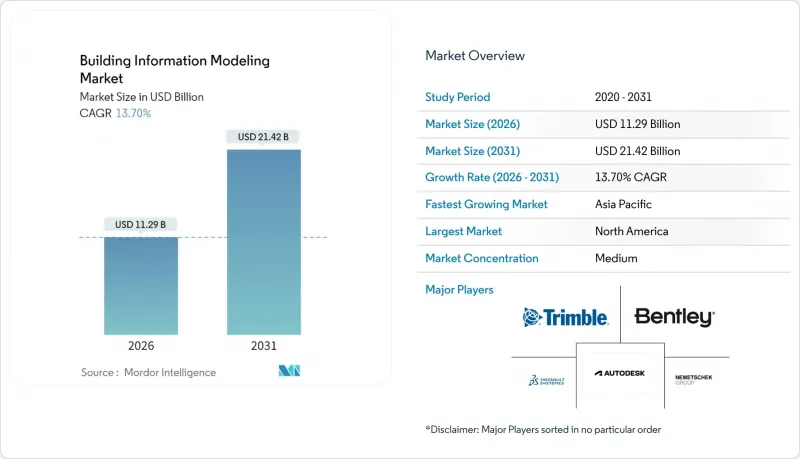
建築資訊模型(BIM)市場預計將從 2025 年的 99.3 億美元成長到 2026 年的 112.9 億美元,預計到 2031 年將達到 214.2 億美元,2026 年至 2031 年的複合年成長率為 13.7%。
建築、工程、施工和營運領域的快速數位轉型,使得BIM從簡單的視覺化工具發展成為雲端協作平台。政府監管的日益嚴格、人工智慧和數位雙胞胎的整合,以及SaaS模式的廣泛應用(降低了中小企業的初期成本),都推動了BIM的成長。供應商正將4D進度安排、5D成本估算和永續性分析等功能作為標準配置,使得用戶轉換的門檻居高不下。激烈的市場競爭推動BIM不斷升級,提升互通性和工作流程自動化水平,也使得使用者在整個計劃生命週期中更加依賴訂閱生態系統。
全球BIM市場趨勢與洞察
數位化要求和 ISO 19650 合規性加速了全球 BIM 的普及應用。
在公共工程領域強制使用BIM正在推動成熟建築經濟體數位化交貨工作流程的標準化。英國要求到2025年,所有超過500萬英鎊的公共工程都必須採用3級BIM,透過促進結構化資料交換來降低採購風險。超過60%的歐洲公共機構已發布正式的BIM策略,鼓勵私人開發商遵循類似的標準。美國多個州和加拿大省份的類似政策也產生了類似的連鎖反應。基於ISO 19650的標準化簡化了跨國合作,消除了合約歧義,並縮短了新相關人員的上手時間,從而直接推動了建築資訊模型市場的普及。
數位雙胞胎驅動的資產生命週期管理的興起
業主們正擴大將BIM模型與物聯網感測器連接起來,創建即時數位雙胞胎模型,從而最佳化維護並減少停機時間。採用感測器驅動孿生模型的建築報告稱,年度營運成本降低了5%,維護響應時間縮短了35%。營運階段(佔擁有成本的80%)的量化節省正促使設施營運商將其傳統模型升級為數據豐富的孿生模型,從而推動BIM市場在營運階段的軟體和業務收益成長。
中小型承包商面臨高昂的許可證和培訓成本
初始授權費用可能超過1萬美元,而年度續約和硬體升級又會增加總擁有成本,這令許多中小企業望而卻步。新加坡的生產力解決方案補助金等財政援助計畫(可補貼高達50%的軟體成本)在一定程度上減輕了負擔,但在可預見的未來,成本敏感度可能仍將是BIM市場發展的限制因素。
細分市場分析
軟體收入佔比高達67.30%(價值66.8億美元)。 Revit和Archicad等設計套件是模型創建的入門級工具,其整合的4D和5D功能如今已被視為基本功能,而非高級附加元件。持續更新並融入人工智慧驅動的碰撞偵測功能,有效降低了客戶流失率,並推動了BIM市場的發展。
隨著業主和承包商將模型開發、協調和分析外包,BIM業務收益正以15.6%的複合年成長率成長。外包使公司能夠在無需承擔固定薪資負擔的情況下利用稀缺人才。在歐洲和亞洲,專業的BIM顧問公司經常被聘請參與複雜的公共交通項目,這擴大了BIM服務市場的潛在規模。
到2025年,本地部署將佔總收入的71.10%,即70.6億美元。大型設計公司更傾向於使用符合嚴格資料主權法規的本地伺服器。雖然FedRAMP和ISO 27001等安全認證正在逐步緩解人們的擔憂,但根深蒂固的工作流程卻阻礙了遷移進程。
雲採用率正以18.1%的複合年成長率成長。訂閱授權模式降低了資本支出,並實現了即時擴展,使分散的企劃團隊能夠即時協作處理模式。疫情證明了遠距辦公的可行性後,許多公司將SaaS視為面向未來的工作方式,BIM市場的重點也正穩步轉向託管解決方案。
區域分析
預計到2025年,北美地區將創造37.1億美元的收入,佔全球收入的37.40%。聯邦政府的基礎設施支出以及數位化交貨的需求正在推動交通運輸和公共產業領域的廣泛應用。美國BIM市場規模的成長得益於標準化物件庫,這些物件庫簡化了採購和生命週期管理。
歐洲則位居第二,這得益於英國和德國的強制性政策,預計到 2025 年,該地區的收入將達到 31.2 億美元,到 2033 年將翻倍。像 Nemec 這樣的區域軟體領導者利用其與學術研究的緊密聯繫,保持強大的技能供應,並提高 BIM 市場的競爭力。
亞太地區是成長最快的地區,複合年成長率達14.6%。中國的智慧城市計畫、日本為解決勞動力短缺問題而大力推動自動化以及印度不斷擴展的交通走廊,都顯著推動了市場需求。新加坡政府對軟體支出的補貼計畫是區域內政策主導發展的標桿,進一步促進了BIM市場的擴張。
儘管中東和非洲地區面積不大,但海灣國家展現出強勁的成長動能。沙烏地阿拉伯的NEOM等大型企劃正在採用全面的數位雙胞胎策略,樹立了新的區域標準。各國正在進行能力建設項目,提升本地人才技能,逐步減少對進口技術的依賴。
其他福利:
- Excel格式的市場預測(ME)表
- 3個月的分析師支持
目錄
第1章 引言
- 研究假設和市場定義
- 調查範圍
第2章調查方法
第3章執行摘要
第4章 市場情勢
- 市場概覽
- 市場促進因素
- 強制數位化和與 ISO 19650 標準的接軌將加速 BIM 在全球的普及。
- 數位雙胞胎驅動的資產生命週期管理的興起
- 綠建築和淨零排放合規壓力
- 模組化/異地施工中無縫預製協調的必要性
- 雲端採用和SaaS定價降低了進入門檻。
- 透過人工智慧驅動的衍生設計和預測分析提高生產力
- 市場限制
- 中小型承包商面臨高昂的許可證和培訓成本
- 編寫工具與開放標準之間的互通性
- 雲端工作流程中網路安全和智慧財產權保護的擔憂
- 老牌企業對流程再造存在文化抵觸情緒
- 價值/價值鏈分析
- 監理與技術展望
- 波特五力分析
- 供應商的議價能力
- 買方的議價能力
- 新進入者的威脅
- 替代品的威脅
- 競爭對手之間的競爭
第5章 市場規模與成長預測
- 按解決方案類型
- 軟體
- 方面
- 3D
- 4D
- 5D
- 6D
- 7天或以上
- 方面
- 服務
- 諮詢顧問
- 部署與整合
- 培訓和支持
- 託管服務
- 軟體
- 透過部署模式
- 本地部署
- 雲
- 計劃生命週期階段
- 施工前期(規劃與設計)
- 施工(現場施工)
- 建設後(營運/維護)
- 透過使用
- 商業建築
- 住宅建築
- 工業和製造設施
- 基礎建設(公路、鐵路、機場、港口、橋樑)
- 機構(醫療保健、教育、政府)
- 其他用途
- 最終用戶
- 建築師和設計師
- 工程師(結構、機電)
- 承包商和建設公司
- 業主和開發人員
- 設施和資產管理
- 顧問和計劃經理
- 按地區
- 北美洲
- 美國
- 加拿大
- 墨西哥
- 南美洲
- 巴西
- 阿根廷
- 其他南美洲
- 歐洲
- 德國
- 英國
- 法國
- 義大利
- 北歐國家
- 其他歐洲地區
- 中東
- 阿拉伯聯合大公國
- 沙烏地阿拉伯
- 土耳其
- 其他中東地區
- 非洲
- 南非
- 其他非洲地區
- 亞太地區
- 中國
- 日本
- 印度
- 韓國
- 東南亞
- 亞太其他地區
- 北美洲
第6章 競爭情勢
- 市場集中度
- 策略性舉措(併購、資金籌措、合作)
- 市佔率分析
- 公司簡介
- Autodesk Inc.
- Nemetschek SE
- Bentley Systems Inc.
- Trimble Inc.
- Dassault Systemes SE
- Hexagon AB
- AVEVA Group PLC
- Asite Solutions Ltd
- RIB Software GmbH
- Graphisoft SE
- Allplan GmbH
- Topcon Positioning Systems Inc.
- Procore Technologies Inc.
- ACCA Software SPA
- Revizto SA
- CMiC Inc.
- Beck Technology Ltd
- Vectorworks Inc.
- Tekla Corporation(Trimble)
- Bimeye Inc.
第7章 市場機會與未來展望
The building information modeling market is expected to grow from USD 9.93 billion in 2025 to USD 11.29 billion in 2026 and is forecast to reach USD 21.42 billion by 2031 at 13.7% CAGR over 2026-2031.
Rapid digital transformation across architecture, engineering, construction and operations is expanding BIM from a visualization tool into a cloud-enabled collaboration platform. Growth is reinforced by tighter government mandates, integration with artificial intelligence and digital twins, and wider SaaS availability that lowers up-front costs for smaller firms. Vendors are also embedding 4D scheduling, 5D cost estimation and sustainability analytics as default capabilities, which keeps switching barriers high. Intense competition is prompting continuous upgrades that improve interoperability and workflow automation, deepening user reliance on subscription ecosystems throughout the project lifecycle.
Global Building Information Modeling Market Trends and Insights
E-mandates and ISO 19650 alignment accelerating global BIM uptake
Mandated BIM use on public projects is normalizing digital delivery workflows across mature construction economies. The United Kingdom's requirement for Level 3 BIM on public projects above GBP 5 million by 2025 encourages structured data exchanges that lower procurement risk. More than 60% of European public agencies now publish formal BIM strategies, which pushes private developers to follow the same standards. Comparable policies in several US states and provinces in Canada have the same cascading effect. Standardization around ISO 19650 simplifies cross-border collaboration, reduces contractual ambiguity and shortens onboarding time for new stakeholders, directly lifting adoption rates for the building information modeling market.
Rise of digital-twin-enabled asset lifecycle management
Owners increasingly connect BIM models with IoT sensors to generate live digital twins that optimize maintenance and reduce downtime. Buildings equipped with sensor-linked twins have reported 5% annual operating cost cuts and 35% faster maintenance response times. The promise of quantified savings during the 80% cost-of-ownership phase is compelling facility operators to upgrade legacy models into data-rich twins, which lifts software and service revenues throughout the operational stage of building information modeling market adoption.
High Licensing & Training Costs for SME Contractors
Initial seat licenses can exceed USD 10,000 while annual renewals and hardware upgrades increase total cost of ownership, causing many small firms to defer adoption. Funding programs such as Singapore's Productivity Solutions Grant that reimburses up to 50% of software expenses partially mitigate the burden, yet cost sensitivity remains a near-term drag on the building information modeling market.
Other drivers and restraints analyzed in the detailed report include:
- Green-building and net-zero compliance pressures
- Modular or off-site construction demanding seamless prefab coordination
- Interoperability & open-standards gaps across authoring tools
For complete list of drivers and restraints, kindly check the Table Of Contents.
Segment Analysis
Software holds a 67.30% revenue share worth USD 6.68 billion. Authoring suites such as Revit and Archicad remain the entry point for model creation, with integrated 4D and 5D functions now interpreted as table stakes rather than premium add-ons. Continuous updates that incorporate AI-driven clash detection keep customer churn low, anchoring the building information modeling market.
Service revenue is rising at a 15.6% CAGR as owners and contractors outsource model development, coordination and analytics. Outsourcing gives firms access to scarce talent without fixed payroll commitments. Complex public-transportation schemes in Europe and Asia commonly appoint specialist BIM consultancies, expanding the addressable building information modeling market size for services.
On-premises installations represent USD 7.06 billion and 71.10% of 2025 revenue. Large design houses favor local servers that align with strict data-sovereignty rules. Security certifications such as FedRAMP and ISO 27001 are gradually easing those concerns, yet entrenched workflows slow migration.
Cloud deployments are growing at 18.1% CAGR. Subscription licensing lowers capital expenditure and delivers instant scalability, letting dispersed project teams co-author models in real time. After pandemic-driven remote work proved viable, many firms adopted SaaS to future-proof operations, steadily shifting the center of gravity of the building information modeling market toward hosted solutions.
The Building Information Modeling Market Report is Segmented by Solution (Software, Services), Deployment Mode (On-Premises, Cloud), Project Lifecycle Stage (Pre-Construction, Construction, Post-Construction), Application (Commercial Buildings, Residential Buildings, and More), End User (Architects and Designers, Engineers, and More), and Geography. The Market Forecasts are Provided in Terms of Value (USD).
Geography Analysis
North America generated USD 3.71 billion and 37.40% of global revenue in 2025. Federal infrastructure spending tied to digital-delivery requirements fuels broad adoption across transportation and utilities. The building information modeling market size in the United States benefits from standardized object libraries that simplify procurement and lifecycle management.
Europe ranks second, anchored by mandates in the United Kingdom and Germany. The continent's 2025 revenue reached USD 3.12 billion and is on course to double by 2033. Regional software champions such as Nemetschek leverage close ties to academic research, which sustains a robust skills pipeline and keeps the building information modeling market competitive.
Asia-Pacific is the fastest-growing region at 14.6% CAGR. China's smart-city initiatives, Japan's automation push to counter labor shortages, and India's expanding transport corridors create substantial volume. Government incentives in Singapore that cover a portion of software expenditure make it the region's benchmark for policy-led progress, further enlarging the building information modeling market.
The Middle East and Africa remain smaller but exhibit strong momentum in Gulf states. Mega-projects like NEOM in Saudi Arabia adopt full digital-twin strategies, setting new regional standards. Capacity-building programs are underway to upskill local talent, gradually reducing reliance on imported expertise.
- Autodesk Inc.
- Nemetschek SE
- Bentley Systems Inc.
- Trimble Inc.
- Dassault Systemes SE
- Hexagon AB
- AVEVA Group PLC
- Asite Solutions Ltd
- RIB Software GmbH
- Graphisoft SE
- Allplan GmbH
- Topcon Positioning Systems Inc.
- Procore Technologies Inc.
- ACCA Software SPA
- Revizto SA
- CMiC Inc.
- Beck Technology Ltd
- Vectorworks Inc.
- Tekla Corporation (Trimble)
- Bimeye Inc.
Additional Benefits:
- The market estimate (ME) sheet in Excel format
- 3 months of analyst support
TABLE OF CONTENTS
1 INTRODUCTION
- 1.1 Study Assumptions and Market Definition
- 1.2 Scope of the Study
2 RESEARCH METHODOLOGY
3 EXECUTIVE SUMMARY
4 MARKET LANDSCAPE
- 4.1 Market Overview
- 4.2 Market Drivers
- 4.2.1 E-mandates and ISO 19650 Alignment Accelerating Global BIM Uptake
- 4.2.2 Rise of Digital-Twin-enabled Asset Lifecycle Management
- 4.2.3 Green-Building and Net-Zero Compliance Pressures
- 4.2.4 Modular / Off-site Construction Demanding Seamless Prefab Coordination
- 4.2.5 Cloud adoption and SaaS pricing lowering entry barriers
- 4.2.6 AI-driven generative design and predictive analytics boosting productivity
- 4.3 Market Restraints
- 4.3.1 High Licensing and Training Costs for SME Contractors
- 4.3.2 Interoperability and Open-Standards Gaps Across Authoring Tools
- 4.3.3 Cyber-security and IP Protection Concerns in Cloud Workflows
- 4.3.4 Cultural Resistance to Process Re-engineering in Legacy Firms
- 4.4 Value/Supply-Chain Analysis
- 4.5 Regulatory and Technological Outlook
- 4.6 Porter's Five Forces Analysis
- 4.6.1 Bargaining Power of Suppliers
- 4.6.2 Bargaining Power of Buyers
- 4.6.3 Threat of New Entrants
- 4.6.4 Threat of Substitutes
- 4.6.5 Intensity of Competitive Rivalry
5 MARKET SIZE AND GROWTH FORECASTS (VALUE)
- 5.1 By Solution Type
- 5.1.1 Software
- 5.1.1.1 Dimension
- 5.1.1.1.1 3D
- 5.1.1.1.2 4D
- 5.1.1.1.3 5D
- 5.1.1.1.4 6D
- 5.1.1.1.5 7D and Beyond
- 5.1.1.1 Dimension
- 5.1.2 Services
- 5.1.2.1 Consulting and Advisory
- 5.1.2.2 Implementation and Integration
- 5.1.2.3 Training and Support
- 5.1.2.4 Managed Services
- 5.1.1 Software
- 5.2 By Deployment Mode
- 5.2.1 On-premises
- 5.2.2 Cloud
- 5.3 By Project Lifecycle Stage
- 5.3.1 Pre-construction (Planning and Design)
- 5.3.2 Construction (Site Execution)
- 5.3.3 Post-construction (Operations and Maintenance)
- 5.4 By Application
- 5.4.1 Commercial Buildings
- 5.4.2 Residential Buildings
- 5.4.3 Industrial and Manufacturing Facilities
- 5.4.4 Infrastructure (Roads, Rail, Airports, Ports, Bridges)
- 5.4.5 Institutional (Healthcare, Education, Government)
- 5.4.6 Other Applications
- 5.5 By End User
- 5.5.1 Architects and Designers
- 5.5.2 Engineers (Structural, MEP)
- 5.5.3 Contractors and Builders
- 5.5.4 Owners and Developers
- 5.5.5 Facilities and Asset Managers
- 5.5.6 Consultants and Project Managers
- 5.6 By Geography
- 5.6.1 North America
- 5.6.1.1 United States
- 5.6.1.2 Canada
- 5.6.1.3 Mexico
- 5.6.2 South America
- 5.6.2.1 Brazil
- 5.6.2.2 Argentina
- 5.6.2.3 Rest of South America
- 5.6.3 Europe
- 5.6.3.1 Germany
- 5.6.3.2 United Kingdom
- 5.6.3.3 France
- 5.6.3.4 Italy
- 5.6.3.5 Nordics
- 5.6.3.6 Rest of Europe
- 5.6.4 Middle East
- 5.6.4.1 United Arab Emirates
- 5.6.4.2 Saudi Arabia
- 5.6.4.3 Turkey
- 5.6.4.4 Rest of Middle East
- 5.6.5 Africa
- 5.6.5.1 South Africa
- 5.6.5.2 Rest of Africa
- 5.6.6 Asia-Pacific
- 5.6.6.1 China
- 5.6.6.2 Japan
- 5.6.6.3 India
- 5.6.6.4 South Korea
- 5.6.6.5 Southeast Asia
- 5.6.6.6 Rest of Asia-Pacific
- 5.6.1 North America
6 COMPETITIVE LANDSCAPE
- 6.1 Market Concentration
- 6.2 Strategic Moves (M&A, Funding, Partnerships)
- 6.3 Market Share Analysis
- 6.4 Company Profiles (includes Global-level Overview, Market-level Overview, Core Segments, Financials as available, Strategic Information, Market Rank/Share, Products and Services, Recent Developments)
- 6.4.1 Autodesk Inc.
- 6.4.2 Nemetschek SE
- 6.4.3 Bentley Systems Inc.
- 6.4.4 Trimble Inc.
- 6.4.5 Dassault Systemes SE
- 6.4.6 Hexagon AB
- 6.4.7 AVEVA Group PLC
- 6.4.8 Asite Solutions Ltd
- 6.4.9 RIB Software GmbH
- 6.4.10 Graphisoft SE
- 6.4.11 Allplan GmbH
- 6.4.12 Topcon Positioning Systems Inc.
- 6.4.13 Procore Technologies Inc.
- 6.4.14 ACCA Software SPA
- 6.4.15 Revizto SA
- 6.4.16 CMiC Inc.
- 6.4.17 Beck Technology Ltd
- 6.4.18 Vectorworks Inc.
- 6.4.19 Tekla Corporation (Trimble)
- 6.4.20 Bimeye Inc.
7 MARKET OPPORTUNITIES AND FUTURE OUTLOOK
- 7.1 White-space and Unmet-need Assessment

 建築資訊模型(BIM)市場報告:趨勢、預測與競爭分析(至2035年)
 5D建築資訊模型市場-2026-2032年全球市場預測
 2026-2030年全球建築資訊模型(BIM)軟體市場建築資訊模型(BIM)市場:組件、專案規模、等級類型、定價模式、應用、最終用戶、專案類型、部署模式 - 2026-2032年全球預測
 建築資訊模型(BIM)市場規模、佔有率和成長分析:按組件、功能、企業類型、技術、部署模式、最終用戶和地區分類-2026年至2033年產業預測
 建築資訊模型(BIM)市場規模、佔有率、趨勢和預測:按產品類型、部署類型、應用、最終用途領域、最終用戶和地區分類(2026-2034 年)
 建築資訊模型(BIM)市場:按交付類型、應用、最終用戶和地區分類
 2026年全球建築資訊模型市場報告
 建築資訊模型(BIM)市場:依組件、部署類型、專案生命週期、建築類型、應用和最終用戶劃分 - 全球預測至2036年
 建築資訊模型 (BIM) 市場分析及至 2035 年預測:按類型、產品類型、服務、技術、組件、應用、流程、部署類型、最終用戶和階段分類