


 |
市場調查報告書
商品編碼
2121522
3D列印資料:市場佔有率分析、產業趨勢與統計、成長預測(2026-2031年)3D Printing Materials - Market Share Analysis, Industry Trends & Statistics, Growth Forecasts (2026 - 2031) |
||||||

※ 本網頁內容可能與最新版本有所差異。詳細情況請與我們聯繫。
據 Mordor Intelligence 稱,2026 年 3D 列印材料市場預計價值 30.2 億美元,預計在預測期(2026-2031 年)內將以 22.23% 的複合年成長率成長,到 2031 年達到 82.4 億美元。
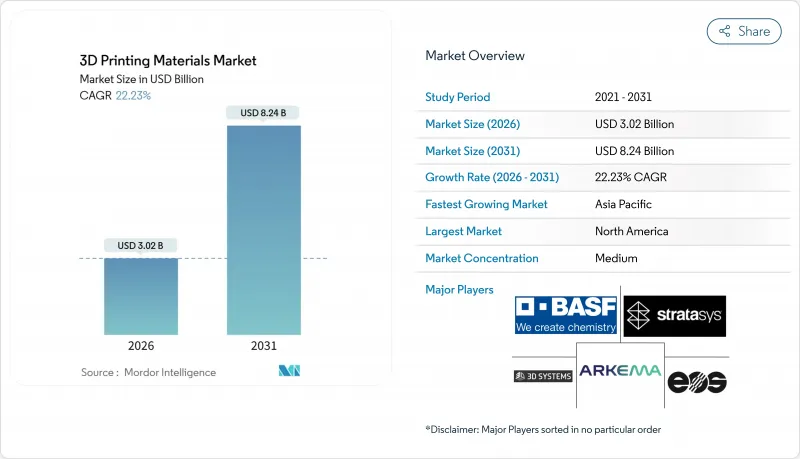
本報告按材料類型(塑膠[ABS、PLA、尼龍、聚醯胺、聚碳酸酯及其他塑膠]、金屬、陶瓷及其他材料)、形態(粉末、絲材、液體/樹脂)、終端用戶產業(航太與國防及其他)和地區(亞太、北美、歐洲、南美、中東和非洲)進行細分。市場預測以美元計價。
全球3D列印材料市場趨勢與洞察
金屬粉末在航太和醫療領域的大規模生產應用正在迅速成長。
目前,領先的航太產業公司正在對渦輪葉片和支架等飛行關鍵部件進行認證,將鈦粉和鋁粉從設計實驗室轉移到生產線。在醫療領域,製造商正在擴大鈷鉻合金粉末在髖關節和膝關節植入中的應用。供應商優先考慮批次間的一致性和氧含量限制,而非價格,從而增強了其品質保證優勢。 3D列印的鈦支架比機械加工零件更輕,其終身燃油成本節省足以抵消更高的材料成本。然而,ASTM F42標準對顆粒尺寸和純度的要求設定了很高的進入門檻,限制了新參與企業只能在小眾應用領域開展業務。
高性能聚合物的快速發展
聚醚醚酮 (PEEK) 和聚醚酮酮 (PEKK) 正在取代金屬,用於那些對無菌性和阻燃性要求高於重量的應用領域。阿科瑪的 Kepstan PEKK 可承受持續高溫,是可承受反覆高壓釜的手術托盤的理想選擇。維克特克斯公司增加了 PEEK 的出貨量,主要針對符合美國聯邦航空管理局 (FAA) 阻燃標準且無需額外塗層的飛機客艙和脊椎移植。材料供應商現在直接向終端用戶提供樹脂認證,繞過了印表機 OEM 製造商。這種方法顯著縮短了認證流程所需的時間。儘管 PEEK 價格較高,但由於其長期性能優勢超過了初始成本,因此其應用正在不斷成長。同時,中等等級的聚合物正在開闢一個利基市場,填補通用尼龍和航太高級等級之間的空白,擴大了潛在的市場需求。
設備和材料高成本
工業金屬印表機價格昂貴,PEEK耗材的價格也遠高於通用ABS耗材。儘管即使年產量有限,這些技術在經濟上仍然可行,但新興市場的中型製造商卻對採用這些技術猶豫不決。惠普的「多射流熔融」(Multi Jet Fusion)技術主要在契約製造製造商而非終端用戶中流行起來。此外,粉末和技術支援相結合的訂閱模式需要簽訂多年契約,這對小規模企業來說是一個挑戰,並造成了市場兩極分化。資金雄厚的OEM製造商正在擴張業務,而原型製作商卻被迫停滯不前。
細分市場分析
金屬材料的成長速度超過其他任何類別,預計將縮小與塑膠的差距,塑膠在2025年將佔據47.78%的市場佔有率。鈦合金在航太支架、渦輪葉片和燃油噴嘴等領域佔據主導地位,而鋁合金(例如AlSi10Mg)則為汽車輕量化專案提供支援。鈷鉻合金粉末現已成為髖關節和膝關節置換術的標準材料,外科醫生報告再次手術率下降。隨著認證的不斷積累,金屬基3D列印材料的市場規模預計將在2031年之前以23.34%的複合年成長率成長。塑膠在桌面原型製作仍然佔據核心地位,因為ABS和PLA的價格低於30美元。然而,在對無菌性和阻燃性要求極高的領域,例如飛機內飾和手術器械,高性能聚合物(例如PEEK、PEKK和尼龍12)正在取代金屬。
在建構長期產品系列,同時提供通用型耗材和航太級粉末的供應商將具有優勢。領先的供應商已在多個地區獲得 ASTM 和 ISO 認證,從而降低了客戶的實施成本。陶瓷材料雖然仍屬於小眾領域,但在牙冠和高溫模具領域的重要性日益凸顯。蠟和黏合劑雖然用量較小,但在熔模鑄造中仍然必不可少,這表明 3D 列印材料市場需求廣泛。
區域分析
預計到2025年,北美將維持39.52%的市佔率。這主要歸功於航太和醫療行業的強大生態系統,以及聯邦政府資助的項目,例如“美國製造”(America Makes)計劃,該計劃為材料認證和人力資源開發課程提供津貼。美國大型航太公司、加拿大引擎製造商和墨西哥加工廠的強大實力支撐了穩定的需求。儘管成長動能依然強勁,但成長速度低於亞太地區,顯示先發優勢正在逐漸減弱。
亞太地區正處於最快的成長軌道上,預計到2031年複合年成長率將達到26.78%。中國工業和資訊化部正在投資建造鈦粉和鋁粉的新產能,以加強國內供應鏈,並降低對歐美進口的依賴。印度正在推廣個人化整形外科植入,這使得當地製造商能夠更方便地獲得鈷鉻粉。日本和韓國正在將高性能聚合物引入電子和造船產業,而新加坡則正努力打造一個適應其熱帶氣候的認證和研發中心。因此,亞太地區正從需求中心向供應中心轉變,重塑3D列印材料市場的貿易格局。
歐洲的成長主要由德國領先的汽車公司和法國空中巴士公司推動,後者在其飛機中使用了3D列印的鈦合金支架。歐盟的「循環經濟行動計畫」正在透過加快制定再生粉末標準和推廣可生物分解聚合物,加強永續性工作。南美和中東仍然是新興市場,但巴西航空工業公司和沙烏地阿拉伯國防相關企業對3D列印技術的試點應用表明,這些市場具有長期成長潛力。對標準、回收和本地生產能力的持續投資將決定現有企業能否保持市場佔有率,還是會被新參與企業搶佔先機。
其他好處:
- Excel格式的市場預測(ME)表
- 3個月的分析師支持
目錄
第1章:引言
- 市場分析與定義的前提條件
- 分析範圍
第2章 分析方法
第3章執行摘要
第4章 市場狀況
- 市場概覽
- 市場促進因素
- 金屬粉末在航太和醫療領域的大規模生產應用正在迅速成長。
- 高性能聚合物的快速發展
- 減輕汽車重量的努力
- 醫療和消費品領域大規模客製化的勢頭
- 監管機構推動按需備件庫存(國防、鐵路)
- 市場限制因素
- 設備和材料高成本
- 符合航太和醫療等級的嚴格認證標準。
- 對奈米顆粒的釋放和廢棄粉末的處理表示擔憂。
- 價值鏈分析
- 波特五力分析
第5章:預測市場規模與成長率
- 依材料類型
- 塑膠
- ABS(丙烯腈-丁二烯-苯乙烯)
- PLA(聚乳酸)
- 尼龍
- 聚醯胺
- 聚碳酸酯
- 其他塑膠(複合材料、可生物分解聚合物等)
- 金屬
- 陶瓷
- 其他材料(氣體、蠟)
- 塑膠
- 按形狀
- 粉末
- 燈絲
- 液體/樹脂
- 按最終用戶行業分類
- 航太/國防
- 車
- 醫療保健
- 家用電子電器
- 其他終端用戶產業(能源電力、工業機械等)
- 按地區
- 亞太地區
- 中國
- 日本
- 韓國
- 印度
- 新加坡
- 其他亞太國家
- 北美洲
- 美國
- 加拿大
- 墨西哥
- 歐洲
- 德國
- 英國
- 法國
- 義大利
- 俄羅斯
- 其他歐洲國家
- 南美洲
- 巴西
- 阿根廷
- 其他南美國家
- 中東和非洲
- 沙烏地阿拉伯
- 南非
- 其他中東和非洲國家
- 亞太地區
第6章 競爭情勢
- 市場集中度
- 策略趨勢
- 市佔率和排名分析
- 公司簡介
- 3D Systems, Inc.
- Arkema
- BASF
- CRP TECHNOLOGY Srl
- Custom Resin Solutions
- EnvisionTEC US LLC
- EOS GmbH
- Evonik Industries AG
- General Electric Company
- Henkel AG & Co. KGaA
- Hoganas AB
- HP Development Company, LP
- Materialise
- Renishaw plc
- Sandvik AB
- Solvay
- Stratasys
- voxeljet AG
第7章 市場機會與未來展望
According to Mordor Intelligence, the 3D printing materials market size is estimated at USD 3.02 billion in 2026, and is expected to reach USD 8.24 billion by 2031, at a CAGR of 22.23% during the forecast period (2026-2031).
This report is Segmented by Material Type (Plastics [ABS, PLA, Nylon, Polyamide, Polycarbonate, and Other Plastics], Metals, Ceramics, and Other Materials), Form (Powder, Filament, and Liquid/Resin), End-User Industry (Aerospace and Defense, and More), and Geography (Asia-Pacific, North America, Europe, South America, and Middle-East and Africa). Market Forecasts are Provided in Terms of Value (USD).
Global 3D Printing Materials Market Trends and Insights
Surge in Metal Powder Usage for Serial Aerospace and Medical Production
Aerospace giants are now certifying flight-critical components, such as turbine blades and brackets, transitioning titanium and aluminum powders from design labs to production lines. In the medical sector, producers are ramping up their use of cobalt-chrome powders for hip and knee implants. Suppliers are prioritizing batch consistency and oxygen thresholds over price, thereby strengthening their quality-assurance edge. Printed titanium brackets, being lighter than their machined counterparts, offer lifetime fuel savings that counterbalance a material-cost premium. Meanwhile, ASTM F42's standards on particle size and purity are setting high entry barriers, confining newcomers to niche applications.
Rapid Advances in High-Performance Polymers
Polyetheretherketone (PEEK) and polyetherketoneketone (PEKK) are replacing metals in applications where sterilizability and flame resistance take precedence over weight considerations. Arkema's Kepstan PEKK can endure continuous exposure to high temperatures, making it ideal for surgical trays that can withstand repeated autoclave cycles. Victrex boosted its PEEK shipments, targeting aerospace cabins and spinal implants that comply with FAA flammability standards, all without the need for additional coatings. Material suppliers are now certifying resins directly with end-users, sidestepping printer OEMs. This approach has notably reduced the qualification process timeline. Even with a high price tag, PEEK's adoption is on the rise, driven by its long-term performance benefits that overshadow the initial cost. Meanwhile, mid-tier polymers are carving out a niche, bridging the divide between commodity nylons and premium aerospace grades, thus broadening the market's addressable demand.
High Equipment and Material Cost
Industrial metal printers are expensive, and PEEK filament is significantly more costly than commodity ABS. Despite the favorable economics for producing limited units annually, mid-tier manufacturers in emerging markets are hesitant to adopt these technologies. HP's Multi Jet Fusion has seen its uptake predominantly among contract manufacturers rather than end-users. Furthermore, subscription models that combine powders with engineering support require multi-year commitments. This poses a challenge for smaller firms, leading to a divided market: while cash-rich OEMs expand, prototypers find themselves at a standstill.
Other drivers and restraints analyzed in the detailed report include:
- Automotive Lightweighting Initiatives
- Mass-Customization Momentum in Healthcare and Consumer Goods
- Stringent Certification for Aerospace and Medical Grades
For complete list of drivers and restraints, kindly check the Table Of Contents.
Segment Analysis
Metals expanded faster than any other category, and they are set to close the gap with plastics, which held a 47.78% share in 2025. Titanium alloys dominate aerospace brackets, turbine blades, and fuel nozzles, while aluminum alloys such as AlSi10Mg underpin automotive lightweighting programs. Cobalt-chrome powders are now routine for hip and knee replacements as surgeons report reduced revision surgeries. The 3D printing materials market size for metals is forecast to grow at a 23.34% CAGR through 2031 as certifications accumulate. Plastics remain core in desktop prototyping thanks to sub-USD 30 ABS and PLA. Nevertheless, high-performance polymers like PEEK, PEKK, and nylon 12 are displacing metals in cabin interiors and surgical instruments where sterilizability and flame retardance are critical.
The long-run portfolio mix will favor suppliers that straddle commodity filaments and aerospace-grade powders. Larger vendors hold ASTM and ISO credentials across multiple geographic zones, lowering customer onboarding costs. Ceramics, still a niche, gain relevance in dental crowns and high-temperature tooling. Waxes and binder agents comprise a small volume yet remain critical for investment casting, showcasing the breadth of demand within the 3D printing materials market.
Complete Report Scope:
- By Material Type
- Plastics
- Acrylonitrile Butadiene Styrene (ABS)
- Polylactic Acid (PLA)
- Nylon
- Polyamide
- Polycarbonate
- Other Plastics (Composites, Biodegradable Polymers, etc.)
- Metals
- Ceramics
- Other Materials (Gases, Waxes)
- Plastics
- By Form
- Powder
- Filament
- Liquid / Resin
- By End-user Industry
- Aerospace and Defense
- Automotive
- Medical
- Consumer Electronics
- Other End-user Industries (Energy and Power, Industrial Machinery, etc.)
- By Geography
- Asia-Pacific
- China
- Japan
- South Korea
- India
- Singapore
- Rest of Asia-Pacific
- North America
- United States
- Canada
- Mexico
- Europe
- Germany
- United Kingdom
- France
- Italy
- Russia
- Rest of Europe
- South America
- Brazil
- Argentina
- Rest of South America
- Middle-East and Africa
- Saudi Arabia
- South Africa
- Rest of Middle-East and Africa
- Asia-Pacific
Geography Analysis
North America maintained a 39.52% share in 2025, leveraging deep aerospace and medical ecosystems and federally funded programs such as America Makes that subsidize material qualification and workforce curricula. U.S. aerospace primes, Canadian engine builders, and Mexican automotive maquiladoras collectively sustain steady demand. Growth remains positive yet slower than Asia-Pacific, hinting that first-mover advantage is plateauing.
Asia-Pacific commands the fastest trajectory with a 26.78% CAGR through 2031. China's Ministry of Industry and Information Technology invested in new titanium and aluminum powder capacity, tightening domestic supply chains and reducing reliance on Western imports. India incentivizes patient-specific orthopedic implants, placing cobalt-chrome powder within reach of regional manufacturers. Japan and South Korea incorporate high-performance polymers into electronics and shipbuilding, while Singapore positions itself as a certification and research and development hub tailor-made for tropical climates. As a result, Asia-Pacific is transitioning from a demand center to a supply powerhouse, reshaping trade flows in the 3D printing materials market.
Europe's growth is anchored by German automotive leaders and by France-based Airbus adopting printed titanium brackets in fuselages. The EU Circular Economy Action Plan accelerates recycled-powder standards and biodegradable polymers, reinforcing sustainability credentials. South America and the Middle East remain emerging, yet Brazil's Embraer and Saudi defense contractors pilot additive approaches, signaling long-term upside. Continuous investment in standards, recycling, and regional capacity will determine whether incumbents hold share or cede ground to new entrants.
- 3D Systems, Inc.
- Arkema
- BASF
- CRP TECHNOLOGY S.r.l.
- Custom Resin Solutions
- EnvisionTEC US LLC
- EOS GmbH
- Evonik Industries AG
- General Electric Company
- Henkel AG & Co. KGaA
- Hoganas AB
- HP Development Company, L.P.
- Materialise
- Renishaw plc
- Sandvik AB
- Solvay
- Stratasys
- voxeljet AG
Additional Benefits:
- The market estimate (ME) sheet in Excel format
- 3 months of analyst support
TABLE OF CONTENTS
1 Introduction
- 1.1 Study Assumptions and Market Definition
- 1.2 Scope of the Study
2 Research Methodology
3 Executive Summary
4 Market Landscape
- 4.1 Market Overview
- 4.2 Market Drivers
- 4.2.1 Surge in metal powder usage for serial aerospace and medical production
- 4.2.2 Rapid advances in high-performance polymers
- 4.2.3 Automotive lightweighting initiatives
- 4.2.4 Mass-customization momentum in healthcare and consumer goods
- 4.2.5 Regulatory push for on-demand spare-part inventories (defense, rail)
- 4.3 Market Restraints
- 4.3.1 High equipment and material cost
- 4.3.2 Stringent certification for aerospace and medical grades
- 4.3.3 Nanoparticle emission and waste-powder disposal concerns
- 4.4 Value Chain Analysis
- 4.5 Porter's Five Forces
- 4.5.1 Bargaining Power of Suppliers
- 4.5.2 Bargaining Power of Buyers
- 4.5.3 Threat of New Entrants
- 4.5.4 Threat of Substitutes
- 4.5.5 Degree of Competition
5 Market Size and Growth Forecasts (Value)
- 5.1 By Material Type
- 5.1.1 Plastics
- 5.1.1.1 Acrylonitrile Butadiene Styrene (ABS)
- 5.1.1.2 Polylactic Acid (PLA)
- 5.1.1.3 Nylon
- 5.1.1.4 Polyamide
- 5.1.1.5 Polycarbonate
- 5.1.1.6 Other Plastics (Composites, Biodegradable Polymers, etc.)
- 5.1.2 Metals
- 5.1.3 Ceramics
- 5.1.4 Other Materials (Gases, Waxes)
- 5.1.1 Plastics
- 5.2 By Form
- 5.2.1 Powder
- 5.2.2 Filament
- 5.2.3 Liquid / Resin
- 5.3 By End-user Industry
- 5.3.1 Aerospace and Defense
- 5.3.2 Automotive
- 5.3.3 Medical
- 5.3.4 Consumer Electronics
- 5.3.5 Other End-user Industries (Energy and Power, Industrial Machinery, etc.)
- 5.4 By Geography
- 5.4.1 Asia-Pacific
- 5.4.1.1 China
- 5.4.1.2 Japan
- 5.4.1.3 South Korea
- 5.4.1.4 India
- 5.4.1.5 Singapore
- 5.4.1.6 Rest of Asia-Pacific
- 5.4.2 North America
- 5.4.2.1 United States
- 5.4.2.2 Canada
- 5.4.2.3 Mexico
- 5.4.3 Europe
- 5.4.3.1 Germany
- 5.4.3.2 United Kingdom
- 5.4.3.3 France
- 5.4.3.4 Italy
- 5.4.3.5 Russia
- 5.4.3.6 Rest of Europe
- 5.4.4 South America
- 5.4.4.1 Brazil
- 5.4.4.2 Argentina
- 5.4.4.3 Rest of South America
- 5.4.5 Middle-East and Africa
- 5.4.5.1 Saudi Arabia
- 5.4.5.2 South Africa
- 5.4.5.3 Rest of Middle-East and Africa
- 5.4.1 Asia-Pacific
6 Competitive Landscape
- 6.1 Market Concentration
- 6.2 Strategic Moves
- 6.3 Market Share (%)/Ranking Analysis
- 6.4 Company Profiles (includes Global-level Overview, Market-level Overview, Core Segments, Financials as available, Strategic Information, Products and Services, and Recent Developments)
- 6.4.1 3D Systems, Inc.
- 6.4.2 Arkema
- 6.4.3 BASF
- 6.4.4 CRP TECHNOLOGY S.r.l.
- 6.4.5 Custom Resin Solutions
- 6.4.6 EnvisionTEC US LLC
- 6.4.7 EOS GmbH
- 6.4.8 Evonik Industries AG
- 6.4.9 General Electric Company
- 6.4.10 Henkel AG & Co. KGaA
- 6.4.11 Hoganas AB
- 6.4.12 HP Development Company, L.P.
- 6.4.13 Materialise
- 6.4.14 Renishaw plc
- 6.4.15 Sandvik AB
- 6.4.16 Solvay
- 6.4.17 Stratasys
- 6.4.18 voxeljet AG
7 Market Opportunities and Future Outlook
- 7.1 White-space and Unmet-Need Assessment
- 7.2 Introduction of New Materials such as Graphene Enabling New Applications
- 7.3 Adoption of 3D Printing Technology in Home Printing

 全球3D列印材料市場規模、佔有率、趨勢和成長分析報告(2026-2034年)
 3D列印材料市場報告:趨勢、預測和競爭分析(至2035年)
 3D列印資料與服務:市場佔有率分析、產業趨勢與統計資料、成長預測(2026-2031年)
 3D列印材料市場:依材料成分、形狀、印表機相容性、終端用戶產業及通路分類-2026-2032年全球市場預測
 先進材料積層製造市場預測至2034年-按材料類型、技術、材料形態、功能、應用、最終用戶和地區分類的全球分析
 2026-2030年全球3D列印材料市場2034年工業3D列印先進材料市場預測-按材料類型、形狀、相容性、應用、最終用戶和地區分類的全球分析
 3D列印材料市場規模、佔有率和成長分析:按材料類型、形狀、技術、應用、最終用途產業和地區分類-2026-2033年產業預測
 3D列印材料市場報告:按類型、形式、最終用戶和地區分類(2026-2034年)粉末感測器市場報告:趨勢、預測和競爭分析(至2035年)