


 |
市場調查報告書
商品編碼
2113183
3D列印資料與服務:市場佔有率分析、產業趨勢與統計資料、成長預測(2026-2031年)3D Printing Materials And Services - Market Share Analysis, Industry Trends & Statistics, Growth Forecasts (2026 - 2031) |
||||||

※ 本網頁內容可能與最新版本有所差異。詳細情況請與我們聯繫。
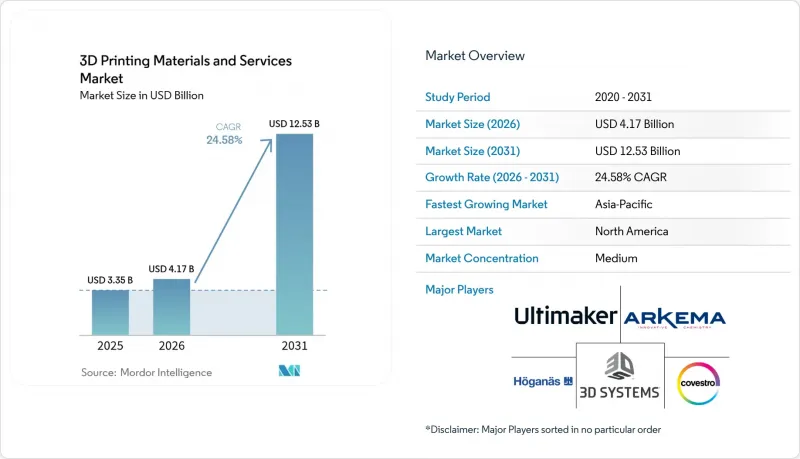
根據 Mordor Intelligence 預測,3D 列印材料和服務市場將從 2025 年的 33.5 億美元成長到 2026 年的 41.7 億美元,然後在 2031 年達到 125.3 億美元,2026 年至 2031 年的複合年成長率為 24.58%。
本報告按供應(材料等)、技術(FDM/FFF、SLS/SLA/DLP、DMLS/EBM/L-PBF 等)、形式(材料)(絲材、粉末等)、應用(原型製作、功能組件等)、最終用戶(航太和國防、汽車和電動汽車等)和地區進行分類。
全球3D列印材料及服務市場趨勢及洞察
金屬積層製造技術在航太領域的快速普及。
監管機構目前已批准在航空航太領域使用經認證的金屬積層製造 (AM) 零件。 Materialise 公司將於 2025 年獲得 EN 9100 認證,屆時將能夠供應符合航太品質標準的鈦合金和鋁合金結構零件。此外,美國國防部正與美國製造聯盟 (America Makes) 合作,推動認證流程的標準化。 3D Systems 公司已為太空任務交付了2000 多個關鍵任務所需的鈦合金或鋁合金零件。這些成就凸顯了積層製造技術在安全關鍵零件領域的有效性,並加速了採購中從傳統鑄造零件轉向積層製造的轉變。
由於削減成本的壓力,按需服務正在擴大。
庫存成本和模具成本的上漲正促使製造商將製造外包給分散式服務供應商。 MX3D在2025年籌集了700萬歐元,用於拓展其電弧積層製造業務,採用「按需列印」模式,預計可減少高達90%的原料浪費。 Protolabs報告稱,其3D列印業務在2024年的收入達到8300萬美元,這表明其「服務優先」模式取得了商業性成功,該模式縮短了前置作業時間並增加了自由現金流。
高純度金屬粉末的價格波動
由於礦產供不應求和監管限制,鈦粉和銅粉的價格波動,推高了航太和醫療器材製造業的零件成本。儘管鈦積層製造(AM)市場預計到2032年將達到14億美元,但供應不穩定迫使原始設備製造商(OEM)囤積原料並回收廢料以維持利潤率。這一趨勢在能源成本高昂的歐洲尤其明顯。
細分市場分析
到2025年,服務部門將佔銷售額的57.40%,並以13.55%的複合年成長率成長,這主要得益於企業將設計檢驗和小批量生產外包。預計到2025年,3D列印材料和服務市場的服務板塊規模將達到19.2億美元,到2031年將超過41.2億美元。 3Dock等供應商提供的訂閱方案降低了間歇性用戶的進入門檻。材料板塊雖然規模較小,但高利潤的特殊粉末和生物聚合物正在推動服務創新。材料板塊正以11.40%的年成長率成長,主要由粉末層熔融(PBF)粉末驅動。到2025年,長絲將佔最大佔有率,達到47.10%。惠普的無鹵PA 12 FR就是一個典型的例子,它是一種工程聚合物,既符合嚴格的阻燃標準,又能降低20%的營運成本。再生長絲和複合顆粒技術的進步正獲得尋求減少環境影響的客戶的支持,這增強了我們在材料主導服務交付方面的差異化優勢。
憑藉其豐富的經驗和相對實惠的價格,FDM/FFF技術在2025年仍保持37.20%的市場佔有率。儘管該細分市場仍保持10.40%的成長率,但MJF和黏著劑噴塗成型以13.20%的複合年成長率超越了它。這些粉末基技術具有近乎等向性的特性,使其適用於夾具、固定裝置以及中小批量生產。惠普公司與INDO-MIM公司在黏著劑噴塗成型領域的合作正朝著金屬零件的大規模生產邁進,這些零件已通過航太領域的檢驗,證明其具備大規模生產的條件。
SLA、DLP 和 SLS 技術在精密牙科模型和醫療設備繼續發揮至關重要的作用。 EOS 的系統能夠在數天內為每位病患客製化顱骨植入,進而提升醫院的產能。線弧積層製造(Wire arc AM)目前仍是一個小眾領域,但隨著 MX3D 公司獲得資金籌措並實現擴張,其在能源和海事領域大型鈦結構的製造方面正日益受到關注。
區域分析
預計到2025年,北美將佔全球積層製造銷售額的39.20%。國防項目正在加速金屬積層製造的認證,通用電氣航空航太公司10億美元的產能擴張計畫將加強美國國內的積層製造供應鏈。醫院正在使用3D列印的解剖模型,這些模型可以將手術時間縮短多達30%,從而提振醫療產業的需求。歐洲佔據第二大市場佔有率,這得益於德國的良好記錄以及歐盟對可回收材料的獎勵。弗勞恩霍夫研究所將聚丙烯廢棄物轉化為長絲的計畫清楚展現了政策主導的創新。西班牙被指定為Formnext 2025的合作夥伴國,凸顯了該地區製造業的復甦和出口導向。亞太地區是成長最快的地區,複合年成長率達14.45%。積層製造在中國被應用於汽車、電子和髖關節等領域,而日本則專注於精密模具製造。政府津貼、強大的製造業生態系統和不斷成長的醫療保健支出都支持市場需求。在南美和中東等新興市場,積層製造(AM)正被用於石油和天然氣行業的備件以及航太零件的生產,雖然規模較小,但這些市場正在成為進一步成長的中心。
其他好處:
- Excel格式的市場預測(ME)表
- 3個月的分析師支持
目錄
第1章:引言
- 本研究的假設與市場定義
- 調查範圍
第2章:調查方法
第3章執行摘要
第4章 市場狀況
- 市場概覽
- 市場促進因素
- 金屬積層製造(AM)技術在航太領域迅速普及,用於生產符合航空適航標準的零件。
- 成本削減壓力推動美國和歐盟按需製造服務的發展
- 生物相容性聚合物為亞洲的即時醫療列印開闢了新的可能性。
- 混合材料的擠出成型過程能夠製造電動車的輕量零件。
- 市場限制因素
- 高純度金屬粉末價格波動
- 汽車製造關鍵零件積層製造認證標準有限
- 價值供應鏈分析
- 監管和技術展望
- 波特五力模型
- 評估新冠肺炎疫情的地緣經濟影響
第5章 市場規模與成長預測
- 報價
- 材料
- 塑膠(PLA、ABS/ASA、PETG、光敏聚合物)
- 金屬(Ti-6Al-4V、Inconel、AlSi10Mg、SS 316L)
- 陶瓷(氧化鋁、氧化鋯、氮化矽)
- 複合材料及其他材料(碳纖維、生物聚合物)
- 服務
- 快速原型製作
- 夾具和固定裝置
- 生產/橋樑製造
- 設計及工程服務
- 材料
- 透過技術
- FDM/FFF
- SLS/SLA/DLP
- MJF黏著劑噴塗成型
- DMLS/EBM/L-PBF
- 其他(LCD、CLIP、WAAM)
- 按形式(材料)
- 燈絲
- 粉末
- 液體/樹脂
- 透過使用
- 原型製作
- 功能部件
- 模具和鑄件
- 牙科和整形外科植入
- 最終用戶
- 航太/國防
- 汽車和電動旅行
- 醫療保健和生命科學
- 工業機械
- 消費品/電子設備
- 建築/建築設計
- 按地區
- 北美洲
- 美國
- 加拿大
- 歐洲
- 德國
- 法國
- 英國
- 其他歐洲國家
- 亞太地區
- 中國
- 日本
- 韓國
- 其他亞太國家
- 南美洲
- 巴西
- 其他南美國家
- 中東和非洲
- GCC
- 南非
- 其他中東和非洲國家
- 北美洲
第6章 競爭情勢
- 市場集中度
- 策略性措施與資金籌措
- 市佔率分析
- 公司簡介
- 3D Systems Corp.
- Stratasys Ltd.
- EOS GmbH
- General Electric(GE Additive)
- HP Inc.
- SLM Solutions Group AG
- Desktop Metal Inc.
- Materialise NV
- Arkema SA
- BASF Forward AM
- Evonik Industries AG
- Hoganas AB
- Sandvik AB
- Royal DSM(Covestro)
- Markforged Holding Corp.
- Protolabs Inc.
- Voxeljet AG
- ExOne(Desktop Metal)
- Carbon Inc.
- Ultimaker BV
- Carpenter Technology Corporation
- Renishaw plc
- Xometry Inc.
第7章 市場機會與未來展望
According to Mordor Intelligence, the 3D printing materials and services market size market is expected to grow from USD 3.35 billion in 2025 to USD 4.17 billion in 2026 and is forecast to reach USD 12.53 billion by 2031 at 24.58% CAGR over 2026-2031.
This report is Segmented by Offering ( Materials and More), Technology ( FDM / FFF, SLS / SLA / DLP, DMLS / EBM / L-PBF and More), Form (Materials) ( Filament, Powder and More), Application ( Prototyping, Functional Parts and More), End-User ( Aerospace and Defense, Automotive and E-Mobility, and More), and Geography
Global 3D Printing Materials And Services Market Trends and Insights
Rapid adoption of metal AM in aerospace
Regulators now accept certified metal AM parts for flight use. Materialise obtained EN 9100 accreditation in 2025, unlocking the supply of structural titanium and aluminum components that meet aerospace quality standards. Parallel U.S. defense programs with America Makes are standardizing qualification pathways, and 3D Systems has already delivered over 2,000 mission-critical titanium or aluminum components for space missions.These milestones validate AM for safety-critical parts, accelerating procurement away from legacy castings.
Cost-down pressure fueling on-demand services
Inventory inflation and tooling costs have led manufacturers to outsource builds to distributed service bureaus. MX3D raised EUR 7 million in 2025 to scale Wire Arc AM on a Print-on-Demand model that cuts raw-material waste by up to 90%. Protolabs reported USD 83 million in 2024 3D-printing revenue, illustrating commercial traction for service-first models that compress lead time and free cash flow.
Volatility of high-purity metal powder prices
Prices for titanium and copper powders swing with ore shortages and regulatory curbs, inflating bill-of-material costs for aerospace and medical builds. The titanium AM market is expected to reach USD 1.4 billion by 2032, yet supply instability forces OEMs to stockpile feedstock and recycle scrap to maintain margins, especially in Europe, where energy tariffs are high.
Other drivers and restraints analyzed in the detailed report include:
- Bio-compatible polymers for point-of-care
- Hybrid extrusion for lightweight e-mobility
- Energy-intensive post-processing inflating TCO
For complete list of drivers and restraints, kindly check the Table Of Contents.
Segment Analysis
Services generated 57.40% of 2025 revenue and are expanding at a 13.55% CAGR as enterprises outsource design validation and low-volume production. The 3D printing materials and services market size for services stood at USD 1.92 billion in 2025 and is forecast to exceed USD 4.12 billion by 2031. Subscription packages from providers like 3Dock lower entry barriers for intermittent users. Materials, while smaller, fuel service innovation through higher-margin specialty powders and bio-polymers. The materials segment is growing 11.40% per year, propelled by powders for powder-bed fusion. Filament held the largest 47.10% share in 2025. HP's halogen-free PA 12 FR illustrates how engineered polymers trim operating costs by 20% while meeting strict flame-retardancy norms. Advancements in recycled filament and composite pellets appeal to customers seeking lower environmental impact, reinforcing material-driven differentiation within service offerings.
FDM/FFF retained a 37.20% revenue share in 2025 through its vast installed base and accessible price point. The segment still registers 10.40% growth, but MJF and Binder Jetting are outpacing it at a 13.20% CAGR. These powder-based technologies deliver near-isotropic properties that suit jigs, fixtures, and low-to-mid-volume production runs. HP and INDO-MIM's binder-jet partnership is scaling metal parts that pass aerospace validation, indicating readiness for serial output.
SLA, DLP, and SLS retain relevance for precision dental models and medical devices. EOS systems fabricate patient-specific cranial implants within days, enhancing hospital throughput. Wire Arc AM, currently niche, is gaining traction for large titanium structures in energy and maritime sectors, as demonstrated by MX3D's funded expansion.
Complete Report Scope:
- By Offering
- Materials
- Plastics (PLA, ABS/ASA, PETG, Photopolymers)
- Metals (Ti-6Al-4V, Inconel, AlSi10Mg, SS 316L)
- Ceramics (Alumina, Zirconia, Silicon Nitride)
- CompositesandOthers (Carbon-Fiber, Bio-Polymers)
- Services
- Rapid Prototyping
- ToolingandFixtures
- Production / Bridge Manufacturing
- DesignandEngineering Services
- Materials
- By Technology
- FDM / FFF
- SLS / SLA / DLP
- MJFandBinder Jetting
- DMLS / EBM / L-PBF
- Other Emerging (LCD, CLIP, WAAM)
- By Form (Materials)
- Filament
- Powder
- Liquid / Resin
- By Application
- Prototyping
- Functional Parts
- ToolingandMolds
- DentalandOrthopedic Implants
- By End-user
- AerospaceandDefense
- Automotiveande-Mobility
- HealthcareandLife Sciences
- Industrial Machinery
- Consumer ProductsandElectronics
- ConstructionandArchitecture
- By Geography
- North America
- US
- Canada
- Europe
- Germany
- France
- UK
- Rest of Europe
- Asia Pacific
- China
- Japan
- South Korea
- Rest of Asia Pacific
- South America
- Brazil
- Rest of South America
- Middle East and Africa
- GCC
- South Africa
- Rest of Middle East and Africa
- North America
Geography Analysis
North America accounted for 39.20% of 2025 revenue. Defense programs accelerate metal AM qualification, and GE Aerospace's USD 1 billion capacity expansion will strengthen domestic AM supply chains. Hospitals adopt printed anatomical models that cut surgical time by up to 30%, adding healthcare pull. Europe holds the second-largest position, bolstered by Germany's installed base and EU incentives for recyclable materials. Fraunhofer's project that converts polypropylene waste to filament illustrates policy-driven innovation. Spain's designation as Formnext 2025 partner country underscores the region's manufacturing renaissance and export orientation. Asia Pacific is the fastest-growing region at 14.45% CAGR. China deploys AM for automotive, electronics, and hip implants, while Japan emphasizes precision tooling. Government grants, a deep manufacturing ecosystem, and rising healthcare spending underpin demand. Emerging markets in South America and the Middle East use AM for oil-and-gas spares and aerospace parts, providing additional, though smaller, growth nodes.
- 3D Systems Corp.
- Stratasys Ltd.
- EOS GmbH
- General Electric (GE Additive)
- HP Inc.
- SLM Solutions Group AG
- Desktop Metal Inc.
- Materialise NV
- Arkema SA
- BASF Forward AM
- Evonik Industries AG
- Hoganas AB
- Sandvik AB
- Royal DSM (Covestro)
- Markforged Holding Corp.
- Protolabs Inc.
- Voxeljet AG
- ExOne (Desktop Metal)
- Carbon Inc.
- Ultimaker B.V.
- Carpenter Technology Corporation
- Renishaw plc
- Xometry Inc.
Additional Benefits:
- The market estimate (ME) sheet in Excel format
- 3 months of analyst support
TABLE OF CONTENTS
1 INTRODUCTION
- 1.1 Study AssumptionsandMarket Definition
- 1.2 Scope of the Study
2 RESEARCH METHODOLOGY
3 EXECUTIVE SUMMARY
4 MARKET LANDSCAPE
- 4.1 Market Overview
- 4.2 Market Drivers
- 4.2.1 Rapid Adoption of Metal AM in Aerospace for Air-Worthiness Certified Parts
- 4.2.2 Cost-Down Pressure Fueling On-Demand Manufacturing Services in USandEU
- 4.2.3 Bio-compatible Polymers Unlocking Point-of-Care Medical Printing in Asia
- 4.2.4 Hybrid Material Extrusion Enabling Lightweight e-Mobility Components
- 4.3 Market Restraints
- 4.3.1 Volatility of High-Purity Metal Powder Prices
- 4.3.2 Limited Qualification Standards for AM in Critical Parts
- 4.4 Value/Supply-Chain Analysis
- 4.5 RegulatoryandTechnological Outlook
- 4.6 Porter's Five Forces
- 4.6.1 Threat of New Entrants
- 4.6.2 Bargaining Power of Buyers
- 4.6.3 Bargaining Power of Suppliers
- 4.6.4 Threat of Substitutes
- 4.6.5 Intensity of Competitive Rivalry
- 4.7 COVID-19 and Geo-economic Impact Assessment
5 MARKET SIZE AND GROWTH FORECASTS (VALUE)
- 5.1 By Offering
- 5.1.1 Materials
- 5.1.1.1 Plastics (PLA, ABS/ASA, PETG, Photopolymers)
- 5.1.1.2 Metals (Ti-6Al-4V, Inconel, AlSi10Mg, SS 316L)
- 5.1.1.3 Ceramics (Alumina, Zirconia, Silicon Nitride)
- 5.1.1.4 CompositesandOthers (Carbon-Fiber, Bio-Polymers)
- 5.1.2 Services
- 5.1.2.1 Rapid Prototyping
- 5.1.2.2 ToolingandFixtures
- 5.1.2.3 Production / Bridge Manufacturing
- 5.1.2.4 DesignandEngineering Services
- 5.1.1 Materials
- 5.2 By Technology
- 5.2.1 FDM / FFF
- 5.2.2 SLS / SLA / DLP
- 5.2.3 MJFandBinder Jetting
- 5.2.4 DMLS / EBM / L-PBF
- 5.2.5 Other Emerging (LCD, CLIP, WAAM)
- 5.3 By Form (Materials)
- 5.3.1 Filament
- 5.3.2 Powder
- 5.3.3 Liquid / Resin
- 5.4 By Application
- 5.4.1 Prototyping
- 5.4.2 Functional Parts
- 5.4.3 ToolingandMolds
- 5.4.4 DentalandOrthopedic Implants
- 5.5 By End-user
- 5.5.1 AerospaceandDefense
- 5.5.2 Automotiveande-Mobility
- 5.5.3 HealthcareandLife Sciences
- 5.5.4 Industrial Machinery
- 5.5.5 Consumer ProductsandElectronics
- 5.5.6 ConstructionandArchitecture
- 5.6 By Geography
- 5.6.1 North America
- 5.6.1.1 US
- 5.6.1.2 Canada
- 5.6.2 Europe
- 5.6.2.1 Germany
- 5.6.2.2 France
- 5.6.2.3 UK
- 5.6.2.4 Rest of Europe
- 5.6.3 Asia Pacific
- 5.6.3.1 China
- 5.6.3.2 Japan
- 5.6.3.3 South Korea
- 5.6.3.4 Rest of Asia Pacific
- 5.6.4 South America
- 5.6.4.1 Brazil
- 5.6.4.2 Rest of South America
- 5.6.5 Middle East and Africa
- 5.6.5.1 GCC
- 5.6.5.2 South Africa
- 5.6.5.3 Rest of Middle East and Africa
- 5.6.1 North America
6 COMPETITIVE LANDSCAPE
- 6.1 Market Concentration
- 6.2 Strategic MovesandFunding
- 6.3 Market Share Analysis
- 6.4 Company Profiles (includes Global level Overview, Market level overview, Core Segments, Financials as available, Strategic Information, Market Rank/Share for key companies, ProductsandServices, and Recent Developments)
- 6.4.1 3D Systems Corp.
- 6.4.2 Stratasys Ltd.
- 6.4.3 EOS GmbH
- 6.4.4 General Electric (GE Additive)
- 6.4.5 HP Inc.
- 6.4.6 SLM Solutions Group AG
- 6.4.7 Desktop Metal Inc.
- 6.4.8 Materialise NV
- 6.4.9 Arkema SA
- 6.4.10 BASF Forward AM
- 6.4.11 Evonik Industries AG
- 6.4.12 Hoganas AB
- 6.4.13 Sandvik AB
- 6.4.14 Royal DSM (Covestro)
- 6.4.15 Markforged Holding Corp.
- 6.4.16 Protolabs Inc.
- 6.4.17 Voxeljet AG
- 6.4.18 ExOne (Desktop Metal)
- 6.4.19 Carbon Inc.
- 6.4.20 Ultimaker B.V.
- 6.4.21 Carpenter Technology Corporation
- 6.4.22 Renishaw plc
- 6.4.23 Xometry Inc.
7 MARKET OPPORTUNITIES AND FUTURE OUTLOOK
- 7.1 White-spaceandUnmet-need Assessment

 全球3D列印材料市場規模、佔有率、趨勢和成長分析報告(2026-2034年)
 3D列印材料市場報告:趨勢、預測和競爭分析(至2035年)
 3D列印資料:市場佔有率分析、產業趨勢與統計、成長預測(2026-2031年)
 3D列印材料市場:依材料成分、形狀、印表機相容性、終端用戶產業及通路分類-2026-2032年全球市場預測
 先進材料積層製造市場預測至2034年-按材料類型、技術、材料形態、功能、應用、最終用戶和地區分類的全球分析
 2026-2030年全球3D列印材料市場2034年工業3D列印先進材料市場預測-按材料類型、形狀、相容性、應用、最終用戶和地區分類的全球分析
 3D列印材料市場規模、佔有率和成長分析:按材料類型、形狀、技術、應用、最終用途產業和地區分類-2026-2033年產業預測
 3D列印材料市場報告:按類型、形式、最終用戶和地區分類(2026-2034年)粉末感測器市場報告:趨勢、預測和競爭分析(至2035年)