


 |
市場調查報告書
商品編碼
2121511
防腐蝕塗料:市場佔有率分析、產業趨勢與統計、成長預測(2026-2031)Anti-Corrosion Coatings - Market Share Analysis, Industry Trends & Statistics, Growth Forecasts (2026 - 2031) |
||||||

※ 本網頁內容可能與最新版本有所差異。詳細情況請與我們聯繫。
2025 年防腐蝕塗料市場價值為 248.4 億美元,預計到 2031 年將達到 298.7 億美元,而 2026 年為 256.2 億美元,預測期(2026-2031 年)複合年成長率為 3.12%。
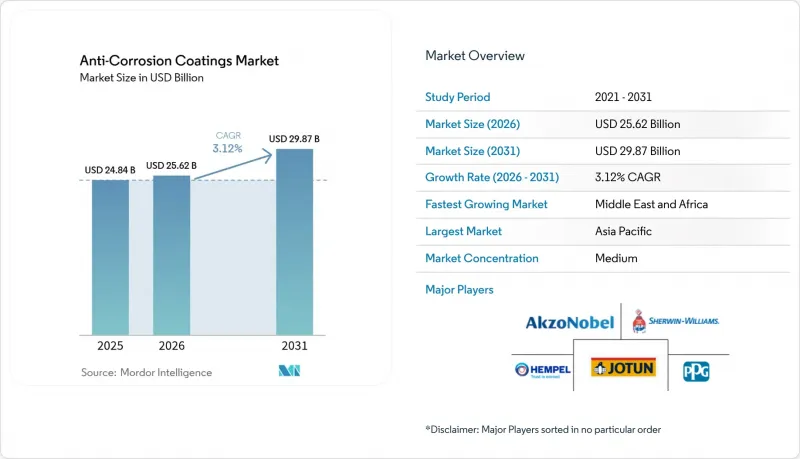
本報告按樹脂類型(環氧樹脂、聚酯樹脂、聚氨酯樹脂等)、技術(水性、溶劑型、粉末、紫外光固化)、終端用戶產業(石油天然氣、船舶、電力、基礎設施、工業、航太與國防等)以及地區(亞太地區、北美地區、歐洲地區、南美地區、中東和非洲)進行細分。市場預測以美元計價。
全球防腐蝕塗料市場趨勢及洞察
美國、歐盟和日本的基礎建設更新超級週期
在這三個成熟經濟體中,橋樑、隧道和鐵路設施正同時老化。美國已累計1,100億美元用於公路和橋樑建設,各州交通部門現已強制要求鋼骨使用符合SSPC-Paint 36標準的三層環氧聚氨酯塗層系統。日本國土交通省報告稱,2025年,該國73萬座橋樑中有63%將超過50年歷史,並已表示計劃在2030年投資5.3兆美元(約350億美元)用於防腐蝕措施。同時,僅在德國,一項耗資28億歐元的計畫正在進行中,旨在維修4,000座高速公路橋樑。鑑於鋼結構的重新塗裝週期為15至25年,且標準組織強制要求符合ISO 12944-C5-M標準,這些同步進行的預算為防腐蝕塗料市場提供了強力的支撐。
離岸風力發電電場塗裝需求激增
2025年底,離岸風力發電裝置容量將達到75吉瓦,所有單樁、過渡段和海上變電站都需要多層鋅-環氧-聚矽氧烷塗層保護。奧斯特德公司(Olsted)的2.9吉瓦Hornsea 3專案需要經1萬小時鹽霧試驗驗證、使用壽命長達25年的塗層。在美國方面,預計到2032年,2024年拍賣的六個大西洋租賃區域將需要約18萬噸塗層。由於全球只有不到20家船廠擁有DNV認證的離岸風力發電設備製造資質,塗層規格受到嚴格控制,防腐蝕塗層市場正轉向具有高品質化學成分的產品,這些產品的價格溢價高達30-40%。
全球揮發性有機化合物/異氰酸酯暴露限值收緊
歐盟指令2020/1149規定,所有處理濃度超過0.1%的二異氰酸酯的歐洲工人必須完成認可的培訓,每個工廠的合規成本為5,000至15,000歐元。歐洲化學品管理局(ECHA)計劃在2029年前實施6 µg NCO/m³的基準值,該標準比現行標準嚴格約10倍。美國也正在效仿,職業安全與健康管理局(OSHA)提案NCO限值設為5 µg NCO/m³。雖然這些法規對溶劑型聚氨酯產品線造成了影響,但也促使買家轉向水性分散體,儘管4-6小時的乾燥時間會降低工廠的生產效率。
細分市場分析
到2025年,環氧樹脂系統將佔據防腐蝕塗料市場38.98%的佔有率,其優勢在於對鋼材的良好附著力以及與陰極防蝕方法的兼容性。隨著煉油廠、管線營運商和海上平台對儲槽內襯和防濺區屏障進行翻新,預計環氧樹脂防腐蝕塗料市場將穩定成長。由於陸上風力渦輪機塔筒、太陽能發電框架和幕牆鋼材需要具備紫外線穩定性和保色性,聚氨酯的需求正以3.81%的複合年成長率快速成長。
醇酸樹脂和聚酯樹脂在對成本敏感的細分市場中仍然佔有一席之地,但其成長速度落後於整個防腐蝕塗料市場。環氧底漆和聚氨酯面漆相結合的混合體係正在模糊品類界限,並使那些透過加速老化試驗證明交聯相容性的供應商受益。阿克蘇諾貝爾在2024年至2025年間獲得的14項專利重點介紹了自修復和腐蝕感測型顏料,這些顏料代表了下一代化學技術,預計將維護週期延長至25年以上,從而進一步鞏固其在防腐蝕塗料行業的領先地位。
區域分析
到2025年,亞太地區將佔全球防腐蝕塗料市場佔有率的46.72%。這主要得益於中國新建的八座煉油廠(總合合計達240萬桶)以及印度沿海管線的維修工程。此外,隨著東南亞業者鋪設1.8萬公里防腐蝕海底管線,以及日本政府投資5.3兆日圓用於橋樑維修以延長其使用壽命,該地區的防腐塗料市場正在進一步擴張。
在北美,美國高達1,100億美元的橋樑建設預算推動了對SSPC認證的三層塗層系統的需求,而加拿大油砂項目則保證了高溫環氧酚塗料訂單的強勁成長。歐洲20%的市佔率主要得益於北海離岸風力發電項目和德國高速公路橋樑翻新項目,這兩個項目均指定使用符合ISO 12944-C5-M標準的塗料,從而推高了價格。
中東和非洲地區是成長最快的地區,複合年成長率達3.41%。沙烏地阿美公司投資120億美元的Marjan和Beli擴建項目、阿布達比國家石油公司(ADNOC)的Sourgas 大型企劃以及沿岸地區的海水淡化廠,都為能夠滿足硫化氫和鹽水暴露標準的供應商帶來了穩定的訂單。拉丁美洲和南亞地區落後於上述地區,但預計巴西石油公司在印度的鹽層下下層維護和港口建設項目將帶來間歇性的需求激增。這種多元化的市場環境使得防腐蝕塗料市場保持地理分散,避免了對單一需求中心的過度依賴。
其他好處:
- Excel格式的市場預測(ME)表
- 3個月的分析師支持
目錄
第1章:引言
- 研究假設和市場定義
- 調查範圍
第2章:調查方法
第3章執行摘要
第4章 市場狀況
- 市場概覽
- 市場促進因素
- 美國、歐盟和日本的基礎建設更新超級週期
- 離岸風力發電電廠塗裝熱潮
- 為延長亞太地區海上管道的使用壽命而進行的支出
- 國際海事組織 (IMO) 的 CII 法規增加了船體重新塗漆的頻率。
- 由於受管制物質污染問題,LNG接收站需要進行技術升級。
- 市場限制因素
- 全球對揮發性有機化合物/異氰酸酯的暴露限值正在收緊。
- 環氧樹脂(Bis-A、ECH)原物料價格上漲
- 石油和天然氣產業低迷時期延後資本投資
- 價值鏈分析
- 波特五力模型
第5章 市場規模與成長預測
- 依樹脂類型
- 環氧樹脂
- 醇酸樹脂
- 聚酯纖維
- 聚氨酯
- 乙烯基酯
- 其他樹脂類型
- 透過技術
- 水溶液
- 溶劑型
- 粉末
- 紫外線固化型
- 按最終用戶行業分類
- 石油和天然氣
- 海上
- 電力
- 基礎設施
- 產業
- 航太/國防
- 運輸
- 其他終端用戶產業
- 按地區
- 亞太地區
- 中國
- 印度
- 日本
- 韓國
- 東南亞國協
- 其他亞太國家
- 北美洲
- 美國
- 加拿大
- 墨西哥
- 歐洲
- 德國
- 英國
- 法國
- 西班牙
- 義大利
- 北歐國家
- 其他歐洲國家
- 南美洲
- 巴西
- 阿根廷
- 其他南美國家
- 中東和非洲
- 沙烏地阿拉伯
- 阿拉伯聯合大公國
- 南非
- 奈及利亞
- 其他中東和非洲國家
- 亞太地區
第6章 競爭情勢
- 市場集中度
- 策略趨勢
- 市佔率和排名分析
- 公司簡介
- Akzo Nobel NV
- Axalta Coating Systems, LLC
- BASF
- Beckers Group
- Berger Paints India
- Carboline
- Chugoku Marine Paints, Ltd.
- HB Fuller Company
- Hempel A/S
- Jotun
- Kansai Paint Co., Ltd.
- Nippon Paint Holdings Co., Ltd.
- PPG Industries, Inc.
- RPM International Inc.
- Sika AG
- Teknos Group
- The Sherwin-Williams Company
- Tikkurila
第7章 市場機會與未來展望
According to Mordor Intelligence, the anti-Corrosion coatings market size was valued at USD 24.84 billion in 2025 and is estimated to grow from USD 25.62 billion in 2026 to reach USD 29.87 billion by 2031, at a CAGR of 3.12% during the forecast period (2026-2031).
This report is Segmented by Resin Type (Epoxy, Polyester, Polyurethane, and More), Technology (Water-Borne, Solvent-Borne, Powder, and UV-Cured), End-User Industry (Oil and Gas, Marine, Power, Infrastructure, Industrial, Aerospace and Defense, and More), and Geography (Asia-Pacific, North America, Europe, South America, and Middle East and Africa). The Market Forecasts are Provided in Terms of Value (USD).
Global Anti-Corrosion Coatings Market Trends and Insights
Infrastructure-Renewal Super-Cycle in US, European Union and Japan
Bridge, tunnel, and rail assets are aging in lockstep across three mature economies. The United States has earmarked USD 110 billion for roads and bridges; state transportation agencies now require three-coat epoxy-polyurethane systems that meet SSPC-Paint 36 for steel structures. Japan's Ministry of Land, Infrastructure, Transport and Tourism reported in 2025 that 63% of the nation's 730,000 bridges exceed 50 years of age, unlocking JPY 5.3 trillion (USD 35 billion) for corrosion remediation through 2030. Meanwhile, Germany alone is replacing 4,000 Autobahn bridges under an EUR 2.8 billion initiative. These synchronized budgets create a durable floor for the Anti-Corrosion Coatings market, as steel recoating cycles last 15-25 years and specification bodies insist on ISO 12944-C5-M compliance.
Offshore Wind-Farm Coating Boom
Installed offshore-wind capacity reached 75 GW by late 2025, and every monopile, transition piece, and offshore substation demands multi-layer zinc-epoxy-polysiloxane protection. Orsted's 2.9 GW Hornsea Three project requires 25-year service-life coatings approved after 10,000-hour salt-spray testing. On the US side, six Atlantic lease areas auctioned in 2024 will need roughly 180,000 tons of coatings through 2032. Because fewer than 20 global yards hold DNV certification for offshore-wind fabrication, coating specifications are tightly controlled, pushing the Anti-Corrosion Coatings market toward premium chemistries that command 30-40% price premiums.
Global VOC / Isocyanate Exposure Caps Tightening
Directive 2020/1149 compels every European worker handling >0.1% diisocyanate to complete certified training, adding EUR 5,000-15,000 per facility in compliance costs. The European Chemicals Agency will enforce a 6 µg NCO/m3 limit by 2029, roughly 10 times stricter than prior levels. The United States is following with a proposed OSHA 5 µg NCO/m3 limit. These caps penalize solvent polyurethane lines and nudge buyers toward water-borne dispersions, though 4-6 hour dry times hamper throughput in fabrication shops.
Other drivers and restraints analyzed in the detailed report include:
- Offshore Pipeline Life-Extension Spend in Asia-Pacific
- IMO CII Rules Driving More Frequent Hull Recoating
- Epoxy Raw-Material Price Spikes (Bis-A, ECH)
For complete list of drivers and restraints, kindly check the Table Of Contents.
Segment Analysis
Epoxy systems represented 38.98% of the Anti-Corrosion Coatings market share in 2025, underscoring the chemistry's adhesion to steel and compatibility with cathodic-protection schemes. The Anti-Corrosion Coatings market size attributable to epoxy is projected to climb at a steady clip as refiners, pipeline operators, and offshore platforms renew tank linings and splash-zone barriers. Polyurethane demand is rising faster, expanding 3.81% CAGR, because onshore wind towers, solar frames, and facade steel require UV stability and color retention.
Alkyd and polyester resins persist in cost-sensitive niches, yet their growth trails the overall Anti-Corrosion Coatings market. Hybrid epoxy-primer plus polyurethane topcoat systems are blurring category lines, rewarding suppliers that validate cross-link compatibility through accelerated weathering. Self-healing and corrosion-sensing pigments, highlighted by 14 Akzo Nobel patents in 2024-25, point to next-generation chemistries that could elongate maintenance intervals beyond 25 years, strengthening premium positions within the Anti-Corrosion Coatings industry.
Complete Report Scope:
- By Resin Type
- Epoxy
- Alkyds
- Polyester
- Polyurethane
- Vinyl Ester
- Other Resin Types
- By Technology
- Water-borne
- Solvent-borne
- Powder
- UV-cured
- By End-user Industry
- Oil and Gas
- Marine
- Power
- Infrastructure
- Industrial
- Aerospace and Defense
- Transportation
- Other End-user Industries
- By Geography
- Asia-Pacific
- China
- India
- Japan
- South Korea
- ASEAN Countries
- Rest of Asia-Pacific
- North America
- United States
- Canada
- Mexico
- Europe
- Germany
- United Kingdom
- France
- Spain
- Italy
- NORDIC Countries
- Rest of Europe
- South America
- Brazil
- Argentina
- Rest of South America
- Middle-East and Africa
- Saudi Arabia
- United Arab Emirates
- South Africa
- Nigeria
- Rest of Middle-East and Africa
- Asia-Pacific
Geography Analysis
Asia-Pacific generated 46.72% of the Anti-Corrosion Coatings market revenue in 2025, backed by China's eight new refineries totaling 2.4 million b/d and India's coastal pipeline rehabilitation initiatives. The Anti-Corrosion Coatings market size in the region swells further as Southeast Asian operators extend 18,000 km of subsea lines and Japanese authorities funnel JPY 5.3 trillion into bridge lifeline upgrades.
In North America, the USD 110 billion US bridge budget is channeling demand for SSPC-certified three-coat systems, while Canada's oil sands keep high-temperature epoxy-phenolic orders consistent. Europe's 20% share rides on North Sea offshore wind and Autobahn bridge replacements, both specifying ISO 12944-C5-M coatings that drive premium pricing.
The Middle East & Africa is the fastest rising geography at 3.41% CAGR. Saudi Aramco's USD 12 billion Marjan and Berri expansions, ADNOC's sour-gas megaproject, and Gulf desalination plants collectively ensure steady throughput for suppliers able to meet hydrogen-sulfide and brine-exposure criteria. Latin America and South Asia trail but offer episodic surges tied to Petrobras pre-salt maintenance and Indian port construction. This mosaic keeps the Anti-Corrosion Coatings market geographically diversified, limiting overreliance on a single demand hub.
- Akzo Nobel N.V.
- Axalta Coating Systems, LLC
- BASF
- Beckers Group
- Berger Paints India
- Carboline
- Chugoku Marine Paints, Ltd.
- H.B. Fuller Company
- Hempel A/S
- Jotun
- Kansai Paint Co., Ltd.
- Nippon Paint Holdings Co., Ltd.
- PPG Industries, Inc.
- RPM International Inc.
- Sika AG
- Teknos Group
- The Sherwin-Williams Company
- Tikkurila
Additional Benefits:
- The market estimate (ME) sheet in Excel format
- 3 months of analyst support
TABLE OF CONTENTS
1 Introduction
- 1.1 Study Assumptions and Market Definition
- 1.2 Scope of the Study
2 Research Methodology
3 Executive Summary
4 Market Landscape
- 4.1 Market Overview
- 4.2 Market Drivers
- 4.2.1 Infrastructure-renewal super-cycle in US, European Union and Japan
- 4.2.2 Offshore wind-farm coating boom
- 4.2.3 Offshore pipeline life-extension spend in Asia-Pacific
- 4.2.4 IMO CII rules driving more frequent hull recoating
- 4.2.5 CUI-driven specification upgrades at LNG terminals
- 4.3 Market Restraints
- 4.3.1 Global VOC / isocyanate exposure caps tightening
- 4.3.2 Epoxy raw-material price spikes (Bis-A, ECH)
- 4.3.3 Deferred CAPEX in oil-&-gas downturn cycles
- 4.4 Value Chain Analysis
- 4.5 Porter's Five Forces
- 4.5.1 Bargaining Power of Suppliers
- 4.5.2 Bargaining Power of Buyers
- 4.5.3 Threat of New Entrants
- 4.5.4 Threat of Substitutes
- 4.5.5 Degree of Competition
5 Market Size and Growth Forecasts (Value)
- 5.1 By Resin Type
- 5.1.1 Epoxy
- 5.1.2 Alkyds
- 5.1.3 Polyester
- 5.1.4 Polyurethane
- 5.1.5 Vinyl Ester
- 5.1.6 Other Resin Types
- 5.2 By Technology
- 5.2.1 Water-borne
- 5.2.2 Solvent-borne
- 5.2.3 Powder
- 5.2.4 UV-cured
- 5.3 By End-user Industry
- 5.3.1 Oil and Gas
- 5.3.2 Marine
- 5.3.3 Power
- 5.3.4 Infrastructure
- 5.3.5 Industrial
- 5.3.6 Aerospace and Defense
- 5.3.7 Transportation
- 5.3.8 Other End-user Industries
- 5.4 By Geography
- 5.4.1 Asia-Pacific
- 5.4.1.1 China
- 5.4.1.2 India
- 5.4.1.3 Japan
- 5.4.1.4 South Korea
- 5.4.1.5 ASEAN Countries
- 5.4.1.6 Rest of Asia-Pacific
- 5.4.2 North America
- 5.4.2.1 United States
- 5.4.2.2 Canada
- 5.4.2.3 Mexico
- 5.4.3 Europe
- 5.4.3.1 Germany
- 5.4.3.2 United Kingdom
- 5.4.3.3 France
- 5.4.3.4 Spain
- 5.4.3.5 Italy
- 5.4.3.6 NORDIC Countries
- 5.4.3.7 Rest of Europe
- 5.4.4 South America
- 5.4.4.1 Brazil
- 5.4.4.2 Argentina
- 5.4.4.3 Rest of South America
- 5.4.5 Middle-East and Africa
- 5.4.5.1 Saudi Arabia
- 5.4.5.2 United Arab Emirates
- 5.4.5.3 South Africa
- 5.4.5.4 Nigeria
- 5.4.5.5 Rest of Middle-East and Africa
- 5.4.1 Asia-Pacific
6 Competitive Landscape
- 6.1 Market Concentration
- 6.2 Strategic Moves
- 6.3 Market Share(%)/Ranking Analysis
- 6.4 Company Profiles (includes Global Overview, Market Overview, Core Segments, Financials, Strategic Information, Products and Services, Recent Developments)
- 6.4.1 Akzo Nobel N.V.
- 6.4.2 Axalta Coating Systems, LLC
- 6.4.3 BASF
- 6.4.4 Beckers Group
- 6.4.5 Berger Paints India
- 6.4.6 Carboline
- 6.4.7 Chugoku Marine Paints, Ltd.
- 6.4.8 H.B. Fuller Company
- 6.4.9 Hempel A/S
- 6.4.10 Jotun
- 6.4.11 Kansai Paint Co., Ltd.
- 6.4.12 Nippon Paint Holdings Co., Ltd.
- 6.4.13 PPG Industries, Inc.
- 6.4.14 RPM International Inc.
- 6.4.15 Sika AG
- 6.4.16 Teknos Group
- 6.4.17 The Sherwin-Williams Company
- 6.4.18 Tikkurila
7 Market Opportunities and Future Outlook
- 7.1 White-space and Unmet-need Assessment

 耐腐蝕塗層:市場佔有率分析、行業趨勢和統計數據以及成長預測(2026-2031 年)
 全球防腐蝕塗料市場:機會與策略展望(至2035年)
 防腐蝕塗料市場-2026-2032年全球市場預測
 防腐蝕塗料市場:預測至2034年-按塗料類型、技術、應用和地區分類的全球分析防腐蝕塗料市場:按類型、樹脂化學性質、技術、基材、產品形式、應用、最終用途產業和銷售管道分類-2026-2032年全球市場預測
 全球耐腐蝕橡膠產品市場展望、詳細分析及至 2032 年的預測。奈米工程塗層市場預測至2034年-全球分析(按塗層類型、奈米材料類型、技術、基材類型、應用、最終用戶和地區分類)
 防腐蝕塗料市場規模、佔有率和成長分析:按塗料類型、技術、應用、終端用戶產業、基材類型、功能和地區分類-2026-2033年產業預測
 全球防腐蝕塗料市場規模、佔有率、趨勢和成長分析報告(2026-2034)
 防腐蝕包裝市場:商機、成長要素、產業趨勢分析及2026-2035年預測