


 |
市場調查報告書
商品編碼
2118956
耐腐蝕塗層:市場佔有率分析、行業趨勢和統計數據以及成長預測(2026-2031 年)Corrosion Protection Coating - Market Share Analysis, Industry Trends & Statistics, Growth Forecasts (2026 - 2031) |
||||||

※ 本網頁內容可能與最新版本有所差異。詳細情況請與我們聯繫。
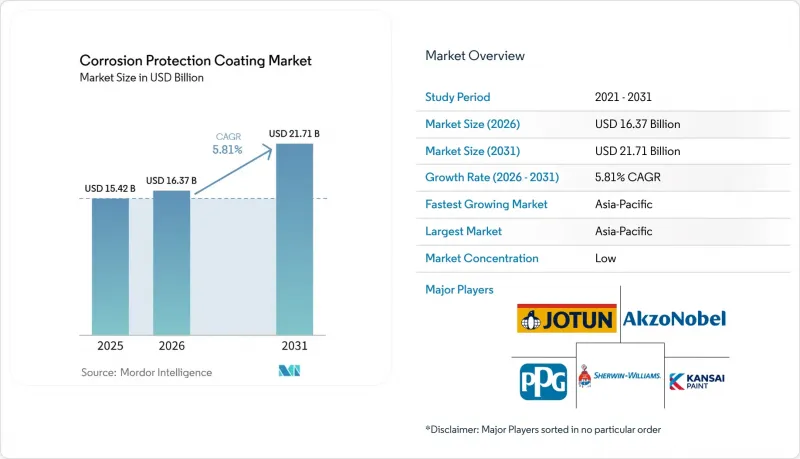
據 Mordor Intelligence 稱,防腐蝕塗料市場預計在 2025 年達到 154.2 億美元,預計在預測期(2026-2031 年)內將以 5.81% 的複合年成長率成長,從 2026 年的 163.7 億美元成長到 2031 年的 217.1 億美元。
本報告按樹脂類型(環氧樹脂、聚氨酯等)、技術(水性、溶劑型等)、終端用戶產業(造船、石油天然氣等)和地區(亞太、北美、歐洲、南美、中東和非洲)進行細分。市場預測以美元計價。
全球耐腐蝕塗料市場趨勢及洞察
增加對基礎設施維修和維護活動的投資
在多個地區,基礎設施維修仍然是防腐蝕塗料需求的重要促進因素。橋樑、水處理設施、港口、機場和道路維修都需要根據專案規範量身定做的防護系統。橋樑鋼骨和管道網路在建成後需要維護,因此對重新塗裝的需求持續存在。此外,與新建設施相比,現有結構需要更複雜的表面處理、防護措施和環境管理。這些因素可能會促使人們使用高黏度環氧底漆和聚氨酯面漆,有助於降低未來營運停機的風險。在東南亞和海灣合作理事會(GCC)地區,隨著基礎設施的持續發展,對初始塗層的需求也不斷成長。
離岸風電、海洋和沿海基礎設施的擴張正在推動對防腐蝕塗料的需求。
離岸風力發電正在擴大惡劣海洋環境下防腐蝕塗料的市場。預計2025年,全球離岸風力發電裝置容量將達到57吉瓦,到2030年將超過120吉瓦。單樁、過渡段和陣列間電纜需要設計成能夠承受水下和大氣環境下長達25年的腐蝕的系統。這些要求促使人們青睞優質的鋅、環氧樹脂和聚氨酯塗層系統,這些系統的價格比標準大氣塗層高出30%至40%。 2010年代中期在北海安裝的項目正進入大規模維護週期,除了新建設外,售後市場需求也不斷成長。 DNV-ST-0437對耐腐蝕葉片保護的要求有利於擁有認證特種產品的供應商。
防護塗層系統表面處理和施工成本高昂
在複雜的工業和海上維修項目中,表面處理成本在塗裝第一層底漆之前可能佔總成本的40%到60%。噴砂清理、圍護措施、環保法規的合規性以及作業設備都會推高所安裝防護系統的總成本。如果必須在有限的停機時間內去除舊漆,這項挑戰將更加突出。北美和歐洲不斷上漲的現場人事費用使得工廠塗裝系統在設備設計允許的情況下成為更具吸引力的選擇。雖然使用水性工廠底漆可以在一定程度上減少新鋼材的現場噴砂需求,但這並不會改變現有設備維修的成本結構。如果實施符合標準的系統的成本超出小規模企業的短期預算,他們可能會推遲重新塗裝,從而導致未來維修和更換需求的增加。
細分市場分析
環氧樹脂因其在各種腐蝕環境下的廣泛應用,預計到2025年將佔據防腐蝕塗料市場39.92%的佔有率。這項預測已在ISO 12944和NORSOK M-501認證體系庫中得到證實,涵蓋從C3大氣暴露環境到C5-M海洋環境的各個層級。聚氨酯通常用作環氧底漆的面漆,可提供抗紫外線性能和優異的表面光潔度。這種組合是海洋和基礎設施項目中高品質多層塗層規範的基礎。丙烯酸和醇酸樹脂產品在需求較低的C2和C3應用領域仍佔據重要地位,因為價格因素在這些應用中更為關鍵。這些產品常用於一般建築和輕工業維護。
預計到2031年,乙烯基酯的複合年成長率將達到6.73%,是所有樹脂類型中成長率最高的。乙烯基酯防腐塗料市場受益於其在化學浸沒環境中的應用,而這些應用範圍超出了環氧塗料的典型使用範圍。排煙脫硫系統、酸液儲存系統和海水淡化廠是其主要應用案例。一項發表於2026年的研究發現,雖然複合環氧樹脂的氫阻隔性能為10 MPa,但乙烯基酯樹脂在氫氣和水分共同作用下表現出更優異的性能。這種性能差異可能會影響氫氣儲存和運輸設備的塗層規格。儘管氯化橡膠仍然作為一種小眾的船舶底漆使用,但矽酮和氟聚合物產品在極端溫度環境和隔熱材料下腐蝕(CIU)環境中的應用日益廣泛。
區域分析
預計到2025年,亞太地區將佔全球耐腐蝕塗料市場佔有率的42.71%,並在2031年之前以6.32%的複合年成長率成長。中國佔該地區消費量的56%以上,主要驅動力來自造船、離岸風力發電、液化天然氣(LNG)接收站和石化聯合企業。綠氫能的發展正在推動現有造船和油氣產業的需求。韓國和日本透過商業造船以及對船體、安定器艙和上層建築塗料系統的需求,為市場做出貢獻。印度透過基礎設施投資和擴大石化產能來推動需求,產品規格正向高性能產品轉變。
北美和歐洲各自擁有獨特但穩定的需求基礎。美國的基礎建設支出支撐著橋樑、航道和水利設施的維護工作,而煉油廠和管線的檢修作業則推動了對工業塗料的需求。歐盟2030年可再生能源目標正在推動北海和波羅的海離岸風力發電計畫的需求。 2025年,漢高推出了用於防腐蝕應用的Avantguard 750 Pro。德國、英國、法國和義大利仍然是工業維護工作的主要中心。
南美洲、中東和非洲在防腐蝕塗料市場中所佔佔有率相對較小。在巴西和阿根廷,管道維修和海上鹽層下開發正在推進,這催生了對用於資產維護的水下和隔熱材料下防腐系統的需求。沙烏地阿拉伯的「2030願景」計畫以及海灣合作理事會(GCC)成員國石化產業的擴張,也推動了對耐高溫和耐化學腐蝕系統的需求。在南非和其他撒哈拉以南非洲國家,採礦基礎設施、港口和水處理項目正在創造需求。在這些市場,符合國際標準的首層塗層規範正日益應用。
其他好處:
- Excel格式的市場預測(ME)表
- 3個月的分析師支持
目錄
第1章:引言
- 研究假設和市場定義
- 調查範圍
第2章:調查方法
第3章執行摘要
第4章 市場狀況
- 市場概覽
- 市場促進因素
- 增加對基礎設施維修和維護活動的投資
- 離岸風力發電和海洋及沿海基礎設施的擴張正在推動對防護塗料的需求。
- 為了回應環境法規的要求,低VOC和水性塗料技術正在逐步推廣應用。
- 智慧塗層和預測性維護技術的進步
- 電池、氫氣和清潔能源基礎設施對防腐蝕的要求日益提高。
- 市場限制因素
- 防護塗層系統表面處理和施工成本高昂
- 原料價格波動,包括環氧樹脂和溶劑。
- 關鍵工業應用的長期認證和批准流程
- 價值鏈分析
- 波特五力分析
第5章 市場規模與成長預測
- 依樹脂類型
- 環氧樹脂
- 聚氨酯
- 丙烯酸纖維
- 阿爾基多
- 乙烯基酯
- 橡膠氯
- 其他樹脂類型
- 透過技術
- 水溶液
- 溶劑型
- 粉末塗裝
- 其他技術
- 按最終用戶行業分類
- 海上
- 石油和天然氣
- 石油化工
- 基礎設施
- 發電
- 水處理
- 其他終端用戶產業
- 按地區
- 亞太地區
- 中國
- 印度
- 日本
- 韓國
- 其他亞太國家
- 北美洲
- 美國
- 加拿大
- 墨西哥
- 歐洲
- 德國
- 英國
- 法國
- 義大利
- 俄羅斯
- 其他歐洲國家
- 南美洲
- 巴西
- 阿根廷
- 其他南美國家
- 中東和非洲
- 沙烏地阿拉伯
- 南非
- 其他中東和非洲國家
- 亞太地區
第6章 競爭情勢
- 市場集中度
- 策略趨勢
- 市佔率和排名分析
- 公司簡介
- Akzo Nobel NV
- Ashland Inc.
- Asian Paints Limited
- Axalta Coating Systems Ltd.
- Berger Paints India Limited
- Carboline Company
- Hempel A/S
- Jotun
- Kansai Paint Co.,Ltd.
- KCC Corporation
- Nippon Paint Holdings Co., Ltd.
- PPG Industries, Inc.
- RPM International Inc.
- Sika AG
- Teknos Group
- The Sherwin-Williams Company
- Tnemec
- Wacker Chemie AG
第7章 市場機會與未來展望
According to Mordor Intelligence, the corrosion protection coating market size was estimated at USD 15.42 billion in 2025 and is projected to grow from USD 16.37 billion in 2026 to USD 21.71 billion by 2031, at a CAGR of 5.81% during the forecast period (2026-2031).
This report is Segmented by Resin Type (Epoxy, Polyurethane, and More), Technology (Water-Based, Solvent-Based, and More), End-User Industry (Marine, Oil and Gas, and More), and Geography (Asia-Pacific, North America, Europe, South America, and Middle-East and Africa). The Market Forecasts are Provided in Terms of Value (USD).
Global Corrosion Protection Coating Market Trends and Insights
Increasing Investments in Infrastructure Rehabilitation and Maintenance Activities
Infrastructure rehabilitation remains a reliable driver of demand for corrosion protection coatings across several regions. Bridge, water treatment, port, airport, and road upgrades require protective systems under project specifications. Recoating programs create recurring demand because bridge steel and pipeline networks require maintenance after their initial construction. Existing structures also require more complex surface preparation, containment, and environmental controls than new assets. These conditions can encourage the use of high-build epoxy primers and polyurethane topcoats, which help limit future shutdown risk. Southeast Asia and the Gulf Cooperation Council also add first-coat demand through ongoing infrastructure development.
Expansion of Offshore Wind, Marine, and Coastal Infrastructure Driving Demand for Protective Coatings
Offshore wind is expanding the corrosion protection coating market in a demanding marine application. Global offshore wind capacity reached 57 GW in 2025 and is expected to exceed 120 GW by 2030. Monopiles, transition pieces, and inter-array cabling need systems designed for 25-year exposure in immersion and atmospheric conditions. These requirements support premium zinc, epoxy, and polyurethane systems, which command a 30% to 40% premium over standard atmospheric specifications. North Sea projects installed during the mid-2010s are approaching major maintenance cycles, adding aftermarket demand beyond new construction. DNV-ST-0437 requirements for erosion-resistant blade protection favor suppliers with qualified specialist products.
High Surface Preparation and Application Costs for Protective Coating Systems
Surface preparation can account for 40% to 60% of the total cost of complex industrial and offshore rehabilitation work before the first coat is applied. Blast cleaning, containment, environmental compliance, and access equipment increase the overall cost of installed protective systems. This challenge is more pronounced when old coatings must be removed during limited operating shutdowns. Rising field labor costs in North America and Europe make shop-applied systems more attractive where asset design permits their use. Waterborne shop primers can reduce some field sandblasting requirements for new steel, but they do not change the cost structure of existing asset rehabilitation. Smaller operators may defer recoating when compliant systems exceed their short-term budgets, increasing the need for later repairs or replacements.
Other drivers and restraints analyzed in the detailed report include:
- Rising Adoption of Low-VOC and Water-Based Coating Technologies to Meet Environmental Regulations
- Advancements in Smart Coatings and Predictive Asset Monitoring Technologies
- Volatility in Raw Material Prices, Including Epoxy Resins and Solvents
For complete list of drivers and restraints, kindly check the Table Of Contents.
Segment Analysis
Epoxy held 39.92% of the corrosion protection coating market share in 2025, supported by its use across a wide range of corrosion categories. It is established in ISO 12944- and NORSOK M-501-approved system libraries, from C3 atmospheric exposure to C5-M offshore settings. Polyurethane typically serves as a topcoat over epoxy primers, providing ultraviolet resistance and improved surface finish performance. This combination supports premium multi-coat specifications in marine and infrastructure projects. Acrylic and alkyd products retain meaningful use in lower-demand C2 and C3 applications, where price has greater influence. Their use is common in general construction and light industrial maintenance.
Vinyl ester is forecast to record a 6.73% CAGR through 2031, the fastest rate among resin types. The corrosion protection coating market for vinyl ester benefits from applications involving chemical immersion beyond the typical operating range of epoxy coatings. Flue gas desulfurization equipment, acid containment, and desalination assets are important use cases. Research published in 2026 found that formulated epoxy can provide hydrogen-barrier protection at 10 MPa, while vinyl ester performs better under combined hydrogen and moisture exposure. This performance difference may influence coating specifications for hydrogen storage and transport assets. Chlorinated rubber remains a niche marine primer option, while silicone and fluoropolymer products are gaining use in extreme-temperature and corrosion-under-insulation settings.
Complete Report Scope:
- By Resin Type
- Epoxy
- Polyurethane
- Acrylic
- Alkyd
- Vinyl Ester
- Chlorinated Rubber
- Other Resin Types
- By Technology
- Water-Based
- Solvent-Based
- Powder Coatings
- Other Technologies
- By End-User Industry
- Marine
- Oil and Gas
- Petrochemical
- Infrastructure
- Power Generation
- Water Treatment
- Other End-User Industries
- By Geography
- Asia-Pacific
- China
- India
- Japan
- South Korea
- Rest of Asia-Pacific
- North America
- United States
- Canada
- Mexico
- Europe
- Germany
- United Kingdom
- France
- Italy
- Russia
- Rest of Europe
- South America
- Brazil
- Argentina
- Rest of South America
- Middle-East and Africa
- Saudi Arabia
- South Africa
- Rest of Middle-East and Africa
- Asia-Pacific
Geography Analysis
Asia-Pacific accounted for 42.71% of the corrosion protection coating market in 2025 and is projected to grow at a CAGR of 6.32% through 2031. China represented more than 56% of regional consumption, driven by shipbuilding, offshore wind, Liquefied Natural Gas (LNG) terminals, and petrochemical complexes. Green hydrogen development is adding to existing marine and oil-and-gas demand. South Korea and Japan contribute through commercial shipbuilding and demand for hull, ballast tank, and superstructure coating systems. India adds volume through infrastructure investment and expanding petrochemical capacity, with specifications shifting toward higher-performance products.
North America and Europe have distinct but stable demand bases. Infrastructure disbursements in the United States support maintenance work on bridges, waterways, and water assets, while refinery and pipeline turnaround activity drives demand for industrial coatings. The European Union's renewable energy targets for 2030 are concentrating demand on offshore wind projects in the North and Baltic Seas. In 2025, Hempel introduced Avantguard 750 Pro for corrosion protection applications. Germany, the United Kingdom, France, and Italy remain key locations for industrial maintenance work.
South America, the Middle-East, and Africa hold smaller shares of the corrosion protection coating market. Brazil and Argentina benefit from pipeline rehabilitation and offshore pre-salt development, with asset integrity work requiring immersion-zone and corrosion-under-insulation systems. Saudi Arabia's Vision 2030 program and petrochemical expansion across the Gulf Cooperation Council support demand for high-temperature, chemical-resistant systems. South Africa and other sub-Saharan countries generate demand through mining infrastructure, ports, and water treatment projects. These markets are increasingly adopting first-coat specifications aligned with international standards.
- Akzo Nobel N.V.
- Ashland Inc.
- Asian Paints Limited
- Axalta Coating Systems Ltd.
- Berger Paints India Limited
- Carboline Company
- Hempel A/S
- Jotun
- Kansai Paint Co.,Ltd.
- KCC Corporation
- Nippon Paint Holdings Co., Ltd.
- PPG Industries, Inc.
- RPM International Inc.
- Sika AG
- Teknos Group
- The Sherwin-Williams Company
- Tnemec
- Wacker Chemie AG
Additional Benefits:
- The market estimate (ME) sheet in Excel format
- 3 months of analyst support
TABLE OF CONTENTS
1 Introduction
- 1.1 Study Assumptions and Market Definition
- 1.2 Scope of the Study
2 Research Methodology
3 Executive Summary
4 Market Landscape
- 4.1 Market Overview
- 4.2 Market Drivers
- 4.2.1 Increasing Investments in Infrastructure Rehabilitation and Maintenance Activities
- 4.2.2 Expansion of Offshore Wind, Marine, and Coastal Infrastructure Driving Demand for Protective Coatings
- 4.2.3 Rising Adoption of Low-VOC and Water-Based Coating Technologies to Meet Environmental Regulations
- 4.2.4 Advancements in Smart Coatings and Predictive Asset Monitoring Technologies
- 4.2.5 Growing Corrosion Protection Requirements in Battery, Hydrogen, and Clean Energy Infrastructure
- 4.3 Market Restraints
- 4.3.1 High Surface Preparation and Application Costs for Protective Coating Systems
- 4.3.2 Volatility in Raw Material Prices, Including Epoxy Resins and Solvents
- 4.3.3 Lengthy Qualification and Approval Processes for Critical Industrial Applications
- 4.4 Value Chain Analysis
- 4.5 Porter's Five Forces Analysis
- 4.5.1 Threat of New Entrants
- 4.5.2 Bargaining Power of Suppliers
- 4.5.3 Bargaining Power of Buyers
- 4.5.4 Threat of Substitutes
- 4.5.5 Competitive Rivalry
5 Market Size and Growth Forecasts (Value and Volume)
- 5.1 By Resin Type
- 5.1.1 Epoxy
- 5.1.2 Polyurethane
- 5.1.3 Acrylic
- 5.1.4 Alkyd
- 5.1.5 Vinyl Ester
- 5.1.6 Chlorinated Rubber
- 5.1.7 Other Resin Types
- 5.2 By Technology
- 5.2.1 Water-Based
- 5.2.2 Solvent-Based
- 5.2.3 Powder Coatings
- 5.2.4 Other Technologies
- 5.3 By End-User Industry
- 5.3.1 Marine
- 5.3.2 Oil and Gas
- 5.3.3 Petrochemical
- 5.3.4 Infrastructure
- 5.3.5 Power Generation
- 5.3.6 Water Treatment
- 5.3.7 Other End-User Industries
- 5.4 By Geography
- 5.4.1 Asia-Pacific
- 5.4.1.1 China
- 5.4.1.2 India
- 5.4.1.3 Japan
- 5.4.1.4 South Korea
- 5.4.1.5 Rest of Asia-Pacific
- 5.4.2 North America
- 5.4.2.1 United States
- 5.4.2.2 Canada
- 5.4.2.3 Mexico
- 5.4.3 Europe
- 5.4.3.1 Germany
- 5.4.3.2 United Kingdom
- 5.4.3.3 France
- 5.4.3.4 Italy
- 5.4.3.5 Russia
- 5.4.3.6 Rest of Europe
- 5.4.4 South America
- 5.4.4.1 Brazil
- 5.4.4.2 Argentina
- 5.4.4.3 Rest of South America
- 5.4.5 Middle-East and Africa
- 5.4.5.1 Saudi Arabia
- 5.4.5.2 South Africa
- 5.4.5.3 Rest of Middle-East and Africa
- 5.4.1 Asia-Pacific
6 Competitive Landscape
- 6.1 Market Concentration
- 6.2 Strategic Moves
- 6.3 Market Share (%)/Ranking Analysis
- 6.4 Company Profiles (includes Global Overview, Market Overview, Core Segments, Financials as available, Strategic Information, Products and Services, and Recent Developments)
- 6.4.1 Akzo Nobel N.V.
- 6.4.2 Ashland Inc.
- 6.4.3 Asian Paints Limited
- 6.4.4 Axalta Coating Systems Ltd.
- 6.4.5 Berger Paints India Limited
- 6.4.6 Carboline Company
- 6.4.7 Hempel A/S
- 6.4.8 Jotun
- 6.4.9 Kansai Paint Co.,Ltd.
- 6.4.10 KCC Corporation
- 6.4.11 Nippon Paint Holdings Co., Ltd.
- 6.4.12 PPG Industries, Inc.
- 6.4.13 RPM International Inc.
- 6.4.14 Sika AG
- 6.4.15 Teknos Group
- 6.4.16 The Sherwin-Williams Company
- 6.4.17 Tnemec
- 6.4.18 Wacker Chemie AG
7 Market Opportunities and Future Outlook
- 7.1 White-Space and Unmet-Need Assessment
- 7.2 Bio-Based and Lower-Carbon Binder Formulations

 全球防腐蝕塗料市場:機會與策略展望(至2035年)
 防腐蝕塗料:市場佔有率分析、產業趨勢與統計、成長預測(2026-2031)
 防腐蝕塗料市場-2026-2032年全球市場預測
 防腐蝕塗料市場:預測至2034年-按塗料類型、技術、應用和地區分類的全球分析防腐蝕塗料市場:按類型、樹脂化學性質、技術、基材、產品形式、應用、最終用途產業和銷售管道分類-2026-2032年全球市場預測
 全球耐腐蝕橡膠產品市場展望、詳細分析及至 2032 年的預測。奈米工程塗層市場預測至2034年-全球分析(按塗層類型、奈米材料類型、技術、基材類型、應用、最終用戶和地區分類)
 防腐蝕塗料市場規模、佔有率和成長分析:按塗料類型、技術、應用、終端用戶產業、基材類型、功能和地區分類-2026-2033年產業預測
 全球防腐蝕塗料市場規模、佔有率、趨勢和成長分析報告(2026-2034)
 防腐蝕包裝市場:商機、成長要素、產業趨勢分析及2026-2035年預測