


 |
市場調查報告書
商品編碼
2121486
雲端 MFT 服務:市場佔有率分析、產業趨勢與統計、成長預測(2026-2031 年)Cloud MFT Services - Market Share Analysis, Industry Trends & Statistics, Growth Forecasts (2026 - 2031) |
||||||

※ 本網頁內容可能與最新版本有所差異。詳細情況請與我們聯繫。
根據 Mordor Intelligence 預測,雲端 MFT 服務市場將從 2025 年的 22.4 億美元成長到 2026 年的 24.5 億美元,然後在 2031 年達到 38.4 億美元,2026 年至 2031 年的複合年成長率為 9.40%。
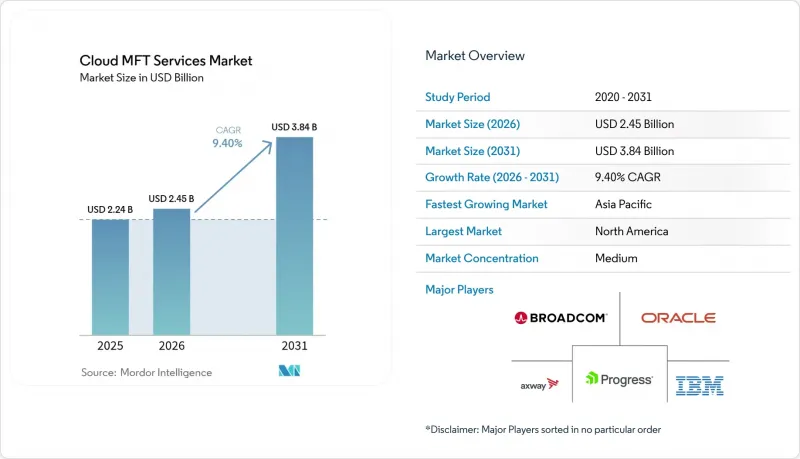
本報告按雲端類型(公有雲、私有雲、混合雲)、最終用戶產業(政府、零售、其他)、組織規模(大型企業、其他)、傳輸類型(專案傳輸、系統間傳輸、行動間傳輸)和地區(北美、南美、歐洲、亞太、其他)進行細分。市場預測以美元計價。
全球雲端MFT服務市場趨勢與洞察
對安全檔案傳輸日益成長的需求
根據美國聯邦調查局網路犯罪申訴中心 (IC3) 的數據,2024 年針對安全防護薄弱的檔案傳輸端點的勒索軟體攻擊年增 38%。因此,企業正在透過實施端對端加密、多因素身份驗證和基於策略的隔離措施來加強其文件共享工作流程的安全性。美國網路安全與基礎設施安全局 (CISA) 的第 23-01 號指令強制要求美國聯邦機構將零信任原則納入所有文件傳輸。同樣,支付卡產業資料安全標準 (PCI DSS) v4.0 對傳輸中資料加密要求的收緊也促使支付生態系統出現類似趨勢,推動支付處理商和商家收收購方機構採用經認證的多檔案傳輸 (MFT) 服務。 2024 年,美國衛生與公眾服務部對違反《健康保險流通與責任法案》(HIPAA) 中關於未加密資料傳輸規定的行為處以 475 萬美元的罰款,加速了醫療保健行業的普及。
混合雲端架構的普及
2024 年雲端安全聯盟 (CSA) 的一項調查顯示,67% 的企業已經在至少三個雲端環境中運行工作負載。採用混合多文件終端 (MFT) 使企業能夠在本地保留敏感文件以滿足駐留合規性要求,同時利用公共雲端的可擴展性來應對突發工作負載。歐洲銀行正在採用混合模式以遵守歐洲銀行管理局 (EBA) 的外包法規,該法規要求關鍵結算文件託管在歐盟境內的基礎設施上。製造商正在私有產品生命週期管理 (PLM) 系統和供應商入口網站之間同步大規模CAD 文件,以縮短迭代週期。電信業者正在將 MFT 微服務整合到 5G 邊緣節點中,以解決自動駕駛汽車等對延遲敏感的應用場景。
對傳統 FTPS 基礎設施的依賴
根據國際數據公司 (IDC) 的研究,54% 的大型企業仍依賴 FTPS 進行至少一半的外部資料交換。硬編碼的 IP 位址、自訂腳本和專有身分驗證方法是遷移的主要障礙。以大型主機為中心的金融機構受到的影響最大,因為 FTPS 閘道與其核心銀行系統的整合非常複雜。重建工作流程以適應 REST API 和 OAuth 可能需要全球企業花費超過 500 萬美元,導致專案延期。傳統架構中缺乏原生 S3 和 Azure Blob 連接器,因此必須採用中介軟體,這會增加延遲和風險。
細分市場分析
從2026年到2031年,混合部署的複合年成長率(CAGR)最高,達到13.92%,主要得益於各機構在滿足監管要求和確保容量彈性之間尋求平衡。 2025年,公共雲端在雲端行動金融終端(MFT)服務領域維持了45.72%的市場佔有率,因為銀行和電信業者在季節性交易高峰期優先考慮計量收費的擴展模式。同時,對於受FedRAMP High及類似主權要求約束的機構而言,私有雲端仍然至關重要。
隨著企業採用多重雲端策略以避免依賴單一供應商,混合雲的普及速度正在加快。低延遲邊緣節點將工廠車間和分店連接到集中式合規引擎,與混合模式相關的雲端MFT服務的市場規模將穩步擴大。供應商現在將容器化閘道器和軟體定義連接器捆綁在一起,以在AWS、Azure、Google Cloud和本地叢集集中強制執行統一策略。對於透過供應商網路和物流平台分發CAD更新並同時根據出口管制法規保護智慧財產權的製造商而言,這種能力至關重要。
受PCI DSS和SWIFT CSP審計等早期監理因素的推動,銀行、金融和保險(BFSI)產業預計到2025年將佔23.74%的市場佔有率。雖然與BFSI相關的雲端MFT服務市場規模預計將持續成長,但醫療保健產業預計12.95%的複合年成長率表明,它將成為主要的成長動力。電子健康記錄(EHR)互通性的監管以及遠端醫療的擴展,正在推動醫療服務提供者、保險公司和患者之間受保護健康資訊(PHI)數量的激增。
《21世紀治癒法案》要求美國醫療服務提供者在2025年前發布標準化API,這刺激了對連接器的投資,這些連接器能夠將HL7流轉換為FHIR,同時保持加密。藥房和臨床研究機構也需要檢驗的傳輸日誌以進行監管審計。其他行業的成熟速度各不相同。政府正在採用多重通訊協定檔案傳輸(MFT)進行稅務申報和許可證續期,製造業需要安全地交換設計和測試文件,媒體行業則需要安全地傳輸用於串流媒體播放的高解析度內容。
區域分析
到2025年,北美將佔據雲端多文件傳輸(MFT)服務市場36.68%的佔有率。這主要得益於《健康保險互通性與課責法案》(HIPAA)、《薩班斯-奧克斯利法案》以及各州嚴格的資料外洩通知法,這些法律強制要求對傳輸中的資料進行加密。企業正主導全球零信任架構的普及,將檢驗策略擴展到所有檔案共享端點。美國證券交易委員會(SEC)於2024年修訂了SP規則,要求金融機構在其事件回應計畫中納入安全傳輸協議。加拿大機構也面臨《個人資訊保護和電子文件法》(PIPEDA)下的類似要求,這推動了對具備基於區塊鏈的審計追蹤功能的認證平台的需求。
預計到2031年,亞太地區的複合年成長率將達到13.55%,在所有地區中成長最高。印度的《數位個人資料保護法》強制要求在國內處理高度敏感的個人數據,而中國的《網路安全法》及相關措施則規定了國內儲存以及向國外傳輸需獲得監管部門批准。日本和韓國都將在2024年加強其個人資料法規,這將迫使企業實施具備精細存取控制能力的多通路資料交換(MFT)服務。該地區龐大的製造業基礎依賴即時供應鏈中的安全資料交換,而汽車和電子產業叢集正在加速採用這種技術。
歐洲的趨勢受《一般資料保護規範》(GDPR)的影響,該規範對資料傳輸中的安全漏洞處以巨額罰款。歐洲銀行管理局 (EBA) 2024 年修訂版要求銀行保留對外包檔案傳輸業務的監管權。德國的 BSI 雲端指南和英國的《資料保護法》規定了產業間的差異。中東的監管機構正在強制推行自主雲端架構,例如沙烏地阿拉伯國家網路安全局要求多帳戶交易 (MFT) 必須託管在國內。在非洲,南非和奈及利亞透過以安全行動匯款為中心的普惠金融計畫主導雲端技術的普及,而巴西的《通用資料保護條例》(LGPD) 正在推動南美洲類似的現代化進程。
其他好處:
- Excel格式的市場預測(ME)表
- 3個月的分析師支持
目錄
第1章:引言
- 市場定義和範圍
- 研究的先決條件
第2章:調查方法
第3章執行摘要
第4章 市場狀況
- 市場概覽
- 市場促進因素
- 安全檔案傳輸的需求日益成長
- 混合雲端架構的普及
- 資料保護監管合規要求
- 透過人工智慧驅動的自適應路由最佳化頻寬利用率。
- 邊緣運算的擴展正在催生傳輸樞紐。
- 事件驅動型架構的日益普及,需要即時檔案串流傳輸。
- 市場限制因素
- 依賴傳統的FTPS基礎設施
- 大型企業的轉換成本很高
- MFT協定實作中IPv6支援的局限性
- 隨著人們對環境、社會和治理(ESG)的關注度不斷提高,資料中心能源審計的成本也在上升。
- 產業價值鏈分析
- 宏觀經濟因素對市場的影響
- 監理情勢
- 技術展望
- 波特五力分析
第5章 市場規模與成長預測
- 按雲類型
- 民眾
- 私人的
- 混合
- 按最終用戶行業分類
- 政府
- 零售
- 製造業
- 能源公用事業
- 電訊
- BFSI
- 衛生保健
- 其他行業
- 按組織規模
- 大公司
- 小型企業
- 透過傳輸法
- 專案傳輸
- 系統間傳輸
- 手機間傳輸
- 按地區
- 北美洲
- 美國
- 加拿大
- 墨西哥
- 南美洲
- 巴西
- 阿根廷
- 其他南美國家
- 歐洲
- 英國
- 德國
- 法國
- 義大利
- 西班牙
- 俄羅斯
- 其他歐洲國家
- 亞太地區
- 中國
- 日本
- 印度
- 韓國
- 澳洲
- 其他亞太國家
- 中東
- 沙烏地阿拉伯
- 阿拉伯聯合大公國
- 土耳其
- 其他中東國家
- 非洲
- 南非
- 奈及利亞
- 埃及
- 其他非洲國家
- 北美洲
第6章 競爭情勢
- 市場集中度
- 策略趨勢
- 市佔率分析
- 公司簡介
- International Business Machines Corporation
- Axway Software SA
- Progress Software Corporation(Ipswitch)
- Broadcom Inc.
- Oracle Corporation
- Citrix Systems Inc.(ShareFile)
- Accellion Inc.
- OPEN TEXT CORPORATION
- Software AG
- Saison Information Systems Co. Ltd.
- TIBCO Software Inc.
- Cleo Communications Inc.
- GlobalSCAPE Inc.
- Coviant Software LLC
- South River Technologies Inc.
- JSC Stonebranch
- Seeburger AG
- HelpSystems LLC(GoAnywhere)
- Primeur Group
- Maytech Communications Ltd.
- Hightail Inc.
- Box Inc.
- Dropbox Inc.(Secure MFT offerings)
- Thru Inc.
- Biscom Inc.
第7章 市場機會與未來展望
According to Mordor Intelligence, the cloud MFT services market size is expected to grow from USD 2.24 billion in 2025 to USD 2.45 billion in 2026 and is forecast to reach USD 3.84 billion by 2031 at 9.40% CAGR over 2026-2031.
This report is Segmented by Cloud Type (Public, Private, and Hybrid), End-User Industry (Government, Retail, and More), Organization Size (Large Enterprises, and More), Transfer Type (Ad-Hoc Transfer, System-To-System Transfer, and Mobile-To-Mobile Transfer), and Geography (North America, South America, Europe, Asia Pacific, and More). The Market Forecasts are Provided in Terms of Value (USD).
Global Cloud MFT Services Market Trends and Insights
Increasing Need for Secure File Transfer
Ransomware incidents targeting insecure file-transfer endpoints climbed 38% year-over-year in 2024, according to the FBI's Internet Crime Complaint Center.Enterprises are therefore hardening exchange workflows with end-to-end encryption, multi-factor authentication, and policy-based quarantines. The Cybersecurity and Infrastructure Security Agency's directive 23-01 compels U.S. federal agencies to embed zero-trust principles in every file movement. Parallel momentum is evident in payment ecosystems following the tightening of PCI DSS v4.0 requirements for encrypted data-in-motion, which has catalyzed the procurement of certified MFT services by processors and merchant acquirers. Healthcare adoption accelerated when the Department of Health and Human Services imposed USD 4.75 million in HIPAA fines for unencrypted transmissions during 2024.
Proliferation of Hybrid Cloud Architectures
A 2024 Cloud Security Alliance survey found that 67% of enterprises already operate workloads across at least three cloud environments. Hybrid MFT deployments enable firms to retain sensitive files on-premises for residency compliance while leveraging public cloud scalability for burst workloads. European banks are adopting hybrid models to comply with the European Banking Authority's outsourcing rules, which mandate that critical payment files be hosted on EU-domiciled infrastructure. Manufacturers synchronize large CAD files between private PLM systems and supplier portals, reducing iteration cycles. Telecom operators are injecting MFT micro-services into 5G edge nodes to serve latency-sensitive use cases such as autonomous vehicles.
Dependence on Legacy FTPS Infrastructure
International Data Corporation research indicates 54% of large enterprises still rely on FTPS for at least half of their external exchanges.Hard-coded IPs, custom scripts, and proprietary authentication loom as migration hurdles. Mainframe-centric financial institutions bear the heaviest burden, as FTPS gateways are intricately integrated with core banking systems. Re-engineering workflows to support REST APIs and OAuth can exceed USD 5 million for global firms, delaying projects. The absence of native S3 or Azure Blob connectors in legacy stacks forces middleware deployments that add latency and risk.
Other drivers and restraints analyzed in the detailed report include:
- Regulatory Compliance Requirements for Data Protection
- AI-Powered Adaptive Routing Optimizing Bandwidth Utilization
- High Switching Costs for Large Enterprises
For complete list of drivers and restraints, kindly check the Table Of Contents.
Segment Analysis
Hybrid deployments contributed the fastest 13.92% CAGR from 2026 to 2031, as organizations blended regulatory assurance with elastic capacity. Public cloud retained 45.72% of the Cloud MFT Services market share in 2025, as banks and telecom operators prized pay-as-you-go scaling during seasonal transaction peaks. Private cloud remained essential for agencies bound by FedRAMP High and similar sovereignty requirements.
Hybrid adoption intensifies as enterprises adopt multicloud playbooks to avoid single-vendor dependence. The Cloud MFT Services market size tied to hybrid models will expand steadily as low-latency edge nodes connect factory floors and branch offices to centralized compliance engines. Vendors now bundle containerized gateways and software-defined connectors that expose uniform policies across AWS, Azure, Google Cloud, and on-premises clusters. This capability is vital for manufacturers distributing CAD updates through supplier networks and logistics platforms, while safeguarding intellectual property in accordance with export control rules.
BFSI captured a 23.74% share in 2025, driven by early regulatory triggers, including PCI DSS and SWIFT CSP audits. The Cloud MFT Services market size linked to BFSI will continue to grow, yet healthcare's 12.95% forecast CAGR positions the sector as the prime accelerator. Electronic health record interoperability mandates and the growth of telehealth raise the volume of protected health information (PHI) circulating among providers, payers, and patients.
The 21st Century Cures Act compels U.S. providers to expose standardized APIs by 2025, driving investment in connectors that translate HL7 streams to FHIR while preserving encryption. Pharmacies and clinical research organizations similarly need validated transfer logs for regulatory audits. Other verticals are maturing at varying speeds: the government is embracing MFT for tax filings and license renewals, manufacturing relies on the secure exchange of design and inspection files, and the media sector secures high-resolution content transfers for streaming distribution.
Complete Report Scope:
- By Cloud Type
- Public
- Private
- Hybrid
- By End-User Industry
- Government
- Retail
- Manufacturing
- Energy and Utilities
- Telecommunications
- BFSI
- Healthcare
- Other Industries
- By Organization Size
- Large Enterprises
- Small and Medium Enterprises
- By Transfer Type
- Ad-Hoc Transfer
- System-to-System Transfer
- Mobile-to-Mobile Transfer
- By Geography
- North America
- United States
- Canada
- Mexico
- South America
- Brazil
- Argentina
- Rest of South America
- Europe
- United Kingdom
- Germany
- France
- Italy
- Spain
- Russia
- Rest of Europe
- Asia Pacific
- China
- Japan
- India
- South Korea
- Australia
- Rest of Asia Pacific
- Middle East
- Saudi Arabia
- United Arab Emirates
- Turkey
- Rest of Middle East
- Africa
- South Africa
- Nigeria
- Egypt
- Rest of Africa
- North America
Geography Analysis
North America controlled 36.68% of the Cloud MFT Services market in 2025, driven by the Health Insurance Portability and Accountability Act (HIPAA), Sarbanes-Oxley rules, and stringent state breach-notification laws that mandate the encryption of data in motion. Enterprises lead global zero-trust adoption, extending verification policies to every file exchange endpoint. The U.S. Securities and Exchange Commission amended Regulation S-P in 2024, obliging financial institutions to integrate secure transfer protocols into incident response plans. Canadian organizations face similar imperatives under PIPEDA, boosting demand for certified platforms with blockchain audit trails.
Asia Pacific is forecast to deliver a 13.55% CAGR through 2031, the highest regional pace. India's Digital Personal Data Protection Act mandates the local processing of sensitive personal information, whereas China's Cybersecurity Law and supporting measures stipulate in-country storage and regulatory approval for outbound transfers. Japan and South Korea both tightened personal data statutes in 2024, prompting enterprises to adopt MFT services with granular permission controls. The region's vast manufacturing base relies on secure exchange for just-in-time supply chains, intensifying adoption among automotive and electronics clusters.
Europe's trajectory is shaped by the GDPR, with supervisory authorities imposing significant penalties for lapses in data transfer security. The European Banking Authority's 2024 update insists that banks retain oversight of outsourced file-transfer operations. Germany's BSI cloud guidelines and the United Kingdom's Data Protection Act add sector nuances. Middle Eastern regulators mandate sovereign cloud architectures, exemplified by Saudi Arabia's National Cybersecurity Authority, which requires locally hosted MFT. In Africa, South Africa and Nigeria spearhead uptake through financial inclusion programs that hinge on secure mobile transfers, while Brazil's LGPD drives similar modernization in South America.
- International Business Machines Corporation
- Axway Software SA
- Progress Software Corporation (Ipswitch)
- Broadcom Inc.
- Oracle Corporation
- Citrix Systems Inc. (ShareFile)
- Accellion Inc.
- OPEN TEXT CORPORATION
- Software AG
- Saison Information Systems Co. Ltd.
- TIBCO Software Inc.
- Cleo Communications Inc.
- GlobalSCAPE Inc.
- Coviant Software LLC
- South River Technologies Inc.
- JSC Stonebranch
- Seeburger AG
- HelpSystems LLC (GoAnywhere)
- Primeur Group
- Maytech Communications Ltd.
- Hightail Inc.
- Box Inc.
- Dropbox Inc. (Secure MFT offerings)
- Thru Inc.
- Biscom Inc.
Additional Benefits:
- The market estimate (ME) sheet in Excel format
- 3 months of analyst support
TABLE OF CONTENTS
1 INTRODUCTION
- 1.1 Market Definition and Scope
- 1.2 Study Assumptions
2 RESEARCH METHODOLOGY
3 EXECUTIVE SUMMARY
4 MARKET LANDSCAPE
- 4.1 Market Overview
- 4.2 Market Drivers
- 4.2.1 Increasing Need for Secure File Transfer
- 4.2.2 Proliferation of Hybrid Cloud Architectures
- 4.2.3 Regulatory Compliance Requirements for Data Protection
- 4.2.4 AI-Powered Adaptive Routing Optimizing Bandwidth Utilization
- 4.2.5 Expansion of Edge Computing Creating Micro-Transfer Hubs
- 4.2.6 Rising Adoption of Event-Driven Architectures Requiring Real-Time File Streaming
- 4.3 Market Restraints
- 4.3.1 Dependence on Legacy FTPS Infrastructure
- 4.3.2 High Switching Costs for Large Enterprises
- 4.3.3 Limited IPv6 Support in MFT Protocol Implementations
- 4.3.4 ESG Scrutiny Elevating Data Center Energy Audit Costs
- 4.4 Industry Value Chain Analysis
- 4.5 Impact of Macroeconomic Factors on the Market
- 4.6 Regulatory Landscape
- 4.7 Technological Outlook
- 4.8 Porter's Five Forces Analysis
- 4.8.1 Bargaining Power of Suppliers
- 4.8.2 Bargaining Power of Buyers
- 4.8.3 Threat of New Entrants
- 4.8.4 Threat of Substitutes
- 4.8.5 Intensity of Competitive Rivalry
5 MARKET SIZE AND GROWTH FORECASTS (VALUE)
- 5.1 By Cloud Type
- 5.1.1 Public
- 5.1.2 Private
- 5.1.3 Hybrid
- 5.2 By End-User Industry
- 5.2.1 Government
- 5.2.2 Retail
- 5.2.3 Manufacturing
- 5.2.4 Energy and Utilities
- 5.2.5 Telecommunications
- 5.2.6 BFSI
- 5.2.7 Healthcare
- 5.2.8 Other Industries
- 5.3 By Organization Size
- 5.3.1 Large Enterprises
- 5.3.2 Small and Medium Enterprises
- 5.4 By Transfer Type
- 5.4.1 Ad-Hoc Transfer
- 5.4.2 System-to-System Transfer
- 5.4.3 Mobile-to-Mobile Transfer
- 5.5 By Geography
- 5.5.1 North America
- 5.5.1.1 United States
- 5.5.1.2 Canada
- 5.5.1.3 Mexico
- 5.5.2 South America
- 5.5.2.1 Brazil
- 5.5.2.2 Argentina
- 5.5.2.3 Rest of South America
- 5.5.3 Europe
- 5.5.3.1 United Kingdom
- 5.5.3.2 Germany
- 5.5.3.3 France
- 5.5.3.4 Italy
- 5.5.3.5 Spain
- 5.5.3.6 Russia
- 5.5.3.7 Rest of Europe
- 5.5.4 Asia Pacific
- 5.5.4.1 China
- 5.5.4.2 Japan
- 5.5.4.3 India
- 5.5.4.4 South Korea
- 5.5.4.5 Australia
- 5.5.4.6 Rest of Asia Pacific
- 5.5.5 Middle East
- 5.5.5.1 Saudi Arabia
- 5.5.5.2 United Arab Emirates
- 5.5.5.3 Turkey
- 5.5.5.4 Rest of Middle East
- 5.5.6 Africa
- 5.5.6.1 South Africa
- 5.5.6.2 Nigeria
- 5.5.6.3 Egypt
- 5.5.6.4 Rest of Africa
- 5.5.1 North America
6 COMPETITIVE LANDSCAPE
- 6.1 Market Concentration
- 6.2 Strategic Moves
- 6.3 Market Share Analysis
- 6.4 Company Profiles (includes Global Level Overview, Market Level Overview, Core Segments, Financials as available, Strategic Information, Market Rank/Share for Key Companies, Products and Services, and Recent Developments)
- 6.4.1 International Business Machines Corporation
- 6.4.2 Axway Software SA
- 6.4.3 Progress Software Corporation (Ipswitch)
- 6.4.4 Broadcom Inc.
- 6.4.5 Oracle Corporation
- 6.4.6 Citrix Systems Inc. (ShareFile)
- 6.4.7 Accellion Inc.
- 6.4.8 OPEN TEXT CORPORATION
- 6.4.9 Software AG
- 6.4.10 Saison Information Systems Co. Ltd.
- 6.4.11 TIBCO Software Inc.
- 6.4.12 Cleo Communications Inc.
- 6.4.13 GlobalSCAPE Inc.
- 6.4.14 Coviant Software LLC
- 6.4.15 South River Technologies Inc.
- 6.4.16 JSC Stonebranch
- 6.4.17 Seeburger AG
- 6.4.18 HelpSystems LLC (GoAnywhere)
- 6.4.19 Primeur Group
- 6.4.20 Maytech Communications Ltd.
- 6.4.21 Hightail Inc.
- 6.4.22 Box Inc.
- 6.4.23 Dropbox Inc. (Secure MFT offerings)
- 6.4.24 Thru Inc.
- 6.4.25 Biscom Inc.
7 MARKET OPPORTUNITIES AND FUTURE OUTLOOK
- 7.1 White-Space and Unmet-Need Assessment

 雲端管理網路全球市場規模、佔有率、趨勢和成長分析報告(2026-2034)
 面向電信業者的雲端管理服務:市場佔有率分析、產業趨勢和統計數據以及成長預測(2026-2031 年)雲端託管服務:市場佔有率分析、行業趨勢和統計數據、成長預測(2026-2031 年)
 雲端管理網路市場 - 全球預測,2026-2032 年雲端管理服務市場:2026-2032年全球市場預測(依服務類型、平台、服務模式、定價模式、合約期限、組織規模及最終用戶分類)
 AWS託管服務全球市場報告(2026年)2026年全球雲端託管服務市場報告
 雲端託管服務市場分析及預測(至 2035 年):按類型、產品、服務、技術、組件、應用、部署、最終用戶和解決方案分類全球雲端託管服務市場規模、佔有率、趨勢和成長分析報告(2026-2034)
 雲端管理服務市場規模、佔有率、趨勢和預測(按服務類型、部署模式、組織規模、行業垂直領域和地區分類),2026-2034 年