


 |
市場調查報告書
商品編碼
2119340
面向電信業者的雲端管理服務:市場佔有率分析、產業趨勢和統計數據以及成長預測(2026-2031 年)Telco Cloud Managed Services - Market Share Analysis, Industry Trends & Statistics, Growth Forecasts (2026 - 2031) |
||||||

※ 本網頁內容可能與最新版本有所差異。詳細情況請與我們聯繫。
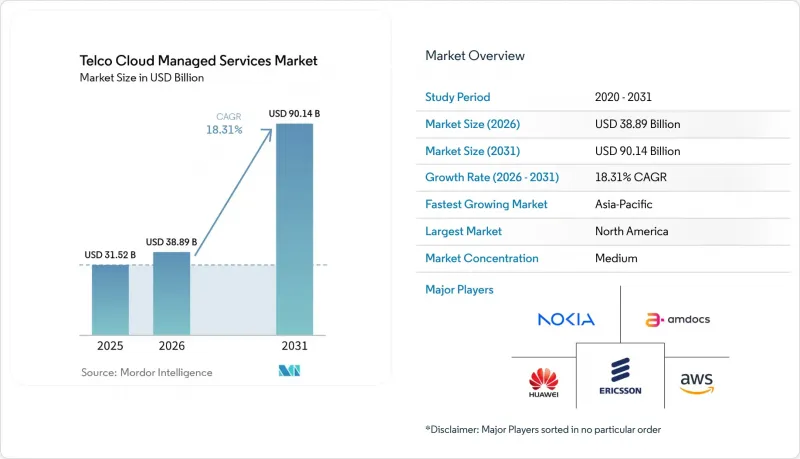
據 Mordor Intelligence 稱,2025 年電信營運商雲端管理服務市場價值為 315.2 億美元,預計到 2031 年將達到 901.4 億美元,而 2026 年為 388.9 億美元,2026 年至 2031 年預測成長率內的複合成長率為 18.31%。
本報告按託管服務類型(例如網路服務)、部署模式(例如公共雲端)、雲端服務模式(例如網路即服務)、NFV 軟體(例如編配和生命週期管理)、應用程式(例如私人 5G)、企業規模(大型企業和中小企業)以及地區進行細分。市場預測以美元計價。
全球雲端託管服務市場趨勢及電信業者洞察
5G獨立組網和雲端原生網路的部署
隨著 5G 獨立組網部署從測試階段過渡到生產階段,電信業者的雲端管理服務市場正從中受益。 NTT DOCOMO 於 2026 年 3 月在混合 AWS 環境中推出了其商用 5G 核心網路服務。該公司利用基於代理的人工智慧技術,將部署時間縮短了 80%,事件回應時間縮短了 50%。此案例研究表明,隨著生產環境中雲端核心網路的出現,對工程、監控和事件管理的需求持續成長。 O2 Telefonica 也將其生產規模的 5G 核心網路功能遷移到其自有資料中心內的 AWS Outposts,將雲端的可擴充性與本地資料管理能力結合。 ETSI 標準為跨多廠商雲端環境運作的網路功能提供了通用的互通性框架。這種情況正在推動對能夠管理整個網路生命週期技術營運的服務提供者的需求。
企業對混合雲和多重雲端營運的需求
企業客戶越來越期望營運商能夠透過單一的營運模式整合連接、邊緣容量、雲端資源和安全性。 GSMA指出,到2025年,將雲端和保全服務整合到連接服務中的營運商將為企業技術服務帶來近1兆美元的支出。隨著服務供應商將混合營運打包成託管服務,而不是要求客戶自行整合各個供應商,營運商雲端託管服務市場正在不斷擴張。網路即服務(NaaS)平台透過將網路效能與更廣泛的服務產品關聯起來,為這種模式提供了支援。此外,歐洲的合規性要求企業記錄多重雲端風險,這提升了具有清晰營運責任的託管架構的價值。因此,能夠管理雲端運營而不將其與底層網路分離的服務提供者的作用變得愈發關鍵。
傳統網路整合的複雜性
電信業者的雲端管理服務市場面臨著許多限制因素,其中之一是許多業者必須同時營運虛擬網路和雲端原生網路功能。這種混合環境使得服務範圍、資料流和網路運作的協調變得更加複雜。此外,許多營運商仍然依賴傳統的數據工具和單體營運系統,這使得即時自動化更加困難。在定義託管服務的營運模式之前,服務提供者必須重新評估其與OSS、BSS和企業資源計劃(ERP)系統的整合。如果客戶環境高度客製化,這可能會延長談判週期並延遲實施。這種整合負擔也使得具備強大轉型和系統整合能力的服務提供者更具優勢。
細分市場分析
到2025年,網路服務將佔電信營運商雲端託管服務市場佔有率的20.22%,成為最大的託管服務類別。這一地位反映出,隨著網路環境日益複雜,營運商對外部支援在連接生命週期管理方面的依賴性不斷增強。預計2026年至2031年,雲端基礎設施服務將以18.46%的複合年成長率成長。這一成長主要得益於服務供應商從完全擁有基礎設施轉向利用基礎設施平台。隨著供應商將網路管理和安全管理整合到單一服務中,保全服務的重要性也日益凸顯。資料中心和備份服務正在幫助營運商將分散式系統整合到集中管理之下。
在多重雲端環境中,對整個基礎設施和網路層可見度的需求不斷成長,這拓展了編配和服務保障的範疇。專業服務和支援服務也受益於OSS和BSS環境現代化所需的工作。 2026年8月,Amdocs和Lumen Technologies擴展了其託管服務合作夥伴關係,涵蓋AWS、Google Cloud和Microsoft Azure,並利用了aOS作業系統。該協議表明,編配、訂單管理、網路運營和轉型服務可以納入單一計劃。 ETSI的NFV架構為這些服務領域的互通性提供了標準參考。因此,電信業者的雲端託管服務產業正朝著涵蓋營運和轉型責任的更廣泛的合約方向發展。
到2025年,私有雲端將佔據部署模式細分市場的71.56%。這種主導地位主要源自於資料居住要求,這些要求限制了共用公共雲端容量在高度敏感的網路功能中的使用。混合雲端預計將在2026年至2031年間以19.01%的複合年成長率成長。電信業者正在利用這種模式,將受監管的工作負載保留在自身可控的環境中,同時在雲端區域部署彈性運算任務。 O2 Telefonica在其自有資料中心中採用了這種方法,用於在AWS Outposts上部署其5G生產核心網路。電信業者的雲端管理服務市場需要能夠同時營運這種混合雲架構兩端的服務供應商。
對於那些無力投資自建雲端基礎架構的小規模電信業者而言,公共雲端的重要性日益凸顯。 2026年2月,Citymesh與諾基亞和AWS合作,針對機場、醫院和活動場館等企業用戶推出了商用5G核心SaaS服務。分散式雲端和邊緣雲端的部署週期較長,因為它們依賴分散式設施、雲端原生軟體和本地硬體。這些模型適用於應用需要靠近使用者的計算資源的情況。它們還將營運任務分散到多個地點,而不是集中在少數幾個中心站點。面向電信業者的雲端管理服務市場可以透過遠端管理、生命週期支援和現場服務保障來應對這種複雜性。
區域分析
至2025年,北美將佔據電信營運商雲端管理服務市場37.45%的佔有率。該地區擁有強大的超大規模資料中心業者基礎設施,營運商也擁有成熟的雲端轉型計畫。美國農村地區5G寬頻的建設資金正在擴大對雲端管理服務的需求,使其不再局限於主要大都會圈,即使在營運商技術資源有限的地區也出現了需求。在墨西哥,行動網路正在現代化,區域營運商正在尋求合作夥伴,以在預算限制內推進5G部署。在加拿大,隨著營運商擴展其雲端和雲端管理服務計劃,需求也不斷成長。
預計亞太地區在2026年至2031年間將以18.51%的複合年成長率成長。日本是主要驅動力,NTT Docomo利用AWS部署混合5G核心網路,為超過9,100萬用戶提供服務。在韓國,以製造業為基礎的私有5G託管服務正在擴展。同時,在印度,隨著託管服務滲透到一級營運商以外的企業垂直市場,成長機會正在湧現。中國的雲端原生通訊需求和MEC邊緣雲端標準為投資雲端原生託管服務提供了正式框架。隨著區域營運商對更結構化的部署支援的需求增加,營運商雲端託管服務市場也從中受益。
歐洲市場由德國、英國和法國主導,這些國家的隱私和網路安全要求正在影響服務設計。歐盟委員會的雲端主權框架正在協助制定主權雲端採購要求。德國電信部署在谷歌雲端上的主權平台展示了外部金鑰管理如何保護通話詳細記錄和網路遙測資料。南美洲、中東和非洲是電信營運商雲端管理服務市場具有長期成長潛力的地區,其中巴西、沙烏地阿拉伯和南非是主要貢獻者。當區域營運商無法以5G競爭所需的速度獲得雲端原生轉型所需的資金時,外包是特別有效的解決方案。
其他好處:
- Excel格式的市場預測(ME)表
- 3個月的分析師支持
目錄
第1章:引言
- 研究假設和市場定義
- 調查範圍
第2章:調查方法
第3章執行摘要
第4章 市場狀況
- 市場概覽
- 宏觀經濟因素對市場的影響
- 市場促進因素
- 5G獨立組網和雲端原生網路的部署
- 企業對混合雲和多重雲端營運的需求
- 人工智慧驅動的網路自動化和預測性運營
- 邊緣運算和低延遲工作負載
- 開放式無線接取網路與網路功能虛擬化(NFV)的部署
- 通訊服務供應商(CSP) 外包電信雲端營運模式,但其容量有限
- 市場限制因素
- 整合傳統網路所帶來的複雜性
- 數據主權和跨境合規成本
- 多個供應商之間的互通性和可移植性存在差距
- 雲端原生通訊工程師短缺
- 產業價值鏈分析
- 監理情勢
- 技術展望
- 波特五力分析
第5章 市場規模與成長預測
- 按託管服務類型
- 網路服務
- 雲端基礎設施服務
- 保全服務
- 資料中心和備份服務
- 編配與服務保證
- 專業服務與支援服務
- 按部署模式
- 公共雲端
- 私有雲端
- 混合雲端
- 分散式雲和邊緣雲端
- 按類型分類的雲端服務模型
- Infrastructure as a Service
- Platform as a Service
- Software as a Service
- Network as a Service
- NFV軟體類型
- 虛擬網路功能 (VNF) 與雲端原生網路功能
- 網路功能虛擬化 (NFV) 基礎設施
- 編配與生命週期管理
- 政策、保障和分析軟體
- 透過使用
- 網路、資料儲存和運算
- 交通管理及服務保障
- 雲端遷移與轉型
- 網路安全和安全存取服務邊緣
- 專用 5G 和工業連接
- 邊緣運算和物聯網運營
- 按公司規模
- 大公司
- 小型企業
- 按地區
- 北美洲
- 美國
- 加拿大
- 墨西哥
- 南美洲
- 巴西
- 阿根廷
- 其他南美國家
- 歐洲
- 德國
- 英國
- 法國
- 俄羅斯
- 其他歐洲國家
- 亞太地區
- 中國
- 日本
- 印度
- 韓國
- 澳洲
- 其他亞太國家
- 中東
- 沙烏地阿拉伯
- 阿拉伯聯合大公國
- 土耳其
- 其他中東國家
- 非洲
- 南非
- 奈及利亞
- 肯亞
- 其他非洲國家
- 北美洲
第6章 競爭情勢
- 市場集中度
- 策略趨勢
- 市佔率分析
- 公司簡介
- Amazon Web Services, Inc.
- Microsoft Corporation
- Google LLC
- International Business Machines Corporation
- Telefonaktiebolaget LM Ericsson
- Nokia Corporation
- Huawei Technologies Co., Ltd.
- Cisco Systems, Inc.
- Oracle Corporation
- Broadcom Inc.
- Hewlett Packard Enterprise Company
- Rakuten Symphony, Inc
- ZTE Corporation
- Amdocs Limited
- Mavenir Systems, Inc.
- Wind River Systems, Inc.
- Red Hat, Inc.
- Accenture plc
- Capgemini SE
- Tata Consultancy Services Limited
- NTT DATA Corporation
- Tech Mahindra Limited
第7章 市場機會與未來展望
According to Mordor Intelligence, the telco cloud managed services market size was valued at USD 31.52 billion in 2025 and is estimated to grow from USD 38.89 billion in 2026 to reach USD 90.14 billion by 2031, at a CAGR of 18.31% during the forecast period 2026-2031.
This report is Segmented by Managed Service Type (Network Services, and More), Deployment Model (Public Cloud, and More), Cloud Service Model (Network As A Service, and More), NFV Software (Orchestration and Lifecycle Management, and More), Application (Private 5G, and More), Enterprise Size (Large Enterprises, and SMEs), and Geography. The Market Forecasts are Provided in Terms of Value (USD).
Global Telco Cloud Managed Services Market Trends and Insights
5G Standalone And Cloud-Native Network Rollouts
The Telco cloud managed services market benefits as 5G Standalone deployments move from trials into production operations. NTT DOCOMO launched commercial 5G Core services on a hybrid AWS environment in March 2026, using agentic AI to cut deployment time by 80% and incident-response time by 50%. The deployment shows that production cloud cores create continuing requirements for engineering, monitoring, and incident management. O2 Telefonica also moved production-scale 5G core functions to AWS Outposts in its own data center, combining cloud scalability with onsite data controls. ETSI standards provide a shared interoperability framework for network functions that run across multi-vendor cloud environments. ETSI These conditions increase demand for providers that can manage technical operations through the full network lifecycle.
Enterprise Demand For Hybrid And Multi-Cloud Operations
Enterprise customers increasingly expect telecommunications providers to coordinate connectivity, edge capacity, cloud resources, and security through a single operating model. The GSMA stated in 2025 that operators could address close to USD 1 trillion of enterprise technology-services spending by embedding cloud and security services into connectivity offerings. The Telco cloud managed services market gains where service providers package hybrid operations as a managed offering rather than leaving customers to integrate separate vendors. Network as a Service platforms support that approach because they can link network performance to broader service delivery. European compliance obligations also require enterprises to document multi-cloud risks, which raises the value of managed architectures with clear operational accountability. The result is a larger role for providers that can manage cloud operations without separating them from the underlying network.
Legacy Network Integration Complexity
The Telco cloud managed services market faces a constraint because many operators must run virtual and cloud-native network functions at the same time. This mixed environment complicates service scope, data flows, and the coordination of network operations. Many communications providers also retain traditional data tools and monolithic operational systems, which makes real-time automation more difficult. Providers must review OSS, BSS, and enterprise resource planning connections before defining a managed-services operating model. That work can lengthen negotiations and delay implementation where the customer estate is highly customized. The integration burden also favors providers with strong transformation and systems-integration capabilities.
Other drivers and restraints analyzed in the detailed report include:
- AI-Enabled Network Automation And Predictive Operations
- Edge Computing And Low-Latency Workloads
- Data Sovereignty And Cross-Border Compliance Costs
For complete list of drivers and restraints, kindly check the Table Of Contents.
Segment Analysis
Network Services held 20.22% of the Telco cloud managed services market share in 2025, making it the largest managed-service type. The position reflects operators' dependence on external support for connectivity lifecycle management as network estates become more complex. Cloud Infrastructure Services is forecast to grow at a 18.46% CAGR from 2026 to 2031. This growth follows the shift toward infrastructure platforms that service providers consume instead of fully owning. Security Services are also becoming more relevant as suppliers bundle network and security management into one offering. Data Center and Backup Services support operators that are consolidating distributed systems under centralized management.
Orchestration and Service Assurance are expanding because multi-cloud environments require visibility across infrastructure and network layers. Professional and Support Services also benefit from the work needed to modernize OSS and BSS environments. Amdocs and Lumen Technologies extended their managed-services collaboration in August 2026 across AWS, Google Cloud, and Microsoft Azure using the aOS operating system.The agreement illustrates how a single program can cover orchestration, order management, network operations, and transformation services. ETSI's NFV architecture provides a standards reference for interoperability across those service areas. ETSI The Telco cloud managed services industry is therefore moving toward broader contracts that combine operational and transformation responsibilities.
Private Cloud accounted for 71.56% of the deployment-model segment in 2025. Its lead is primarily related to data-residency obligations that limit the use of shared public-cloud capacity for sensitive network functions. Hybrid Cloud is forecast to grow at a 19.01% CAGR from 2026 to 2031. Operators use this model to retain regulated workloads in sovereign environments while placing elastic computing tasks in cloud regions. O2 Telefonica's production 5G core deployment on AWS Outposts used this approach within its own data center. The Telco cloud managed services market needs providers that can operate both sides of this hybrid design.
Public Cloud is becoming more relevant for smaller operators that cannot finance proprietary cloud infrastructure. Citymesh launched a commercial 5G Core SaaS service in February 2026 with Nokia and AWS for enterprise users at airports, hospitals, and venues. Distributed and Edge Cloud have a longer implementation path because they depend on distributed facilities, cloud-native software, and local hardware. These models are suited to deployments where applications need computing resources close to the user. They also add operational tasks across many locations rather than concentrating them in a few central sites. The Telco cloud managed services market can address this complexity through remote management, lifecycle support, and localized service assurance.
Complete Report Scope:
- By Managed Service Type
- Network Services
- Cloud Infrastructure Services
- Security Services
- Data Center and Backup Services
- Orchestration and Service Assurance
- Professional and Support Services
- By Deployment Model
- Public Cloud
- Private Cloud
- Hybrid Cloud
- Distributed and Edge Cloud
- By Cloud Service Model
- Infrastructure as a Service
- Platform as a Service
- Software as a Service
- Network as a Service
- By NFV Software
- Virtual Network Functions and Cloud-Native Network Functions
- Network Functions Virtualization Infrastructure
- Orchestration and Lifecycle Management
- Policy, Assurance, and Analytics Software
- By Application
- Network, Data Storage, and Computing
- Traffic Management and Service Assurance
- Cloud Migration and Transformation
- Cybersecurity and Secure Access Service Edge
- Private 5G and Industry Connectivity
- Edge Computing and IoT Operations
- By Enterprise Size
- Large Enterprises
- Small and Medium-Sized Enterprises
- By Geography
- North America
- United States
- Canada
- Mexico
- South America
- Brazil
- Argentina
- Rest of South America
- Europe
- Germany
- United Kingdom
- France
- Russia
- Rest of Europe
- Asia-Pacific
- China
- Japan
- India
- South Korea
- Australia
- Rest of Asia-Pacific
- Middle East
- Saudi Arabia
- United Arab Emirates
- Turkey
- Rest of Middle East
- Africa
- South Africa
- Nigeria
- Kenya
- Rest of Africa
- North America
Geography Analysis
North America accounted for 37.45% of the Telco cloud managed services market share in 2025. The region has deep hyperscaler infrastructure and mature operator cloud-transformation programs. U.S. funding for rural 5G broadband is extending managed service needs beyond major metropolitan locations, creating demand in regions where operators have limited engineering resources. Mexico is undergoing mobile-network modernization, and regional operators are seeking partners to advance 5G deployment within capital constraints. Canada also adds growing demand as operators broaden their cloud and managed-service programs.
Asia-Pacific is forecast to advance at an 18.51% CAGR from 2026 to 2031. Japan is a key contributor, with NTT DOCOMO's hybrid AWS 5G Core deployment serving more than 91 million subscribers. South Korea is expanding private 5G managed services for manufacturing applications, while India presents a growth opportunity as managed services move into enterprise verticals beyond tier-1 operators. China's cloud-native telecommunications requirements and MEC edge-cloud standard provide formal frameworks for cloud-native managed-service investment. The Telco cloud managed services market benefits as regional providers need support with more structured deployments.
Europe is shaped by Germany, the United Kingdom, and France, where privacy and cybersecurity requirements influence service design. The European Commission's Cloud Sovereignty Framework supports the development of sovereign cloud procurement requirements. Deutsche Telekom's sovereign platform on Google Cloud shows how external key management can protect call-detail records and network telemetry. South America, the Middle East, and Africa are longer-term areas for the Telco cloud managed services market, with Brazil, Saudi Arabia, and South Africa as the primary contributors. Outsourcing is especially relevant where regional operators cannot fund cloud-native transformations at the speed required by 5G competition.
- Amazon Web Services, Inc.
- Microsoft Corporation
- Google LLC
- International Business Machines Corporation
- Telefonaktiebolaget LM Ericsson
- Nokia Corporation
- Huawei Technologies Co., Ltd.
- Cisco Systems, Inc.
- Oracle Corporation
- Broadcom Inc.
- Hewlett Packard Enterprise Company
- Rakuten Symphony, Inc
- ZTE Corporation
- Amdocs Limited
- Mavenir Systems, Inc.
- Wind River Systems, Inc.
- Red Hat, Inc.
- Accenture plc
- Capgemini SE
- Tata Consultancy Services Limited
- NTT DATA Corporation
- Tech Mahindra Limited
Additional Benefits:
- The market estimate (ME) sheet in Excel format
- 3 months of analyst support
TABLE OF CONTENTS
1 INTRODUCTION
- 1.1 Study Assumptions and Market Definition
- 1.2 Scope of the Study
2 RESEARCH METHODOLOGY
3 EXECUTIVE SUMMARY
4 MARKET LANDSCAPE
- 4.1 Market Overview
- 4.2 Impact of Macroeconomic Factors on the Market
- 4.3 Market Drivers
- 4.3.1 5G Standalone and Cloud-Native Network Rollouts
- 4.3.2 Enterprise Demand for Hybrid and Multi-Cloud Operations
- 4.3.3 AI-Enabled Network Automation and Predictive Operations
- 4.3.4 Edge Computing and Low-Latency Workloads
- 4.3.5 Open RAN and Network Function Virtualization Adoption
- 4.3.6 Telco Cloud Operating-Model Outsourcing by Capacity-Constrained CSPs
- 4.4 Market Restraints
- 4.4.1 Legacy Network Integration Complexity
- 4.4.2 Data Sovereignty and Cross-Border Compliance Costs
- 4.4.3 Multi-Vendor Interoperability and Portability Gaps
- 4.4.4 Shortage of Cloud-Native Telecom Engineering Talent
- 4.5 Industry Value Chain Analysis
- 4.6 Regulatory Landscape
- 4.7 Technological Outlook
- 4.8 Porter's Five Forces Analysis
- 4.8.1 Threat of New Entrants
- 4.8.2 Bargaining Power of Suppliers
- 4.8.3 Bargaining Power of Buyers
- 4.8.4 Threat of Substitutes
- 4.8.5 Competitive Rivalry
5 MARKET SIZE AND GROWTH FORECASTS (VALUE)
- 5.1 By Managed Service Type
- 5.1.1 Network Services
- 5.1.2 Cloud Infrastructure Services
- 5.1.3 Security Services
- 5.1.4 Data Center and Backup Services
- 5.1.5 Orchestration and Service Assurance
- 5.1.6 Professional and Support Services
- 5.2 By Deployment Model
- 5.2.1 Public Cloud
- 5.2.2 Private Cloud
- 5.2.3 Hybrid Cloud
- 5.2.4 Distributed and Edge Cloud
- 5.3 By Cloud Service Model
- 5.3.1 Infrastructure as a Service
- 5.3.2 Platform as a Service
- 5.3.3 Software as a Service
- 5.3.4 Network as a Service
- 5.4 By NFV Software
- 5.4.1 Virtual Network Functions and Cloud-Native Network Functions
- 5.4.2 Network Functions Virtualization Infrastructure
- 5.4.3 Orchestration and Lifecycle Management
- 5.4.4 Policy, Assurance, and Analytics Software
- 5.5 By Application
- 5.5.1 Network, Data Storage, and Computing
- 5.5.2 Traffic Management and Service Assurance
- 5.5.3 Cloud Migration and Transformation
- 5.5.4 Cybersecurity and Secure Access Service Edge
- 5.5.5 Private 5G and Industry Connectivity
- 5.5.6 Edge Computing and IoT Operations
- 5.6 By Enterprise Size
- 5.6.1 Large Enterprises
- 5.6.2 Small and Medium-Sized Enterprises
- 5.7 By Geography
- 5.7.1 North America
- 5.7.1.1 United States
- 5.7.1.2 Canada
- 5.7.1.3 Mexico
- 5.7.2 South America
- 5.7.2.1 Brazil
- 5.7.2.2 Argentina
- 5.7.2.3 Rest of South America
- 5.7.3 Europe
- 5.7.3.1 Germany
- 5.7.3.2 United Kingdom
- 5.7.3.3 France
- 5.7.3.4 Russia
- 5.7.3.5 Rest of Europe
- 5.7.4 Asia-Pacific
- 5.7.4.1 China
- 5.7.4.2 Japan
- 5.7.4.3 India
- 5.7.4.4 South Korea
- 5.7.4.5 Australia
- 5.7.4.6 Rest of Asia-Pacific
- 5.7.5 Middle East
- 5.7.5.1 Saudi Arabia
- 5.7.5.2 United Arab Emirates
- 5.7.5.3 Turkey
- 5.7.5.4 Rest of Middle East
- 5.7.6 Africa
- 5.7.6.1 South Africa
- 5.7.6.2 Nigeria
- 5.7.6.3 Kenya
- 5.7.6.4 Rest of Africa
- 5.7.1 North America
6 COMPETITIVE LANDSCAPE
- 6.1 Market Concentration
- 6.2 Strategic Moves
- 6.3 Market Share Analysis
- 6.4 Company Profiles (includes Global Level Overview, Market Level Overview, Core Segments, Financials as available, Strategic Information, Market Rank/Share, Products and Services, Recent Developments)
- 6.4.1 Amazon Web Services, Inc.
- 6.4.2 Microsoft Corporation
- 6.4.3 Google LLC
- 6.4.4 International Business Machines Corporation
- 6.4.5 Telefonaktiebolaget LM Ericsson
- 6.4.6 Nokia Corporation
- 6.4.7 Huawei Technologies Co., Ltd.
- 6.4.8 Cisco Systems, Inc.
- 6.4.9 Oracle Corporation
- 6.4.10 Broadcom Inc.
- 6.4.11 Hewlett Packard Enterprise Company
- 6.4.12 Rakuten Symphony, Inc
- 6.4.13 ZTE Corporation
- 6.4.14 Amdocs Limited
- 6.4.15 Mavenir Systems, Inc.
- 6.4.16 Wind River Systems, Inc.
- 6.4.17 Red Hat, Inc.
- 6.4.18 Accenture plc
- 6.4.19 Capgemini SE
- 6.4.20 Tata Consultancy Services Limited
- 6.4.21 NTT DATA Corporation
- 6.4.22 Tech Mahindra Limited
7 MARKET OPPORTUNITIES AND FUTURE OUTLOOK
- 7.1 White-Space and Unmet-Need Assessment

 雲端管理網路全球市場規模、佔有率、趨勢和成長分析報告(2026-2034)
 雲端託管服務:市場佔有率分析、行業趨勢和統計數據、成長預測(2026-2031 年)
 雲端管理網路市場 - 全球預測,2026-2032 年雲端 MFT 服務:市場佔有率分析、產業趨勢與統計、成長預測(2026-2031 年)雲端管理服務市場:2026-2032年全球市場預測(依服務類型、平台、服務模式、定價模式、合約期限、組織規模及最終用戶分類)
 AWS託管服務全球市場報告(2026年)2026年全球雲端託管服務市場報告
 雲端託管服務市場分析及預測(至 2035 年):按類型、產品、服務、技術、組件、應用、部署、最終用戶和解決方案分類全球雲端託管服務市場規模、佔有率、趨勢和成長分析報告(2026-2034)
 雲端管理服務市場規模、佔有率、趨勢和預測(按服務類型、部署模式、組織規模、行業垂直領域和地區分類),2026-2034 年