


 |
市場調查報告書
商品編碼
2121418
歐洲生質塑膠:市場佔有率分析、產業趨勢與統計及成長預測(2026-2031)Europe Bioplastics - Market Share Analysis, Industry Trends & Statistics, Growth Forecasts (2026 - 2031) |
||||||

※ 本網頁內容可能與最新版本有所差異。詳細情況請與我們聯繫。
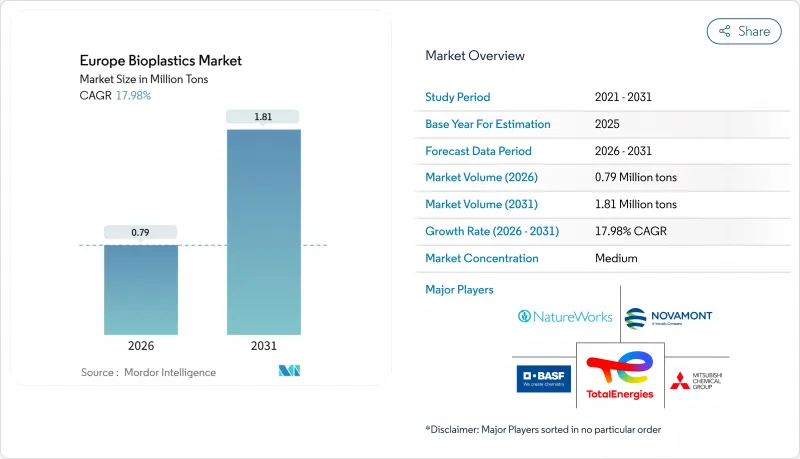
據 Mordor Intelligence 稱,歐洲生質塑膠市場預計在 2026 年達到 79 萬噸,預計在預測期(2026-2031 年)內將以 17.98% 的複合年成長率成長,到 2031 年達到 181 萬噸。
本報告按類型(生物基可生物分解材料和生物基不可生物分解材料)、原料(甘蔗/甜菜、玉米等)、加工技術(擠出、射出成型等)、應用(軟包裝、硬包裝、汽車等)和地區(德國、英國、義大利等)進行細分。市場預測以噸為單位。
歐洲生質塑膠市場趨勢與洞察
歐盟一次性塑膠指令加速了可堆肥產品的普及。
這項指令於2024年7月生效,禁止使用聚苯乙烯食品容器、杯子和刀叉餐具,並強制要求即時改用符合EN 13432標準的產品。法國正透過AGEC法案擴大這項規定的適用範圍,該法案將於2025年強制要求餐飲服務使用可堆肥或可重複使用的包裝。因此,快餐店目前指定使用PBAT和澱粉混合物,這些材料可在工業設施中於90天內分解。義大利的360個認證堆肥設施已建立了一個無縫循環系統,可同時收集食物垃圾和生質塑膠包裝。德國各市也正透過公私合營效法此模式。澱粉樹脂和PBAT共聚物是此次轉換的主流,因為它們的熔體流動速率與聚苯乙烯相匹配,這使得加工商可以繼續使用其傳統的熱成型生產線。東歐在這方面進展緩慢,市政回收率僅28%,因此品牌商在西歐使用雙標準可堆肥包裝,在東歐使用可回收的生物基聚乙烯(bio-PE)包裝。
品牌所有者在包裝和紡織業的永續性
消費品產業的主要參與者正在採購合約中加入有關生物基含量的條款,並且這些合約中明確規定了成本溢價。達能揭露,為了確保在2025年獲得4.5萬噸生物基PET,其支付了高於PET現貨價格1200萬歐元的溢價。在服裝業,H&M和Inditex正在試行使用PLA纖維,與尼龍6,6相比,這種纖維在「從搖籃到大門」的整個生產過程中可減少30%的碳排放。同時,寶潔公司計劃在2025年初推出用於其Fairy清潔劑的生物基PE瓶。這些長期合約穩定了市場需求,並為曾經被貸款機構視為高風險的產能擴張提供了合理性。因此,歐洲生質塑膠市場獲得了持續的價格支撐。
工業堆肥能力短缺
歐盟僅有42%的城市擁有經認證的堆肥設施,而這些設施的產運轉率已達78%,幾乎沒有剩餘的處理能力來應對預計到2028年將激增的34萬噸可堆肥廢棄物。馬德里唯一的堆肥設施無法處理該市的垃圾量,因此剩餘垃圾被送往掩埋,在厭氧條件下分解過程停滯不前。在德國,認證標準要求“58°C,持續10天”,小規模的本地設施如果達不到這一要求,就會面臨關於殘留薄膜的爭議。法國已累計3億歐元用於新建一座堆肥設施,但預計核准程序和建設工作要到2028年才能完成。
細分市場分析
到2025年,生物基生物分解性塑膠將佔歐洲生質塑膠市場59.81%的佔有率,預計到2031年將以22.59%的複合年成長率成長。澱粉混合物用於散裝填充材和購物袋,其成本比PLA低15%。 PLA在需要透明度的硬質翻蓋式容器和3D列印領域佔據高階市場。 PHA目前市佔率不足3%,但隨著希臘利用廢油生產的新產能運作,預計2029年其經濟效益將與PBAT相當。 PBAT、PBS和PCL在需要柔軟性的應用中仍然發揮著重要作用,它們與澱粉混合以符合EN 13432標準。
即使到了2025年,生物基不可分解材料仍佔據相當大的市場。生物基PET受到可口可樂等飲料品牌的青睞,該公司報告稱,2025年其瓶裝飲料中生物基含量為30%的瓶子佔其總量的22%。生物基PE使家用護理品牌無需更改生產線即可更換材料,這在汽車燃料箱和清潔劑瓶等檢驗週期較長的領域具有優勢。儘管價格溢價高達40%,阿科瑪的蓖麻油衍生PA11仍保持其在高磨損零件市場的地位。
到2025年,甘蔗和甜菜將供應44.77%的原料,但纖維素材料和木材廢棄物預計將以22.42%的複合年成長率超越它們。 2025年玉米的平均價格為每噸245歐元,並因生質乙醇的需求而持續上漲。木薯和馬鈴薯的面積面積仍然有限。相較之下,利用鋸木廠殘渣進行酵素水解生產糖的成本為每噸180-210歐元,比玉米製葡萄糖便宜15%。贏創公司正在進行一項試點項目,並獲得了創新基金2500萬歐元的津貼,支持利用二氧化碳和氫氣進行氣體發酵的技術,目標是到2027年實現5000噸的產量。
其他好處:
- Excel格式的市場預測(ME)表
- 3個月的分析師支持
目錄
第1章:引言
- 研究假設和市場定義
- 調查範圍
第2章:調查方法
第3章執行摘要
第4章 市場狀況
- 市場概覽
- 市場促進因素
- 歐盟的一次性塑膠指令正在加速可堆肥產品的普及。
- 品牌所有者在包裝和紡織業的永續發展舉措
- 企業淨零排放目標正在推動生物基原料的轉變。
- 歐盟紙漿廠整合木質纖維素糖將實現PLA/PHA的現場生產。
- 進口化石燃料聚合物所需的 CBAM(化學骨質銨)成本的增加,提高了歐盟生質塑膠產業的經濟可行性。
- 市場限制因素
- 工業堆肥能力短缺
- 歐盟能源價格上漲推高了擠壓和加工成本。
- 由於 RED-III 指令強制實施先進生質燃料,原料競爭加劇。
- 價值鏈分析
- 波特五力模型
第5章 市場規模與成長預測
- 按類型
- 生物基可生物分解材料
- 澱粉衍生的
- 聚乳酸(PLA)
- 聚羥基烷酯(PHA)
- 聚酯(PBS、PBAT、PCL)
- 其他生物基可生物分解材料
- 生物基不可生物分解產品
- 生物基聚對苯二甲酸乙二醇酯(PET)
- 生物聚乙烯
- 生物聚醯胺
- 生物基聚對苯二甲酸丙二醇酯
- 其他生物衍生的不可生物分解產品
- 生物基可生物分解材料
- 按原料
- 甘蔗/甜菜
- 玉米
- 木薯和土豆
- 纖維素基和木材廢棄物
- 其他(源自藻類和微生物的油脂)
- 透過加工技術
- 擠壓
- 射出成型
- 吹塑成型
- 3D列印
- 其他(熱成型等)
- 透過使用
- 軟包裝
- 硬包裝
- 汽車和組裝工藝
- 農業和園藝
- 建造
- 紡織品
- 電氣和電子設備
- 其他用途
- 國家
- 德國
- 英國
- 義大利
- 法國
- 荷蘭
- 西班牙
- 北歐國家
- 其他歐洲國家
第6章 競爭情勢
- 市場集中度
- 策略趨勢
- 市佔率和排名分析
- 公司簡介
- Arkema
- BASF
- BIO ON SpA
- Biome Bioplastics
- BIOTEC Biologische Naturverpackungen GmbH & Co. KG.
- Eni SpA(Novamont)
- Evonik Industries AG
- FKuR
- FUTERRO
- Green Dot Bioplastics Inc
- Innovia Films
- Lactips
- Minima
- Mitsubishi Chemical Group Corporation
- NatureWorks LLC
- Plantic
- Rodenburg Biopolymers
- RWDC Industries
- Sulapac Oy
- TORAY INDUSTRIES, INC.
- TotalEnergies(Total Corbion)
第7章 市場機會與未來展望
According to Mordor Intelligence, the Europe bioplastics market size is estimated at 0.79 million tons in 2026, and is expected to reach 1.81 million tons by 2031, at a CAGR of 17.98% during the forecast period (2026-2031).
This report is Segmented by Type (Bio-Based Biodegradables and Bio-Based Non-Biodegradables), Feedstock (Sugarcane/Beet, Corn, and More), Processing Technology (Extrusion, Injection Molding, and More), Application (Flexible Packaging, Rigid Packaging, Automotive, and More), and Geography (Germany, United Kingdom, Italy, and More). Market Forecasts are Provided in Terms of Volume (Tons).
Europe Bioplastics Market Trends and Insights
EU Single-Use Plastics Directive Accelerates Compostable Uptake
The directive that took effect in July 2024 prohibits polystyrene food containers, cups, and cutlery, forcing immediate substitution with EN 13432-compliant items. France extended this rule through the AGEC law and will require compostable or reusable food-service packaging in 2025, so quick-service outlets now specify PBAT-starch blends that degrade within 90 days in industrial facilities. Italy's 360 certified composters create a seamless loop for co-collecting food scraps and bioplastic packaging, a model that German municipalities replicate through public-private deals. Starch resins and PBAT copolymers dominate the switch because their melt-flow index matches polystyrene, allowing converters to keep legacy thermoforming lines. Eastern Europe lags, with only 28% municipal coverage, so brands use dual-spec compostable packaging for the West and recyclable bio-PE for the East.
Brand-Owner Sustainability Commitments in Packaging and Textiles
Consumer-goods leaders embed bio-content clauses in procurement, and cost premiums are now written into contracts. Danone disclosed that it paid EUR 12 million above spot PET to secure 45,000 tons of bio-PET in 2025. In apparel, H&M and Inditex pilot PLA fibers that cut cradle-to-gate carbon by 30% versus nylon 6,6, while Procter & Gamble released bio-PE bottles for Fairy dish soap in early 2025. These long agreements stabilize demand and justify capacity expansions that lenders once viewed as risky. As a result, the Europe bioplastics market receives durable price support.
Limited Industrial-Composting Capacity
Only 42% of municipalities across the bloc run certified facilities, and those plants already operate at 78% utilization, leaving little spare capacity for the expected 340,000-ton surge in compostable waste by 2028. Madrid's single composter cannot handle city volumes, so overflow swings to landfill, where anaerobic settings stall degradation. Germany enforces a 58 °C, 10-day rule for certification, a hurdle that small rural sites miss, sparking disputes over residual films. Though France earmarked EUR 300 million for new sites, permits, and buildings will not finish until 2028.
Other drivers and restraints analyzed in the detailed report include:
- Corporate Net-Zero Targets Favor Bio-Content Substitution
- Lignocellulosic Sugar Integration by Pulp Mills
- High EU Energy Prices Inflate Extrusion and Conversion Costs
For complete list of drivers and restraints, kindly check the Table Of Contents.
Segment Analysis
Bio-based biodegradables held 59.81% of the Europe bioplastics market in 2025 and will post a 22.59% CAGR to 2031. Starch blends serve loose-fill and shopping bags at a cost of 15% below PLA. PLA commands the premium slice in rigid clamshells and 3D printing, where clarity matters. PHA stays below 3% share for now, yet new waste-oil capacity in Greece signals that economics can equal PBAT by 2029. PBAT, PBS, and PCL remain critical for flexibility, blended with starch to meet EN 13432.
Bio-based non-biodegradables also held a considerable market share in 2025. Bio-PET appeals to beverage brands such as Coca-Cola, which reported 22% of bottles with 30% bio-content in 2025. Bio-PE lets home-care brands shift without line changes, a gain in automotive fuel tanks and detergent bottles with long validation cycles. Arkema's PA11 from castor oil keeps a foothold in high-abrasion parts despite a 40% price premium.
Sugarcane/sugar beet supplied 44.77% of inputs in 2025, but cellulosic and wood waste will outpace at 22.42% CAGR. Corn prices averaged EUR 245 per ton in 2025 and continue upward due to bioethanol demand. Cassava and potato acreage expansion remains limited. By contrast, enzymatic hydrolysis of sawmill residue delivers sugars at EUR 180-210 per ton, 15% under corn glucose. Gas fermentation using CO2 and hydrogen has pilot backing from Evonik and a EUR 25 million Innovation Fund grant, targeting 5,000 tons in 2027.
Complete Report Scope:
- By Type
- Bio-based Biodegradables
- Starch-based
- Polylactic Acid (PLA)
- Polyhydroxyalkanoates (PHA)
- Polyesters (PBS, PBAT, PCL)
- Other Bio-based Biodegradables
- Bio-based Non-biodegradables
- Bio Polyethylene Terephthalate (PET)
- Bio Polyethylene
- Bio Polyamides
- Bio Polytrimethylene Terephthalate
- Other Bio-based Non-biodegradables
- Bio-based Biodegradables
- By Feedstock
- Sugarcane / Sugar Beet
- Corn
- Cassava and Potato
- Cellulosic and Wood Waste
- Others (Algae and Microbial Oil)
- By Processing Technology
- Extrusion
- Injection Molding
- Blow Molding
- 3D Printing
- Others (Thermoforming, etc.)
- By Application
- Flexible Packaging
- Rigid Packaging
- Automotive and Assembly Operations
- Agriculture and Horticulture
- Construction
- Textiles
- Electrical and Electronics
- Other Applications
- By Country
- Germany
- United Kingdom
- Italy
- France
- Netherlands
- Spain
- Nordic
- Rest of Europe
List of Companies Covered in this Report:
- Arkema
- BASF
- BIO ON SpA
- Biome Bioplastics
- BIOTEC Biologische Naturverpackungen GmbH & Co. KG.
- Eni S.p.A. (Novamont)
- Evonik Industries AG
- FKuR
- FUTERRO
- Green Dot Bioplastics Inc
- Innovia Films
- Lactips
- Minima
- Mitsubishi Chemical Group Corporation
- NatureWorks LLC
- Plantic
- Rodenburg Biopolymers
- RWDC Industries
- Sulapac Oy
- TORAY INDUSTRIES, INC.
- TotalEnergies (Total Corbion)
Additional Benefits:
- The market estimate (ME) sheet in Excel format
- 3 months of analyst support
TABLE OF CONTENTS
1 Introduction
- 1.1 Study Assumptions and Market Definition
- 1.2 Scope of the Study
2 Research Methodology
3 Executive Summary
4 Market Landscape
- 4.1 Market Overview
- 4.2 Market Drivers
- 4.2.1 EU Single-Use Plastics Directive accelerates compostable uptake
- 4.2.2 Brand-owner sustainability commitments in packaging and textiles
- 4.2.3 Corporate net-zero targets favour bio-content substitution
- 4.2.4 Lignocellulosic sugar integration by EU pulp mills enables on-site PLA/PHA
- 4.2.5 CBAM cost on fossil polymer imports boosts EU bioplastics economics
- 4.3 Market Restraints
- 4.3.1 Limited industrial-composting capacity
- 4.3.2 High EU energy prices inflate extrusion and conversion costs
- 4.3.3 Feedstock competition from RED-III advanced-biofuel mandates
- 4.4 Value Chain Analysis
- 4.5 Porter's Five Forces
- 4.5.1 Bargaining Power of Suppliers
- 4.5.2 Bargaining Power of Buyers
- 4.5.3 Threat of New Entrants
- 4.5.4 Threat of Substitutes
- 4.5.5 Degree of Competition
5 Market Size and Growth Forecasts (Volume)
- 5.1 By Type
- 5.1.1 Bio-based Biodegradables
- 5.1.1.1 Starch-based
- 5.1.1.2 Polylactic Acid (PLA)
- 5.1.1.3 Polyhydroxyalkanoates (PHA)
- 5.1.1.4 Polyesters (PBS, PBAT, PCL)
- 5.1.1.5 Other Bio-based Biodegradables
- 5.1.2 Bio-based Non-biodegradables
- 5.1.2.1 Bio Polyethylene Terephthalate (PET)
- 5.1.2.2 Bio Polyethylene
- 5.1.2.3 Bio Polyamides
- 5.1.2.4 Bio Polytrimethylene Terephthalate
- 5.1.2.5 Other Bio-based Non-biodegradables
- 5.1.1 Bio-based Biodegradables
- 5.2 By Feedstock
- 5.2.1 Sugarcane / Sugar Beet
- 5.2.2 Corn
- 5.2.3 Cassava and Potato
- 5.2.4 Cellulosic and Wood Waste
- 5.2.5 Others (Algae and Microbial Oil)
- 5.3 By Processing Technology
- 5.3.1 Extrusion
- 5.3.2 Injection Molding
- 5.3.3 Blow Molding
- 5.3.4 3D Printing
- 5.3.5 Others (Thermoforming, etc.)
- 5.4 By Application
- 5.4.1 Flexible Packaging
- 5.4.2 Rigid Packaging
- 5.4.3 Automotive and Assembly Operations
- 5.4.4 Agriculture and Horticulture
- 5.4.5 Construction
- 5.4.6 Textiles
- 5.4.7 Electrical and Electronics
- 5.4.8 Other Applications
- 5.5 By Country
- 5.5.1 Germany
- 5.5.2 United Kingdom
- 5.5.3 Italy
- 5.5.4 France
- 5.5.5 Netherlands
- 5.5.6 Spain
- 5.5.7 Nordic
- 5.5.8 Rest of Europe
6 Competitive Landscape
- 6.1 Market Concentration
- 6.2 Strategic Moves
- 6.3 Market Share(%)/Ranking Analysis
- 6.4 Company Profiles {(includes Global level Overview, Market level overview, Core Segments, Financials as available, Strategic Information, Market Rank/Share for key companies, Products and Services, Recent Developments)}
- 6.4.1 Arkema
- 6.4.2 BASF
- 6.4.3 BIO ON SpA
- 6.4.4 Biome Bioplastics
- 6.4.5 BIOTEC Biologische Naturverpackungen GmbH & Co. KG.
- 6.4.6 Eni S.p.A. (Novamont)
- 6.4.7 Evonik Industries AG
- 6.4.8 FKuR
- 6.4.9 FUTERRO
- 6.4.10 Green Dot Bioplastics Inc
- 6.4.11 Innovia Films
- 6.4.12 Lactips
- 6.4.13 Minima
- 6.4.14 Mitsubishi Chemical Group Corporation
- 6.4.15 NatureWorks LLC
- 6.4.16 Plantic
- 6.4.17 Rodenburg Biopolymers
- 6.4.18 RWDC Industries
- 6.4.19 Sulapac Oy
- 6.4.20 TORAY INDUSTRIES, INC.
- 6.4.21 TotalEnergies (Total Corbion)
7 Market Opportunities and Future Outlook
- 7.1 EU Circular Economy and Green Deal Strategies
- 7.2 White-space and Unmet-need Assessment

 2026年全球澱粉基生物生質塑膠包裝市場報告2026年全球澱粉基生物生質塑膠市場報告2026年全球纖維素生物生質塑膠市場報告
 生質塑膠:市場佔有率分析、產業趨勢與統計、成長預測(2026-2031)
 農業生質塑膠市場:按類型、原料、加工技術、應用和分銷管道分類-2026-2032年全球市場預測
 生物基聚合物和生質塑膠市場預測至 2034 年—按聚合物類型、應用、最終用戶和地區分類的全球分析。生質塑膠市場:2026-2032年全球市場預測(依產品階段、原料、產品形式、生物分解、加工方法、最終用戶及通路分類)
 全球生質塑膠市場(2026-2036 年)生質塑膠市場擴張預測至2034年:按類型、應用、最終用戶和地區分類的全球分析
 射出複合材料生質塑膠射出成型市場:依聚合物、纖維類型、終端用戶產業及地區分類。