


 |
市場調查報告書
商品編碼
2113615
生質塑膠:市場佔有率分析、產業趨勢與統計、成長預測(2026-2031)Bioplastics - Market Share Analysis, Industry Trends & Statistics, Growth Forecasts (2026 - 2031) |
||||||

※ 本網頁內容可能與最新版本有所差異。詳細情況請與我們聯繫。
根據 Mordor Intelligence 預測,生質塑膠市場規模將從 2025 年的 237 萬噸成長到 2026 年的 278 萬噸,到 2031 年達到 618 萬噸,預計 2026 年至 2031 年的複合年成長率將達到 17.33%。
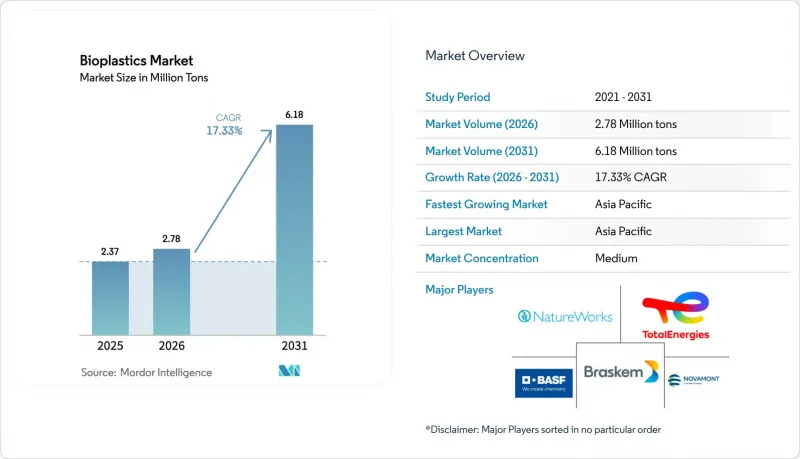
本報告按類型(生物基生物分解性塑膠和生物基不可生物分解性塑膠)、原料(甘蔗/甜菜、玉米等)、加工技術(擠出、射出成型、吹塑成型等)、應用(軟包裝、硬包裝等)和地區(亞太地區、北美地區、歐洲地區等)進行細分。市場預測以數量(噸)為單位。
全球生質塑膠市場趨勢與洞察
歐洲和亞洲強制禁止使用一次性塑膠製品
自2021年以來,監管機構對發泡聚苯乙烯、Oxo分解塑膠袋和聚乙烯吸管的禁令已使石油基塑膠的需求減少了約120萬噸,從而即時催生了對經認證的可堆肥替代品的需求。歐盟委員會於2024年7月發布的指導意見進一步收緊了可堆肥塑膠的定義,將豁免條款與EN 13432標準掛鉤,從而淘汰了含有Oxo添加劑的包裝材料,並加速了PLA在食品服務容器中的應用。在印度,中央污染控制委員會在2024年全年進行了突擊檢查,查獲了價值5億印度盧比的不合規庫存,促使加工商簽訂了PLA和澱粉混合材料的多年期合約。泰國於2025年1月發布的藍圖擴大了適用範圍,將酒店和快餐店納入其中,並強制要求到2027年可堆肥材料的比例達到40%,從而降低了國內新增產能的風險。由於違反監管規定可能導致品牌所有者面臨罰款和法律責任,因此,從海南到古吉拉突邦,投資待開發區工廠的決策現在都以收購協議為後盾。
對永續包裝材料和環保塑膠的需求正在飆升。
大型消費品公司聯合承諾在2030年取代850萬噸原生塑膠,但截至2025年中期,其中82%的需求仍未簽訂合約。這項採購缺口正推動可直接取代原生塑膠的生物基聚乙烯(bio-PE)和新一代聚乳酸(PLA)合金的提案數量增加。聯合利華2024年將其生物基聚乙烯採購量年增22%,達到4.7萬噸,並計劃在2027年增加兩倍。雀巢水業在法國開展了全PLA瓶的試點項目,與再生聚對苯二甲酸乙二醇酯(rPET)相比,PLA瓶的「從搖籃到大門」排放量減少了35%,但由於PLA瓶在55°C以上會發生熱變形,因此其銷售僅限於冷藏管道。 2025年3月,達能與NatureWorks合作,將PLA的熱變形溫度上限提高到70 度C,旨在使南歐地區的優格杯能夠常溫保存。從中可以得出明確的教訓:每個品牌都在對其採購進行細分,使用即用型產品生產硬質容器,使用可生物分解合金生產軟性薄膜,每種方法都滿足不同的監管測試要求,同時最大限度地減少對現有生產線的影響。
原油價格低迷時期,石油基塑膠價格溢價上漲
2024年至2025年間,PLA的交易價格在每噸2,200美元至3,800美元之間,約為當時布蘭特原油均價為每桶75美元的LDPE原生料價格的兩倍。在缺乏碳排放稅或強制性堆肥措施的情況下,印度和東南亞的加工商在將外帶餐盒的生產材料從PP轉向PLA時,將面臨高達60%的成本成長。 2025年初,由於巴西乾旱導致乙醇價格上漲12%,Braschem公司的生物基PE溢價從每噸300美元擴大到450美元。因此,如果原油價格長期保持低位,除政策主導的需求外,所有需求都將受到威脅,迫使大多數生產商透過與糖價而非原油價格掛鉤的長期銷售合約來保障利潤率。
細分市場分析
到2025年,生物基非生物生物分解性塑膠將佔生質塑膠市場佔有率的56.64%。這是因為生物基PET和生物基PE可以利用現有設施生產,維持瓶級透明度,並能融入現有的回收循環。可口可樂公司於2024年交付了其第900億個“植物瓶”,透過部分生物摻入實現了規模經濟,且不會影響PET原料的純度。以PLA和澱粉混合物主導的生物分解性塑膠市場正以23.46%的成長率成長,隨著減少掩埋廢棄物的法規從歐洲擴展到南美,預計其市場佔有率將進一步擴大。 PLA已在北美透明翻蓋式容器市場佔據主導地位,而澱粉和PBAT的組合,在比玉米母料便宜15%的木薯基母粒母粒的支持下,正在東南亞食品包裝市場佔據主導地位。 PHA的海洋生物分解性使其能夠應對廢棄物風險嚴重的場景,例如漁具。百加得在瓶蓋中使用PHA表明,即使是小眾應用場景,只要性能符合品牌美學,也能實現規模化生產。生物基PA繼續保持其作為高性能聚合物在燃油管路和紡織品領域的地位,其高利潤率使生產商免受原油價格波動的影響。總體而言,該領域的趨勢表明,雖然即用型材料將繼續維持大規模生產包裝的市場,但生物分解材料將滲透到受監管的小眾市場,並在2031年前推動差異化生產能力的提升。
到2025年,源自甘蔗和甜菜的原料將佔總產量的42.28%,從而穩定成本曲線。這是因為巴西糖廠將甘蔗渣的汽電共生額度與乙醇避險結合,穩定了其投入利潤率。 NatureWorks公司位於內布拉斯加州布萊爾的年產15萬噸PLA工廠使用玉米葡萄糖,但價格波動和嚴格的土地使用審查迫使生產商轉向使用殘渣衍生糖。纖維素路線預計將以24.59%的複合年成長率成長。引領這一成長的是一家紙漿廠,該紙漿廠向Avantium公司的Polyethylene Furanoate(PFA)中試生產線出售木質纖維素糖漿,該生產線生產的PFA的氧氣阻隔性比PET提高了50%。在泰國,木薯澱粉是熱塑性塑膠袋的原料,這得益於當地的農業技術和泰國投資促進委員會(BOI)的稅收優惠政策,這些政策將損益平衡點縮短至六年。藻類和微生物油在創業投資資金,目前以比目前PHA指數價格低20%的價格供應RWDC的「Solon PHA」。因此,原物料多元化降低了商品風險,並符合大型快速消費品(FMCG)公司零毀林採購的承諾。
區域分析
預計到2025年,亞太地區將佔全球總量的47.75%,並在2031年之前以22.51%的複合年成長率成長。這項成長主要受以下因素驅動:中國強制要求宅配包裝使用30%可生物分解材料;泰國為PLA工廠提供稅收優惠;以及印度限制一次性塑膠的使用,這些措施促使12,000家加工商轉向使用可堆肥樹脂。 2024年9月,中國石化在海南省投產了一座年產6萬噸的PBAT生產設施。該設施與甘蔗製乙醇結合,降低了15%的原料成本,同時也符合自由貿易港優惠政策。信實工業和丹尼瑪計劃在2026年前在古吉拉突邦建造一座年產3萬噸的PHA工廠,以滿足國內地膜需求和歐洲對海洋生物分解性塑膠的需求。日本於 2025 年 4 月推出的補貼計畫將為改用生物樹脂的中小型模塑製造商提供 50% 的資本投資補貼,這表明政策上認知到供應鏈本地化是應對氣候變遷和保障國家安全的目標。
北美和歐洲仍然是引領全球標準的創新中心。美國《通貨膨脹控制法案》為碳負排放聚合物提供45Q稅額扣抵,即使布蘭特原油價格接近70美元,內布拉斯加州的PLA生產仍具有競爭力。德國正在資助一個酵素法回收試點項目,以解決PLA-PET污染問題,歐盟的循環經濟行動計畫也指出,化學回收可以與堆肥並行。法國的AGEC法案將於2024年1月全面實施,該法案強制要求餐廳和自助餐廳使用由道達爾能源科比昂泰國工廠提供的可堆肥刀叉餐具,這表明跨境供應鏈網路如何滿足國內監管要求。英國的塑膠包裝稅間接促進了生物基聚乙烯(bio-PE)的發展,如果其基準值達到30%,即可獲得可再生碳權額度。
在南美洲,巴西的糖業平台正在被利用。 Braschem公司將60%的生物聚乙烯出口到歐洲和北美,但由於缺乏禁令和支付意願低,其在國內的推廣應用進展緩慢。在阿根廷,布宜諾斯艾利斯正在進行一項分類堆肥試點項目,如果污染率能控制在10%以下,將考慮在全國推廣。在中東,人們正在探索生物石腦油的應用,沙烏地基礎工業公司(SABIC)正在考慮在其朱拜勒工廠更換原料,並計劃向歐盟客戶供應產品,但需遵守碳邊境調節規定。南非起草了一項針對不可堆肥產品的生產者責任費,計劃於2024年底前實施,但由於小規模加工商遊說尋求豁免,該費用的實施被推遲。
其他好處:
- Excel格式的市場預測(ME)表
- 3個月的分析師支持
目錄
第1章:引言
- 研究假設和市場定義
- 調查範圍
第2章:調查方法
第3章執行摘要
第4章 市場狀況
- 市場概覽
- 市場促進因素
- 歐洲和亞洲強制禁止使用一次性塑膠製品
- 對永續包裝材料和環保塑膠的需求正在激增。
- 企業對低碳聚合物的淨零排放採購
- 促進先進機械回收相容性的獎勵
- 豐富的可再生原料供應
- 市場限制因素
- 原油價格低迷時期,石油衍生塑膠的價格溢價較高
- 不同等級PLA的熱度和阻隔性差異
- 因缺乏工業堆肥基礎設施而受到處罰
- 價值鏈分析
- 波特五力模型
第5章 市場規模與成長預測
- 按類型
- 生物基可生物分解材料
- 澱粉衍生的
- 聚乳酸(PLA)
- 聚羥基烷酯(PHA)
- 聚酯(PBS、PBAT、PCL)
- 其他生物基可生物分解材料
- 生物基不可生物分解材料
- 生物基聚對苯二甲酸乙二醇酯(PET)
- 生物聚乙烯
- 生物聚醯胺
- 生物基聚對苯二甲酸丙二醇酯
- 其他生物衍生的不可生物分解材料
- 生物基可生物分解材料
- 按原料
- 甘蔗/甜菜
- 玉米
- 木薯和土豆
- 纖維素基和木材廢棄物
- 其他(源自藻類和微生物的油脂)
- 透過加工技術
- 擠壓
- 射出成型
- 吹塑成型
- 3D列印
- 其他(熱成型等)
- 透過使用
- 軟包裝
- 硬包裝
- 汽車和組裝作業
- 農業和園藝
- 建造
- 紡織品
- 電氣和電子設備
- 其他用途
- 按地區
- 亞太地區
- 中國
- 印度
- 日本
- 韓國
- 印尼
- 泰國
- 其他亞太國家
- 北美洲
- 美國
- 加拿大
- 墨西哥
- 歐洲
- 德國
- 英國
- 義大利
- 法國
- 荷蘭
- 西班牙
- 其他歐洲國家
- 南美洲
- 巴西
- 阿根廷
- 其他南美國家
- 中東和非洲
- 沙烏地阿拉伯
- 阿拉伯聯合大公國
- 南非
- 埃及
- 其他中東和非洲國家
- 亞太地區
第6章 競爭情勢
- 市場集中度
- 策略趨勢
- 市佔率和排名分析
- 公司簡介
- Arkema
- Avantium NV
- BASF
- BIOTEC Biologische Naturverpackungen GmbH & Co. KG.
- Braskem
- CJ CHEIL JEDANG CORP
- Danimer Scientific
- Eni SpA(Novamont)
- Futerro
- Green Dot Bioplastics
- Indorama Ventures
- Kaneka Corporation
- Minima
- NatureWorks LLC
- Rodenburg Group
- RWDC Industries
- TotalEnergies(Total Corbion)
- Trinseo
第7章 市場機會與未來展望
According to Mordor Intelligence, the bioplastics market size is expected to increase from 2.37 Million tons in 2025 to 2.78 Million tons in 2026 and reach 6.18 Million tons by 2031, growing at a CAGR of 17.33% over 2026-2031.
This report is Segmented by Type (Bio-Based Biodegradables and Bio-Based Non-Biodegradables), Feedstock (Sugarcane/Sugar Beet, Corn, and More), Processing Technology (Extrusion, Injection Molding, Blow Molding, and More), Application (Flexible Packaging, Rigid Packaging, and More), and Geography (Asia-Pacific, North America, Europe, and More). Market Forecasts are Provided in Terms of Volume (Tons).
Global Bioplastics Market Trends and Insights
Mandate for Single-Use-Plastic Bans in Europe and Asia
Regulatory prohibitions on polystyrene foam, Oxo-degradable bags, and polyethylene straws have removed roughly 1.2 million tons of petro-plastic demand since 2021, creating an immediate pull for certified-compostable alternatives. European Commission guidance issued in July 2024 further tightened definitions by linking exemptions to EN 13432, which sidelined oxo-additive packaging and accelerated PLA penetration into food-service ware. In India, the Central Pollution Control Board used spot audits throughout 2024 to seize non-compliant inventory valued at INR 500 million, prompting converters to lock in multi-year PLA and starch-blend contracts. Thailand's January 2025 roadmap extended the mandate to hotels and quick-service restaurants, requiring 40% compostable share by 2027 and thus derisking new domestic capacity. Because enforcement carries financial penalties and brand-owner liability, offtake contracts now underpin capital spending decisions for greenfield plants from Hainan to Gujarat.
Surging Demand for Sustainable Packaging and Eco-Friendly Plastics
Consumer-packaged-goods leaders collectively pledged to displace 8.5 million tons of virgin plastic by 2030, yet 82% of that requirement remained uncontracted as of mid-2025. This procurement gap has fueled RFPs for both drop-in bio-PE and next-generation PLA alloys. Unilever lifted its bio-PE intake to 47,000 tons in 2024-up 22% year over year-and targets a three-fold increase by 2027. Nestle Waters piloted full-PLA bottles in France that cut cradle-to-gate emissions by 35% versus rPET, though heat-distortion above 55 °C restricted sales to refrigerated channels. Danone's March 2025 collaboration with NatureWorks aims to push PLA's heat-deflection ceiling to 70 °C, unlocking ambient yogurt cups in Southern Europe. The takeaway is clear: brands are segmenting procurement between drop-ins for rigid formats and biodegradable alloys for flexible films, each pathway minimizing disruption to existing lines while meeting diverging regulatory tests.
Price Premium vs. Petro-Plastics Amid Low Oil Prices
PLA traded between USD 2,200 and USD 3,800 per ton in 2024-2025, roughly double virgin LDPE when Brent averaged USD 75 per barrel. Without carbon levies or mandated compostability, converters in India and Southeast Asia confront up to a 60% cost penalty for switching from PP to PLA in takeaway containers. Braskem's bio-PE premium widened from USD 300 to USD 450 per ton in early 2025 as ethanol prices spiked 12% on Brazilian drought. Sustained crude weakness therefore threatens all but policy-driven demand, forcing most producers to hedge margins through long-term offtake deals indexed to sugar rather than oil.
Other drivers and restraints analyzed in the detailed report include:
- Corporate Net-Zero Procurement of Low-Carbon Polymers
- Advanced Mechanical-Recycling Compatibility Incentives
- Heat-Resistance and Barrier-Property Gaps in PLA Grades
For complete list of drivers and restraints, kindly check the Table Of Contents.
Segment Analysis
The bio-based non-biodegradable class held a 56.64% bioplastics market share in 2025 because bio-PET and bio-PE run on legacy facilities, preserve bottle-grade clarity, and fit established recycling loops. Coca-Cola shipped its 90 billionth PlantBottle in 2024, validating the scale advantage of partial bio-content that keeps PET bale purity intact. The biodegradables family, led by PLA and starch blends, is growing at 23.46% and will erode share as landfill-diversion mandates spread from Europe to South America. PLA already dominates transparent clamshells for North American produce, while starch-PBAT combinations own grocery bags across Southeast Asia, aided by cassava-based masterbatches priced 15% below corn counterparts. PHA's marine-biodegradable profile tackles use-cases where litter risk is acute, such as fishing gear; Bacardi's adoption for bottle caps demonstrates how niche applications can scale once performance meets brand aesthetics. Bio-PA remains a performance polymer for fuel-lines and textile fibers, its high margin insulating producers from crude swings. Overall, the segment profile signals that drop-ins will retain large-volume packaging accounts while biodegradables penetrate regulated niches, driving differentiated capacity deployment through 2031.
Sugarcane and sugar-beet streams supplied 42.28% of total volume in 2025, anchoring cost curves because Brazilian mills bundle bagasse cogeneration credits and ethanol hedges to stabilize input margins. Corn-based dextrose feeds NatureWorks' 150 ktpa Blair, Nebraska, PLA unit, yet price volatility and land-use scrutiny are pushing producers toward residue-based sugars. Cellulosic pathways will expand at a 24.59% CAGR, spearheaded by pulp mills that sell lignocellulosic syrup into Avantium's polyethylene furanoate pilot line, which touts a 50% oxygen-barrier gain over PET. Cassava starch underwrites Thailand's thermoplastic bag grades, exploiting local agronomy and BOI tax holidays that cut break-even time to six years. Algae and microbial oils attracted USD 180 million in venture funding during 2024-2025 and now supply RWDC's Solon PHA at 20% below prevailing PHA index prices. Feedstock diversification, therefore, limits commodity risk and aligns with deforestation-free procurement pledges issued by major FMCG companies.
Complete Report Scope:
- By Type
- Bio-based Biodegradables
- Starch-based
- Polylactic Acid (PLA)
- Polyhydroxyalkanoates (PHA)
- Polyesters (PBS, PBAT, PCL)
- Other Bio-based Biodegradables
- Bio-based Non-biodegradables
- Bio Polyethylene Terephthalate (PET)
- Bio Polyethylene
- Bio Polyamides
- Bio Polytrimethylene Terephthalate
- Other Bio-based Non-biodegradables
- Bio-based Biodegradables
- By Feedstock
- Sugarcane / Sugar Beet
- Corn
- Cassava and Potato
- Cellulosic and Wood Waste
- Others (Algae and Microbial Oil)
- By Processing Technology
- Extrusion
- Injection Molding
- Blow Molding
- 3D Printing
- Others (Thermoforming, etc.)
- By Application
- Flexible Packaging
- Rigid Packaging
- Automotive and Assembly Operations
- Agriculture and Horticulture
- Construction
- Textiles
- Electrical and Electronics
- Other Applications
- By Geography
- Asia-Pacific
- China
- India
- Japan
- South Korea
- Indonesia
- Thailand
- Rest of Asia-Pacific
- North America
- United States
- Canada
- Mexico
- Europe
- Germany
- United Kingdom
- Italy
- France
- Netherlands
- Spain
- Rest of Europe
- South America
- Brazil
- Argentina
- Rest of South America
- Middle-East and Africa
- Saudi Arabia
- United Arab Emirates
- South Africa
- Egypt
- Rest of Middle-East and Africa
- Asia-Pacific
Geography Analysis
Asia-Pacific held 47.75% of global volume in 2025 and will grow at a 22.51% CAGR through 2031, driven by China's 30% biodegradable-packaging mandate for express deliveries, Thailand's tax holidays for PLA plants, and India's single-use-plastic enforcement that re-tooled 12,000 converters toward compostable resins. Sinopec opened a 60 ktpa PBAT facility in Hainan in September 2024, integrated with sugarcane ethanol to shave 15% off feedstock costs while qualifying for Free Trade Port incentives. Reliance Industries and Danimer plan a 30 ktpa PHA plant in Gujarat by 2026 to serve both domestic mulch film and European marine-biodegradable demand. Japan's April 2025 subsidy offset 50% of capex for SME molders converting to bio-resins, signaling policy recognition that supply-chain localization is a climate and security objective.
North America and Europe remain innovation hubs that write global specifications. The U.S. Inflation Reduction Act extends 45Q credits to carbon-negative polymers, making Nebraska's PLA output competitive even when Brent flirts with USD 70. Germany funds enzymatic recycling pilots to handle PLA-PET contamination, hinting that chemical recycling could coexist with composting in the EU Circular Economy Action Plan. France's AGEC law, fully in force since January 2024, pushes restaurants and canteens into compostable cutlery supplied by TotalEnergies Corbion's Thai plant, illustrating how cross-border supply networks meet domestic mandates. The United Kingdom's plastic-packaging tax indirectly favors bio-PE that qualifies for renewable-carbon credits once it reaches the 30% threshold.
South America leverages Brazil's sugar platform; Braskem exports 60% of its bio-PE to Europe and North America, but domestic uptake lags due to absent bans and low willingness to pay. Argentina pilots source-separated compost collection in Buenos Aires and may scale nationally if contamination rates stay below 10%. The Middle East explores bio-naphtha; SABIC studies feedstock switching at Jubail to supply EU customers exposed to carbon-border adjustments. South Africa drafted producer-responsibility fees on non-compostables in late 2024 but faces implementation delays as small converters lobby for exemptions.
- Arkema
- Avantium N.V.
- BASF
- BIOTEC Biologische Naturverpackungen GmbH & Co. KG.
- Braskem
- CJ CHEIL JEDANG CORP
- Danimer Scientific
- Eni S.p.A. (Novamont)
- Futerro
- Green Dot Bioplastics
- Indorama Ventures
- Kaneka Corporation
- Minima
- NatureWorks LLC
- Rodenburg Group
- RWDC Industries
- TotalEnergies (Total Corbion)
- Trinseo
Additional Benefits:
- The market estimate (ME) sheet in Excel format
- 3 months of analyst support
TABLE OF CONTENTS
1 Introduction
- 1.1 Study Assumptions and Market Definition
- 1.2 Scope of the Study
2 Research Methodology
3 Executive Summary
4 Market Landscape
- 4.1 Market Overview
- 4.2 Market Drivers
- 4.2.1 Mandate for single-use-plastic bans in Europe and Asia
- 4.2.2 Surging demand for sustainable packaging and eco-friendly plastics
- 4.2.3 Corporate net-zero procurement of low-carbon polymers
- 4.2.4 Advanced mechanical-recycling compatibility incentives
- 4.2.5 Large availability of renewable feedstock
- 4.3 Market Restraints
- 4.3.1 Price premium vs. petro-plastics amid low oil prices
- 4.3.2 Heat-resistance and barrier-property gaps in PLA grades
- 4.3.3 Limited industrial-composting infrastructure penalties
- 4.4 Value Chain Analysis
- 4.5 Porter's Five Forces
- 4.5.1 Bargaining Power of Suppliers
- 4.5.2 Bargaining Power of Buyers
- 4.5.3 Threat of New Entrants
- 4.5.4 Threat of Substitutes
- 4.5.5 Degree of Competition
5 Market Size and Growth Forecasts (Volume)
- 5.1 By Type
- 5.1.1 Bio-based Biodegradables
- 5.1.1.1 Starch-based
- 5.1.1.2 Polylactic Acid (PLA)
- 5.1.1.3 Polyhydroxyalkanoates (PHA)
- 5.1.1.4 Polyesters (PBS, PBAT, PCL)
- 5.1.1.5 Other Bio-based Biodegradables
- 5.1.2 Bio-based Non-biodegradables
- 5.1.2.1 Bio Polyethylene Terephthalate (PET)
- 5.1.2.2 Bio Polyethylene
- 5.1.2.3 Bio Polyamides
- 5.1.2.4 Bio Polytrimethylene Terephthalate
- 5.1.2.5 Other Bio-based Non-biodegradables
- 5.1.1 Bio-based Biodegradables
- 5.2 By Feedstock
- 5.2.1 Sugarcane / Sugar Beet
- 5.2.2 Corn
- 5.2.3 Cassava and Potato
- 5.2.4 Cellulosic and Wood Waste
- 5.2.5 Others (Algae and Microbial Oil)
- 5.3 By Processing Technology
- 5.3.1 Extrusion
- 5.3.2 Injection Molding
- 5.3.3 Blow Molding
- 5.3.4 3D Printing
- 5.3.5 Others (Thermoforming, etc.)
- 5.4 By Application
- 5.4.1 Flexible Packaging
- 5.4.2 Rigid Packaging
- 5.4.3 Automotive and Assembly Operations
- 5.4.4 Agriculture and Horticulture
- 5.4.5 Construction
- 5.4.6 Textiles
- 5.4.7 Electrical and Electronics
- 5.4.8 Other Applications
- 5.5 By Geography
- 5.5.1 Asia-Pacific
- 5.5.1.1 China
- 5.5.1.2 India
- 5.5.1.3 Japan
- 5.5.1.4 South Korea
- 5.5.1.5 Indonesia
- 5.5.1.6 Thailand
- 5.5.1.7 Rest of Asia-Pacific
- 5.5.2 North America
- 5.5.2.1 United States
- 5.5.2.2 Canada
- 5.5.2.3 Mexico
- 5.5.3 Europe
- 5.5.3.1 Germany
- 5.5.3.2 United Kingdom
- 5.5.3.3 Italy
- 5.5.3.4 France
- 5.5.3.5 Netherlands
- 5.5.3.6 Spain
- 5.5.3.7 Rest of Europe
- 5.5.4 South America
- 5.5.4.1 Brazil
- 5.5.4.2 Argentina
- 5.5.4.3 Rest of South America
- 5.5.5 Middle-East and Africa
- 5.5.5.1 Saudi Arabia
- 5.5.5.2 United Arab Emirates
- 5.5.5.3 South Africa
- 5.5.5.4 Egypt
- 5.5.5.5 Rest of Middle-East and Africa
- 5.5.1 Asia-Pacific
6 Competitive Landscape
- 6.1 Market Concentration
- 6.2 Strategic Moves
- 6.3 Market Share(%)/Ranking Analysis
- 6.4 Company Profiles {(includes Global level Overview, Market level overview, Core Segments, Financials as available, Strategic Information, Market Rank / Share for key companies, Products and Services, and Recent Developments)}
- 6.4.1 Arkema
- 6.4.2 Avantium N.V.
- 6.4.3 BASF
- 6.4.4 BIOTEC Biologische Naturverpackungen GmbH & Co. KG.
- 6.4.5 Braskem
- 6.4.6 CJ CHEIL JEDANG CORP
- 6.4.7 Danimer Scientific
- 6.4.8 Eni S.p.A. (Novamont)
- 6.4.9 Futerro
- 6.4.10 Green Dot Bioplastics
- 6.4.11 Indorama Ventures
- 6.4.12 Kaneka Corporation
- 6.4.13 Minima
- 6.4.14 NatureWorks LLC
- 6.4.15 Rodenburg Group
- 6.4.16 RWDC Industries
- 6.4.17 TotalEnergies (Total Corbion)
- 6.4.18 Trinseo
7 Market Opportunities and Future Outlook
- 7.1 Integration of bioplastics into advanced mechanical-recycling streams
- 7.2 High-heat PLA and PHA alloys for durable automotive parts
- 7.3 White-space and unmet-need assessment

 2026年全球澱粉基生物生質塑膠包裝市場報告2026年全球澱粉基生物生質塑膠市場報告2026年全球纖維素生物生質塑膠市場報告
 歐洲生質塑膠:市場佔有率分析、產業趨勢與統計及成長預測(2026-2031)
 農業生質塑膠市場:按類型、原料、加工技術、應用和分銷管道分類-2026-2032年全球市場預測
 生物基聚合物和生質塑膠市場預測至 2034 年—按聚合物類型、應用、最終用戶和地區分類的全球分析。生質塑膠市場:2026-2032年全球市場預測(依產品階段、原料、產品形式、生物分解、加工方法、最終用戶及通路分類)
 全球生質塑膠市場(2026-2036 年)生質塑膠市場擴張預測至2034年:按類型、應用、最終用戶和地區分類的全球分析
 射出複合材料生質塑膠射出成型市場:依聚合物、纖維類型、終端用戶產業及地區分類。