


 |
市場調查報告書
商品編碼
2121407
汽車攝影機:市場佔有率分析、行業趨勢和統計數據、成長預測(2026-2031)Automotive Camera - Market Share Analysis, Industry Trends & Statistics, Growth Forecasts (2026 - 2031) |
||||||

※ 本網頁內容可能與最新版本有所差異。詳細情況請與我們聯繫。
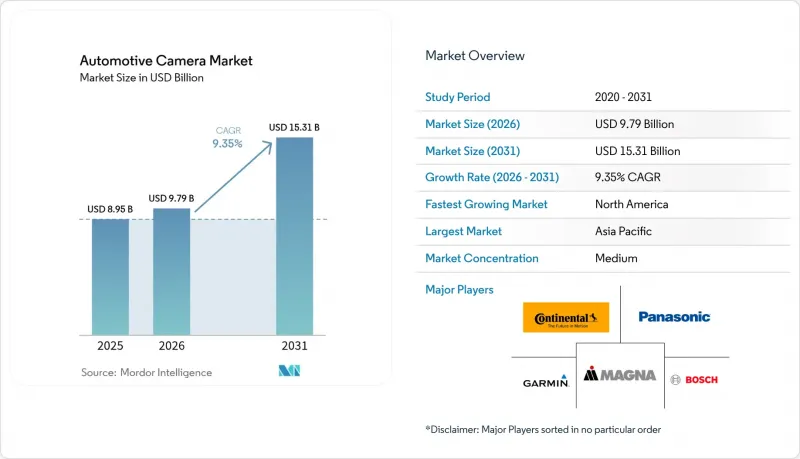
據 Mordor Intelligence 稱,2025 年汽車攝影機市場價值為 89.5 億美元,預計到 2031 年將達到 153.1 億美元,而 2026 年為 97.9 億美元,預測期(2026-2031 年)的複合年成長率為 9.35%。
本報告按車輛類型(乘用車、輕型商用車等)、視角類型(環景/後視/前視/車內)、技術類型(數位式(CMOS)等)、應用領域(停車輔助等)、銷售管道(OEM安裝等)和地區進行細分。以上所有細分市場的規模和預測均以美元(USD)為單位。
全球汽車攝影機市場趨勢及洞察
美國、歐盟和中國強制安裝安全攝影機
隨著安全法規日益一體化,汽車製造商被迫將多攝影機系統整合到所有新車汽車平臺中。歐盟《通用安全法規II》(General Safety Regulations II)將於2024年7月生效,強制要求安裝前置鏡頭,用於車道維持輔助、智慧速度輔助和緊急煞車。中國2024年新車碰撞測試(NCAP)將評估駕駛監控的準確性,實際上也強制要求安裝紅外線車內攝影機。在美國,國家公路交通安全管理局(NHTSA)將於2024年最終確定的法規將強制要求車輛在時速高達90英里(約145公里)的情況下進行行人行人偵測的自動緊急制動,這無疑對可在黑暗中工作的紅外熱成像感測器提出了更高的需求。因此,汽車製造商正在尋求能夠同時滿足這三項法規要求的攝影機架構,從而加快了全球設計週期。擁有高度擴充性參考設計的供應商正收到來自量產平台的大量報價請求。因此,法規的協調統一正在將安全攝影機從差異化產品轉變為標準產品,從而推動汽車攝影機市場的整體出貨量成長。
ADAS和自動駕駛技術的普及
2級以上自動駕駛功能正從高階品牌逐漸擴展到福斯C級車型。 Mobileye的SuperVision平台目前已應用於大眾MQB平台車型,該平台最多可使用11個攝影機感知周圍環境並獲取高清道路定位資訊。SONY預測,到2027年,每輛車的攝影機數量將從目前的8個增加到12個。感測器端人工智慧處理能力將使即時視覺演算法能夠在邊緣處理器上運行,從而降低系統延遲和佈線複雜性。因此,自動化程度的提高將為增加的攝影機數量帶來投資回報,形成成本效益的良性循環。預計這種協同效應將推高攝影機的平均售價(ASP)並推動出貨量激增,到2030年,汽車攝影機市場的複合年成長率(CAGR)將提高2.1個百分點。
多攝影機系統的物料清單成本
目前一套完整的ADAS系統需要8到12個鏡頭,單價依解析度不同,從20美元到500美元不等。對於注重成本的汽車製造商而言,攝影機成本可能占到車輛材料成本的3%,從而擠壓利潤空間。福特公司因後視攝影機軟體缺陷,於2025年召回107.5萬輛汽車,凸顯了系統複雜性帶來的保固風險增加。一級供應商正透過推出整合視覺ECU和單線纜架構來應對這項挑戰,但短期成本上漲仍導致汽車攝影機市場的複合年成長率下降1.8個百分點。
細分市場分析
預計到2025年,乘用車車載攝影機市場規模將達到59.5億美元,佔全球整體銷售額的66.48%。輕型商用車市場目前規模較小,但預計到2031年將以11.02%的複合年成長率成長,超過整體市場成長速度。車隊所有者擴大採用車載攝影機來降低保險費用、減少碰撞事故,並支援基於遠端資訊處理的駕駛員評估。據沃爾沃卡車公司稱,用攝影機監控系統取代傳統後視鏡可節省2%的燃油。因此,物流公司對車載攝影機的需求正在成長,因為其投資報酬率可以量化。
由於乘用車的大規模生產以及消費者願意為安全配置買單,乘用車仍然佔據主導地位。 2025年,新型輕型乘用車的ADAS(高級駕駛輔助系統)普及率將超過90%,確保穩定的部署量。在重型卡車領域,攝影機的普及與歐盟GSR II(盲點偵測法規)等監管里程碑的實施一致。 Stoner Ridge的「MirrorEye」系統已安裝在Freightliner Cascadia重型卡車上,該系統配備八個鏡頭,展現了冗餘性,未來或將擴展到乘用車SUV。成本效益模組和已證實的車隊成本節約效果,正推動商用車領域汽車攝影機市場達到兩位數的銷售成長。
即使到了2025年,可視攝影機仍將保持56.80%的銷售佔有率,主要透過後視攝影機、環視攝影機和後視鏡替代功能來推動汽車攝影機市場佔有率的成長。然而,隨著汽車製造商(OEM)傾向於優先考慮感知功能而非顯示功能,立體感知攝影機的市場佔有率正以12.95%的複合年成長率快速成長。斯巴魯的下一代EyeSight系統採用了安森美半導體(ON Semiconductor)的Hyperlux AR0823AT感測器,實現了先前只有雷射雷達(LiDAR)系統才能達到的車道居中定位精度。目前,立體感知系統已在日本獲得L3級自動駕駛系統(ADS)認證,這進一步推動了其應用。隨著更多經濟型車型配備立體感知攝影機,感知型汽車攝影機市場的規模將與傳統視覺攝影機市場規模的差距逐漸縮小。
傳統視覺系統也在不斷發展,HDR性能得到提升,並採用了防濺塗層,即使在泥濘路面上也能保持清晰度。汽車製造商正在整合「鳥瞰式」計算拼接技術,該技術需要四個攝影機逐幀同步,並要求供應商提供傾斜度最小的成像器。 Foresight的立體演算法套件即使在照度低於0.05勒克斯的環境下也能實現物體偵測,使感測攝影機成為雷射雷達的一種經濟高效的替代方案。總而言之,基於影像的感知技術的優越性以及物料清單(BOM)的減少,正推動汽車攝影機市場的成長重心轉移到「智慧」領域。
區域分析
亞太地區在中國的大規模生產和日本半導體產業的領先地位的支撐下,預計到2025年將以40.10%的市場佔有率主導汽車攝影機市場。SONY的目標是到2026年在全球汽車成像器市場佔據顯著佔有率,這將進一步增強亞太地區供應鏈的競爭力。北京的智慧汽車藍圖L2+級系統提供補貼,多攝影機組件正逐漸成為低價電動車的標準配備。韓國汽車製造商正基於國產感測器和鏡頭,為所有新SUV配備先進的環景顯示功能。這些政策以及產業的深厚實力正在鞏固亞太地區在汽車攝影機市場的領先地位。
預計到2025年,北美將佔據26.05%的市場佔有率,這主要得益於消費者對高階安全功能日益成長的需求,以及美國國家公路交通安全管理局(NHTSA)的相關法規。美國法規強制要求在2029年前實施自動緊急煞車系統,促使行車記錄器的部署提前,從而將檢驗成本分攤到更長的週期內。加拿大各省為安裝行車記錄器的車輛提供車隊保險折扣,進一步擴大了售後市場。矽谷半導體公司提供的前沿人工智慧參考設計,縮短了國內原始設備製造商(OEM)的產品上市時間。這些因素共同推動了北美汽車攝影機市場保持強勁的成長動能。
歐洲已佔據23.15%的市場佔有率,這主要得益於其在GSR II法規下較早訂定的全面攝影機安全措施。德國豪華汽車品牌在其車輛上配備多達10個鏡頭,以確保獲得Euro NCAP五星評級。歐盟對電子後視鏡的批准也為電動車市場注入了新的活力,電動車製造商紛紛採用虛擬後視鏡來降低空氣阻力。然而,由於GDPR法規下嚴格的資料處理規則限制了廣泛的分析,歐洲的成長速度略低於亞太地區。
2025年,中東和非洲地區佔全球銷售額的6.70%,主要得益於海灣合作理事會成員國強制安裝安全設備以及都市化進程的加速。沙烏地阿拉伯汽車分割畫面攝影機生態系統的不斷發展,也為擴大國內組裝生產提供了支援。南美洲的市佔率維持在4.00%,但隨著巴西計畫於2026年符合聯合國歐洲經濟委員會(UN ECE)的後視攝影機標準,預計未來幾年將出現升級換代的趨勢。整體而言,監管實施時間上的差異導致汽車攝影機市場呈現區域分散化。
其他好處:
- Excel格式的市場預測(ME)表
- 3個月的分析師支持
目錄
第1章:引言
- 研究假設和市場定義
- 調查範圍
第2章:調查方法
第3章執行摘要
第4章 市場狀況
- 市場概覽
- 市場促進因素
- 美國、歐盟和中國強制安裝監視攝影機
- ADAS和自動駕駛的普及率
- 停車場/透過360度全景刺激消費需求
- 降低CMOS人工智慧的成本
- 利用電子後視鏡降低電動車的空氣阻力
- 駕駛員監控相關法規的進展
- 市場限制因素
- 多攝影機系統的物料清單成本
- 網路安全和隱私風險
- 紅外線玻璃供應緊張
- CMS法規制定方面存在不確定性
- 價值供應鏈分析
- 監理情勢
- 技術展望
- 波特五力模型
第5章 市場規模與成長預測
- 車輛類型
- 搭乘用車
- 輕型商用車
- 中型和大型商用車輛
- 相機類型
- 觀看方式(環繞/後視/前視/車內)
- 感測/立體相機
- 透過技術
- 數位式(CMOS)
- 近紅外線(NIR)
- 熱紅外線(長波紅外線)
- 透過使用
- 停車協助
- 高級駕駛輔助系統(ADAS)
- 駕駛員監控和車內安全
- 按銷售管道
- OEM設備
- 售後市場
- 按地區
- 北美洲
- 美國
- 加拿大
- 其他北美國家
- 歐洲
- 德國
- 法國
- 英國
- 其他歐洲國家
- 亞太地區
- 中國
- 日本
- 印度
- 韓國
- 其他亞太國家
- 中東和非洲
- 沙烏地阿拉伯
- 阿拉伯聯合大公國
- 南非
- 其他中東和非洲國家
- 南美洲
- 巴西
- 阿根廷
- 其他南美國家
- 北美洲
第6章 競爭情勢
- 市場集中度
- 策略趨勢
- 市佔率分析
- 公司簡介
- Robert Bosch GmbH
- Continental AG
- Magna International Inc.
- Valeo SA
- ZF Friedrichshafen AG
- Gentex Corporation
- Autoliv Inc.
- Hella GmbH & Co KGaA
- Panasonic Corp.
- Garmin Ltd
- Denso Corp.
- Mobileye NV
- Aptiv PLC
- onsemi(Semiconductor Components Industries LLC)
- Ambarella Inc.
- Mitsubishi Electric Corp.
- Hyundai Mobis
第7章 市場機會與未來展望
According to Mordor Intelligence, the automotive camera market size was valued at USD 8.95 billion in 2025 and estimated to grow from USD 9.79 billion in 2026 to reach USD 15.31 billion by 2031, at a CAGR of 9.35% during the forecast period (2026-2031).
This report is Segmented by Vehicle Type (Passenger Vehicles, Light Commercial Vehicles, and More), Type (Viewing (Surround/Rear/Front/Interior) and More), Technology (Digital (CMOS), and More), Application (Park Assist and More), Sales Channel (OEM-Installed and More), and Geography. The Market Sizes and Forecasts are Provided in Terms of Value (USD) and for all the Above Segments.
Global Automotive Camera Market Trends and Insights
Safety-camera mandates in US, EU & China
A convergence of safety regulations is forcing OEMs to integrate multi-camera suites in every new vehicle platform. The European Union's General Safety Regulation II, effective July 2024, compels forward-facing cameras for lane keeping, intelligent speed assistance, and emergency braking. China's 2024 NCAP now scores driver-monitoring accuracy, effectively requiring infrared cabin cameras. In the United States, the NHTSA rule finalized in 2024 obliges automatic emergency braking with pedestrian detection up to 90 mph, creating a clear pull for thermal sensors that can see in darkness. Automakers, therefore, seek camera architectures that meet all three regimes simultaneously, accelerating global design cycles. Suppliers equipped with scalable reference designs are winning new RFQs from volume platforms. Regulatory alignment is thus turning safety cameras into a baseline commodity rather than a differentiator, lifting overall shipment volumes across the automotive camera market.
ADAS & autonomy penetration
Level 2+ driving functions are shifting from premium nameplates to mass-market C-segment vehicles. Mobileye's SuperVision platform now powers Volkswagen's MQB models, using up to 11 cameras for surround sensing and high-definition road referencing. Sony forecasts each vehicle will embed 12 cameras by fiscal 2027, up from 8 today. AI-on-sensor capabilities let real-time vision algorithms run on edge silicon, trimming system latency and wiring complexity. In turn, higher automation creates a payback for more cameras, closing the cost-benefit loop. The net effect is an upward shift in camera ASPs alongside ballooning unit counts, underpinning an incremental 2.1-percentage-point lift in the automotive camera market CAGR through 2030.
Multi-camera BOM cost
Comprehensive ADAS stacks now need 8-12 cameras, yet unit prices range from USD 20 to USD 500, depending on resolution. For value-oriented nameplates, cameras can consume up to 3% of vehicle material cost, squeezing margins. Ford's 2025 recall of 1.075 million vehicles over rear camera software faults underscores the warranty exposure linked with added complexity. Tier 1 suppliers are responding with consolidated vision ECUs and single-cable architectures, but near-term cost headwinds still trim 1.8 percentage points from the automotive camera market CAGR.
Other drivers and restraints analyzed in the detailed report include:
- Parking/360-view consumer pull
- Driver-monitoring regulation momentum
- Cyber-security & privacy risks
For complete list of drivers and restraints, kindly check the Table Of Contents.
Segment Analysis
The automotive camera market size for passenger vehicles stood at USD 5.95 billion in 2025, equal to 66.48% of global revenue. Light commercial vehicles, while smaller today, are expanding at an 11.02% CAGR through 2031, outpacing overall growth. Fleet owners embrace cameras to trim insurance costs, curb collisions, and support telematics-based driver scoring. Volvo Trucks reports fuel savings of 2% when camera monitor systems replace traditional mirrors. The automotive camera market, therefore, sees rising procurement from logistics firms that can quantify ROI.
Passenger cars keep leadership because of scale production and consumer willingness to pay for safety packs. ADAS penetration exceeded 90% in new light-duty vehicles in 2025, ensuring a stable installed base. In heavy trucks, camera adoption aligns with regulatory milestones such as the EU's GSR II blind-spot detection rule. Stoneridge's MirrorEye system on Freightliner Cascadia heavy trucks has demonstrated 8-camera redundancy that may later cascade to consumer SUVs. The blend of cost-down modules and proven fleet savings sustains a double-digit rise in the automotive camera market across commercial segments.
Viewing cameras retained a 56.80% revenue share in 2025, anchoring the automotive camera market share around reversing, surround, and mirror replacement functions. Yet, sensing and stereo units are scaling at 12.95% CAGR as OEMs prioritize perception over display. Subaru's next-gen EyeSight leverages onsemi Hyperlux AR0823AT sensors to offer lane-centering precision previously limited to lidar setups. Depth-perception stereo rigs are now validated to Automated Driving Systems (ADS) Level 3 in Japan, driving broader uptake. As sensing cameras migrate into affordable trims, the automotive camera market size within perception sub-segments will narrow the gap against legacy viewing categories.
Traditional viewing systems evolve too, with higher HDR and de-spray coatings that maintain clarity in road grime. Automakers are integrating bird-eye computational mosaics that require frame-accurate synchronization across four cameras, pushing suppliers to deliver low-skew imagers. Foresight's stereo algorithm bundles deliver object detection at sub-0.05 lux, positioning sensing cameras as a cost-effective alternative to lidar. Overall, image-based perception advantages and falling BOMs are pivoting growth toward the intelligence end of the automotive camera market.
Complete Report Scope:
- By Vehicle Type
- Passenger Vehicles
- Light Commercial Vehicles
- Medium and Heavy Commercial Vehicles
- By Camera Type
- Viewing (Surround/Rear/Front/Interior)
- Sensing / Stereo Cameras
- By Technology
- Digital (CMOS)
- Infra-red (NIR)
- Thermal (LWIR)
- By Application
- Park Assist
- Advanced Driver Assistance Systems (ADAS)
- Driver Monitoring & Cabin Safety
- By Sales Channel
- OEM-Installed
- Aftermarket
- By Geography
- North America
- United States
- Canada
- Rest of North America
- Europe
- Germany
- France
- United Kingdom
- Rest of Europe
- Asia-Pacific
- China
- Japan
- India
- South Korea
- Rest of Asia-Pacific
- Middle East and Africa
- Saudi Arabia
- United Arab Emirates
- South Africa
- Rest of Middle East and Africa
- South America
- Brazil
- Argentina
- Rest of South America
- North America
Geography Analysis
Asia-Pacific dominated the automotive camera market with a 40.10% share in 2025, buoyed by China's production scale and Japan's semiconductor leadership. Sony targets a significant global share in automotive imagers by fiscal 2026, reinforcing regional supply-chain competitiveness. Beijing's smart-vehicle roadmap subsidizes Level 2+ systems, making multi-camera packages standard even in economy EVs. South Korea's OEMs embed advanced surround-view on every new SUV, underpinned by local sensor and lens fabrication. Such a policy and industrial depth secure APAC's anchor position in the automotive camera market.
North America held a 26.05% share in 2025 as consumer demand for high-end safety features dovetailed with NHTSA mandates. The U.S. rule obliging automatic emergency braking by 2029 incentivizes early camera adoption to spread validation costs over longer cycles. Canadian provinces offer fleet insurance rebates for dash-cams, expanding the retrofit pool. Silicon Valley chip firms provide edge-AI reference designs that reduce time-to-market for domestic OEMs. These factors keep the region's automotive camera market on a firm expansion track.
Europe captured 23.15% share, driven by being first to legislate comprehensive camera-based safety under GSR II. German luxury brands equip vehicles with up to 10 cameras to secure 5-Star Euro NCAP scores. The bloc's e-mirror approval delivers a fresh windfall as EV makers adopt drag-cutting virtual mirrors. However, GDPR imposes strict data processing rules that limit broader analytics, slightly moderating growth relative to APAC.
The Middle East and Africa region accounted for 6.70% of 2025 revenue, thanks to safety-equipment mandates in Gulf Cooperation Council states and expanding urbanization. Saudi Arabia's emerging automotive split-view camera ecosystem underpins domestic assembly ambitions. South America remained at 4.00% share, yet Brazil's 2026 plan to align with UN ECE rearview camera standards sets a multi-year upgrade cycle. Overall, differential regulation timing drives geographic dispersion within the automotive camera market.
- Robert Bosch GmbH
- Continental AG
- Magna International Inc.
- Valeo SA
- ZF Friedrichshafen AG
- Gentex Corporation
- Autoliv Inc.
- Hella GmbH & Co KGaA
- Panasonic Corp.
- Garmin Ltd
- Denso Corp.
- Mobileye N.V.
- Aptiv PLC
- onsemi (Semiconductor Components Industries LLC)
- Ambarella Inc.
- Mitsubishi Electric Corp.
- Hyundai Mobis
Additional Benefits:
- The market estimate (ME) sheet in Excel format
- 3 months of analyst support
TABLE OF CONTENTS
1 Introduction
- 1.1 Study Assumptions & Market Definition
- 1.2 Scope of the Study
2 Research Methodology
3 Executive Summary
4 Market Landscape
- 4.1 Market Overview
- 4.2 Market Drivers
- 4.2.1 Safety-camera mandates in US, EU & China
- 4.2.2 ADAS & autonomy penetration
- 4.2.3 Parking/360-view consumer pull
- 4.2.4 CMOS-AI cost deflation
- 4.2.5 EV drag-reduction via e-mirrors
- 4.2.6 Driver-monitoring regulation momentum
- 4.3 Market Restraints
- 4.3.1 Multi-camera BOM cost
- 4.3.2 Cyber-security & privacy risks
- 4.3.3 IR-glass supply crunch
- 4.3.4 CMS rule-making uncertainty
- 4.4 Value / Supply-Chain Analysis
- 4.5 Regulatory Landscape
- 4.6 Technological Outlook
- 4.7 Porters Five Forces
- 4.7.1 Bargaining Power of Suppliers
- 4.7.2 Bargaining Power of Buyers
- 4.7.3 Threat of New Entrants
- 4.7.4 Threat of Substitutes
- 4.7.5 Competitive Rivalry
5 Market Size & Growth Forecasts (Value in USD)
- 5.1 By Vehicle Type
- 5.1.1 Passenger Vehicles
- 5.1.2 Light Commercial Vehicles
- 5.1.3 Medium and Heavy Commercial Vehicles
- 5.2 By Camera Type
- 5.2.1 Viewing (Surround/Rear/Front/Interior)
- 5.2.2 Sensing / Stereo Cameras
- 5.3 By Technology
- 5.3.1 Digital (CMOS)
- 5.3.2 Infra-red (NIR)
- 5.3.3 Thermal (LWIR)
- 5.4 By Application
- 5.4.1 Park Assist
- 5.4.2 Advanced Driver Assistance Systems (ADAS)
- 5.4.3 Driver Monitoring & Cabin Safety
- 5.5 By Sales Channel
- 5.5.1 OEM-Installed
- 5.5.2 Aftermarket
- 5.6 By Geography
- 5.6.1 North America
- 5.6.1.1 United States
- 5.6.1.2 Canada
- 5.6.1.3 Rest of North America
- 5.6.2 Europe
- 5.6.2.1 Germany
- 5.6.2.2 France
- 5.6.2.3 United Kingdom
- 5.6.2.4 Rest of Europe
- 5.6.3 Asia-Pacific
- 5.6.3.1 China
- 5.6.3.2 Japan
- 5.6.3.3 India
- 5.6.3.4 South Korea
- 5.6.3.5 Rest of Asia-Pacific
- 5.6.4 Middle East and Africa
- 5.6.4.1 Saudi Arabia
- 5.6.4.2 United Arab Emirates
- 5.6.4.3 South Africa
- 5.6.4.4 Rest of Middle East and Africa
- 5.6.5 South America
- 5.6.5.1 Brazil
- 5.6.5.2 Argentina
- 5.6.5.3 Rest of South America
- 5.6.1 North America
6 Competitive Landscape
- 6.1 Market Concentration
- 6.2 Strategic Moves
- 6.3 Market Share Analysis
- 6.4 Company Profiles (Includes Global level Overview, Market level overview, Core Segments, Financials as available, Strategic Information, Market Rank/Share for key companies, Products & Services, and Recent Developments)
- 6.4.1 Robert Bosch GmbH
- 6.4.2 Continental AG
- 6.4.3 Magna International Inc.
- 6.4.4 Valeo SA
- 6.4.5 ZF Friedrichshafen AG
- 6.4.6 Gentex Corporation
- 6.4.7 Autoliv Inc.
- 6.4.8 Hella GmbH & Co KGaA
- 6.4.9 Panasonic Corp.
- 6.4.10 Garmin Ltd
- 6.4.11 Denso Corp.
- 6.4.12 Mobileye N.V.
- 6.4.13 Aptiv PLC
- 6.4.14 onsemi (Semiconductor Components Industries LLC)
- 6.4.15 Ambarella Inc.
- 6.4.16 Mitsubishi Electric Corp.
- 6.4.17 Hyundai Mobis
7 Market Opportunities & Future Outlook
- 7.1 White-space & Unmet-Need Assessment

 汽車攝影機市場報告:趨勢、預測和競爭分析(至2035年)
 印度汽車攝影機市場:市場佔有率分析、產業趨勢與統計及成長預測(2026-2031)
 汽車攝影機市場:2026-2032年全球市場預測(按攝影機類型、視野角、技術、解析度、車輛類型、應用、最終用戶和銷售管道)汽車攝影機市場:2026-2032年全球市場預測(按產品類型、連接方式、解析度、通道數、應用和車輛類型分類)
 汽車攝影機市場預測至2034年-全球分析(按攝影機類型、技術、驅動系統、解析度、自動駕駛等級、應用和地區分類)
 自行車電腦市場規模、佔有率和成長分析:按產品技術、顯示器規格、無線連接方式、銷售管道、分銷管道和地區分類-2026-2033年產業預測
 全球整合雷達攝影機市場:市場規模、佔有率、趨勢和成長分析(2026-2034)
 汽車攝影機市場分析及預測(至2035年):類型、產品、技術、組件、應用、最終用戶、功能、安裝類型、解決方案
 全球汽車攝影機市場:按技術、燃油/電動車應用、車輛類型、視覺範圍、電動車類型、自動駕駛等級和地區分類-預測(至2033年)2026-2034年全球汽車攝影機市場規模、佔有率、趨勢和成長分析報告