


 |
市場調查報告書
商品編碼
2113759
印度汽車攝影機市場:市場佔有率分析、產業趨勢與統計及成長預測(2026-2031)India Automotive Camera - Market Share Analysis, Industry Trends & Statistics, Growth Forecasts (2026 - 2031) |
||||||

※ 本網頁內容可能與最新版本有所差異。詳細情況請與我們聯繫。
2025 年印度汽車攝影機市場價值為 3.0221 億美元,預計到 2031 年將達到 6.9767 億美元,而 2026 年為 3.4742 億美元,預測期(2026-2031 年)複合年成長率為 14.96%。
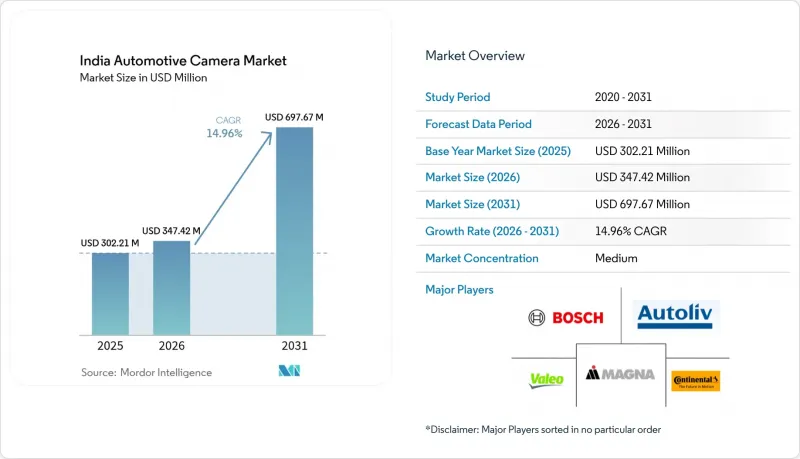
本報告按車輛類型(乘用車和商用車)、攝影機類型(可視攝影機和偵測攝影機)、應用領域(ADAS、停車和環景、駕駛監控)、解析度(100萬像素及以下和100萬像素及以上)、銷售管道(OEM和售後市場)、安裝位置(前視、後視及其他)和地區進行細分。市場預測以美元(USD)為單位。
印度汽車攝影機市場趨勢與洞察
更嚴格的AIS-150和Bharat NCAP安全標準
自2026年起,AIS-150將強制所有車型配備電子穩定控制系統(ESC)和高級煞車系統,在新法律規範下重塑印度汽車攝影機市場。由於Bharat NCAP評級與基於攝影機的ADAS直接掛鉤,Mahindra、Hyundai和Tata等汽車製造商正在其中端車型上增加L2級功能,以獲得更高的評級。雖然分階段推廣的計畫允許企業分散投資,但小規模的汽車製造商卻難以承擔認證成本,這使得擁有成熟安全認證的供應商更具優勢。隨著NCAP星級評定在展示室行銷中日益普及,消費者意識不斷提高,進一步推動了全國對攝影機的需求。
泊車輔助和環景顯示功能的需求日益成長
在交通擁擠和停車位日益緊張的都市區,人們對基於攝影機的駕駛輔助系統越來越感興趣。尤其是在配備先進多攝影機系統的豪華車型中,泊車輔助和環景顯示影像等技術的需求尤其強勁,這些系統能夠幫助駕駛員在狹窄的城市街道中安全行駛。同時,價格適中的倒車影像系統在售後市場也越來越受歡迎,許多車主選擇為老舊車輛加裝倒車影像系統以提升視野。與停車相關的保險理賠激增,也印證了消費者對這些視覺輔助設備的依賴性日益增強,鞏固了其在各個車型領域的市場地位。
惡劣天氣和道路灰塵會對感測器產生負面影響。
在印度,夏季氣溫超過攝氏50度C,季風季節暴雨傾盆,季節性沙塵暴還會覆蓋擋風玻璃。這些惡劣環境會導致車燈內部結露,進而劣化電子元件。車主往往忽略定期清潔,導致影像失真,並對產品失去信心。供應商正透過推出防護等級較高的IP防護型產品和防水塗層來解決這個問題,但這會增加元件成本,並延長在專用氣候測試箱中的測試週期。
細分市場分析
預計到2025年,乘用車將佔印度汽車攝影機總銷量的71.63%,凸顯了印度汽車攝影機市場對消費者安全功能的重視。同時,由於電氣化法規和物流數位化推動了強制性監控,商用車市場預計將以16.98%的複合年成長率成長。乘用車需求與可支配收入的成長和技術差異化密切相關,而車隊營運商則更關注降低保險費和減少事故責任。
儘管商用車的銷售週期較長,但與遠端資訊處理技術相關的折扣有望帶來更快的投資回報。原廠Line-Fit方案簡化了兩個細分市場的合規性和保固管理,但對於注重預算的運輸商而言,升級舊卡車的改裝方案仍然具有吸引力。受 Mahindra、Hyundai 和 Tata 等廠商推出具有競爭力的新車型的推動,乘用車攝影機的搭載率隨著每次車型更新而不斷提高。這些製造商現在以低於 20 拉克(約 22,500 美元)的價格提供基本的 ADAS 作為標準配置。
到2025年,監視器的出貨量將佔總出貨量的62.74%,這主要得益於消費者對便利停車的需求。預計到2031年,感測攝影機將以18.12%的複合年成長率成長,這主要得益於支援車道維持和碰撞避免功能的立體攝影機配置。雖然由於成本較低,單一攝影機配置在入門級車型中仍佔據主導地位,但配備L2級駕駛輔助功能的高階跨界車型正在興起立體攝影機平台。
隨著處理器價格下降和車輛控制器上的視覺演算法效率提高,印度汽車感測模組市場正在擴張。升級的複雜性日益增加,為維修店的校準服務帶來了收入,也為以軟體為中心的供應商提供了新的競爭優勢。雖然攝影機仍然很重要,但隨著源自新車安全評鑑協會(NCAP)的主動安全法規從高階車型轉向中階車型,其市場佔有率正在下降。
其他好處:
- Excel格式的市場預測(ME)表
- 3個月的分析師支持
目錄
第1章:引言
- 研究假設和市場定義
- 調查範圍
第2章:調查方法
第3章執行摘要
第4章 市場狀況
- 市場概覽
- 市場促進因素
- AIS-150 和 Bharat NCAP 的安全標準更加嚴格。
- 對停車輔助和ADAS功能的需求日益成長
- 降低CMOS相機的成本並實現供應鏈本地化。
- 高階掀背車和SUV銷售成長
- 國內相機模組製造的生產關聯獎勵
- 利用攝影機數據分析基於里程的保險
- 市場限制因素
- 100萬盧比以下細分市場的初始成本溢價
- 惡劣的天氣條件和道路灰塵正在降低感測器的性能。
- FX連結影像感測器的導入依賴項
- 消費者對機上監控的隱私擔憂
- 價值供應鏈分析
- 監理情勢
- 技術展望
- 波特五力模型
第5章 市場規模與成長預測
- 車輛類型
- 搭乘用車
- 掀背車
- 轎車
- 運動型多用途車與多用途車
- 商用車輛
- 輕型商用車
- 中型和大型商用車輛
- 搭乘用車
- 按相機類型
- 監視錄影機
- 感測攝影機
- 黑白
- 立體聲
- 透過使用
- ADAS
- 停車及周邊視野
- 駕駛員監控
- 通過決議
- 最高可達 100 萬像素
- 2~5 MP
- 500萬像素或以上
- 按銷售管道
- OEM-Fit
- 售後市場
- 按安裝位置
- 正面圖
- 後視圖
- 側面圖
- 車輛/車廂內部
- 按地區
- 北方
- 南
- 西方
- 東部和東北部
第6章 競爭情勢
- 市場集中度
- 策略趨勢
- 市佔率分析
- 公司簡介
- Robert Bosch GmbH
- Continental AG
- Valeo SA
- Panasonic Holdings Corporation
- Gentex Corporation
- Magna International Inc.
- Autoliv Inc.
- Denso Corporation
- LG Innotek Co., Ltd.
- Samsung Electro-Mechanics Co., Ltd.
- Omnivision Technologies, Inc.
- Motherson Sumi Wiring India Limited
- Pricol Limited
- Uno Minda Limited
- Hikvision Automotive Electronics Co., Ltd.
- Hero Electronix Private Limited
- Cubtek Inc.
- Mobileye Global Inc.
- Ficosa International SA
第7章 市場機會與未來展望
According to Mordor Intelligence, the India automotive camera market size was valued at USD 302.21 million in 2025 and estimated to grow from USD 347.42 million in 2026 to reach USD 697.67 million by 2031, at a CAGR of 14.96% during the forecast period (2026-2031).
This report is Segmented by Vehicle Type (Passenger Vehicle and Commercial Vehicle), Camera Type (Viewing Camera and Sensing Camera), Application (ADAS, Parking and Surround View, and Driver Monitoring), Resolution (Up To 1 MP and More), Sales Channel (OEM-Fit and Aftermarket), Mounting Location (Front View, Rear View, and More), and Region. The Market Forecasts are Provided in Terms of Value (USD).
India Automotive Camera Market Trends and Insights
Stricter AIS-150 and Bharat NCAP Safety Mandates
Regulatory frameworks reshape the Indian automotive camera market as AIS-150 compels electronic stability control and advanced braking across vehicle categories beginning 2026. Bharat NCAP scores tie directly to camera-enabled ADAS, prompting Mahindra, Hyundai, and Tata to add Level 2 functions in mid-tier trims to secure higher ratings. Phased timelines help firms spread investment, yet small OEMs grapple with certification costs that ultimately favor suppliers holding proven safety credentials. Consumer awareness grows as NCAP star labels appear in showroom marketing, reinforcing camera demand nationwide.
Rising Demand for Parking-Assist and Surround-View Features
As urban areas grapple with congestion and dwindling parking spaces, there's a rising interest in camera-based driver assistance systems. Technologies like parking aids and surround-view cameras are in high demand, especially in premium vehicles that now boast sophisticated multi-camera setups for navigating tight city streets. Meanwhile, budget-friendly rear-view cameras are making waves in the aftermarket, with many drivers opting to enhance older vehicles for improved visibility. The surge in parking-related insurance claims underscores the growing consumer reliance on these visual aids, solidifying their presence across various vehicle segments.
Harsh Climatic and Road-Dust Conditions Impairing Sensors
Indian summers top 50 °C, monsoons bring torrents, and seasonal dust storms coat windscreens. These extreme fog lenses cause condensation in housings and degrade electronics. Owners often ignore frequent cleaning, leading to image loss that erodes trust. Suppliers respond with rugged IP-rated units and hydrophobic coatings, inflating bills of material and lengthening test cycles at dedicated climatic chambers.
Other drivers and restraints analyzed in the detailed report include:
- Declining CMOS Camera Costs and Localized Supply Chains
- Usage-Based Insurance Analytics Leveraging Camera Data
- Consumer Privacy Concerns on In-Cabin Monitoring
For complete list of drivers and restraints, kindly check the Table Of Contents.
Segment Analysis
Passenger models generated 71.63% of 2025 revenue, underscoring the Indian automotive camera market's focus on consumer safety features. Commercial fleets, however, will post a 16.98% CAGR as electrification rules and logistics digitization spur mandatory monitoring. Passenger-car demand matches rising disposable income and technology differentiation, while fleet operators chase lower insurance premiums and accident liability reductions.
Commercial sales cycles are longer, yet telematics-linked discounts yield rapid ROI. OEM line-fit solutions simplify compliance and warranty management for both segments, although retrofits still appeal to budget-minded transporters upgrading legacy trucks. Passenger car camera take-rates escalate with every model refresh, driven by competitive launches from Mahindra, Hyundai, and Tata that now bundle basic ADAS under INR 20 lakh (~ USD 22,500).
Viewing units held 62.74% of shipments in 2025 as consumers prioritized parking ease. Sensing cameras will advance at an 18.12% CAGR through 2031, fueled by stereo configurations supporting lane-keeping and collision avoidance. Mono setups dominate entry-level builds thanks to lower cost, while stereo platforms emerge in premium crossovers touting Level 2 assistance.
The Indian automotive camera market size for sensing modules gains as processors drop in price and vision algorithms run efficiently on vehicle controllers. Upgrade complexity introduces calibration service revenue for workshops and gives software-centric suppliers a fresh edge. Viewing cameras remain relevant but cede share as NCAP-driven active safety rules migrate from premium to mid-range trims.
Complete Report Scope:
- By Vehicle Type
- Passenger Vehicle
- Hatchback
- Sedan
- Sport Utility Vehicle and Multi-Purpose Vehicle
- Commercial Vehicle
- Light Commercial Vehicle
- Medium and Heavy Commercial Vehicle
- Passenger Vehicle
- By Camera Type
- Viewing Camera
- Sensing Camera
- Mono
- Stereo
- By Application
- ADAS
- Parking & Surround View
- Driver Monitoring
- By Resolution
- Up to 1 MP
- 2-5 MP
- Above 5 MP
- By Sales Channel
- OEM-Fit
- Aftermarket
- By Mounting Location
- Front View
- Rear View
- Side View
- Interior/In-Cabin
- By Region
- North
- South
- West
- East & North-East
List of Companies Covered in this Report:
- Robert Bosch GmbH
- Continental AG
- Valeo S.A.
- Panasonic Holdings Corporation
- Gentex Corporation
- Magna International Inc.
- Autoliv Inc.
- Denso Corporation
- LG Innotek Co., Ltd.
- Samsung Electro-Mechanics Co., Ltd.
- Omnivision Technologies, Inc.
- Motherson Sumi Wiring India Limited
- Pricol Limited
- Uno Minda Limited
- Hikvision Automotive Electronics Co., Ltd.
- Hero Electronix Private Limited
- Cubtek Inc.
- Mobileye Global Inc.
- Ficosa International S.A.
Additional Benefits:
- The market estimate (ME) sheet in Excel format
- 3 months of analyst support
TABLE OF CONTENTS
1 Introduction
- 1.1 Study Assumptions & Market Definition
- 1.2 Scope of the Study
2 Research Methodology
3 Executive Summary
4 Market Landscape
- 4.1 Market Overview
- 4.2 Market Drivers
- 4.2.1 Stricter AIS-150 and Bharat NCAP Safety Mandates
- 4.2.2 Rising Demand for Parking-Assist and ADAS Features
- 4.2.3 Declining CMOS Camera Costs and Localized Supply Chains
- 4.2.4 Volume Growth in Premium Hatchbacks and SUVs
- 4.2.5 PLI Incentives for Domestic Camera Module Manufacturing
- 4.2.6 Usage-Based Insurance Analytics Leveraging Camera Data
- 4.3 Market Restraints
- 4.3.1 Up-Front Cost Premiums in the Sub-INR-10-Lakh Segment
- 4.3.2 Harsh Climatic and Road-Dust Conditions Impairing Sensors
- 4.3.3 FX-Linked Import Dependence on Image Sensors
- 4.3.4 Consumer Privacy Concerns on in-Cabin Monitoring
- 4.4 Value / Supply-Chain Analysis
- 4.5 Regulatory Landscape
- 4.6 Technological Outlook
- 4.7 Porter's Five Forces
- 4.7.1 Threat of New Entrants
- 4.7.2 Bargaining Power of Buyers
- 4.7.3 Bargaining Power of Suppliers
- 4.7.4 Threat of Substitutes
- 4.7.5 Competitive Rivalry
5 Market Size and Growth Forecasts (Value, USD)
- 5.1 By Vehicle Type
- 5.1.1 Passenger Vehicle
- 5.1.1.1 Hatchback
- 5.1.1.2 Sedan
- 5.1.1.3 Sport Utility Vehicle and Multi-Purpose Vehicle
- 5.1.2 Commercial Vehicle
- 5.1.2.1 Light Commercial Vehicle
- 5.1.2.2 Medium and Heavy Commercial Vehicle
- 5.1.1 Passenger Vehicle
- 5.2 By Camera Type
- 5.2.1 Viewing Camera
- 5.2.2 Sensing Camera
- 5.2.2.1 Mono
- 5.2.2.2 Stereo
- 5.3 By Application
- 5.3.1 ADAS
- 5.3.2 Parking & Surround View
- 5.3.3 Driver Monitoring
- 5.4 By Resolution
- 5.4.1 Up to 1 MP
- 5.4.2 2-5 MP
- 5.4.3 Above 5 MP
- 5.5 By Sales Channel
- 5.5.1 OEM-Fit
- 5.5.2 Aftermarket
- 5.6 By Mounting Location
- 5.6.1 Front View
- 5.6.2 Rear View
- 5.6.3 Side View
- 5.6.4 Interior/In-Cabin
- 5.7 By Region
- 5.7.1 North
- 5.7.2 South
- 5.7.3 West
- 5.7.4 East & North-East
6 Competitive Landscape
- 6.1 Market Concentration
- 6.2 Strategic Moves
- 6.3 Market Share Analysis
- 6.4 Company Profiles (Includes Global level Overview, Market level overview, Core Segments, Financials as available, Strategic Information, Market Rank/Share, Products & Services, Recent Developments)
- 6.4.1 Robert Bosch GmbH
- 6.4.2 Continental AG
- 6.4.3 Valeo S.A.
- 6.4.4 Panasonic Holdings Corporation
- 6.4.5 Gentex Corporation
- 6.4.6 Magna International Inc.
- 6.4.7 Autoliv Inc.
- 6.4.8 Denso Corporation
- 6.4.9 LG Innotek Co., Ltd.
- 6.4.10 Samsung Electro-Mechanics Co., Ltd.
- 6.4.11 Omnivision Technologies, Inc.
- 6.4.12 Motherson Sumi Wiring India Limited
- 6.4.13 Pricol Limited
- 6.4.14 Uno Minda Limited
- 6.4.15 Hikvision Automotive Electronics Co., Ltd.
- 6.4.16 Hero Electronix Private Limited
- 6.4.17 Cubtek Inc.
- 6.4.18 Mobileye Global Inc.
- 6.4.19 Ficosa International S.A.
7 Market Opportunities & Future Outlook

 汽車攝影機市場報告:趨勢、預測和競爭分析(至2035年)
 汽車攝影機:市場佔有率分析、行業趨勢和統計數據、成長預測(2026-2031)
 汽車攝影機市場:2026-2032年全球市場預測(按攝影機類型、視野角、技術、解析度、車輛類型、應用、最終用戶和銷售管道)汽車攝影機市場:2026-2032年全球市場預測(按產品類型、連接方式、解析度、通道數、應用和車輛類型分類)
 汽車攝影機市場預測至2034年-全球分析(按攝影機類型、技術、驅動系統、解析度、自動駕駛等級、應用和地區分類)
 自行車電腦市場規模、佔有率和成長分析:按產品技術、顯示器規格、無線連接方式、銷售管道、分銷管道和地區分類-2026-2033年產業預測
 全球整合雷達攝影機市場:市場規模、佔有率、趨勢和成長分析(2026-2034)
 汽車攝影機市場分析及預測(至2035年):類型、產品、技術、組件、應用、最終用戶、功能、安裝類型、解決方案
 全球汽車攝影機市場:按技術、燃油/電動車應用、車輛類型、視覺範圍、電動車類型、自動駕駛等級和地區分類-預測(至2033年)2026-2034年全球汽車攝影機市場規模、佔有率、趨勢和成長分析報告