


 |
市場調查報告書
商品編碼
2121381
氮化鎵半導體裝置:市場佔有率分析、產業趨勢與統計、成長預測(2026-2031)GaN Semiconductor Devices - Market Share Analysis, Industry Trends & Statistics, Growth Forecasts (2026 - 2031) |
||||||

※ 本網頁內容可能與最新版本有所差異。詳細情況請與我們聯繫。
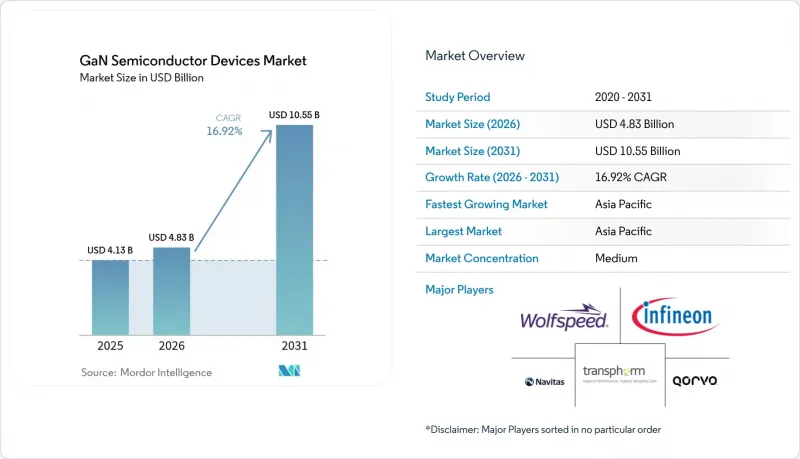
據 Mordor Intelligence 稱,GaN 半導體裝置市場預計到 2026 年價值 48.3 億美元,高於 2025 年的 41.3 億美元,預計到 2031 年將達到 105.5 億美元。
預計從 2026 年到 2031 年,其複合年成長率將達到 16.92%。
本報告按裝置類型(例如,功率半導體)、組件(例如,電晶體)、額定電壓(例如,小於 100V)、晶圓尺寸(例如,2 英吋)、基板技術(例如,GaN-On-SiC)、封裝(例如,表面黏著技術)、終端用戶行業(例如,汽車和移動出行)以及歐洲地區分類(北美、南美、當地)。
全球氮化鎵半導體裝置市場趨勢及洞察
受中國各OEM廠商藍圖的推動,65-240W USB-C PD相容GaN充電器正在普及。
中國消費電子品牌推動了超小型USB PD(通用串行匯流排電源傳輸)充電器的快速普及。 2024年推出的機型最大輸出功率可達240W,體積比同等矽基充電器縮小40%,零售價格降低35%。 Anker的「GaN Prime」系列實現了超過1.8W/cm³的功率密度,能夠在口袋大小的體積內為筆記型電腦和智慧型手機提供多重通訊協定充電。成本的降低促進了其在亞太和北美地區的普及,銷售的成長也對整個氮化鎵半導體裝置市場產生了連鎖反應。
在亞洲和印度部署 5G 大規模 MIMO大型基地台需要功率超過 200 瓦的 GaN-on-SiC 功率放大器。
2024年,中國、印度和日本的行動網路營運商部署了超過15,000個採用3.5GHz以上頻率GaN-on-SiC功率放大器(GaN-on-SiC)的廣域基地台。這項轉變使功耗降低了25%,覆蓋範圍擴大了18%,對於一家日本大型電信業者而言,每年可節省1,800萬美元的營運成本。這些經濟效益鞏固了GaN功率放大器的應用,並擴大了整個GaN半導體裝置市場的潛在收入。
200毫米GaN-on-Si外延晶片的有限供應鏈出現瓶頸
截至2024年,獲得認證的200mm氮化鎵外延晶圓生產商少於10家。其良率比矽基標準低15-20%,這限制了產量並推高了價格。一家歐洲一級汽車零件供應商遭遇了長達六個月的生產延誤,迫使其建立了價值2800萬歐元(3020萬美元)的戰略庫存緩衝。這些瓶頸嚴重影響了氮化鎵半導體裝置市場的短期供應。
細分市場分析
預計到2025年,GaN半導體裝置市場的功率半導體部分將佔據54.78%的佔有率,並在2031年之前以18.41%的複合年成長率成長。資料中心營運商透過升級到效率高達98.2%的GaN伺服器電源,每個設施平均節省了230萬美元的成本。射頻元件市場也緊跟其後,這得益於5G大規模MIMO基礎設施和國防雷達的強勁需求。隨著市場的成熟,策略分化也逐漸顯現。像英飛凌這樣的矽基老牌企業擴展了其車規級GaN MOSFET產品線,而像Wolfspeed這樣的射頻專家則利用GaN-on-SiC的熱裕度,開發了頻率高於3.5 GHz的大型基地台。整合功率級供應商的利潤率高於銷售分立產品。因此,GaN半導體裝置市場正經歷產業結構重組和垂直整合,從而增強規模經濟效益。
到2025年,高電子移動性電晶體(HEMT)將佔銷售額的56.63%,但單晶片功率積體電路(IC)將以29.55%的複合年成長率(CAGR)超越所有其他類別。一家中國智慧型手機OEM廠商透過單一GaN IC取代分立開關,加快了產能擴張,使充電器的材料清單(BOM)成本降低了18%,元件數量減少了45%。整合提高了電磁相容性並減少了寄生元件。這些優勢正推動GaN半導體元件市場發展到系統級封裝(SiP)設計。模組供應商正致力於滿足高功率應用的需求,而二極體在輔助整流應用的銷售仍然強勁。
100-650V電壓範圍支援消費性電子、資料中心和48V工業電源軌,即使到2025年仍將維持69.72%的市場佔有率。同時,在800V驅動架構的推動下,650V以上的頻寬正以39.67%的複合年成長率快速成長。一家高階電動車品牌透過採用900V GaN級,將10-80%的充電時間縮短至28分鐘,並相比SiC充電器減輕了3.2公斤的重量。這種轉變需要新的隔離和測試標準,這對純半導體供應商提出了挑戰。然而,在GaN半導體裝置市場,能夠證明其可靠性超過650V的公司將獲得回報,使它們能夠在汽車行業挖掘到盈利的價值來源。
區域分析
亞太地區在2025年佔總銷售額的37.85%,並以28.35%的複合年成長率實現最快成長。由於中國豐富的鎵資源和政府補貼,Innoscience得以以比競爭對手低35%的成本營運全球最大的8吋GaN-on-Si工廠。韓國主要消費性電子公司和日本汽車製造商成為關鍵客戶,紛紛下達大額訂單,從而形成需求成長和產能提升的良性循環。北美地區持續保持創新活力。一項3500萬美元的聯邦CHIPS津貼使GlobalFoundries得以擴大其在佛蒙特州的GaN產能。國防相關企業部署了基於GaN的相位陣列雷達,在將偵測範圍提高42%的同時,降低了18%的功耗。這是一項至關重要的成就,也將對GaN半導體裝置市場產生深遠影響。在歐洲,高階汽車和工業應用領域成為優先考慮的領域。劍橋氮化鎵裝置公司(Cambridge GaN Devices)已籌集3,050萬歐元(約3,310萬美元)用於業務擴張,反映出投資者對歐洲高功率細分市場的信心。這家領先的德國原始設備製造商(OEM)已實現97.8%的充電器效率,成功減少了30%的組件數量,並符合歐盟生態設計指令。目前,拉丁美洲、中東和非洲的市場佔有率小規模,但隨著能源價格的下降和基礎設施的建設,這些地區在通訊和智慧城市計畫中展現出良好的應用前景。
其他好處:
- Excel格式的市場預測(ME)表
- 3個月的分析師支持
目錄
第1章:引言
- 研究假設和市場定義
- 調查範圍
第2章:調查方法
第3章執行摘要
第4章 市場狀況
- 市場概覽
- 市場促進因素
- 在中國 OEM 製造商藍圖的推動下,65-240W USB-C PD 相容 GaN 充電器正在普及。
- 在亞洲和印度部署 5G 大規模 MIMO大型基地台台需要功率超過 200 瓦的 GaN-on-SiC 功率放大器。
- 向 800V 電動車平台的過渡正在加速雙向 GaN OBC 和 DC-DC 轉換器的採用。
- 在重量至關重要的 Moa Electric 飛機和 eVTOL 的動力傳動系統中,選擇 GaN 轉換器。
- 低衛星群星座衛星向氮化鎵Ku/ Ka波段固態功率放大器的過渡
- 日本和歐盟對氮化鎵生產設施的獎勵措施正在加速氮化鎵產能的擴張。
- 市場限制因素
- 200毫米GaN-on-Si外延晶片供應鏈瓶頸
- 閘電路可靠性挑戰:汽車 0 級認證要求超過 175 度C。
- 在新興市場,低於 3.5 GHz 的宏功率放大器中,與 LDMOS 相比存在成本差異。
- E模式GaN QFN/CSP封裝中分散的測試/封裝生態系統
- 價值鏈分析
- 監管和技術展望
- 波特五力分析
- 宏觀經濟因素對市場的影響
第5章 市場規模與成長預測
- 依設備類型
- 功率半導體
- 射頻半導體
- 光學半導體
- 按組件
- 電晶體(HEMT/FET)
- 二極體(肖特基二極體、PiN二極體)
- 整流器
- 功率積體電路(單晶片、多晶片)
- 模組(半橋、全橋)
- 按額定電壓
- 低於100伏
- 100~650V
- 超過650伏
- 按晶圓尺寸
- 2英吋
- 4吋
- 6吋或更大(包括8吋試產)
- 透過基板技術
- GaN on SiC
- GaN on Si
- GaN on Sapphire
- 體氮化鎵
- 650~1200V
- 超過1200伏
- 透過包裝
- 表面黏著技術(QFN、DFN)
- 通孔(TO-220、TO-247)
- 晶片級封裝(CSP)
- 裸晶
- 按最終用戶行業分類
- 汽車與出行
- 電動車(EV)
- 充電基礎設施
- 消費性電子產品
- 智慧型手機快速充電器
- 筆記型電腦和平板電腦充電器
- 遊戲主機和虛擬實境
- 通訊和資料通訊
- 5G基地台
- 資料中心電源
- 工業和能源
- 太陽能逆變器
- 馬達驅動
- 電源單元(SMPS)
- 航太/國防
- 雷達系統
- 電子戰
- 衛星有效載荷衛星有效載荷
- 醫療保健
- 磁共振/CT
- 可攜式醫療設備
- 汽車與出行
- 按地區
- 北美洲
- 美國
- 加拿大
- 墨西哥
- 南美洲
- 巴西
- 阿根廷
- 其他南美國家
- 歐洲
- 德國
- 英國
- 法國
- 義大利
- 西班牙
- 其他歐洲國家
- 亞太地區
- 中國
- 日本
- 韓國
- 印度
- 台灣
- 其他亞太國家
- 中東和非洲
- 中東
- 沙烏地阿拉伯
- 阿拉伯聯合大公國
- 土耳其
- 其他中東國家
- 非洲
- 南非
- 其他非洲國家
- 中東
- 北美洲
第6章 競爭情勢
- 市場集中度
- 策略趨勢
- 市佔率分析
- 公司簡介
- Efficient Power Conversion Corporation
- Navitas Semiconductor
- Transphorm Inc.
- Innoscience Technology Co., Ltd.
- MACOM Technology Solutions Holdings, Inc.
- Tagore Technology Inc.
- VisIC Technologies Ltd.
- Cambridge GaN Devices Ltd.
- NexGen Power Systems, Inc.
- Qromis, Inc.
- EPC Space LLC
- Analog Devices, Inc.
- Power Integrations, Inc.
- Ommic SAS
- Wolfspeed GaN Solutions
- Ampleon Netherlands BV
- Integra Technologies, Inc.
- RFHIC Corporation
- Sumitomo Electric Device Innovations Inc.
- Infineon Technologies AG
- STMicroelectronics NV
- Qorvo Inc.
第7章 市場機會與未來展望
According to Mordor Intelligence, the gallium nitride semiconductor devices market size in 2026 is estimated at USD 4.83 billion, growing from 2025 value of USD 4.13 billion with 2031 projections showing USD 10.55 billion, growing at 16.92% CAGR over 2026-2031.
This report is Segmented by Device Type (Power Semiconductors, and More), Component (Transistors, and More), Voltage Rating (<100 V, and More), Wafer Size (2-Inch, and More), Substrate Technology (GaN-On-SiC, and More), Packaging (Surface-Mount, and More), End-User Industry (Automotive and Mobility, and More), and Geography (North America, South America, Europe, Asia-Pacific, and Middle East and Africa).
Global GaN Semiconductor Devices Market Trends and Insights
Proliferation of 65-240 W USB-C PD GaN Chargers Led by Chinese OEM Road-maps
Chinese consumer-electronics brands propelled a rapid shift toward ultra-compact universal serial bus power-delivery chargers. Models released in 2024 delivered up to 240 W while shrinking volume by 40% relative to silicon equivalents and lowering retail prices by 35%. Anker's GaN Prime line exceeded 1.8 W/cm3 power density, enabling multiprotocol charging for laptops and phones within pocket-sized enclosures. Cost-downs stimulated mainstream uptake across Asia-Pacific and North America, lifting unit volumes that ripple across the gallium nitride semiconductor devices market.
5G Massive-MIMO Macro-Cell Roll-outs Requiring >200 W GaN-on-SiC PAs in Asia and India
Mobile network operators in China, India, and Japan deployed more than 15,000 macro base stations in 2024 using GaN-on-SiC power amplifiers above 3.5 GHz. The switch trimmed power consumption by 25% and stretched coverage by 18%, translating into USD 18 million annual operating expense savings for one leading Japanese carrier. Such economics cement GaN PA design wins and expand addressable revenue across the gallium nitride semiconductor devices market.
Limited 200 mm GaN-on-Si Epi Wafer Supply Chain Bottlenecks
Fewer than 10 qualified suppliers produced 200 mm GaN epitaxial wafers in 2024. Yields sat 15-20% below silicon benchmarks, constraining throughput and sustaining premium pricing. A European Tier-1 automotive supplier recorded a six-month production delay that forced strategic inventory buffers worth EUR 28 million (USD 30.2 million). Bottlenecks weigh on near-term volumes within the gallium nitride semiconductor devices market.
Other drivers and restraints analyzed in the detailed report include:
- Shift to 800 V EV Platforms Driving Bidirectional GaN OBC and DC-DC Adoption
- Weight-Critical More-Electric Aircraft and eVTOL Powertrains Selecting GaN Converters
- Gate Reliability Challenges >175 °C for Automotive Grade-0 Qualification
For complete list of drivers and restraints, kindly check the Table Of Contents.
Segment Analysis
The power-semiconductor slice of the gallium nitride semiconductor devices market held 54.78% share in 2025 and is projected to compound at 18.41% to 2031. Data-center operators saved USD 2.3 million per facility by upgrading to GaN server power supplies that reached 98.2% efficiency. RF devices followed as 5G massive-MIMO infrastructure and defense radar sustained premium demand. Maturity signaled a strategic fork. Silicon incumbents such as Infineon expanded automotive-grade GaN MOSFET lines, while RF specialists like Wolfspeed leveraged GaN-on-SiC thermal headroom for>3.5 GHz macro cells. Integrated power-stage providers captured a higher margin by moving beyond discrete sales. The gallium nitride semiconductor devices market, therefore, experiences both consolidation and vertical integration, reinforcing scale advantages.
High-electron-mobility transistors occupied 56.63% revenue in 2025, yet monolithic power ICs outpaced all other categories at 29.55% CAGR. A Chinese smartphone OEM cut the charger bill-of-materials by 18% by replacing discrete switches with a single GaN IC, shrinking part count by 45% and catalyzing volume ramps. Integration improves electromagnetic compatibility and trims parasitics, benefits that explain why the gallium nitride semiconductor devices market is tilting toward system-in-package designs. Module suppliers address high-power installations, while diode sales remain steady in auxiliary rectification roles.
The 100-650 V corridor kept a 69.72% share in 2025 as it aligns with consumer, data-center, and 48 V industrial rails. Meanwhile, the >650 V band races ahead at 39.67% CAGR, fueled by 800 V propulsion architectures. One premium EV brand slashed 10-80% charge time to 28 minutes using 900 V GaN stages and cut charger mass by 3.2 kg versus SiC. This transition prompts new isolation and test standards, challenging pure-play suppliers. Nevertheless, the gallium nitride semiconductor devices market rewards those able to validate reliability beyond 650 V, unlocking lucrative automotive value pools.
Complete Report Scope:
- By Device Type
- Power Semiconductors
- RF Semiconductors
- Opto-Semiconductors
- By Component
- Transistors (HEMT/FET)
- Diodes (Schottky, PiN)
- Rectifiers
- Power ICs (Monolithic, Multi-chip)
- Modules (Half-bridge, Full-bridge)
- By Voltage Rating
- < 100 V
- 100 - 650 V
- > 650 V
- By Wafer Size
- 2-inch
- 4-inch
- 6-inch and Above (incl. 8-inch Pilot)
- By Substrate Technology
- GaN-on-SiC
- GaN-on-Si
- GaN-on-Sapphire
- Bulk GaN
- 650 - 1200 V
- > 1200 V
- By Packaging
- Surface-Mount (QFN, DFN)
- Through-Hole (TO-220, TO-247)
- Chip-Scale Package (CSP)
- Bare Die
- By End-User Industry
- Automotive and Mobility
- Electric Vehicles
- Charging Infrastructure
- Consumer Electronics
- Smartphone Fast Chargers
- Laptop and Tablet Chargers
- Gaming Consoles and VR
- Telecom and Datacom
- 5G Base Stations
- Data Center Power
- Industrial and Energy
- Solar Inverters
- Motor Drives
- Power Supply Units (SMPS)
- Aerospace and Defense
- Radar Systems
- Electronic Warfare
- Satellite Payloads
- Medical
- MRI and CT
- Portable Medical Devices
- Automotive and Mobility
- By Geography
- North America
- United States
- Canada
- Mexico
- South America
- Brazil
- Argentina
- Rest of South America
- Europe
- Germany
- United Kingdom
- France
- Italy
- Spain
- Rest of Europe
- Asia-Pacific
- China
- Japan
- South Korea
- India
- Taiwan
- Rest of Asia-Pacific
- Middle East and Africa
- Middle East
- Saudi Arabia
- United Arab Emirates
- Turkey
- Rest of Middle East
- Africa
- South Africa
- Rest of Africa
- Middle East
- North America
Geography Analysis
Asia-Pacific commanded 37.85% of 2025 sales and remained the fastest riser at 28.35% CAGR. China's access to gallium, plus state subsidies, allowed Innoscience to operate the world's largest 8-inch GaN-on-Si plant at costs 35% below peers. South Korea's consumer-electronics titans and Japan's automotive majors seeded high-volume anchor customers, sustaining a virtuous cycle of demand and capacity growth. North America stayed an innovation hotbed. Federal CHIPS grants of USD 35 million helped GlobalFoundries broaden GaN capacity in Vermont. Defense contractors deployed GaN-based phased-array radars that boosted detection range by 42% while trimming power by 18%, showcasing mission-critical gains that flow into the gallium nitride semiconductor devices market. Europe prioritized premium automotive and industrial use cases. Cambridge GaN Devices raised EUR 30.5 million (USD 33.1 million) for expansion, reflecting investor belief in high-power European niches. A leading German OEM realized 97.8% charger efficiency and 30% component reduction, aligning with EU eco-design directives. Latin America, the Middle East, and Africa presently hold modest shares yet demonstrate promising uptake in telecom and smart-city projects as energy prices and infrastructure buildouts converge.
- Efficient Power Conversion Corporation
- Navitas Semiconductor
- Transphorm Inc.
- Innoscience Technology Co., Ltd.
- MACOM Technology Solutions Holdings, Inc.
- Tagore Technology Inc.
- VisIC Technologies Ltd.
- Cambridge GaN Devices Ltd.
- NexGen Power Systems, Inc.
- Qromis, Inc.
- EPC Space LLC
- Analog Devices, Inc.
- Power Integrations, Inc.
- Ommic SAS
- Wolfspeed GaN Solutions
- Ampleon Netherlands B.V.
- Integra Technologies, Inc.
- RFHIC Corporation
- Sumitomo Electric Device Innovations Inc.
- Infineon Technologies AG
- STMicroelectronics N.V.
- Qorvo Inc.
Additional Benefits:
- The market estimate (ME) sheet in Excel format
- 3 months of analyst support
TABLE OF CONTENTS
1 INTRODUCTION
- 1.1 Study Assumptions and Market Definition
- 1.2 Scope of the Study
2 RESEARCH METHODOLOGY
3 EXECUTIVE SUMMARY
4 MARKET LANDSCAPE
- 4.1 Market Overview
- 4.2 Market Drivers
- 4.2.1 Proliferation of 65-240 W USB-C PD GaN Chargers Led by Chinese OEM Road-maps
- 4.2.2 5G Massive-MIMO Macro-Cell Roll-outs Requiring >200 W GaN-on-SiC PAs in Asia and India
- 4.2.3 Shift to 800 V EV Platforms Driving Bidirectional GaN OBC and DC-DC Adoption
- 4.2.4 Weight-Critical More-Electric Aircraft and eVTOL Powertrains Selecting GaN Converters
- 4.2.5 LEO Constellation Satellites Migrating to GaN Ku/Ka-Band SSPAs
- 4.2.6 Japanese and EU Fab Incentives Accelerating GaN Capacity Expansion
- 4.3 Market Restraints
- 4.3.1 Limited 200 mm GaN-on-Si Epi Wafer Supply Chain Bottlenecks
- 4.3.2 Gate Reliability Challenges >175 °C for Automotive Grade-0 Qualification
- 4.3.3 Cost Delta vs. LDMOS in Sub-3.5 GHz Macro PAs in Emerging Markets
- 4.3.4 Fragmented Test/Packaging Ecosystem for E-mode GaN QFN/CSP Packages
- 4.4 Value Chain Analysis
- 4.5 Regulatory and Technological Outlook
- 4.6 Porter's Five Forces Analysis
- 4.6.1 Bargaining Power of Suppliers
- 4.6.2 Bargaining Power of Buyers
- 4.6.3 Threat of New Entrants
- 4.6.4 Threat of Substitutes
- 4.6.5 Intensity of Competitive Rivalry
- 4.7 Impact of Macroeconomic Factors on the market
5 MARKET SIZE AND GROWTH FORECASTS (VALUE)
- 5.1 By Device Type
- 5.1.1 Power Semiconductors
- 5.1.2 RF Semiconductors
- 5.1.3 Opto-Semiconductors
- 5.2 By Component
- 5.2.1 Transistors (HEMT/FET)
- 5.2.2 Diodes (Schottky, PiN)
- 5.2.3 Rectifiers
- 5.2.4 Power ICs (Monolithic, Multi-chip)
- 5.2.5 Modules (Half-bridge, Full-bridge)
- 5.3 By Voltage Rating
- 5.3.1 < 100 V
- 5.3.2 100 - 650 V
- 5.3.3 > 650 V
- 5.4 By Wafer Size
- 5.4.1 2-inch
- 5.4.2 4-inch
- 5.4.3 6-inch and Above (incl. 8-inch Pilot)
- 5.5 By Substrate Technology
- 5.5.1 GaN-on-SiC
- 5.5.2 GaN-on-Si
- 5.5.3 GaN-on-Sapphire
- 5.5.4 Bulk GaN
- 5.5.5 650 - 1200 V
- 5.5.6 > 1200 V
- 5.6 By Packaging
- 5.6.1 Surface-Mount (QFN, DFN)
- 5.6.2 Through-Hole (TO-220, TO-247)
- 5.6.3 Chip-Scale Package (CSP)
- 5.6.4 Bare Die
- 5.7 By End-User Industry
- 5.7.1 Automotive and Mobility
- 5.7.1.1 Electric Vehicles
- 5.7.1.2 Charging Infrastructure
- 5.7.2 Consumer Electronics
- 5.7.2.1 Smartphone Fast Chargers
- 5.7.2.2 Laptop and Tablet Chargers
- 5.7.2.3 Gaming Consoles and VR
- 5.7.3 Telecom and Datacom
- 5.7.3.1 5G Base Stations
- 5.7.3.2 Data Center Power
- 5.7.4 Industrial and Energy
- 5.7.4.1 Solar Inverters
- 5.7.4.2 Motor Drives
- 5.7.4.3 Power Supply Units (SMPS)
- 5.7.5 Aerospace and Defense
- 5.7.5.1 Radar Systems
- 5.7.5.2 Electronic Warfare
- 5.7.5.3 Satellite Payloads
- 5.7.6 Medical
- 5.7.6.1 MRI and CT
- 5.7.6.2 Portable Medical Devices
- 5.7.1 Automotive and Mobility
- 5.8 By Geography
- 5.8.1 North America
- 5.8.1.1 United States
- 5.8.1.2 Canada
- 5.8.1.3 Mexico
- 5.8.2 South America
- 5.8.2.1 Brazil
- 5.8.2.2 Argentina
- 5.8.2.3 Rest of South America
- 5.8.3 Europe
- 5.8.3.1 Germany
- 5.8.3.2 United Kingdom
- 5.8.3.3 France
- 5.8.3.4 Italy
- 5.8.3.5 Spain
- 5.8.3.6 Rest of Europe
- 5.8.4 Asia-Pacific
- 5.8.4.1 China
- 5.8.4.2 Japan
- 5.8.4.3 South Korea
- 5.8.4.4 India
- 5.8.4.5 Taiwan
- 5.8.4.6 Rest of Asia-Pacific
- 5.8.5 Middle East and Africa
- 5.8.5.1 Middle East
- 5.8.5.1.1 Saudi Arabia
- 5.8.5.1.2 United Arab Emirates
- 5.8.5.1.3 Turkey
- 5.8.5.1.4 Rest of Middle East
- 5.8.5.2 Africa
- 5.8.5.2.1 South Africa
- 5.8.5.2.2 Rest of Africa
- 5.8.5.1 Middle East
- 5.8.1 North America
6 COMPETITIVE LANDSCAPE
- 6.1 Market Concentration
- 6.2 Strategic Moves
- 6.3 Market Share Analysis
- 6.4 Company Profiles (includes Global level Overview, Market level overview, Core Segments, Financials as available, Strategic Information, Market Rank/Share for key companies, Products and Services, Recent Developments)
- 6.4.1 Efficient Power Conversion Corporation
- 6.4.2 Navitas Semiconductor
- 6.4.3 Transphorm Inc.
- 6.4.4 Innoscience Technology Co., Ltd.
- 6.4.5 MACOM Technology Solutions Holdings, Inc.
- 6.4.6 Tagore Technology Inc.
- 6.4.7 VisIC Technologies Ltd.
- 6.4.8 Cambridge GaN Devices Ltd.
- 6.4.9 NexGen Power Systems, Inc.
- 6.4.10 Qromis, Inc.
- 6.4.11 EPC Space LLC
- 6.4.12 Analog Devices, Inc.
- 6.4.13 Power Integrations, Inc.
- 6.4.14 Ommic SAS
- 6.4.15 Wolfspeed GaN Solutions
- 6.4.16 Ampleon Netherlands B.V.
- 6.4.17 Integra Technologies, Inc.
- 6.4.18 RFHIC Corporation
- 6.4.19 Sumitomo Electric Device Innovations Inc.
- 6.4.20 Infineon Technologies AG
- 6.4.21 STMicroelectronics N.V.
- 6.4.22 Qorvo Inc.
7 MARKET OPPORTUNITIES AND FUTURE OUTLOOK
- 7.1 White-Space and Unmet-Need Assessment

 2026年全球氮化鎵射頻(GaN)半導體裝置市場報告
 氮化鎵半導體市場預測至2034年-全球分析(依元件類型、晶圓技術、組件、電壓範圍、晶圓尺寸、終端用戶產業、應用、通路和地區分類)
 中國LED外延片:市佔率分析、產業趨勢與統計及成長預測(2026-2031年)亞太地區LED外延片:市佔率分析、產業趨勢與統計及成長預測(2026-2031年)氮化鎵裝置市場預測至2034年-按產品類型、元件、電壓範圍、最終用戶和地區分類的全球分析氮化鎵基LED外延片:市佔率分析、產業趨勢與統計及成長預測(2026-2031年)氮化鎵矽基(GaN-on-Si)LED外延片:市佔率分析、產業趨勢與統計數據以及成長預測(2026-2031年)
 2026-2034年全球氮化鎵工業裝置市場規模、佔有率、趨勢與成長分析報告
 氮化鎵半導體裝置市場:2026-2032年全球市場預測(按裝置類型、晶圓尺寸、應用和最終用途產業分類)矽基基板的氮化鎵(GaN)晶圓:市佔率分析、產業趨勢與統計、成長預測(2026-2031)