


 |
市場調查報告書
商品編碼
2121282
甲酸:市場佔有率分析、產業趨勢與統計、成長預測(2026-2031)Formic Acid - Market Share Analysis, Industry Trends & Statistics, Growth Forecasts (2026 - 2031) |
||||||

※ 本網頁內容可能與最新版本有所差異。詳細情況請與我們聯繫。
根據 Mordor Intelligence 預測,甲酸市場規模將從 2025 年的 110 萬噸成長到 2026 年的 114 萬噸,然後在 2031 年達到 138 萬噸,2026 年至 2031 年的複合年成長率為 3.86%。
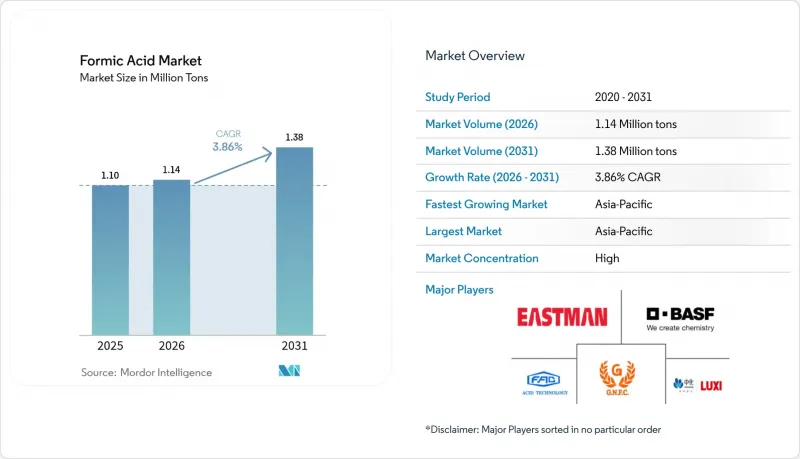
本報告按應用領域(飼料和乾草添加劑、皮革鞣製及其他)、生產方法(甲酸甲酯水解法、羰基化技術及其他)、終端用戶行業(農業、皮革和鞋類及其他)以及地區(亞太地區、北美地區及其他)進行細分。市場預測以噸為單位。
全球甲酸市場趨勢與洞察
對飼料和儲存乾草添加劑的需求不斷成長
對無抗生素畜牧養殖日益成長的需求,使得甲酸成為理想的防腐劑和抗菌劑。在禽類飼料中添加4公斤/噸的甲酸,可將沙門氏菌含量降低至檢測極限以下,從而確保食品安全並加強監管合規性。歐洲食品安全局(EFSA)允許在豬飼料中添加高達12,000毫克/公斤的甲酸,在禽類飼料中添加高達10,000毫克/公斤的甲酸,這項法律確定性正在加速甲酸的應用。這些因素共同導致飼料領域對甲酸的消費成長速度超過了甲酸市場的整體成長率。
皮革和製革產業的強勁需求
在高級皮革生產中,甲酸用於調節鞣製液的pH值至3.8-4.2,這有利於鉻的固定,同時與無機酸相比,還能降低鹽的含量。中國和印度的製革廠是全球皮革的重要供應國,它們擴大指定使用純度為85%或更高的甲酸,這為能夠保證品質穩定的供應商創造了獲得溢價的機會。
甲醇原料價格波動
由於甲醇佔甲酸甲酯水解生產成本的60-70%,與天然氣價格相關的波動正在擠壓利潤空間,並導致難以簽訂長期供應合約。生產商正透過進行二氧化碳減排發電製程的示範試驗來規避風險,如果再生能源價格持續下降,這些試驗有望降低他們對原料的依賴。
細分市場分析
到2025年,飼料和牧草添加劑將佔全球甲酸總量的36.62%,成為甲酸市場最大的細分領域。在抗生素生長促進劑限制的推動下,預計該細分市場將以4.12%的複合年成長率成長。在禽類飼料中,甲酸能夠以4公斤/噸的濃度消除可檢測的沙門氏菌,這正贏得養殖戶的信賴,並被零售商所接受。皮革鞣製仍然是甲酸的第二大應用領域,充分利用了甲酸的許多優勢,例如調節pH值和增強鉻的滲透性。同時,紡織廠也看重甲酸在染浴中的緩衝能力。甲酸在製藥和特用化學品領域的應用也正在興起,在對純度要求較高的領域,甲酸的價格也水漲船高。
成長前景也延伸至天然橡膠加工領域,甲酸正被用於提高固化速度並增強骨材的抗張強度。清潔和除垢領域佔據著小規模但穩定的細分市場,其優勢在於能夠溶解礦物垢,同時與更強的無機酸相比,對環境的影響更小。一些注重安全性的配方,例如“SoftAcid”,正受到小規模企業的青睞,預計在預測期內需求將進一步成長。
區域分析
到2025年,亞太地區將佔全球甲酸消費量的52.88%,佔據甲酸市場最大佔有率。中國憑藉其甲醇及下游化學品一體化生產基地,確保成本競爭力,從而主導該地區的甲酸供應。在出口獎勵政策和國內皮革產量成長的支持下,印度生產商正在建造新工廠,以提高該地區的甲酸自給率。日本和韓國正在採購高純度甲酸用於電子產品和藥品的合成,而印尼則透過橡膠產業不斷成長的需求,進一步推動了甲酸市場的成長。
北美是第二大市場,這主要得益於其龐大的動物性蛋白質產業以及政府對二氧化碳利用相關研發的大力投入。美國在電化學生產裝置的試點部署方面主導,目標是在本世紀末實現商業化運作。加拿大的需求主要集中在糧食和畜牧業,而墨西哥的需求則在皮革和紡織業不斷成長。
在歐洲,對飼料和化學品的嚴格監管,以及積極的脫碳目標,正在推動對生物基製程的投資。歐盟對進口化學品的反傾銷措施加劇了競爭,同時也鼓勵了本地產能的擴張。南美洲的成長主要集中在巴西不斷擴張的畜牧業,而中東則受益於促進特種化學品投資的經濟多元化政策。隨著亞洲出口的成長和西方國家向低碳供應鏈轉型,預計區域間的貿易流動將保持暢通。
其他好處
- Excel格式的市場預測(ME)表
- 3個月的分析師支持
目錄
第1章:引言
- 調查假設和市場定義
- 調查範圍
第2章:調查方法
第3章執行摘要
第4章 市場狀況
- 市場概覽
- 市場促進因素
- 對飼料和儲存乾草添加劑的需求不斷成長
- 皮革和製革產業的強勁需求
- 橡膠製品需求不斷成長
- 因其抗菌特性,在製藥業得到更廣泛的應用。
- 生物基生產技術的進步不斷擴展
- 市場限制因素
- 甲醇原料價格波動
- 與腐蝕和搬運相關的風險
- 擴大生物丙酸作為替代品的應用
- 價值鏈分析
- 波特五力模型
- 價格分析
第5章 市場規模與成長預測
- 透過使用
- 飼料和儲存乾草的添加劑
- 皮革鞣製
- 紡織品的染色和整理
- 醫藥和化學品中間體
- 其他用途(橡膠和乳膠固化劑、清潔劑/除垢劑等)
- 透過製造方法
- 甲酸甲酯的水解
- 羰基化技術
- 其他生產方法(草酸法、發酵/生物基法)
- 按最終用途行業分類
- 農業
- 皮革和鞋類
- 纖維
- 化學品和溶劑
- 製藥
- 橡皮
- 其他終端用戶產業(石油和天然氣、食品和飲料等)
- 按地區
- 亞太地區
- 中國
- 印度
- 日本
- 韓國
- 其他亞太國家
- 北美洲
- 美國
- 加拿大
- 墨西哥
- 歐洲
- 德國
- 英國
- 法國
- 義大利
- 其他歐洲國家
- 南美洲
- 巴西
- 阿根廷
- 其他南美國家
- 中東和非洲
- 沙烏地阿拉伯
- 南非
- 其他中東和非洲國家
- 亞太地區
第6章 競爭情勢
- 市場集中度
- 策略趨勢
- 市佔率和排名分析
- 公司簡介
- BASF
- Eastman Chemical Company
- Gujarat Narmada Valley Fertilizers and Chemicals Ltd
- Luxi Chemical Group Co.,Ltd.
- Perstorp
- POLIOLI SpA
- Sintas Kurama Perdana
- Rashtriya Chemicals and Fertilizers Ltd
- Shandong Acid Technology Co., Ltd.
- Shandong Rongyue Chemical Co. Ltd
- Wuhan Ruisunny Chemical Co. Ltd
第7章 市場機會與未來展望
According to Mordor Intelligence, the formic acid market size is expected to grow from 1.10 Million tons in 2025 to 1.14 Million tons in 2026 and is forecast to reach 1.38 Million tons by 2031 at 3.86% CAGR over 2026-2031.
This report is Segmented by Application (Animal Feed and Silage Additives, Leather Tanning, and More), Production Method (Methyl Formate Hydrolysis, Carbonylation Technology, and Other Production Methods), End-Use Industry (Agriculture, Leather and Footwear, and More) and Geography (Asia-Pacific, North America, and More). The Market Forecasts are Provided in Terms of Volume (tons).
Global Formic Acid Market Trends and Insights
Growing Demand for Animal Feed and Silage Additives
Demand for antibiotic-free livestock production has positioned formic acid as a preferred preservative and antimicrobial. At 4 kg/ton in poultry diets, the acid can drive Salmonella counts to undetectable levels, safeguarding food safety and reinforcing regulatory compliance. The European Food Safety Authority allows inclusion rates up to 12,000 mg/kg for pigs and 10,000 mg/kg for poultry, providing legal certainty that accelerates adoption. These factors collectively lift feed-segment consumption above overall formic acid market growth.
Substantial Demand from Leather and Tanning Industry
Premium leather production relies on formic acid to adjust bath pH to 3.8-4.2, accelerating chrome fixation while lowering salt loads compared with mineral acids. Chinese and Indian tanneries, which supply a sizable portion of global hides, increasingly specify >= 85% purity, opening price-premium opportunities for suppliers able to guarantee consistency.
Methanol Feedstock Price Volatility
Because methanol represents 60-70% of production costs in methyl formate hydrolysis, natural-gas-linked price swings compress margins and complicate long-term supply contracts. Producers are hedging by piloting CO2 electro-reduction routes that could break feedstock dependence if renewable power prices keep falling.
Other drivers and restraints analyzed in the detailed report include:
- Increasing Demand for Rubber Products
- Growing Adoption in Pharmaceutical Industry for Antibacterial Properties
- Risks Related to Corrosion and Handling
For complete list of drivers and restraints, kindly check the Table Of Contents.
Segment Analysis
Animal feed & silage additives controlled 36.62% of global volume in 2025, giving the segment the largest slice of formic acid market size. Supported by regulatory curbs on antibiotic growth promoters, this share is projected to widen at a 4.12% CAGR. In poultry rations, inclusion rates of 4 kg/ton eliminate detectable Salmonella, boosting farmer confidence and retailer acceptance. Leather tanning remains the second-largest application, capitalizing on the acid's pH control and chrome-penetration benefits, while textile mills value its dye-bath buffering capability. Pharmaceutical and specialty chemical uses are emerging, where high-purity requirements yield premium prices.
Growth prospects extend to natural rubber processing, which adopts formic acid for faster coagulation kinetics and higher aggregate tensile strength. Cleaning and descaling occupy a steady but smaller niche, leveraging the acid's mineral-scale dissolving power at lower environmental impact than stronger inorganic acids. Safety-engineered formulations such as SoftAcid broaden access among smaller operations, suggesting incremental demand upside over the forecast period.
Complete Report Scope:
- By Application
- Animal Feed and Silage Additives
- Leather Tanning
- Textile Dyeing and Finishing
- Intermediary in Pharmaceuticals and Chemicals
- Other Applications (Rubber and Latex Coagulation, Cleaning and Descaling Agents, etc.)
- By Production Method
- Methyl Formate Hydrolysis
- Carbonylation Technology
- Other Production Methods (Oxalic-acid Route, Fermentation/Bio-based Route)
- By End-use Industry
- Agriculture
- Leather and Footwear
- Textile
- Chemicals and Solvents
- Pharmaceuticals
- Rubber
- Others End User Industries (Oil and Gas, Food and Beverage, etc.)
- By Geography
- Asia-Pacific
- China
- India
- Japan
- South Korea
- Rest of Asia-Pacific
- North America
- United States
- Canada
- Mexico
- Europe
- Germany
- United Kingdom
- France
- Italy
- Rest of Europe
- South America
- Brazil
- Argentina
- Rest of South America
- Middle East and Africa
- Saudi Arabia
- South Africa
- Rest of Middle-East and Africa
- Asia-Pacific
Geography Analysis
Asia-Pacific held 52.88% of global consumption in 2025, giving the region the largest slice of formic acid market share. China dominates regional supply, leveraging integrated methanol and downstream chemical complexes to ensure cost competitiveness. India's producers, supported by export incentives and growing domestic leather output, are building new plants that lift regional self-sufficiency. Japan and South Korea source high-purity material for electronics and pharmaceutical synthesis, while Indonesia drives incremental growth through rubber-sector uptake.
North America is the second-largest region, propelled by a vast animal-protein sector and government funding for CO2-utilization R&D. The United States leads pilot deployment of electrochemical production units, eyeing commercial scale by decade-end. Canada's demand is tied mainly to grain and livestock production, whereas Mexico sees rising leather and textile usage.
Europe combines strict feed and chemical regulations with aggressive decarbonization targets, spurring investment in bio-based processes. EU anti-dumping measures on imported chemicals intensify competition and encourage local capacity expansion. South America's growth centers on Brazil's expanding livestock sector, while the Middle East benefits from diversification agendas that encourage specialty-chemical investments. Cross-regional trade flows will likely stay fluid as Asia grows exports and western regions pivot to low-carbon supply chains.
- BASF
- Eastman Chemical Company
- Gujarat Narmada Valley Fertilizers and Chemicals Ltd
- Luxi Chemical Group Co.,Ltd.
- Perstorp
- POLIOLI SpA
- Sintas Kurama Perdana
- Rashtriya Chemicals and Fertilizers Ltd
- Shandong Acid Technology Co., Ltd.
- Shandong Rongyue Chemical Co. Ltd
- Wuhan Ruisunny Chemical Co. Ltd
Additional Benefits:
- The market estimate (ME) sheet in Excel format
- 3 months of analyst support
TABLE OF CONTENTS
1 Introduction
- 1.1 Study Assumptions and Market Definition
- 1.2 Scope of the Study
2 Research Methodology
3 Executive Summary
4 Market Landscape
- 4.1 Market Overview
- 4.2 Market Drivers
- 4.2.1 Growing Demand for Animal Feed and Silage Additives
- 4.2.2 Substantial Demand from Leather and Tanning Industry
- 4.2.3 Increasing Demand for Rubber Products
- 4.2.4 Growing Adoption in Pharmaceutical Industry for Antibacterial Properties
- 4.2.5 Growing Advancements in its Bio-based Production Technologies
- 4.3 Market Restraints
- 4.3.1 Methanol feedstock price volatility
- 4.3.2 Risks Related to Corrosion and Handling
- 4.3.3 Rising Usage of bio-propionic acid as alternative
- 4.4 Value Chain Analysis
- 4.5 Porter's Five Forces
- 4.5.1 Bargaining Power of Suppliers
- 4.5.2 Bargaining Power of Buyers
- 4.5.3 Threat of New Entrants
- 4.5.4 Threat of Substitutes
- 4.5.5 Degree of Competition
- 4.6 Price Analysis
5 Market Size and Growth Forecasts (Volume)
- 5.1 By Application
- 5.1.1 Animal Feed and Silage Additives
- 5.1.2 Leather Tanning
- 5.1.3 Textile Dyeing and Finishing
- 5.1.4 Intermediary in Pharmaceuticals and Chemicals
- 5.1.5 Other Applications (Rubber and Latex Coagulation, Cleaning and Descaling Agents, etc.)
- 5.2 By Production Method
- 5.2.1 Methyl Formate Hydrolysis
- 5.2.2 Carbonylation Technology
- 5.2.3 Other Production Methods (Oxalic-acid Route, Fermentation/Bio-based Route)
- 5.3 By End-use Industry
- 5.3.1 Agriculture
- 5.3.2 Leather and Footwear
- 5.3.3 Textile
- 5.3.4 Chemicals and Solvents
- 5.3.5 Pharmaceuticals
- 5.3.6 Rubber
- 5.3.7 Others End User Industries (Oil and Gas, Food and Beverage, etc.)
- 5.4 By Geography
- 5.4.1 Asia-Pacific
- 5.4.1.1 China
- 5.4.1.2 India
- 5.4.1.3 Japan
- 5.4.1.4 South Korea
- 5.4.1.5 Rest of Asia-Pacific
- 5.4.2 North America
- 5.4.2.1 United States
- 5.4.2.2 Canada
- 5.4.2.3 Mexico
- 5.4.3 Europe
- 5.4.3.1 Germany
- 5.4.3.2 United Kingdom
- 5.4.3.3 France
- 5.4.3.4 Italy
- 5.4.3.5 Rest of Europe
- 5.4.4 South America
- 5.4.4.1 Brazil
- 5.4.4.2 Argentina
- 5.4.4.3 Rest of South America
- 5.4.5 Middle East and Africa
- 5.4.5.1 Saudi Arabia
- 5.4.5.2 South Africa
- 5.4.5.3 Rest of Middle-East and Africa
- 5.4.1 Asia-Pacific
6 Competitive Landscape
- 6.1 Market Concentration
- 6.2 Strategic Moves
- 6.3 Market Share (%)/Ranking Analysis
- 6.4 Company Profiles (includes Global level Overview, Market level overview, Core Segments, Financials as available, Strategic Information, Market Rank/Share for key companies, Products and Services, and Recent Developments)
- 6.4.1 BASF
- 6.4.2 Eastman Chemical Company
- 6.4.3 Gujarat Narmada Valley Fertilizers and Chemicals Ltd
- 6.4.4 Luxi Chemical Group Co.,Ltd.
- 6.4.5 Perstorp
- 6.4.6 POLIOLI SpA
- 6.4.7 Sintas Kurama Perdana
- 6.4.8 Rashtriya Chemicals and Fertilizers Ltd
- 6.4.9 Shandong Acid Technology Co., Ltd.
- 6.4.10 Shandong Rongyue Chemical Co. Ltd
- 6.4.11 Wuhan Ruisunny Chemical Co. Ltd
7 Market Opportunities and Future Outlook
- 7.1 White-space and Unmet-need Assessment
- 7.2 Sustainable Use of Formic Acid in Fuel Cell

 亞太地區甲酸市場:市場佔有率分析、產業趨勢與統計及成長預測(2026-2031)
 甲酸市場-2026-2032年全球市場預測
 甲酸市場:按類型、應用和地區分類
 甲酸市場規模、佔有率和成長分析(按等級、生產方法、應用、終端用戶產業和地區分類)-2026-2033年產業預測
 甲酸全球市場規模、佔有率、趨勢和成長分析報告(2026-2034)
 甲酸市場規模、佔有率、趨勢及預測(按類型、應用、最終用途和地區分類)(2026-2034 年)
 2026年全球甲酸市場報告全球甲酸市場:市場規模、佔有率、成長率、產業分析、依類型、應用和地區劃分的分析以及未來預測(2026-2034)
 2026-2030年全球甲酸市場
 甲酸市場-全球產業規模、佔有率、趨勢、機會、預測:按類型、應用、地區和競爭格局分類,2021-2031年