


 |
市場調查報告書
商品編碼
2119638
亞太地區甲酸市場:市場佔有率分析、產業趨勢與統計及成長預測(2026-2031)Asia Pacific Formic Acid - Market Share Analysis, Industry Trends & Statistics, Growth Forecasts (2026 - 2031) |
||||||

※ 本網頁內容可能與最新版本有所差異。詳細情況請與我們聯繫。
據 Mordor Intelligence 稱,2025 年亞太地區甲酸市值為 3.9139 億美元,預計到 2031 年將達到 5.1262 億美元,而 2026 年為 4.0939 億美元,預測期(2026-2031 年)複合年成長率為 4.60%。
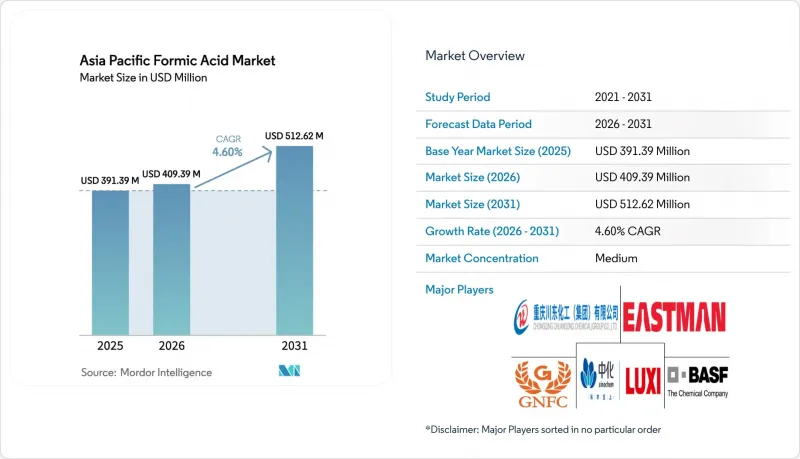
本報告按純度等級(75%、80%、85%、90%、94%、99%)、應用領域(動物飼料、皮革鞣製、紡織品染色和整理、醫藥和化學中間體等)以及地區(中國、印度、日本、韓國、印尼、泰國、馬來西亞、越南和其他亞太地區)進行細分。市場預測以美元計價。
亞太地區甲酸市場趨勢及洞察。
畜牧業生產的激增帶動了飼料和青貯飼料中酸性添加劑的需求。
預計到2034年,亞太地區的畜牧業生產將佔全球農業成長的54%,其中印度預計將佔近40%。低收入和中等收入國家對高蛋白飼料的需求日益成長,推高了平均飼料消耗量,迫使綜合畜牧企業採用甲酸來控制病原體數量並減少抗生素的使用。儘管中國將生產重心轉向豬肉和家禽,提高了畜牧業生產效率,但每噸飼料對酸性添加劑的需求仍強勁。印度領先的飼料生產商目前指定使用含有甲酸的有機酸混合物,以滿足2025年實施的出口生物安全標準。由於GNFC和RCF的產能有限,該地區的供應仍然緊張,中國和馬來西亞的出口商填補了這一缺口。據供應鏈負責人稱,隨著綜合畜牧企業將酸性添加劑的使用與死亡率和飼料轉換率的顯著降低聯繫起來,市場對高純度甲酸的價格敏感度有所降低。
擴大中國、印度和東協皮革及紡織業的產能
在亞洲皮革產業的核心地帶,面向歐洲和北美市場的高階成品需求正在成長,這促使製革廠將酸洗和鉻掩蔽製程中85-90%的工業級甲酸的使用標準化。中國和印度將於2025年實施的環境法規降低了廢水中鉻和硫酸鹽的允許限值,加速了甲酸替代硫酸的進程。東亞地區甲酸生產設施的季節性維護恰逢2025年皮革產量激增,導致局部地區供應短缺,現貨價格較上一季上漲8%。孟加拉和越南的紡織印染廠提高了活性染料的產能,並優先在固色浴中使用甲酸,以符合ZDHC「零化學品路線圖」的要求。相關人員表示,由於注重品質的買家對pH值波動非常敏感,因為pH值波動會導致皮革表面膨脹和染色色調變化,因此需求彈性有限。
飼料和製革業中廉價有機酸的替代
從一體化(一體化)工廠採購的丙酸和乙酸,每噸價格比甲酸便宜10-15%,因為這些工廠的固定成本可以攤提。一家中國大型飼料整合企業已開始試行使用丙酸基混合料,以期在2025年前降低飼料加工成本。孟加拉的皮革鞣製企業也轉向使用雙酸酸洗系統,該系統使用乙酸進行顯著的pH值調節,並使用甲酸進行後整理。在泰國和印度尼西亞,木醋液作為乳膠凝固劑的田間檢驗正在進行中,這為小規模農場提供了另一種替代方案。如果原物料價格差距進一步擴大,這種替代趨勢可能會加速,並抑制高階產品的成長,儘管終端市場的需求正在增加。
細分市場分析
到2025年,85%純度甲酸將佔據亞太市場64.51%的佔有率,預計到2031年將以4.08%的複合年成長率成長,主要消費叢集的產能也將隨之擴大。雖然大型綜合企業可以在生產過程中調整甲酸的純度,但85%純度的甲酸仍然是皮革加工商、染色商和橡膠加工商的最佳選擇,能夠滿足他們對產量、防腐蝕性和pH穩定性的雙重需求。中國和越南的皮革出口商正在推動強勁的需求,因為他們可以透過持續的甲酸處理來獲得更柔軟、更飽滿的皮革,從而獲得更高的價格。BASF的85%純度甲酸產品於2025年6月上市,該產品碳足跡低,有望成為永續性發展採購的典範,並在未來三年內開闢一個高階細分市場。
純度75%和80%的酸液主要供應價格敏感的橡膠凝固應用和通用紡織品,但由於木醋液和混合酸的替代作用日益增強,其市場佔有率正在下降。純度為90%、94%和99%的高純度酸液滿足了日本和韓國在電子設備清洗、醫藥中間體以及氫氣儲存先導計畫的需求,但銷售量仍然相對較低。隨著2030年後在細分市場實現商業化,成長前景日益光明,一家日本燃料電池開發公司已指定其直接甲酸燃料電池的陽極使用純度為94%的酸液。到2027年,魯西化工將擁有一條年產運作40萬噸的生產線,將提高高純度酸液的供應穩定性。但在出口主導地區,產能和對永續性的承諾將是買家的決定性因素。
其他好處:
- Excel格式的市場預測(ME)表
- 3個月的分析師支持
目錄
第1章:引言
- 研究假設和市場定義
- 調查範圍
第2章:調查方法
第3章執行摘要
第4章 市場狀況
- 市場概覽
- 市場促進因素
- 畜牧業的蓬勃發展帶動了飼料和青貯飼料中酸性添加劑的需求。
- 擴大中國、印度和東協皮革及紡織業的產能
- 東南亞橡膠和乳膠化學品消費量迅速成長
- 以甲酸為液態氫載體燃料的示範項目
- 鼓勵「印度製造」以擴大國內生產能力的誘因
- 市場限制因素
- 在飼料和製革過程中使用更便宜的有機酸替代品。
- 甲醇和一氧化碳原料成本的波動
- 腐蝕性化學品處理合規成本不斷上升
- 價值鏈分析
- 波特五力模型
第5章 市場規模與成長預測
- 等級類型
- 75%
- 80%
- 85%
- 90%
- 94%
- 99%
- 透過使用
- 動物飼料
- 皮革鞣製
- 紡織品的染色和整理
- 醫藥和化學品中間體
- 其他
- 按地區
- 中國
- 印度
- 日本
- 韓國
- 印尼
- 泰國
- 馬來西亞
- 越南
- 其他亞太國家
第6章 競爭情勢
- 市場集中度
- 策略趨勢
- 市佔率和排名分析
- 公司簡介
- Addcon Group GmbH
- Anhui Asahi Kasei Chemical Co., Ltd.
- BASF
- Chongqing Chuandong Chemical(Group)Co., Ltd.
- Eastman Chemical Company
- Feicheng Acid Chemicals Co., Ltd.
- Gujarat Narmada Valley Fertilizers & Chemicals Limited
- Helm
- Kemira Oyj
- Luxi Group
- MKS Marmara Entegre Kimya
- Perstorp
- Rashtriya Chemicals and Fertilizers Limited
- Shandong Acid Technology Co., Ltd.
- Sintas Kurama Perdana
- Wanhua
- Wuhan Ruisunny Chemical Co., Ltd.
第7章 市場機會與未來展望
According to Mordor Intelligence, the Asia Pacific formic acid market size was valued at USD 391.39 million in 2025 and is estimated to grow from USD 409.39 million in 2026 to reach USD 512.62 million by 2031, at a CAGR of 4.60% during the forecast period (2026-2031).
This report is Segmented by Grade Type (75%, 80%, 85%, 90%, 94%, and 99%), Application (Animal Feed, Leather Tanning, Textile Dyeing and Finishing, Intermediary in Pharmaceuticals and Chemicals, and Other Applications), and Geography (China, India, Japan, South Korea, Indonesia, Thailand, Malaysia, Vietnam, and Rest of Asia Pacific). The Market Forecasts are Provided in Terms of Value (USD).
Asia Pacific Formic Acid Market Trends and Insights
Livestock Boom Driving Demand for Feed and Silage Acidifiers
Asia Pacific livestock output is forecast to deliver 54% of incremental global agricultural growth by 2034, and India alone is projected to supply nearly 40% of that expansion. Protein-rich diets in lower-middle-income countries are raising average feed intensity, compelling integrators to adopt formic acid to curb pathogenic load and reduce antibiotic use. China's pivot toward pork and poultry sustains per-ton acidifier demand even as herd efficiency rises. Large Indian feed mills now specify organic-acid blends that include formic acid to meet export-oriented biosafety standards issued in 2025. Regional supply remains tight because GNFC and RCF operate modest capacities, allowing Chinese and Malaysian exporters to fill the gap. Supply chain managers report that price sensitivity has eased for high-purity grades as integrators link acidifier use to measurable reductions in mortality and feed conversion.
Leather and Textile Capacity Additions in China-India-ASEAN
Asian leather hubs are upgrading to premium finished goods destined for Europe and North America, prompting tanneries to standardize on 85-90% technical-grade formic acid for pickling and chrome masking. Environmental regulations introduced in China and India in 2025 mandated lower effluent chromium and sulfate thresholds, driving substitution away from sulfuric toward formic acid. Seasonal maintenance at East Asian formic acid units coincided with the 2025 leather production surge, causing localized tightness that lifted spot prices 8% quarter-on-quarter. Textile dyeing units in Bangladesh and Vietnam expanded capacity for reactive dyes, favoring formic acid in the fixation bath to comply with the ZDHC Roadmap to Zero chemicals list. Stakeholders indicate that demand elasticity is limited because quality-conscious buyers penalize pH drift that leads to leather grain swelling or dye shade variability.
Substitution by Cheaper Organic Acids in Feed and Tanning
Propionic and acetic acids undercut formic acid by 10-15% per ton when sourced from integrated Verbund sites able to amortize fixed costs. Large feed integrators in China began trialing propionic-dominant blends in 2025 to lower cost of gain, and Bangladeshi tanners have shifted to dual-acid pickling systems that use acetic acid for bulk pH adjustment with formic acid finishing. Wood vinegar's field validation as a latex coagulant in Thailand and Indonesia adds another substitution lever at the smallholder level. If raw-material spreads widen further, substitution could accelerate, capping premium-grade growth despite rising end-market volumes.
Other drivers and restraints analyzed in the detailed report include:
- Surging Rubber/Latex Chemical Consumption in Southeast Asia
- Pilot Projects Using Formic Acid as Liquid H2-Carrier Fuel
- Volatile Methanol/CO Feedstock Costs
For complete list of drivers and restraints, kindly check the Table Of Contents.
Segment Analysis
The 85% grade commanded 64.51% of the Asia Pacific formic acid market in 2025, and it is projected to grow at a 4.08% CAGR through 2031 as key consuming clusters widen capacity. Integrated giants can switch purity levels mid-run, but 85% remains the sweet spot between yield, corrosion control, and pH stability demanded by tanners, dyers, and rubber processors. Demand resilience is strengthened because leather exporters in China and Vietnam receive higher unit prices for softer, fuller grain finished with consistent formic-acid pickling. BASF's June 2025 launch of low-product-carbon-footprint 85% grade created a template for sustainability-driven procurement that may carve out a premium micro-segment over the next three years.
Purity bands at 75% and 80% serve price-sensitive rubber coagulation and commodity textile lines, but substitution by wood vinegar and blended acids is shaving share. High-purity 90%, 94%, and 99% grades fulfill electronics cleaning, pharmaceutical intermediates, and hydrogen-storage pilot demands in Japan and South Korea, yet volumes remain comparatively small. Growth visibility is rising as Japanese fuel-cell developers specify 94% purity for direct formic acid fuel-cell anodes, expecting niche commercialization post-2030. With Luxi Chemical bringing a 400,000 MT/y line onstream by 2027, supply security for premium grades improves, though sustainability credentials rather than capacity alone will shape buyer choice in export-driven belts.
Complete Report Scope:
- By Grade Type
- 85%
- 75%
- 80%
- 90%
- 94%
- 99%
- By Application
- Animal Feed
- Leather Tanning
- Textile Dyeing and Finishing
- Intermediary in Pharmaceuticals and Chemicals
- Other Applications
- By Geography
- China
- India
- Japan
- South Korea
- Indonesia
- Thailand
- Malaysia
- Vietnam
- Rest of Asia Pacific
List of Companies Covered in this Report:
- Addcon Group GmbH
- Anhui Asahi Kasei Chemical Co., Ltd.
- BASF
- Chongqing Chuandong Chemical (Group) Co., Ltd.
- Eastman Chemical Company
- Feicheng Acid Chemicals Co., Ltd.
- Gujarat Narmada Valley Fertilizers & Chemicals Limited
- Helm
- Kemira Oyj
- Luxi Group
- MKS Marmara Entegre Kimya
- Perstorp
- Rashtriya Chemicals and Fertilizers Limited
- Shandong Acid Technology Co., Ltd.
- Sintas Kurama Perdana
- Wanhua
- Wuhan Ruisunny Chemical Co., Ltd.
Additional Benefits:
- The market estimate (ME) sheet in Excel format
- 3 months of analyst support
TABLE OF CONTENTS
1 Introduction
- 1.1 Study Assumptions and Market Definition
- 1.2 Scope of the Study
2 Research Methodology
3 Executive Summary
4 Market Landscape
- 4.1 Market Overview
- 4.2 Market Drivers
- 4.2.1 Livestock Boom Driving Demand for Feed and Silage Acidifiers
- 4.2.2 Leather and Textile Capacity Additions in China-India-ASEAN
- 4.2.3 Surging Rubber/Latex Chemical Consumption in Southeast Asia
- 4.2.4 Pilot Projects Using Formic Acid as Liquid H2-Carrier Fuel
- 4.2.5 Make-In-India Incentives for Domestic Capacity Expansion
- 4.3 Market Restraints
- 4.3.1 Substitution by Cheaper Organic Acids in Feed and Tanning
- 4.3.2 Volatile Methanol/CO Feedstock Costs
- 4.3.3 Rising Compliance Costs for Corrosive-Chemical Handling
- 4.4 Value Chain Analysis
- 4.5 Porter's Five Forces
- 4.5.1 Bargaining Power of Suppliers
- 4.5.2 Bargaining Power of Buyers
- 4.5.3 Threat of New Entrants
- 4.5.4 Threat of Substitutes
- 4.5.5 Degree of Competition
5 Market Size and Growth Forecasts (Value)
- 5.1 By Grade Type
- 5.1.1 85%
- 5.1.2 75%
- 5.1.3 80%
- 5.1.4 90%
- 5.1.5 94%
- 5.1.6 99%
- 5.2 By Application
- 5.2.1 Animal Feed
- 5.2.2 Leather Tanning
- 5.2.3 Textile Dyeing and Finishing
- 5.2.4 Intermediary in Pharmaceuticals and Chemicals
- 5.2.5 Other Applications
- 5.3 By Geography
- 5.3.1 China
- 5.3.2 India
- 5.3.3 Japan
- 5.3.4 South Korea
- 5.3.5 Indonesia
- 5.3.6 Thailand
- 5.3.7 Malaysia
- 5.3.8 Vietnam
- 5.3.9 Rest of Asia Pacific
6 Competitive Landscape
- 6.1 Market Concentration
- 6.2 Strategic Moves
- 6.3 Market Share/Ranking Analysis
- 6.4 Company Profiles (includes Global level Overview, Market level overview, Core Segments, Financials as available, Strategic Information, Market Rank/Share for key companies, Products and Services, and Recent Developments)
- 6.4.1 Addcon Group GmbH
- 6.4.2 Anhui Asahi Kasei Chemical Co., Ltd.
- 6.4.3 BASF
- 6.4.4 Chongqing Chuandong Chemical (Group) Co., Ltd.
- 6.4.5 Eastman Chemical Company
- 6.4.6 Feicheng Acid Chemicals Co., Ltd.
- 6.4.7 Gujarat Narmada Valley Fertilizers & Chemicals Limited
- 6.4.8 Helm
- 6.4.9 Kemira Oyj
- 6.4.10 Luxi Group
- 6.4.11 MKS Marmara Entegre Kimya
- 6.4.12 Perstorp
- 6.4.13 Rashtriya Chemicals and Fertilizers Limited
- 6.4.14 Shandong Acid Technology Co., Ltd.
- 6.4.15 Sintas Kurama Perdana
- 6.4.16 Wanhua
- 6.4.17 Wuhan Ruisunny Chemical Co., Ltd.
7 Market Opportunities and Future Outlook
- 7.1 White-space and Unmet-Need Assessment

 甲酸市場-2026-2032年全球市場預測
 甲酸:市場佔有率分析、產業趨勢與統計、成長預測(2026-2031)
 甲酸市場:按類型、應用和地區分類
 甲酸市場規模、佔有率和成長分析(按等級、生產方法、應用、終端用戶產業和地區分類)-2026-2033年產業預測
 甲酸全球市場規模、佔有率、趨勢和成長分析報告(2026-2034)
 甲酸市場規模、佔有率、趨勢及預測(按類型、應用、最終用途和地區分類)(2026-2034 年)
 2026年全球甲酸市場報告全球甲酸市場:市場規模、佔有率、成長率、產業分析、依類型、應用和地區劃分的分析以及未來預測(2026-2034)
 2026-2030年全球甲酸市場
 甲酸市場-全球產業規模、佔有率、趨勢、機會、預測:按類型、應用、地區和競爭格局分類,2021-2031年