


 |
市場調查報告書
商品編碼
2121271
美國汽車感測器:市場佔有率分析、產業趨勢與統計及成長預測(2026-2031 年)US Automotive Sensors - Market Share Analysis, Industry Trends & Statistics, Growth Forecasts (2026 - 2031) |
||||||

※ 本網頁內容可能與最新版本有所差異。詳細情況請與我們聯繫。
根據 Mordor Intelligence 預測,美國汽車感測器市場規模將從 2025 年的 57.3 億美元成長到 2026 年的 61.3 億美元,然後在 2031 年達到 86.2 億美元,2026 年至 2031 年的複合年成長率為 7.05%。
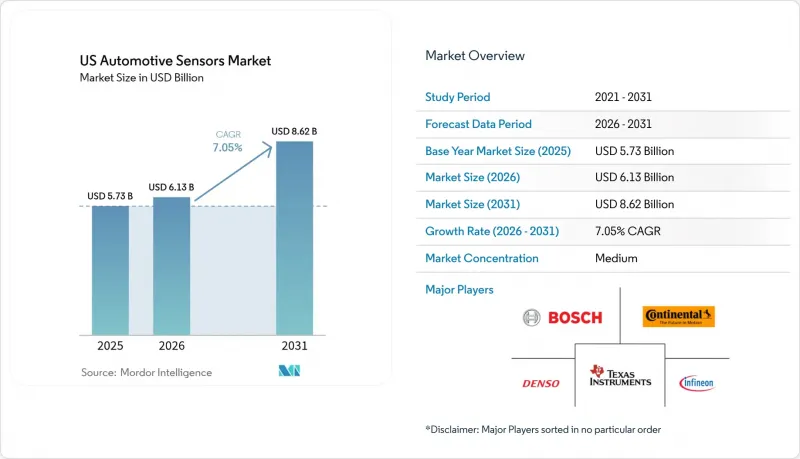
本報告按感測器類型(溫度感測器及其他)、應用領域(動力傳動系統及其他)、車輛類型(摩托車及其他)、分銷管道(OEM及其他)、驅動方式(內燃機車輛及其他)和感測器技術(MEMS及其他)進行分類。市場預測以美元和銷售(單位)兩種形式呈現。
美國汽車感測器市場趨勢與洞察
《晶片技術創新法案》將加速國內微機電系統製造的建設。
總額達390億美元的新聯邦津貼正在推動亞利桑那州、德克薩斯州和紐約州北部地區的晶圓製造廠項目,確保構成引擎、電池和底盤控制系統基礎的微機電系統(MEMS)壓力感測器、慣性感測器和磁性感測器的本地供應鏈。 Rogue Valley Microdevices公司已為其位於佛羅裡達州的工廠獲得了670萬美元的津貼,這將使其汽車MEMS產能提升近三倍,展現了小規模代工廠如何在該計劃下實現規模化發展。產能的提升將縮短前置作業時間,降低運輸風險,並支援向底特律和沿海地區的組裝廠進行準時交貨。大學正在獲得研究津貼,用於開發下一代微加工工藝,進一步鞏固美國汽車感測器市場的創新。所有這些努力將共同提高供應鏈的韌性,並將未來的生產從海外晶圓廠帶回國內。
電動車的普及將推動每輛車安裝的感測器數量增加。
電動車 (EV) 車型所含半導體數量是內燃機 (ICE) 汽車的兩到三倍,預計到 2030 年,感測器的價值還將進一步提升。即使是單一電池管理系統也需要多個溫度、電流和電壓測量點,以防止熱失控。位置感知器和磁性感知器用於監測馬達的轉速,而高壓隔離裝置則確保安全。隨著政府對全國充電基礎設施的稅額扣抵和津貼加速交付,供應商正在擴大基於碳化矽 (SiC) 的壓力和溫度晶片的生產規模,以應對更嚴苛的引擎室環境。因此,儘管汽車總產量趨於平穩,但美國汽車感測器市場仍受益於平均售價的上漲。
水資源短缺導致矽供應受限
即將在亞利桑那州建設的下一代晶圓廠,每個廠區每天可能消耗大量水資源,這可能會進一步增加已受乾旱影響的地下含水層的壓力。當地民眾的反對以及授權核准的延誤可能會限制當地的晶圓產量,進而導致汽車壓力感測器和慣性感測器晶片的短缺。為了降低風險,製造商正在實施封閉回路型回收系統,該系統可回收超過70%的製程用水,但這些投資延長了投資回收期。如果其他工廠未能獲得批准,長期的供不應求可能會減緩美國汽車感測器市場的成長。
細分市場分析
預計到2025年,壓力感知器將佔汽車感知器總銷量的29.02%,主要用於燃油噴射、煞車增壓器和強制性胎壓監測系統等應用。美國汽車感測器市場的壓力感測器市場預計將穩定成長,與燃油效率和排放氣體法規目標保持一致。目前尺寸較小的雷達模組預計到2031年將以8.02%的複合年成長率成長,這主要得益於77GHz晶片組價格的下降以及NCAP盲點監測、前碰撞預警和交叉路口預警功能帶來的額外壓力。一級供應商目前已將四角4D雷達作為標準配置應用於主流SUV,這表明感測器融合技術正從高階市場轉向大眾市場。
第二代毫米波架構將數位波束成形和人工智慧增強型目標分類整合到單一CMOS晶片上。這降低了組件成本並簡化了散熱設計,有助於雷達蠶食僅使用攝影機的ADAS市場佔有率。將雷達和慣性定位單元結合的供應商正在為美國汽車感測器產業創造新的價值來源,即使在GPS不可用的情況下也能實現高精度里程測量。
2025年,動力傳動系統系統將佔汽車零件支出的35.98%,其中包括氣流感知器、爆震感知器、冷卻液溫度感知器和電池組感知器。為符合Tier 3排放氣體標準,動力傳動系統系統仍將維持較高的支出比例。同時,高級駕駛輔助系統(ADAS)和自動駕駛功能預計到2031年將以8.36%的複合年成長率成長,顯著提升其在美國汽車感測器市場的佔有率。 L2+級自動駕駛功能是透過超音波、攝影機、雷達和LiDAR的組合來實現的,而美國國家公路交通安全管理局(NHTSA)關於自動緊急煞車的新規定則確保了基準需求。
為了實現冗餘目標,原始設備製造商 (OEM) 正在為橫向和縱向控制指定兩個獨立的感測通道。預計到 2029 年,每輛車將使用超過 1000 個半導體,這將鞏固高級駕駛輔助系統 (ADAS) 作為感測器領域成長最快的預算項目的地位。持續的空中下載 (OTA) 功能升級將透過在車輛售出多年後利用未使用的運算能力來進一步提高生命週期收入。
其他好處
- Excel格式的市場預測(ME)表
- 3個月的分析師支持
目錄
第1章:引言
- 調查假設和市場定義
- 調查範圍
第2章:調查方法
第3章執行摘要
第4章 市場狀況
- 市場概覽
- 市場促進因素
- 《晶片法》旨在吸引國內MEMS製造工廠。
- 由於電動車的普及,每輛車上的感測器數量不斷增加。
- 聯邦政府加強了胎壓監測系統 (TPMS)、電子穩定控制系統 (ESC) 和新車安全評估協會 (NCAP) 的標準。
- 聯網保險和遠端資訊維修安裝。
- 軟體定義車輛架構
- 車輛脫碳目標(公司)
- 市場限制因素
- 水資源短缺導致矽供應受限
- 成本和價格的下降給一級企業的利潤率帶來了壓力。
- 惡劣運作環境下的可靠性和校準挑戰
- 關於感測器級網路安全的法律責任
- 價值供應鏈分析
- 監理情勢
- 技術展望
- 永續性和能源足跡分析
- 波特五力模型
第5章 市場規模與成長預測
- 依感測器類型
- 溫度感測器
- 壓力感測器
- 速度/加速度計
- 液位/位置感知器
- 磁性感應器
- 氣體/化學感測器
- 慣性感測器(加速計/陀螺儀)
- LiDAR感測器
- 雷達感測器
- 超音波感測器
- 影像/相機感光元件
- 電流感測器
- 透過使用
- 動力傳動系統
- 汽車電子和舒適設備
- 車輛安全保障
- ADAS(進階駕駛輔助系統)與自動駕駛系統
- 車載資訊服務和連接
- 電池管理(電動車)
- 按車輛類型
- 摩托車
- 搭乘用車
- 輕型商用車
- 大型商用車輛
- 透過分銷管道
- OEM
- 售後市場
- 透過推進力
- 內燃機車
- 油電混合車
- 電池電動車
- 燃料電池電動車
- 透過感測器技術
- MEMS
- 非MEMS/宏觀感測器
第6章 競爭情勢
- 市場集中度
- 策略趨勢
- 市佔率分析
- 公司簡介
- Robert Bosch GmbH
- DENSO Corporation
- Continental AG
- HELLA GmbH & Co. KGaA
- Valeo SA
- Texas Instruments Inc.
- Infineon Technologies AG
- NXP Semiconductors NV
- Analog Devices Inc.
- Hitachi Astemo Americas Inc.
- Sensata Technologies
- TE Connectivity
- Aptiv PLC
- STMicroelectronics NV
- onsemi
- BorgWarner Inc.
- Renesas Electronics Corp.
- Honeywell International Inc.
- Allegro MicroSystems LLC
- Microchip Technology Inc.
第7章 市場機會與未來展望
According to Mordor Intelligence, the US automotive sensors market size is expected to grow from USD 5.73 billion in 2025 to USD 6.13 billion in 2026 and is forecast to reach USD 8.62 billion by 2031 at 7.05% CAGR over 2026-2031.
This report is Segmented by Sensor Type (Temperature Sensors and More), Application (Powertrain and More), Vehicle Type (Motorcycles and More), Sales Channel (OEM and More), Propulsion (Internal Combustion Vehicles and More), and Sensor Technology (MEMS and More). The Market Forecasts are Provided in Terms of Value (USD) and Volume (Units).
US Automotive Sensors Market Trends and Insights
CHIPS Act Incentivises On-Shore MEMS Fabs
New federal grants worth USD 39 billion are steering wafer-fab projects to Arizona, Texas and upstate New York, ensuring a local pipeline of MEMS pressure, inertial and magnetic sensors that underpin engine, battery and chassis controls. Rogue Valley Microdevices has already secured USD 6.7 million for a Florida plant that will nearly triple its automotive MEMS capacity, illustrating how smaller foundries can scale under the program. The added capacity reduces lead-times, cuts shipping risk and supports just-in-time delivery for Detroit and coastal assembly plants. Universities gain research grants that seed next-gen micromachining processes, further anchoring innovation inside the United States automotive sensors market. Combined, these actions lift resilience and pull future production back from overseas fabs.
EV Adoption Pushes Sensor Content per Vehicle
Electric models integrate two to three times more semiconductors than ICE cars, pushing sensor value toward a greater share by 2030. Battery-management systems alone require multiple temperature, current and voltage nodes to prevent thermal runaway. Position and magnetic sensors monitor e-motor speed, while high-voltage isolation devices maintain safety. Government tax credits and coast-to-coast charging grants accelerate delivery volumes, so suppliers are scaling SiC-based pressure and temperature dies to meet harsher under-hood environments. As a result, the United States automotive sensors market is benefiting from higher average selling prices even when overall vehicle production remains flat.
Silicon-Supply Water-Stress Constraints
Next-generation fabs in Arizona may each draw significant liters of water daily, straining aquifers already under drought pressure. Community opposition or permitting delays could cap local wafer output, tightening the flow of automotive pressure and inertial dies. To mitigate risk, manufacturers are installing closed-loop recycling that recovers more than 70% of process water, yet capital outlays lengthen payback. Prolonged shortages could temper growth for the United States automotive sensors market if additional sites are not approved.
Other drivers and restraints analyzed in the detailed report include:
- Connected-Insurance Telematics Retrofits
- Software-Defined Vehicle Architectures
- Cost & Price-Erosion Squeeze Tier-1 Margins
For complete list of drivers and restraints, kindly check the Table Of Contents.
Segment Analysis
Pressure devices delivered 29.02% of 2025 revenue, anchoring applications such as fuel injection, brake boost and mandated tire-pressure monitoring. The United States automotive sensors market size for pressure units is set to expand steadily in line with fuel-efficiency and emissions targets. Radar modules, although smaller today, will grow at a 8.02% CAGR through 2031 thanks to falling 77 GHz chipset prices and NCAP pressure to add blind-spot, front-collision and cross-traffic alerts. Tier-1s now bundle four-corner 4D radar into mainstream SUVs, signalling that sensor fusion is shifting from premium to volume segments.
Second-generation millimetre-wave architectures integrate digital beam-forming and AI-enhanced object classification on a single CMOS die. This reduces bill-of-materials and simplifies thermal design, helping radar to erode camera-only ADAS share. Suppliers that combine radar with inertial reference units promise high-accuracy odometry even when GPS is blocked, creating new value pools within the United States automotive sensors industry.
Powertrain systems accounted for 35.98% of 2025 spend, covering air-flow, knock, coolant-temperature and battery pack sensors. Compliance with Tier 3 emissions rules keeps powertrain allocations high. At the same time, ADAS and autonomous functions will expand at an 8.36% CAGR to 2031, raising their portion of the United States automotive sensors market size considerably. Ultrasonic, camera, radar and lidar combinations enable Level-2+ functions, while NHTSA's new automatic emergency-braking mandate locks in baseline volumes.
To meet redundancy targets, OEMs specify dual independent sensing paths for lateral and longitudinal control. This pushes total semiconductor count per vehicle past thousand mark by 2029, cementing ADAS as the fastest-growing budget line for sensors. Continuous over-the-air feature upgrades further stretch lifecycle revenue because dormant compute headroom can be monetised years after vehicle sale.
Complete Report Scope:
- By Sensor Type
- Temperature Sensors
- Pressure Sensors
- Speed / Velocity Sensors
- Level / Position Sensors
- Magnetic Sensors
- Gas / Chemical Sensors
- Inertial Sensors (Accel/Gyro)
- LiDAR Sensors
- Radar Sensors
- Ultrasonic Sensors
- Image / Camera Sensors
- Current Sensors
- By Application
- Powertrain
- Body Electronics & Comfort
- Vehicle Security & Safety
- ADAS & Autonomous Systems
- Telematics & Connectivity
- Battery-Management (EV)
- By Vehicle Type
- Motorcycles
- Passenger Cars
- Light Commercial Vehicles
- Heavy Commercial Vehicles
- By Sales Channel
- OEM
- Aftermarket
- By Propulsion
- Internal-Combustion Vehicles
- Hybrid Electric Vehicles
- Battery Electric Vehicles
- Fuel-Cell Electric Vehicles
- By Sensor Technology
- MEMS
- Non-MEMS / Macro Sensors
List of Companies Covered in this Report:
- Robert Bosch GmbH
- DENSO Corporation
- Continental AG
- HELLA GmbH & Co. KGaA
- Valeo SA
- Texas Instruments Inc.
- Infineon Technologies AG
- NXP Semiconductors NV
- Analog Devices Inc.
- Hitachi Astemo Americas Inc.
- Sensata Technologies
- TE Connectivity
- Aptiv PLC
- STMicroelectronics NV
- onsemi
- BorgWarner Inc.
- Renesas Electronics Corp.
- Honeywell International Inc.
- Allegro MicroSystems LLC
- Microchip Technology Inc.
Additional Benefits:
- The market estimate (ME) sheet in Excel format
- 3 months of analyst support
TABLE OF CONTENTS
1 Introduction
- 1.1 Study Assumptions & Market Definition
- 1.2 Scope of the Study
2 Research Methodology
3 Executive Summary
4 Market Landscape
- 4.1 Market Overview
- 4.2 Market Drivers
- 4.2.1 CHIPS Act Incentivizes On-Shore MEMS Fabs
- 4.2.2 EV Adoption Pushes Sensor Content per Vehicle
- 4.2.3 Federal TPMS, ESC & NCAP Upgrades
- 4.2.4 Connected-Insurance Telematics Retrofits
- 4.2.5 Software-Defined Vehicle Architectures
- 4.2.6 Fleet Decarbonisation Targets (Corporate)
- 4.3 Market Restraints
- 4.3.1 Silicon-Supply Water-Stress Constraints
- 4.3.2 Cost & Price-Erosion Squeeze Tier-1 Margins
- 4.3.3 Harsh-Duty Reliability & Calibration Issues
- 4.3.4 Sensor-Level Cyber-Security Liabilities
- 4.4 Value / Supply-Chain Analysis
- 4.5 Regulatory Landscape
- 4.6 Technological Outlook
- 4.7 Sustainability & Energy-Footprint Analysis
- 4.8 Porter's Five Forces
- 4.8.1 Threat of New Entrants
- 4.8.2 Bargaining Power of Buyers/Consumers
- 4.8.3 Bargaining Power of Suppliers
- 4.8.4 Threat of Substitute Products
- 4.8.5 Intensity of Competitive Rivalry
5 Market Size & Growth Forecasts (Value (USD) and Volume (Units))
- 5.1 By Sensor Type
- 5.1.1 Temperature Sensors
- 5.1.2 Pressure Sensors
- 5.1.3 Speed / Velocity Sensors
- 5.1.4 Level / Position Sensors
- 5.1.5 Magnetic Sensors
- 5.1.6 Gas / Chemical Sensors
- 5.1.7 Inertial Sensors (Accel/Gyro)
- 5.1.8 LiDAR Sensors
- 5.1.9 Radar Sensors
- 5.1.10 Ultrasonic Sensors
- 5.1.11 Image / Camera Sensors
- 5.1.12 Current Sensors
- 5.2 By Application
- 5.2.1 Powertrain
- 5.2.2 Body Electronics & Comfort
- 5.2.3 Vehicle Security & Safety
- 5.2.4 ADAS & Autonomous Systems
- 5.2.5 Telematics & Connectivity
- 5.2.6 Battery-Management (EV)
- 5.3 By Vehicle Type
- 5.3.1 Motorcycles
- 5.3.2 Passenger Cars
- 5.3.3 Light Commercial Vehicles
- 5.3.4 Heavy Commercial Vehicles
- 5.4 By Sales Channel
- 5.4.1 OEM
- 5.4.2 Aftermarket
- 5.5 By Propulsion
- 5.5.1 Internal-Combustion Vehicles
- 5.5.2 Hybrid Electric Vehicles
- 5.5.3 Battery Electric Vehicles
- 5.5.4 Fuel-Cell Electric Vehicles
- 5.6 By Sensor Technology
- 5.6.1 MEMS
- 5.6.2 Non-MEMS / Macro Sensors
6 Competitive Landscape
- 6.1 Market Concentration
- 6.2 Strategic Moves
- 6.3 Market Share Analysis
- 6.4 Company Profiles (Includes Global Level Overview, Market Level Overview, Core Segments, Financials as Available, Strategic Information, Market Rank/Share for Key Companies, Products and Services, SWOT Analysis, and Recent Developments)
- 6.4.1 Robert Bosch GmbH
- 6.4.2 DENSO Corporation
- 6.4.3 Continental AG
- 6.4.4 HELLA GmbH & Co. KGaA
- 6.4.5 Valeo SA
- 6.4.6 Texas Instruments Inc.
- 6.4.7 Infineon Technologies AG
- 6.4.8 NXP Semiconductors NV
- 6.4.9 Analog Devices Inc.
- 6.4.10 Hitachi Astemo Americas Inc.
- 6.4.11 Sensata Technologies
- 6.4.12 TE Connectivity
- 6.4.13 Aptiv PLC
- 6.4.14 STMicroelectronics NV
- 6.4.15 onsemi
- 6.4.16 BorgWarner Inc.
- 6.4.17 Renesas Electronics Corp.
- 6.4.18 Honeywell International Inc.
- 6.4.19 Allegro MicroSystems LLC
- 6.4.20 Microchip Technology Inc.
7 Market Opportunities & Future Outlook
- 7.1 White-space & Unmet-Need Assessment

 2026年全球汽車超音波感測器市場報告
 汽車感測器市場-全球及區域分析:按應用、產品和地區分類-分析與預測(2026-2035年)
 2026-2034年全球汽車感測器市場規模、佔有率、趨勢和成長分析報告底盤感測器市場規模、佔有率、成長、全球產業分析、區域趨勢及2026年至2034年預測。
 印度汽車感測器市場:市場佔有率分析、產業趨勢與統計及成長預測(2026-2031)汽車感測器:市場佔有率分析、產業趨勢與統計、成長預測(2026-2031)混合視覺系統-融合LiDAR和攝影機感測器,實現下一代感知
 汽車超音波感測器市場預測至2034年:按感測器類型、檢測範圍、安裝位置、技術、驅動方式、應用和區域分類的全球分析
 汽車感測器市場:2026-2032年全球市場預測(按感測器類型、驅動系統、偵測技術、訊號輸出、整合、應用、車輛類型、最終用途和銷售管道)
 汽車感測器市場分析及預測(至2035年):類型、產品、技術、組件、應用、最終用戶、功能、安裝類型、解決方案