


 |
市場調查報告書
商品編碼
2113463
汽車感測器:市場佔有率分析、產業趨勢與統計、成長預測(2026-2031)Automotive Sensors - Market Share Analysis, Industry Trends & Statistics, Growth Forecasts (2026 - 2031) |
||||||

※ 本網頁內容可能與最新版本有所差異。詳細情況請與我們聯繫。
據 Mordor Intelligence 稱,2025 年汽車感測器市場價值為 273.4 億美元,預計到 2031 年將達到 386.7 億美元,而 2026 年為 288.3 億美元,預測期(2026-2031 年)的複合年成長率為 6.05%。
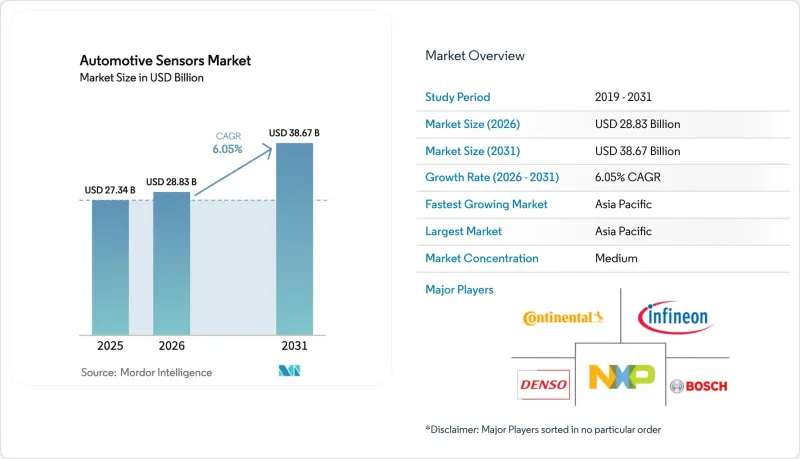
本報告按類型(溫度感測器、壓力感測器、速度感測器等)、應用(動力傳動系統、汽車電子等)、車輛類型(乘用車和商用車)、推進技術(內燃機車輛等)、銷售管道(OEM安裝感測器等)和地區進行細分。市場預測以美元計價。
全球汽車感測器市場趨勢及洞察
ADAS和自動駕駛感應器的普及
新規強制要求美國製造的小型貨車必須配備能夠在夜間偵測行人的自動緊急煞車系統,這要求製造商提升其前視感測器陣列的性能。高級駕駛輔助系統(ADAS)的核准,包括高速公路認證,現在要求使用三重冗餘感測器叢集,這顯著增加了感知硬體的成本。成像雷達技術的進步正促使系統從單一技術向雷達和攝影機結合的混合架構發生顯著轉變。然而,研究不斷指出當前系統存在誤報率問題,並強調了對更高解析度雷射雷達和熱成像技術的必要性。此外,功能安全標準的修訂擴大了審核範圍,將網路安全納入其中,雖然延長了檢驗過程,但也鞏固了供應商的市場地位。
電動車(EV)中熱感應和電池感應技術的快速發展
全球電池式電動車( BEV)產量正急劇成長,為防止熱失控事故,每輛車都在電池組和冷卻迴路中安裝了多個溫度探頭。中國修訂後的標準要求對電池組進行即時監測,導致感測器數量較以往型號顯著增加。歐盟聯合研究中心的一項研究表明,分散式熱感可以顯著降低碰撞事故中災難性故障的風險。為因應這些趨勢,意法半導體(STMicroelectronics)發表了一款專為高壓電池組設計的先進MEMS熱敏電阻器。儘管純電動車的佔有率不斷成長,但對熱感測器的需求仍然強勁,尤其是在插電式混合動力汽車採用雙區冷卻系統的情況下。此外,修訂後的標準要求進行熱傳遞阻力測試,強調了將壓力感測器和溫度感測器放置在同一位置的重要性。
半導體晶圓供應波動
汽車產品的前置作業時間仍遠長於疫情前水平,導致新車上市延遲。儘管英特爾和台積電在亞利桑那州新建的晶圓廠有望提升美國國內產能,但汽車認證流程卻阻礙了供應的顯著改善。歐洲的《晶片法案》旨在擴大該地區半導體市場的佔有率。然而,由於晶圓代工廠繼續優先生產邏輯節點,專用於感測器的生產線仍然有限。一級供應商正在增加庫存緩衝,這加劇了營運資金緊張,降低了獲利能力。這種做法使財務基礎較弱的小型供應商處於不利地位。因此,即使是符合AEC-Q100標準的長壽命元件,雙重採購策略也變得越來越普遍。
細分市場分析
在汽車感測器市場,慣性測量單元(IMU)預計到2025年將佔銷售額的28.13%,並預計在2031年之前以6.47%的複合年成長率成長,因為全球電子穩定控制系統(ESC)和感測器融合系統都將六軸IMU作為標準配置。博斯的SMI240和村田的線控陀螺儀是業界轉型為ASIL D認證韌體的典型例子,這些韌體能夠最大限度地減少漂移並增強抗衝擊能力。電動車電池組整合了多個溫度感測器,以有效應對快速充電過程中溫度的快速變化。壓力模組發揮著至關重要的作用,從監測輪胎壓力到再生柴油顆粒過濾器(DPF)以符合不斷變化的標準。通用速度感測器對於防鎖死煞車系統(ABS)和牽引力控制至關重要,而專為高壓電池組設計的霍爾效應電流感測器則為Allegro和Melexis等公司開闢了盈利的細分市場。
感測器市場還包括液位感測器、位置感測器和氣體感測器。雖然超音波泊車輔助系統可能會被高解析度攝影機取代,但節氣門位置感測器和曲軸感測器預計仍將繼續發揮至關重要的作用,這得益於全球內燃機車的龐大保有量。氣體感測器,特別是用於檢測氮氧化物和顆粒物的感測器,由於法規日益嚴格而需求回升,這使得大陸集團和NGK NTK等公司擁有了更強的定價權。為了迎接新標準的訂定,供應商正在將安全功能整合到下一代感測器晶片中,不僅使其高級產品脫穎而出,也為整個汽車感測器市場注入了新的活力。
預計到2025年,動力傳動系統模組將佔汽車感知器總銷量的40.55%,這主要得益於對氧氣感測器、歧管壓力感知器和曲軸感知器的持續需求,這些感知器對於內燃機仍然至關重要。然而,汽車感測器市場成長最快的細分領域是遠端資訊處理感測器,其成長主要由加速感應器、GPS以及基於里程的保險和車隊分析等技術驅動,這些技術能夠將行動電話數據貨幣化,預計複合年成長率將達到8.86%。
隨著汽車總產量的成長,車身電子設備(例如能夠響應雨水、環境光線和乘員狀況的設備)的需求也隨之成長。同時,智慧型手機接入方式的日益普及也推動了車輛安全模組需求的相應成長。雖然電動車逐步淘汰廢氣感測器可能會降低動力傳動系統在汽車零件中的佔比,但電池管理系統中電壓和溫度感測技術的引入正在彌補這一缺口。遠端資訊處理系統提供的預測性維護數據已證明其能夠減少車輛停機時間,從而證明了投資感測器的經濟合理性。為了滿足更高的安全需求,ISO 26262 標準現在強制要求遠端資訊處理模組採用冗餘訊號路徑。這項新增要求雖然增加了組件成本,但即使在通訊故障的情況下也能確保「無故障」運作。
區域分析
亞太地區是汽車感測器市場的主要驅動力,預計到2025年將佔全球銷售額的42.30%,並預計在2031年之前以9.10%的複合年成長率成長。在中國,新能源汽車的銷售是推動市場成長的主要因素,由於法規修訂,新能源汽車必須配備電池級熱監測系統。在印度,與生產連結獎勵計畫正在加速本地MEMS組裝,從而降低二級供應商的進口成本。在日本,電裝和SONY的成像感測器的應用顯著提高了ADAS(高級駕駛輔助系統)的普及率。同時,韓國的三星和SK海力士正在擴大在該地區的MEMS晶圓代工廠產能。
北美和歐洲佔據了大部分出貨量,但隨著汽車產量趨於穩定,高階汽車對感測器的應用接近飽和,預計成長速度將放緩。美國《基礎設施投資與就業法案》支持公共充電站建設,可能會提振電動車充電器感測器的需求。隨著氮氧化物和顆粒物排放法規的日益嚴格,大陸集團和博世等公司對氣體感測器的需求強勁。北美和歐洲都在努力實現半導體自給自足,英特爾在亞利桑那州的投資和歐洲的《晶片法案》就是例證。然而,汽車產業的認證流程落後於家用電子電器產業,導致汽車產業仍依賴亞洲的生產。
儘管市場佔有率較小,但南美、中東和非洲預計將迎來更快速的成長。在巴西,政府激勵措施正在推動電子穩定控制系統 (ESC) 和胎壓監測系統 (TPMS) 的普及。在土耳其,符合歐盟標準的高級駕駛輔助系統 (ADAS) 出口車輛正在推動國內對感測器的需求。儘管產量較低,但由於更嚴格的柴油車法規以及海灣合作理事會 (GCC) 成員國豪華車車隊的普及,南非每輛車的感測器數量正在增加。在阿根廷,貨幣穩定是經濟復甦的關鍵,但老舊車輛仍然為售後市場帶來了商機。
其他好處:
- Excel格式的市場預測(ME)表
- 3個月的分析師支持
目錄
第1章:引言
- 研究假設和市場定義
- 調查範圍
第2章:調查方法
第3章執行摘要
第4章 市場狀況
- 市場概覽
- 市場促進因素
- ADAS和自動駕駛感應器的普及
- 排放氣體和安全法規要求使用壓力/氣體感知器。
- 電動車熱感和電池感測技術的蓬勃發展
- 微機電系統 (MEMS) 平均售價 (ASP) 的下降使其得以大規模應用。
- 具備OTA自診斷功能的智慧感測器
- 基於使用量的保險對遠端資訊處理技術的需求。
- 市場限制因素
- 大規模生產車輛中的感測器面臨成本壓力
- 半導體晶圓供應波動
- 與ADAS相關的問責問題正在延緩新感測器規範的發展。
- 感測器資料貨幣化中的資料隱私限制
- 價值供應鏈分析
- 監理情勢
- 技術展望
- 波特五力模型
第5章 市場規模與成長預測
- 按類型
- 溫度感測器
- 壓力感測器
- 速度感測器
- 液位/位置感知器
- 磁感測器
- 氣體感測器
- 慣性感測器
- 透過使用
- 動力傳動系統
- 汽車電子設備
- 車輛安全系統
- 車載資訊系統
- 車輛類型
- 搭乘用車
- 商用車輛
- 透過推進技術
- 內燃機車
- 電池式電動車(BEV)
- 插電式混合動力汽車(PHEV)
- 燃料電池電動車(FCEV)
- 按銷售管道
- 原廠正品感測器
- 售後市場
- 按地區
- 北美洲
- 美國
- 加拿大
- 其他北美國家
- 南美洲
- 巴西
- 阿根廷
- 其他南美國家
- 歐洲
- 德國
- 英國
- 法國
- 俄羅斯
- 其他歐洲國家
- 亞太地區
- 中國
- 日本
- 印度
- 韓國
- 其他亞太國家
- 中東和非洲
- 土耳其
- 波灣合作理事會(GCC)
- 南非
- 其他中東和非洲國家
- 北美洲
第6章 競爭情勢
- 市場集中度
- 策略趨勢
- 市佔率分析
- 公司簡介
- Robert Bosch GmbH
- DENSO Corporation
- Continental AG
- Infineon Technologies AG
- NXP Semiconductors NV
- Sensata Technologies PLC
- Texas Instruments Inc.
- Analog Devices Inc.
- Aptiv PLC
- ST Microelectronics NV
- Valeo SA
- Honeywell International Inc.
- Allegro MicroSystems LLC
- Murata Manufacturing Co.
- ON Semiconductor Corporation
- TE Connectivity Ltd.
- Autoliv Inc.
第7章 市場機會與未來展望
According to Mordor Intelligence, the automotive sensor market size was valued at USD 27.34 billion in 2025 and estimated to grow from USD 28.83 billion in 2026 to reach USD 38.67 billion by 2031, at a CAGR of 6.05% during the forecast period (2026-2031).
This report is Segmented by Type (Temperature Sensors, Pressure Sensors, Speed Sensors, and More), Application (Powertrain, Body Electronics, and More), Vehicle Type (Passenger Cars and Commercial Vehicles), Propulsion Technology (Internal Combustion Engine (ICE) Vehicles, and More), Sales Channel (OEM-Fitted Sensors, and More), and Geography. The Market Forecasts are Provided in Terms of Value (USD).
Global Automotive Sensors Market Trends and Insights
ADAS and Autonomous-Driving Sensor Proliferation
New regulations mandate that United States light vehicles include automatic emergency braking systems capable of detecting pedestrians at night, requiring manufacturers to enhance their forward-looking sensor suites . Approvals for advanced driving systems, such as highway certifications, necessitate triple-redundant clusters, significantly increasing perception hardware costs. The transition from single-technology systems to hybrid radar-camera architectures is becoming more prominent with advancements in imaging-radar programs. However, research continues to highlight false-positive rates in current systems, emphasizing the need for higher-resolution lidar and thermal imaging. Additionally, updates to functional-safety standards are broadening audits to include cybersecurity, which extends validation processes but strengthens vendor positions in the market.
Electric Vehicle (EV) Thermal-Battery Sensing Boom
Global production of battery-electric vehicles has increased significantly, with each car incorporating multiple temperature probes across cells and coolant loops to prevent thermal runaway incidents. China's updated standards require real-time monitoring at the cell level, resulting in a notable increase in sensor counts compared to earlier models. Research from the European Union's Joint Research Centre highlights that distributed thermal sensing can substantially reduce catastrophic failures during crash scenarios . In response to these developments, STMicroelectronics introduced advanced MEMS thermistors designed for high-voltage packs. Despite the growing share of pure electric vehicles, the demand for thermal sensors remains strong, particularly with the use of dual-zone cooling in plug-in hybrids. Additionally, updated standards now require tests for thermal-propagation resistance, emphasizing the importance of co-located pressure and temperature devices.
Semiconductor Wafer-Supply Volatility
Automotive-grade lead times remain significantly higher than pre-pandemic levels, causing delays in new-model launches . While new fabs by Intel and Taiwan Semiconductor Manufacturing Company (TSMC) in Arizona are expected to enhance domestic capacity, the automotive qualification process is delaying substantial volume relief. Europe's Chips Act aims to increase the region's share of the semiconductor market. However, foundries continue to prioritize logic nodes, leaving sensor-specific production lines limited. Tier-1 suppliers are increasing inventory buffers, which is straining working capital and reducing returns. This approach places smaller vendors with weaker financial resources at a disadvantage. Consequently, dual-sourcing strategies are now widely adopted, even for long-life AEC-Q100 components.
Other drivers and restraints analyzed in the detailed report include:
- Emission and Safety Mandates Driving Pressure/Gas Sensors
- Falling Micro-Electro-Mechanical Systems (MEMS) ASP Enabling Mass Adoption
- Sensor Cost Pressure on Mass-Market Vehicles
For complete list of drivers and restraints, kindly check the Table Of Contents.
Segment Analysis
Inertial devices commanded 28.13% of the 2025 revenue within the automotive sensor market size and are expected to advance at a 6.47% CAGR to 2031 as global electronic stability control and sensor-fusion stacks standardize on six-axis IMUs. Bosch's SMI240 and Murata's steer-by-wire gyroscopes exemplify the industry's shift toward ASIL D-certified firmware, enabling minimal drift and withstanding extreme shocks. Temperature sensors, with multiple units in each electric vehicle battery pack, adeptly manage rapid thermal gradients during fast charging. Pressure modules play a crucial role, from monitoring tire pressure to regenerating diesel particulate filters in compliance with evolving standards. While commoditized speed sensors are vital for anti-lock braking systems and traction control, Hall-effect current transducers, designed for high-voltage packs, are carving out lucrative niches for companies like Allegro and Melexis.
The sensor landscape also features level, position, and gas sensors. Although ultrasonic parking aids may soon be overshadowed by high-resolution cameras, throttle-position and crankshaft sensors are poised to remain relevant, bolstered by a significant global fleet of internal combustion vehicles. Gas sensors, particularly those for NOx and particulate detection, are experiencing a resurgence in demand due to stricter regulations, granting companies like Continental and NGK NTK enhanced pricing leverage. In anticipation of updated standards, suppliers are integrating cybersecurity features into next-gen sensor chips, not only distinguishing their premium products but also bolstering the overall automotive sensor market.
Powertrain modules retained 40.55% of the revenue in 2025, due to the continued demand for oxygen, manifold-pressure, and crankshaft sensors, which are still required on internal-combustion engines. Yet telematics sensors represent the fastest-growing slice of the automotive sensor market, with an 8.86% CAGR driven by usage-based insurance and fleet analytics that monetize accelerometer, GPS, and cellular data.
As overall vehicle production rises, so too do body electronics, devices responding to rain, ambient light, and occupancy. Meanwhile, as smartphone-based access becomes more prevalent, vehicle security modules see a corresponding uptick. While the share of powertrains may wane due to the phasing out of exhaust-gas sensors in EVs, the introduction of voltage and thermal sensing in battery-management systems offers a counterbalance to this decline. Predictive-maintenance data harnessed from telematics has demonstrated its ability to reduce fleet downtime, underscoring the economic rationale for investing in sensors. Responding to the need for enhanced safety, ISO 26262 now requires telematics modules to have redundant signal paths. This addition, while raising the bill of materials, guarantees a fail-silent operation even during connectivity disruptions.
Complete Report Scope:
- By Type
- Temperature Sensors
- Pressure Sensors
- Speed Sensors
- Level / Position Sensors
- Magnetic Sensors
- Gas Sensors
- Inertial Sensors
- By Application
- Powertrain
- Body Electronics
- Vehicle Security Systems
- Telematics
- By Vehicle Type
- Passenger Cars
- Commercial Vehicles
- By Propulsion Technology
- Internal Combustion Engine (ICE) Vehicles
- Battery-Electric Vehicles (BEV)
- Plug-in Hybrid Vehicles (PHEV)
- Fuel-cell Electric Vehicles (FCEV)
- By Sales Channel
- OEM-fitted Sensors
- Aftermarket
- By Geography
- North America
- United States
- Canada
- Rest of North America
- South America
- Brazil
- Argentina
- Rest of South America
- Europe
- Germany
- United Kingdom
- France
- Russia
- Rest of Europe
- Asia-Pacific
- China
- Japan
- India
- South Korea
- Rest of Asia-Pacific
- Middle East and Africa
- Turkey
- Gulf Cooperation Council (GCC)
- South Africa
- Rest of Middle East and Africa
- North America
Geography Analysis
The Asia-Pacific led the automotive sensor market with 42.30% revenue in 2025 and is forecasted to grow at a 9.10% CAGR through 2031. China's new-energy vehicle sales, now mandated to include cell-level thermal monitoring under updated regulations, have propelled the market. In India, a production-linked incentive is facilitating local MEMS assembly and reducing import bills for tier-2 suppliers. In Japan, ADAS penetration has increased significantly, driven by the use of imaging sensors from DENSO and Sony. Meanwhile, South Korea's Samsung and SK Hynix are expanding their regional MEMS foundry capacity.
While North America and Europe account for a significant share of shipments, their growth is expected to slow as vehicle production stabilizes and sensor usage in premium trims nears saturation. The United States Infrastructure Investment and Jobs Act is backing public charging points, which is likely to boost the demand for sensors in EV chargers. With stricter thresholds for NOx and particulates, companies such as Continental and Bosch are experiencing a consistent demand for gas sensors. Both North America and Europe are striving for semiconductor independence, as evident from Intel's investments in Arizona and the European Chips Act. However, the automotive sector's qualification process lags behind consumer electronics, leading to a continued reliance on Asian production.
South America and the Middle East and Africa, which account for a smaller share of the market, are poised for faster growth. Brazil's incentives are bolstering the adoption of ESC and TPMS. Turkey's export vehicles, now equipped with EU-compliant ADAS, are driving local demand for sensors. Despite smaller production volumes, South Africa's adoption of stricter diesel regulations and the Gulf Cooperation Council's luxury fleet are both increasing the sensor count per vehicle. Argentina, while banking on currency stability for recovery, still presents an aftermarket opportunity due to its aging vehicle fleet.
- Robert Bosch GmbH
- DENSO Corporation
- Continental AG
- Infineon Technologies AG
- NXP Semiconductors NV
- Sensata Technologies PLC
- Texas Instruments Inc.
- Analog Devices Inc.
- Aptiv PLC
- ST Microelectronics NV
- Valeo SA
- Honeywell International Inc.
- Allegro MicroSystems LLC
- Murata Manufacturing Co.
- ON Semiconductor Corporation
- TE Connectivity Ltd.
- Autoliv Inc.
Additional Benefits:
- The market estimate (ME) sheet in Excel format
- 3 months of analyst support
TABLE OF CONTENTS
1 Introduction
- 1.1 Study Assumptions and Market Definition
- 1.2 Scope of the Study
2 Research Methodology
3 Executive Summary
4 Market Landscape
- 4.1 Market Overview
- 4.2 Market Drivers
- 4.2.1 ADAS and Autonomous-Driving Sensor Proliferation
- 4.2.2 Emission and Safety Mandates Driving Pressure / Gas Sensors
- 4.2.3 Electric Vehicle Thermal-Battery Sensing Boom
- 4.2.4 Falling Micro-Electro-Mechanical Systems (MEMS) ASP Enabling Mass Adoption
- 4.2.5 OTA-Ready Self-Diagnostic Smart Sensors
- 4.2.6 Usage-Based-Insurance Telematics Demand
- 4.3 Market Restraints
- 4.3.1 Sensor Cost Pressure on Mass-Market Vehicles
- 4.3.2 Semiconductor Wafer-Supply Volatility
- 4.3.3 ADAS Liability Delaying New Sensor Specs
- 4.3.4 Data-Privacy Limits to Sensor-Data Monetization
- 4.4 Value / Supply-Chain Analysis
- 4.5 Regulatory Landscape
- 4.6 Technological Outlook
- 4.7 Porter's Five Forces
- 4.7.1 Threat of New Entrants
- 4.7.2 Bargaining Power of Buyers
- 4.7.3 Bargaining Power of Suppliers
- 4.7.4 Threat of Substitutes
- 4.7.5 Competitive Rivalry
5 Market Size and Growth Forecasts (Value in USD)
- 5.1 By Type
- 5.1.1 Temperature Sensors
- 5.1.2 Pressure Sensors
- 5.1.3 Speed Sensors
- 5.1.4 Level / Position Sensors
- 5.1.5 Magnetic Sensors
- 5.1.6 Gas Sensors
- 5.1.7 Inertial Sensors
- 5.2 By Application
- 5.2.1 Powertrain
- 5.2.2 Body Electronics
- 5.2.3 Vehicle Security Systems
- 5.2.4 Telematics
- 5.3 By Vehicle Type
- 5.3.1 Passenger Cars
- 5.3.2 Commercial Vehicles
- 5.4 By Propulsion Technology
- 5.4.1 Internal Combustion Engine (ICE) Vehicles
- 5.4.2 Battery-Electric Vehicles (BEV)
- 5.4.3 Plug-in Hybrid Vehicles (PHEV)
- 5.4.4 Fuel-cell Electric Vehicles (FCEV)
- 5.5 By Sales Channel
- 5.5.1 OEM-fitted Sensors
- 5.5.2 Aftermarket
- 5.6 By Geography
- 5.6.1 North America
- 5.6.1.1 United States
- 5.6.1.2 Canada
- 5.6.1.3 Rest of North America
- 5.6.2 South America
- 5.6.2.1 Brazil
- 5.6.2.2 Argentina
- 5.6.2.3 Rest of South America
- 5.6.3 Europe
- 5.6.3.1 Germany
- 5.6.3.2 United Kingdom
- 5.6.3.3 France
- 5.6.3.4 Russia
- 5.6.3.5 Rest of Europe
- 5.6.4 Asia-Pacific
- 5.6.4.1 China
- 5.6.4.2 Japan
- 5.6.4.3 India
- 5.6.4.4 South Korea
- 5.6.4.5 Rest of Asia-Pacific
- 5.6.5 Middle East and Africa
- 5.6.5.1 Turkey
- 5.6.5.2 Gulf Cooperation Council (GCC)
- 5.6.5.3 South Africa
- 5.6.5.4 Rest of Middle East and Africa
- 5.6.1 North America
6 Competitive Landscape
- 6.1 Market Concentration
- 6.2 Strategic Moves
- 6.3 Market Share Analysis
- 6.4 Company Profiles (Includes Global level Overview, Market level overview, Core Segments, Financials as available, Strategic Information, Market Rank/Share for key companies, Products & Services, and Recent Developments)
- 6.4.1 Robert Bosch GmbH
- 6.4.2 DENSO Corporation
- 6.4.3 Continental AG
- 6.4.4 Infineon Technologies AG
- 6.4.5 NXP Semiconductors NV
- 6.4.6 Sensata Technologies PLC
- 6.4.7 Texas Instruments Inc.
- 6.4.8 Analog Devices Inc.
- 6.4.9 Aptiv PLC
- 6.4.10 ST Microelectronics NV
- 6.4.11 Valeo SA
- 6.4.12 Honeywell International Inc.
- 6.4.13 Allegro MicroSystems LLC
- 6.4.14 Murata Manufacturing Co.
- 6.4.15 ON Semiconductor Corporation
- 6.4.16 TE Connectivity Ltd.
- 6.4.17 Autoliv Inc.
7 Market Opportunities and Future Outlook
- 7.1 White-space and Unmet-need Assessment

 汽車安全帶提醒感測器市場:全球市場預測,2026-2032年汽車市場用線性霍爾效應感測器:全球市場預測,2026-2032年汽車數位訊號感測器市場:全球市場預測,2026-2032年
 2026年全球汽車超音波感測器市場報告
 汽車感測器市場預測至2034年-全球分析(按感測器類型、車輛類型、動力類型、銷售管道、技術、應用、最終用戶和地區分類)
 汽車感測器市場-全球及區域分析:按應用、產品和地區分類-分析與預測(2026-2035年)
 2026-2034年全球汽車感測器市場規模、佔有率、趨勢和成長分析報告底盤感測器市場規模、佔有率、成長、全球產業分析、區域趨勢及2026年至2034年預測。
 印度汽車感測器市場:市場佔有率分析、產業趨勢與統計及成長預測(2026-2031)美國汽車感測器:市場佔有率分析、產業趨勢與統計及成長預測(2026-2031 年)