


 |
市場調查報告書
商品編碼
2113635
印度汽車感測器市場:市場佔有率分析、產業趨勢與統計及成長預測(2026-2031)India Automotive Sensors - Market Share Analysis, Industry Trends & Statistics, Growth Forecasts (2026 - 2031) |
||||||

※ 本網頁內容可能與最新版本有所差異。詳細情況請與我們聯繫。
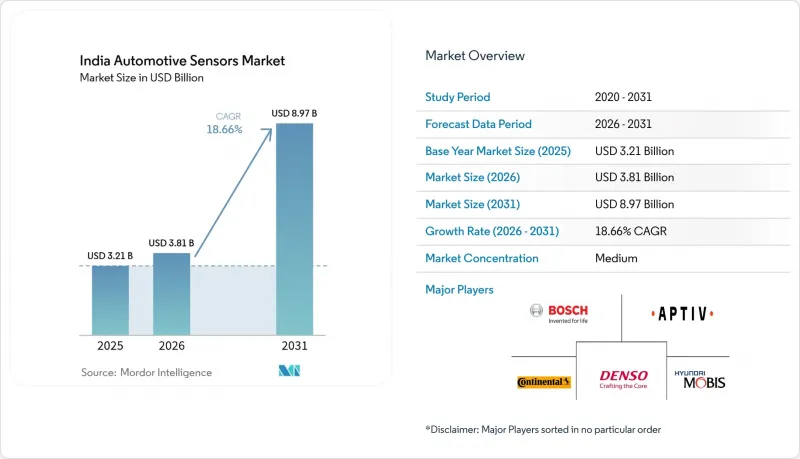
據 Mordor Intelligence 稱,2025 年印度汽車感測器市值為 32.1 億美元,預計到 2031 年將從 2026 年的 38.1 億美元成長至 89.7 億美元,預測期(2026-2031 年)的複合年成長率為 18.66%。
本報告按感測器類型(壓力感測器、溫度感測器等)、車輛驅動系統(內燃機和電動車)、應用領域(引擎和傳動系統、車載電子設備、車輛安全系統及其他應用)以及車輛類型(乘用車、輕型商用車等)進行分類。市場預測以美元計價。
印度汽車感測器市場趨勢與洞察
AIS-145實施後關於ADAS和TPMS的強制法規
印度公路運輸和公路部 (MoRTH) 已提案修訂《中央機動車輛法規》(CMVR)。這些修訂將強制要求從 2026 年 4 月起,所有載客量為 8 人或以上的車輛必須安裝高級緊急煞車系統、車道偏離預警系統和駕駛疲勞預警系統。以往在技術應用方面較為落後的商用車輛車隊,現在無論採用何種平台,都必須安裝雷達、攝影機和慣性感測器。胎壓監測系統 (TPMS) 法規的實施增加了對輪轂式胎壓感知器的需求,催生了一個蓬勃發展的售後市場。這些法規的推出恰逢車輛報廢計劃,該計劃旨在淘汰老舊卡車,從而加速新型感測器的普及。能夠獲得 ISO 26262 合規性和功能安全性能認證的供應商更有可能獲得利潤豐厚的合約。
印度兩輪和三輪車輛快速電氣化
預計到2025會計年度,電動二輪車的銷量將飆升至114萬輛,該細分市場目前每輛車最多配備20個感測器。與同類內燃機車型僅配備8個感測器相比,這是一個顯著的成長。在材料清單(BOM)中,電池溫度、電芯電壓和馬達位置感測器佔據了大部分,而再生煞車系統則增加了扭力和車輪速度感測功能。 2024年,三輪車佔新車註冊量的一半以上,需求主要集中在都市區最後一公里出行網路。對價格敏感的原始設備製造商(OEM)傾向於採用國產封裝的微機電系統(MEMS)裝置以降低成本,這推動了印度國內新建晶圓廠產能的提升。
定價受成本意識強的汽車製造商和利潤率極低的供應商的影響。
在2024會計年度,六大汽車製造商佔據了國內市場的大部分佔有率,形成了買方壟斷市場,迫使供應商將感測器價格定得比全球平均水平低五分之一以上。儘管電動車(EV)車型中的感測器數量增加了三到四倍,但為了獲得大眾市場的認可,零售價格必須保持不變。物流和能源成本的上漲使得印度製造的零件比墨西哥同類產品更貴,給出口商的利潤帶來了壓力。這種持續的利潤率壓力限制了研發預算,延緩了下一代感測器的推出。
細分市場分析
到2025年,壓力感測器將成為印度汽車感測器市場的主要驅動力,佔據43.12%的市場。這主要歸功於胎壓監測系統(TPMS)的強制實施以及其在引擎管理系統中的廣泛應用。現有基礎確保了穩定的銷量,即使隨著電動動力傳動系統總成的普及,電池冷卻液監測和煞車壓力偵測等功能也隨之增加。光電感測器(包括攝影機和紅外線模組)預計將成為成長最快的感測器,到2031年複合年成長率將達到18.79%,這主要得益於高級駕駛輔助系統(ADAS)功能在中檔車型中的日益普及。溫度感測器和速度感測器的市場也將繼續穩定成長,這主要得益於印度第六階段排放氣體法規(Bharat Stage VI)和防鎖死煞車系統(ABS)的強制實施。
電磁設備憑藉近距離和位置檢測應用(例如電力驅動橋監控和自動泊車輔助)不斷擴大市場佔有率。新興的慣性感測器和氣體感測器則佔據「其他」類別,車內空氣品質和車輛動態功能日益成長的客戶期望也日益明顯。像Sona Comstar這樣的本土企業目前正在開發用於盲點檢測的短程雷達原型,這表明印度汽車感測器市場正從通用感測器轉向先進的感知模組。
到2025年,內燃機平台將佔據印度汽車感測器市場62.58%的佔有率,這主要得益於成熟的燃料供應基礎設施以及農村地區電氣化程度的不足。隨著兩輪和三輪車輛在都市區日益普及,電動車(EV)正以18.71%的複合年成長率推動市場成長。電動車每輛車配備的感測器數量比內燃機多五分之三,涵蓋電池電壓、電池組溫度以及高壓絕緣監測等多個方面。混合動力汽車雖然屬於小眾市場,但它們融合了內燃機和電動車的感測功能,因此擁有最複雜的組件配置。
儘管如此,由於BS-VI排放標準要求對粒狀物過濾器和先進燃油噴射控制系統進行監測,內燃機汽車的感知器搭載率仍然很高。隨著充電網路的擴展和電池價格的下降,汽車製造商預測,到2030年,電動車銷售將佔新車註冊量的五分之一以上,這將對印度汽車感測器市場中專注於動力傳動系統專用感測器的供應商而言,成為一個結構性轉折點。
其他好處:
- Excel格式的市場預測(ME)表
- 3個月的分析師支持
目錄
第1章:引言
- 研究假設和市場定義
- 調查範圍
第2章:調查方法
第3章執行摘要
第4章 市場狀況
- 市場概覽
- 市場促進因素
- AIS-145之後ADAS和TPMS的強制性法規
- 印度兩輪和三輪車輛快速電氣化
- 透過PLI和規範獎勵實現MEMS感測器生產的在地化
- OEM主導向域/區域EE架構的過渡
- 用於實現大眾市場車輛感測器融合的超低成本8位MCU
- 普遍負擔保險(UBI)的引入正在推動對車載遠端資訊處理感測器的需求。
- 市場限制因素
- 對成本高度敏感的OEM定價和極低的供應商利潤率
- 二級晶圓級封裝產能延遲
- 安全感測器售後服務網路的去中心化
- 感測器用矽晶片的進口關稅推高了物料清單(BOM)成本。
- 價值供應鏈分析
- 監理情勢
- 技術展望
- 波特五力模型
第5章 市場規模與成長預測
- 依感測器類型
- 壓力感測器
- 溫度感測器
- 速度感測器
- 光電感測器
- 電磁感測器
- 其他感測器
- 車輛傳動系統
- 內燃機車
- 電動車
- 透過使用
- 引擎和傳動系統
- 車上電子設備
- 汽車安全系統
- 其他用途
- 車輛類型
- 摩托車
- 搭乘用車
- 輕型商用車
- 中型和重型商用車輛
第6章 競爭情勢
- 市場集中度
- 策略趨勢
- 市佔率分析
- 公司簡介
- Robert Bosch GmbH
- Continental AG
- DENSO Corporation
- Infineon Technologies AG
- Sensata Technologies Inc.
- Aptiv plc
- Hitachi Astemo Ltd.
- Hella GmbH & Co. KGaA
- Hyundai Mobis Co. Ltd.
- CTS Corporation
- Allegro MicroSystems LLC
- NXP Semiconductors NV
- Texas Instruments Inc.
- Renesas Electronics Corp.
- TE Connectivity Ltd.
- Murata Manufacturing Co. Ltd.
- Valeo SA
- Analog Devices Inc.
- IC Haus GmbH
第7章 市場機會與未來展望
According to Mordor Intelligence, the India automotive sensors market size was valued at USD 3.21 billion in 2025 and estimated to grow from USD 3.81 billion in 2026 to reach USD 8.97 billion by 2031, at a CAGR of 18.66% during the forecast period (2026-2031).
This report is Segmented by Sensor Type (Pressure Sensors, Temperature Sensors, and More), Vehicle Drive-Train (ICE Vehicles and Electric Vehicles), Application (Engine & Drivetrain, Vehicle Electronics, Vehicle Safety Systems, and Other Applications), and Vehicle Type (Passenger Cars, Light Commercial Vehicles, and More). The Market Forecasts are Provided in Terms of Value (USD).
India Automotive Sensors Market Trends and Insights
Mandatory ADAS & TPMS Regulations Post-AIS-145
Ministry of Road Transport and Highways (MoRTH) has proposed amendments to the Central Motor Vehicles Rules (CMVR), which obliges vehicles exceeding eight seats to integrate advanced emergency braking, lane departure, and driver-drowsiness warning systems from April 2026. Traditionally late adopters, commercial fleets must now deploy radar, camera, and inertial sensors across platforms. TPMS rules augment demand for wheel-mounted pressure sensors that generate a continuing aftermarket. The regulation coincides with a vehicle scrappage program that cycles older trucks out of service, accelerating new sensor uptake. Suppliers able to certify ISO 26262 compliance and functional-safety performance are likely to capture premium contracts.
Rapid Electrification of India's Two- & Three-Wheeler Fleet
Electric two-wheeler sales surged to 1.14 million units in FY2025, and the segment now integrates up to 20 sensors per vehicle versus 8 in comparable ICE models. Battery-thermal, cell-voltage, and motor-position sensors dominate the bill of materials, while regenerative braking systems add torque and wheel-speed sensing. Three-wheelers accounted for more than half of new registrations in 2024, concentrating demand in urban last-mile networks. Price-sensitive OEMs favor domestically packaged MEMS devices to contain costs, spurring capacity additions at new Indian fabs.
Cost-Sensitive OEM Pricing and Razor-Thin Supplier Margins
Six leading automakers controlled the majority of domestic sales in FY2024, creating monopsony power that compels vendors to price sensors more than one-fifth below global averages. Electric models add 3-4 times more sensor content yet must hold retail prices flat to win mass-market acceptance. Higher logistics and energy costs render Indian parts costlier than Mexican equivalents, squeezing exporter profit. Sustained margin pressure limits R&D budgets, delaying next-generation sensor rollouts.
Other drivers and restraints analyzed in the detailed report include:
- PLI & SPECS Incentives Localising MEMS Sensor Production
- OEM-Led Shift to Domain/Zone E-E Architectures
- Lag in Tier-II Wafer-Level Packaging Capacity
For complete list of drivers and restraints, kindly check the Table Of Contents.
Segment Analysis
Pressure sensors dominated the India automotive sensors market in 2025 with a 43.12% share, largely due to mandatory TPMS adoption and widespread engine-management use cases. This legacy base ensures steady volume even as electric powertrains add battery-coolant monitoring and brake-pressure sensing. Electro-optical sensors, including cameras and infrared modules, log the fastest 18.79% CAGR through 2031 as ADAS features cascade into mid-segment models. Temperature and speed sensors continue incremental gains tied to Bharat Stage VI emission control and anti-lock braking mandates.
Electromagnetic devices capture share through proximity and position applications such as e-axle monitoring and automated parking assist. Emerging inertial and gas sensors populate the "other" category, where cabin-air-quality and vehicle-dynamics functions highlight rising customer expectations. Domestic players like Sona Comstar now prototype short-range radar for blind-spot detection, underlining India's shift from commodity sensing to advanced perception modules within the India automotive sensors market.
Internal-combustion platforms held 62.58% of India automotive sensors market size in 2025, buoyed by established fueling infrastructure and slower rural electrification. Electric vehicles lead growth at an 18.71% CAGR as two- and three-wheelers proliferate in cities. EVs integrate three-fifths more sensors per unit, spanning battery voltage, pack temperature, and high-voltage isolation monitoring. Hybrid variants, though niche, layer both ICE and EV sensing, representing the most complex bill of materials.
ICE vehicles nonetheless sustain high sensor content through particulate-filter monitoring and advanced fuel-injection control demanded by BS-VI norms. As charging networks widen and battery prices fall, OEMs project EV volumes to top one-fifth of new registrations by 2030, creating a structural pivot for suppliers focused on drivetrain-specific sensors within the India automotive sensors market.
Complete Report Scope:
- By Sensor Type
- Pressure Sensors
- Temperature Sensors
- Speed Sensors
- Electro-Optical Sensors
- Electro-Magnetic Sensors
- Other Sensors
- By Vehicle Drive-train
- ICE Vehicles
- Electric Vehicles
- By Application
- Engine & Drivetrain
- Vehicle Electronics
- Vehicle Safety Systems
- Other Applications
- By Vehicle Type
- Two-Wheelers
- Passenger Cars
- Light Commercial Vehicles
- Medium and Heavy Commercial Vehicles
List of Companies Covered in this Report:
- Robert Bosch GmbH
- Continental AG
- DENSO Corporation
- Infineon Technologies AG
- Sensata Technologies Inc.
- Aptiv plc
- Hitachi Astemo Ltd.
- Hella GmbH & Co. KGaA
- Hyundai Mobis Co. Ltd.
- CTS Corporation
- Allegro MicroSystems LLC
- NXP Semiconductors N.V.
- Texas Instruments Inc.
- Renesas Electronics Corp.
- TE Connectivity Ltd.
- Murata Manufacturing Co. Ltd.
- Valeo SA
- Analog Devices Inc.
- IC Haus GmbH
Additional Benefits:
- The market estimate (ME) sheet in Excel format
- 3 months of analyst support
TABLE OF CONTENTS
1 Introduction
- 1.1 Study Assumptions & Market Definition
- 1.2 Scope of the Study
2 Research Methodology
3 Executive Summary
4 Market Landscape
- 4.1 Market Overview
- 4.2 Market Drivers
- 4.2.1 Mandatory ADAS & TPMS Regulations Post-AIS-145
- 4.2.2 Rapid Electrification Of India'S Two- & Three-Wheeler Fleet
- 4.2.3 PLI & Specs Incentives Localising Mems Sensor Production
- 4.2.4 OEM-Led Shift To Domain/Zone E-E Architectures
- 4.2.5 Ultra-Low-Cost 8-Bit MCUs Enabling Sensor Fusion In Mass-Market Cars
- 4.2.6 Usage-Based-Insurance (UBI) Adoption Spurring Demand For In-Vehicle Telematics Sensors
- 4.3 Market Restraints
- 4.3.1 Cost-Sensitive OEM Pricing And Razor-Thin Supplier Margins
- 4.3.2 Lag In Tier-Ii Wafer-Level Packaging Capacity
- 4.3.3 Fragmented After-Sales Service Network For Safety Sensors
- 4.3.4 Import Duties On Sensor-Grade Silicon Wafers Elevating Bom Costs
- 4.4 Value / Supply-Chain Analysis
- 4.5 Regulatory Landscape
- 4.6 Technological Outlook
- 4.7 Porter's Five Forces
- 4.7.1 Threat of New Entrants
- 4.7.2 Bargaining Power of Buyers
- 4.7.3 Bargaining Power of Suppliers
- 4.7.4 Threat of Substitutes
- 4.7.5 Competitive Rivalry
5 Market Size & Growth Forecasts (Value (USD))
- 5.1 By Sensor Type
- 5.1.1 Pressure Sensors
- 5.1.2 Temperature Sensors
- 5.1.3 Speed Sensors
- 5.1.4 Electro-Optical Sensors
- 5.1.5 Electro-Magnetic Sensors
- 5.1.6 Other Sensors
- 5.2 By Vehicle Drive-train
- 5.2.1 ICE Vehicles
- 5.2.2 Electric Vehicles
- 5.3 By Application
- 5.3.1 Engine & Drivetrain
- 5.3.2 Vehicle Electronics
- 5.3.3 Vehicle Safety Systems
- 5.3.4 Other Applications
- 5.4 By Vehicle Type
- 5.4.1 Two-Wheelers
- 5.4.2 Passenger Cars
- 5.4.3 Light Commercial Vehicles
- 5.4.4 Medium and Heavy Commercial Vehicles
6 Competitive Landscape
- 6.1 Market Concentration
- 6.2 Strategic Moves
- 6.3 Market Share Analysis
- 6.4 Company Profiles (Includes Global Level Overview, Market Level Overview, Core Segments, Financials as Available, Strategic Information, Market Rank/Share for Key Companies, Products and Services, SWOT Analysis, and Recent Developments)
- 6.4.1 Robert Bosch GmbH
- 6.4.2 Continental AG
- 6.4.3 DENSO Corporation
- 6.4.4 Infineon Technologies AG
- 6.4.5 Sensata Technologies Inc.
- 6.4.6 Aptiv plc
- 6.4.7 Hitachi Astemo Ltd.
- 6.4.8 Hella GmbH & Co. KGaA
- 6.4.9 Hyundai Mobis Co. Ltd.
- 6.4.10 CTS Corporation
- 6.4.11 Allegro MicroSystems LLC
- 6.4.12 NXP Semiconductors N.V.
- 6.4.13 Texas Instruments Inc.
- 6.4.14 Renesas Electronics Corp.
- 6.4.15 TE Connectivity Ltd.
- 6.4.16 Murata Manufacturing Co. Ltd.
- 6.4.17 Valeo SA
- 6.4.18 Analog Devices Inc.
- 6.4.19 IC Haus GmbH
7 Market Opportunities & Future Outlook
- 7.1 White-space & Unmet-Need Assessment

 汽車安全帶提醒感測器市場:全球市場預測,2026-2032年汽車市場用線性霍爾效應感測器:全球市場預測,2026-2032年汽車數位訊號感測器市場:全球市場預測,2026-2032年
 2026年全球汽車超音波感測器市場報告
 汽車感測器市場預測至2034年-全球分析(按感測器類型、車輛類型、動力類型、銷售管道、技術、應用、最終用戶和地區分類)
 汽車感測器市場-全球及區域分析:按應用、產品和地區分類-分析與預測(2026-2035年)
 2026-2034年全球汽車感測器市場規模、佔有率、趨勢和成長分析報告底盤感測器市場規模、佔有率、成長、全球產業分析、區域趨勢及2026年至2034年預測。
 汽車感測器:市場佔有率分析、產業趨勢與統計、成長預測(2026-2031)美國汽車感測器:市場佔有率分析、產業趨勢與統計及成長預測(2026-2031 年)