


 |
市場調查報告書
商品編碼
2120786
奈米碳管:市場佔有率分析、產業趨勢與統計、成長預測(2026-2031)Carbon Nanotubes - Market Share Analysis, Industry Trends & Statistics, Growth Forecasts (2026 - 2031) |
||||||

※ 本網頁內容可能與最新版本有所差異。詳細情況請與我們聯繫。
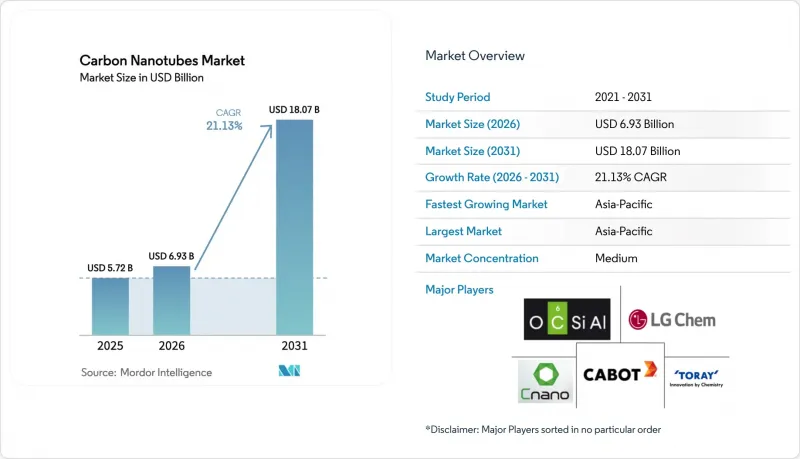
根據 Mordor Intelligence 預測,奈米碳管市場規模將從 2025 年的 57.2 億美元成長到 2026 年的 69.3 億美元,然後在 2031 年達到 180.7 億美元,2026 年至 2031 年的複合年成長率為 21.13%。
本報告按類型(例如,多壁奈米碳管、單壁奈米碳管)、製造方法(例如,化學氣相沉積 (CVD)、高壓一氧化碳沉積 (HiPco))、終端應用產業(例如,電氣電子、能源、汽車)和地區(例如,亞太地區、北美、歐洲)進行細分。市場預測以價值(美元)和數量(噸)兩種單位呈現。
全球奈米碳管市場趨勢及洞察
電動車的蓬勃發展正在加速對碳奈米管的需求。
目前,電動車電池組中添加了0.5-2.0 wt%的碳奈米管(CNTs),以在充放電循環過程中矽石墨負極膨脹時維持電子傳輸通道。 LG化學在韓國的四家工廠根據與一級汽車製造商簽訂的多年契約,每年供應6100噸碳奈米管,確保全球平台推出所需的供應。中國的新能源汽車計畫預計到2025年,碳奈米管的年需求量將達到5萬噸,而江蘇康諾的單體工廠年產能1.2萬噸已能滿足這項需求。隨著向磷酸鋰鐵(LFP)電池的過渡不斷推進,對碳奈米管的需求將進一步成長,因為LFP電池需要更高比例的導電添加劑。隨著QuantumScape和三星SDI等公司將碳奈米管集電器應用於全固態電池原型,碳奈米管有望成為2030年代的過渡解決方案。
高能量密度鋰離子電池和超級電容。
垂直排列的奈米碳管森林的比表面積超過1000 m²/g,使超級電容的功率密度達到10–15 kW/kg。 Resonac Holdings公司供應用於48V輕混模組的分散液,可緩解負載突波並延長電池組壽命。實驗室級的碳奈米管-硫正極材料已達400 Wh/kg,但其商業化過程取決於多硫化物控制措施。錦湖石化運作一座年產1200噸的工廠,生產金屬含量低於100 ppm的超高純度奈米碳管,用於超級電容。目前,加州和德國的電網計畫正在進行碳奈米管超級電容組的示範測試,預計到2030年,如果成本低於200美元/kWh,則年需求量將達到5,000噸。
加強歐盟和美國的職業毒理學和奈米技術監管
2024年,歐洲化學品管理局(ECHA)將多壁奈米碳管(CNT)列為REACH法規附件十四中的「高度關注物質」。這意味著年用量超過一噸的企業需要申請昂貴的認證。美國國家職業安全與健康研究所(NIOSH)也設定了1微克/立方公尺的暴露限值。這要求在封閉迴路境中操作並進行即時氣溶膠監測,中型工廠需要額外投入200萬至500萬美元的資本。雖然已有研究表明,長度超過15微米的碳奈米管纖維會導致囓齒動物肺部出現類似石棉的炎症,但針對人類的流行病學研究仍然有限。歐洲的中小型企業預計合規成本將超過其銷售額的15%,這將加速產業重組。儘管ISO 80004標準下的術語標準化有所幫助,但各國在實施過程中的差異仍阻礙跨境供應鏈的暢通。製造商正在投資表面處理技術,將長寬比降低到 10:1 以下,早期的體外研究表明,這種策略可以降低細胞毒性。
細分市場分析
預計到2025年,多壁奈米碳管(MWCNTs)將佔據奈米碳管市場90.03%的佔有率,並將在2031年之前以20.67%的複合年成長率成長。每公斤50至300美元的價格區間確保了其在電池、複合材料和塑膠等行業的需求,這些行業對成本的敏感度高於最終的導電性。單壁奈米碳管(SWCNTs)的價格為每公斤1500至2000美元,其應用僅限於半導體和量子計算領域,這些領域對純度和窄直徑分佈要求極高。 OCSiAl公司開發的新型短壁奈米碳管在維持SWCNTs 70%導電性的同時,成本降低了40%,使其成為電池製造商在不犧牲性能的前提下減少添加劑用量的理想選擇。扶手椅型單壁奈米碳管預計在OLED導電薄膜中得到應用,前提是薄片電阻能降至100 Ω/sq以下,預計這一里程碑將在三年內實現。
就供應擴充性而言,多壁奈米碳管(MWCNTs)作為原料具有優勢。這是因為採用化學氣相沉積(CVD)技術的巨型工廠能夠提供高功率脈衝光(HiPco)或雷射消熔技術無法實現的產量。在基本案例需求情境下,預計到2031年,多壁奈米碳管產品的市場規模將超過130億美元。隨著直徑的增加,纖維的生物持久性降低,這有利於獲得監管部門的批准。另一方面,採用受智慧財產權保護的提純技術的優質單壁奈米碳管產品線維持較高的利潤率,息稅前利潤率(EBIT)高達30-40%。涵蓋這兩個領域的製造商正在實現收入來源多元化,並開發光電和量子裝置等專業細分市場,同時確保大規模生產的通用產品的銷售。
區域分析
亞太地區佔據主導地位,2025年佔全球出貨量的54.45%,預計2026年至2031年將以21.67%的複合年成長率成長。中國江蘇康諾集團(年產能1.2萬噸)和韓國LG化學(年產能6100噸)是寧德時代、比亞迪、三星SDI和SK Innovation等公司在亞太地區供應鏈中的關鍵組成部分。日本正優先發展航太和半導體領域的高純度產品線,並利用東麗公司投資50億日圓擴大預浸料生產規模。印度目前依賴進口,但生產關聯激勵計畫(PLI)的獎勵預計將在2028年前推動國內化學氣相沉積(CVD)計畫投入運作。由於與石化原料整合以及規模經濟效應,亞太地區多壁奈米碳管的價格在每公斤50至80美元之間。
北美市場的成長主要得益於航太、國防和儲能產業的國內採購。根據《通膨抑制法案》,稅額扣抵預計將支持在電池超級工廠旁新建的年產2,000噸的新產能。加拿大公司Raymor向墨西哥的汽車零件供應商銷售採用水力發電驅動的低碳等電漿炬處理的碳奈米管(CNT),並提供分散式複合材料服務。
歐洲對碳奈米管(CNT)的需求正受到歐洲電池聯盟推動的本地化導電添加劑生產的驅動。 Nanosil 和 Arkema 為空中巴士和 Stellantis 平台運營中型工廠,但遵守 REACH 法規增加了成本,並給小規模參與企業帶來了壓力。 Thomas Swan 在英國的生產線正在確保國防領域的需求,因為 ITAR 法規限制了從亞洲的進口。在南美、中東和非洲地區,市場正在逐步成長,巴西進口碳奈米管用於農業,沙烏地阿拉伯正在考慮將其融入石化產業,作為其「2030 願景」的一部分。
其他好處:
- Excel格式的市場預測(ME)表
- 3個月的分析師支持
目錄
第1章:引言
- 研究假設和市場定義
- 調查範圍
第2章:調查方法
第3章執行摘要
第4章 市場狀況
- 市場概覽
- 市場促進因素
- 電動車的蓬勃發展正在加速對碳奈米管的需求。
- 高能量密度鋰離子電池和超級電容的產量正在迅速成長。
- 促進超輕結構複合材料在航太產業。
- 中東、非洲和亞洲海水淡化及環境感測器部署現狀
- 將導電絲整合到積層製造中
- 市場限制因素
- 歐洲和美國的職業毒理學和奈米技術法規
- 在熱應用領域與石墨烯和氮化硼奈米管的競爭
- 專利密集區域,授權成本集中於此。
- 價值鏈分析
- 波特五力分析
- 專利分析
第5章 市場規模與成長預測
- 按類型
- 多壁奈米碳管(MWCNTs)
- 單壁奈米碳管(SWCNTs)
- 其他類型(扶手椅式、之字形、雙層牆式)
- 透過製造方法
- 化學氣相沉積(CVD)
- 高壓一氧化碳(HiPco)
- 電弧放電
- 雷射消熔
- 按最終用途行業分類
- 電氣和電子設備
- 能源
- 車
- 航太/國防
- 衛生保健
- 其他行業(紡織、建築、塑膠和複合材料)
- 按地區
- 亞太地區
- 中國
- 印度
- 日本
- 韓國
- 其他亞太國家
- 北美洲
- 美國
- 加拿大
- 墨西哥
- 歐洲
- 德國
- 英國
- 義大利
- 法國
- 西班牙
- 其他歐洲國家
- 南美洲
- 巴西
- 阿根廷
- 其他南美國家
- 中東和非洲
- 沙烏地阿拉伯
- 南非
- 其他中東和非洲國家
- 亞太地區
第6章 競爭情勢
- 市場集中度
- 策略趨勢
- 市佔率分析
- 公司簡介
- Applied Nanostructures, Inc.
- Arkema
- Cabot Corporation
- Carbon Solutions, Inc.
- CHASM
- Cheap Tubes
- Chengdu Organic Chemicals Co., Ltd.
- CNT Co., Ltd.
- FutureCarbon GmbH
- Hanwha Group
- Hyperion Catalysis International
- Jiangsu Cnano Technology Co., Ltd.
- Kumho Petrochemical
- LG Chem
- Meijo Nano Carbon Co.,Ltd
- Nano-C
- Nanocyl SA
- OCSiAl
- Raymor Industries Inc.
- Resonac Holdings Corporation
- Thomas Swan & Co., Ltd.
- Toray Industries, Inc.
- Zyvex Technologies
第7章 市場機會與未來展望
According to Mordor Intelligence, the carbon nanotubes market size is expected to grow from USD 5.72 billion in 2025 to USD 6.93 billion in 2026 and is forecast to reach USD 18.07 billion by 2031 at 21.13% CAGR over 2026-2031.
This report is Segmented by Type (Multi-Walled, Single-Walled, and More), Manufacturing Method (Chemical Vapor Deposition (CVD), High-Pressure Carbon Monoxide (HiPco), and More), End-Use Industry (Electrical and Electronics, Energy, Automotive, and More), and Geography (Asia-Pacific, North America, Europe, and More). Market Forecasts are Provided in Terms of Value (USD) and Volume (Tons).
Global Carbon Nanotubes Market Trends and Insights
E-mobility Boom Accelerating CNT Demand
Electric-vehicle battery packs now incorporate 0.5-2.0 wt% CNTs to maintain electron pathways across silicon-graphite anodes that swell during cycling. LG Chem's four South Korean plants deliver 6,100 tons/year output under multi-year contracts with Tier-1 automakers, locking in supply for global platform launches. China's New Energy Vehicle plan sets a 50,000 tons/year CNT requirement by 2025, already matched by Jiangsu Cnano's 12,000 tons/year single-site capacity. The migration toward lithium-iron-phosphate chemistries intensifies demand because LFP cells need higher conductive-additive loadings. Solid-state prototypes from QuantumScape and Samsung SDI embed nanotube current collectors, positioning CNTs as a bridging solution through the 2030s.
Leap in High-Energy-Density Li-ion and Supercapacitor Production
Vertically aligned CNT forests deliver surface areas above 1,000 m2/g that drive supercapacitor power densities of 10-15 kW/kg. Resonac Holdings supplies dispersions for 48-V mild-hybrid modules that buffer load spikes and extend pack life. Laboratory CNT-sulfur cathodes have reached 400 Wh/kg, though commercial timelines depend on polysulfide mitigation. Kumho Petrochemical operates a 1,200-ton/year plant delivering ultra-pure grades with <100 ppm metals for supercapacitors. Grid projects in California and Germany pilot CNT-supercapacitor banks that could absorb 5,000 tons/year by 2030 once costs fall below USD 200/kWh.
Occupational Toxicology and Nano-Regulation Tightening in EU and US
The European Chemicals Agency listed multi-walled CNTs as substances of very great concern under REACH Annex XIV in 2024, triggering costly authorization filings for users above 1 ton/year. NIOSH set a 1 µg/m3 exposure limit that forces enclosed handling and real-time aerosol monitoring, adding USD 2-5 million in capex for mid-scale plants. Long CNT fibers longer than 15 µm show asbestos-like inflammation in rodent lungs, though human epidemiology remains limited. Smaller European firms see compliance costs topping 15% of revenue, accelerating consolidation. ISO 80004 terminology harmonization helps, but divergent national rollouts still hamper cross-border supply chains. Producers invest in surface treatments that shorten aspect ratios below 10:1, a strategy that early in vitro assays suggest lowers cytotoxicity.
Other drivers and restraints analyzed in the detailed report include:
- Aerospace Push for Ultra-Light Structural Composites
- Additive Manufacturing Integration for Conductive Filaments
- Competition from Graphene and Boron-Nitride Nanotubes in Thermal Apps
For complete list of drivers and restraints, kindly check the Table Of Contents.
Segment Analysis
Multi-walled CNTs commanded 90.03% of carbon nanotubes market share in 2025 and are forecast to advance at a 20.67% CAGR through 2031. Pricing between USD 50-300/kg secures traction in battery, composite, and plastics lines where cost sensitivity overrides ultimate conductivity. Single-walled grades' USD 1,500-2,000/kg prices confine them to semiconductor and quantum-computing uses that prize purity and narrow diameter spread. Emerging few-walled variants from OCSiAl preserve 70% of SWCNT conductivity at 40% of the cost, enticing battery makers aiming to slash additive loadings without sacrificing performance. Armchair SWCNTs target OLED conductive films once sheet resistance falls below 100 Ω/sq, a milestone expected within three years.
Supply scalability favors multi-walled feedstock because CVD mega-plants deliver volumes unattainable with HiPco or laser ablation. The carbon nanotubes market size for multi-walled products is projected to exceed USD 13 billion by 2031 under base-case demand scenarios. Regulatory clearance is smoother as larger diameters reduce fiber biopersistence. Yet premium single-walled lines keep margins high through IP-protected purification, commanding 30-40% EBIT. Producers that straddle both tiers hedge revenue streams, capturing high-volume commodity sales while cultivating specialty niches in photonics and quantum devices.
Complete Report Scope:
- By Type
- Multi-Walled Carbon Nanotubes (MWCNT)
- Single-Walled Carbon Nanotubes (SWCNT)
- Other Types (Armchair, Zigzag, Double-Walled)
- By Manufacturing Method
- Chemical Vapor Deposition (CVD)
- High-Pressure Carbon Monoxide (HiPco)
- Arc Discharge
- Laser Ablation
- By End-Use Industry
- Electrical and Electronics
- Energy
- Automotive
- Aerospace and Defense
- Healthcare
- Other Industries (Textiles, Construction, Plastics and Composites)
- By Geography
- Asia-Pacific
- China
- India
- Japan
- South Korea
- Rest of Asia-Pacific
- North America
- United States
- Canada
- Mexico
- Europe
- Germany
- United Kingdom
- Italy
- France
- Spain
- Rest of Europe
- South America
- Brazil
- Argentina
- Rest of South America
- Middle East and Africa
- Saudi Arabia
- South Africa
- Rest of Middle East and Africa
- Asia-Pacific
Geography Analysis
Asia-Pacific dominated with 54.45% of the 2025 volume and is forecast to rise at a 21.67% CAGR during 2026-2031. China's 12,000-ton/year Jiangsu Cnano complex and South Korea's 6,100 tons/year LG Chem network anchor regional supply pipelines to CATL, BYD, Samsung SDI, and SK Innovation. Japan prioritizes high-purity lines for aerospace and semiconductors, leveraging Toray's ¥5 billion prepreg expansion. India relies on imports today, but incentives under its PLI scheme could spark domestic CVD projects by 2028. Regional pricing sits at USD 50-80/kg for multi-walled grades due to integration into petrochemical feedstocks and scale economies.
North America's market growth is influenced by domestic sourcing from the aerospace, defense, and energy storage industries. Inflation Reduction Act tax credits support potential 2,000-ton/year new capacity colocated with battery gigafactories. Canada's Raymor markets low-carbon plasma-torch CNTs powered by hydropower, while Mexico offers dispersion and compounding services for automotive suppliers.
Europe's captured CNT demand is bolstered by the European Battery Alliance's drive for local conductive additives. Nanocyl and Arkema operate mid-scale plants serving Airbus and Stellantis platforms, yet REACH compliance adds cost layers that pressure smaller entrants. Thomas Swan's U.K. lines secure defense demand where ITAR rules deter Asian imports. South America and the Middle East-Africa are witnessing gradual market growth, with Brazil importing CNTs for agrochemicals and Saudi Arabia studying petrochemical integration as part of Vision 2030.
- Applied Nanostructures, Inc.
- Arkema
- Cabot Corporation
- Carbon Solutions, Inc.
- CHASM
- Cheap Tubes
- Chengdu Organic Chemicals Co., Ltd.
- CNT Co., Ltd.
- FutureCarbon GmbH
- Hanwha Group
- Hyperion Catalysis International
- Jiangsu Cnano Technology Co., Ltd.
- Kumho Petrochemical
- LG Chem
- Meijo Nano Carbon Co.,Ltd
- Nano-C
- Nanocyl SA
- OCSiAl
- Raymor Industries Inc.
- Resonac Holdings Corporation
- Thomas Swan & Co., Ltd.
- Toray Industries, Inc.
- Zyvex Technologies
Additional Benefits:
- The market estimate (ME) sheet in Excel format
- 3 months of analyst support
TABLE OF CONTENTS
1 Introduction
- 1.1 Study Assumptions and Market Definition
- 1.2 Scope of the Study
2 Research Methodology
3 Executive Summary
4 Market Landscape
- 4.1 Market Overview
- 4.2 Market Drivers
- 4.2.1 E-mobility Boom Accelerating CNT Demand
- 4.2.2 Leap in High-Energy-Density Li-ion and Supercapacitor Production
- 4.2.3 Aerospace Push for Ultra-light Structural Composites
- 4.2.4 Desalination and Environmental Sensors Adoption in MEA and Asia
- 4.2.5 Additive Manufacturing Integration for Conductive Filaments
- 4.3 Market Restraints
- 4.3.1 Occupational Toxicology and Nano-regulation in Europe and United States
- 4.3.2 Competition from Graphene and Boron-Nitride Nanotubes in Thermal Apps
- 4.3.3 Patent Thickets Concentrating Licensing Costs
- 4.4 Value Chain Analysis
- 4.5 Porter's Five Forces Analysis
- 4.5.1 Bargaining Power of Suppliers
- 4.5.2 Bargaining Power of Buyers
- 4.5.3 Threat of New Entrants
- 4.5.4 Threat of Substitutes
- 4.5.5 Degree of Competition
- 4.6 Patent Analysis
5 Market Size and Growth Forecasts (Value and Volume)
- 5.1 By Type
- 5.1.1 Multi-Walled Carbon Nanotubes (MWCNT)
- 5.1.2 Single-Walled Carbon Nanotubes (SWCNT)
- 5.1.3 Other Types (Armchair, Zigzag, Double-Walled)
- 5.2 By Manufacturing Method
- 5.2.1 Chemical Vapor Deposition (CVD)
- 5.2.2 High-Pressure Carbon Monoxide (HiPco)
- 5.2.3 Arc Discharge
- 5.2.4 Laser Ablation
- 5.3 By End-Use Industry
- 5.3.1 Electrical and Electronics
- 5.3.2 Energy
- 5.3.3 Automotive
- 5.3.4 Aerospace and Defense
- 5.3.5 Healthcare
- 5.3.6 Other Industries (Textiles, Construction, Plastics and Composites)
- 5.4 By Geography
- 5.4.1 Asia-Pacific
- 5.4.1.1 China
- 5.4.1.2 India
- 5.4.1.3 Japan
- 5.4.1.4 South Korea
- 5.4.1.5 Rest of Asia-Pacific
- 5.4.2 North America
- 5.4.2.1 United States
- 5.4.2.2 Canada
- 5.4.2.3 Mexico
- 5.4.3 Europe
- 5.4.3.1 Germany
- 5.4.3.2 United Kingdom
- 5.4.3.3 Italy
- 5.4.3.4 France
- 5.4.3.5 Spain
- 5.4.3.6 Rest of Europe
- 5.4.4 South America
- 5.4.4.1 Brazil
- 5.4.4.2 Argentina
- 5.4.4.3 Rest of South America
- 5.4.5 Middle East and Africa
- 5.4.5.1 Saudi Arabia
- 5.4.5.2 South Africa
- 5.4.5.3 Rest of Middle East and Africa
- 5.4.1 Asia-Pacific
6 Competitive Landscape
- 6.1 Market Concentration
- 6.2 Strategic Moves
- 6.3 Market Share Analysis
- 6.4 Company Profiles (includes Global level Overview, Market level overview, Core Segments, Financials as available, Strategic Information, Products and Services, Recent Developments)
- 6.4.1 Applied Nanostructures, Inc.
- 6.4.2 Arkema
- 6.4.3 Cabot Corporation
- 6.4.4 Carbon Solutions, Inc.
- 6.4.5 CHASM
- 6.4.6 Cheap Tubes
- 6.4.7 Chengdu Organic Chemicals Co., Ltd.
- 6.4.8 CNT Co., Ltd.
- 6.4.9 FutureCarbon GmbH
- 6.4.10 Hanwha Group
- 6.4.11 Hyperion Catalysis International
- 6.4.12 Jiangsu Cnano Technology Co., Ltd.
- 6.4.13 Kumho Petrochemical
- 6.4.14 LG Chem
- 6.4.15 Meijo Nano Carbon Co.,Ltd
- 6.4.16 Nano-C
- 6.4.17 Nanocyl SA
- 6.4.18 OCSiAl
- 6.4.19 Raymor Industries Inc.
- 6.4.20 Resonac Holdings Corporation
- 6.4.21 Thomas Swan & Co., Ltd.
- 6.4.22 Toray Industries, Inc.
- 6.4.23 Zyvex Technologies
7 Market Opportunities and Future Outlook
- 7.1 White-Space and Unmet-Need Assessment
- 7.2 Increasing Demand for Energy Storage Devices

 全球奈米碳管市場(2027-2037 年)
 導電碳分散體:市場佔有率分析、產業趨勢與統計、成長預測(2026-2031)
 奈米增強混凝土市場分析與預測(至2035年):類型、產品、技術、應用、材料類型、製程、最終用戶、功能、建築形式
 奈米碳管管材料市場預測至2034年-全球分析(依產品類型、合成方法、純度、功能化、形狀、直徑、基體材料、應用、終端用戶產業及地區分類)奈米碳管市場預測至2034年—按類型、製造方法、產品形式、功能化、應用、最終用戶和地區分類的全球分析
 奈米碳管市場:按類型、製造方法、產品形式、純度、直徑範圍和應用分類-2026-2032年全球市場預測
 全球奈米碳管市場:按類型、方法、應用和地區分類-預測至2031年
 奈米碳管市場規模、佔有率和成長分析:按應用、終端用戶產業、產品類型和地區分類-2026-2033年產業預測
 奈米碳管市場-全球產業規模、佔有率、趨勢、機會、預測:按類型、方法、應用、最終用戶、地區和競爭格局分類,2021-2031年
 奈米碳管市場報告:按產品、製造方法、應用和地區分類(2026-2034 年)