


 |
市場調查報告書
商品編碼
2119398
導電碳分散體:市場佔有率分析、產業趨勢與統計、成長預測(2026-2031)Conductive Carbon Dispersions - Market Share Analysis, Industry Trends & Statistics, Growth Forecasts (2026 - 2031) |
||||||

※ 本網頁內容可能與最新版本有所差異。詳細情況請與我們聯繫。
據 Mordor Intelligence 稱,導電碳分散體的市場規模預計在 2025 年達到 12.8 億美元,預計在預測期(2026-2031 年)內將以 11.23% 的複合年成長率成長,從 2026 年的 14.2 億美元成長到 2031 年的 24 億美元。
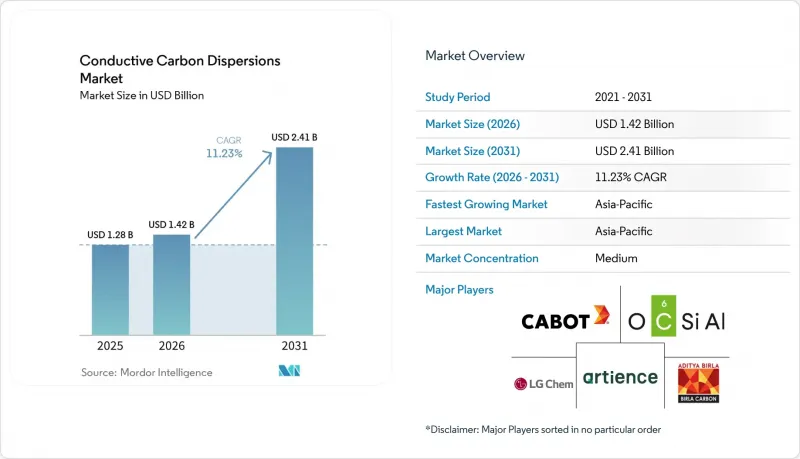
本報告按導電碳類型(例如,炭黑分散體、石墨烯分散體)、分散介質(例如,水性、溶劑型)、應用(例如,鋰離子電池、導電油墨)和地區(亞太地區、北美地區、歐洲地區、南美地區、中東和非洲地區)進行細分。市場預測以美元計價。
全球導電碳分散體市場趨勢及洞察
電動車和電網電池電極的擴展
預計到2025年,全球電動車電池部署量將達到1.2太瓦時(TWh),較2024年成長近30%,是2020年的七倍多。電池產能每增加1太瓦時,正負極的製造過程中就需要更多的電極漿料和導電材料。根據國際能源總署(IEA)的數據,到2025年,磷酸鋰鐵(LFP)將佔全球電動車電池部署量的55%以上,以及固定式儲能系統的90%以上。由於LFP的導電性低於鎳錳鈷(NMC)電池,因此其單位電極面積的添加劑含量通常較高,這支撐了電池製造商擴大電極生產時對炭黑分散體的需求。導電炭黑分散體市場也受惠於固定式儲能系統需求的成長,而LFP仍是這些系統中的主要化學成分。卡博特公司預測,對鋰離子電池的需求將持續成長到本世紀末,這將推動對整個導電碳分散市場的長期投資。
採用富矽陽極和高鎳陰極
富矽負極需要比傳統石墨負極更耐用的導電網路,因為矽在鋰化過程中體積膨脹近300%。軟性高長寬比材料(例如單壁奈米碳管)有助於在膨脹過程中維持導電通路。一項研究採用70:30的炭黑(CB)與單壁奈米碳管質量比,證實所得導電網路能夠支撐700µm厚的塗層而不會出現開裂或分層。高鎳含量的NMC811和NCA90正極也需要改善電子傳導通路,同時減少添加劑用量。這些性能要求為能夠提供經認證的碳奈米管和混合分散液的供應商帶來了商機,這些產品可用於先進的電極設計。
碳奈米管和石墨烯的高成本與炭黑的成本比較。
碳奈米管(CNT)和石墨烯分散液與炭黑分散液之間的價格差異仍然是電動車電池大規模生產計劃的一個重大障礙。這種成本績效平衡在磷酸鐵鋰電池(LFP)正極應用中尤其具有挑戰性,因為買家特別關注電極的總成本。根據IOPscience會議紀錄報告,預計到2024年,全球多壁奈米碳管(MWCNT)的工業產量將達到每年2.5萬噸,其中大部分採用化學氣相沉積(CVD)法,包括流化床法和懸浮催化法。單壁碳奈米管(SWCNT)的產量仍落後於MWCNT,這解釋了其在高價值電池應用中的高價。在相同填充量下,CNT和石墨烯分散液的價格是炭黑的5到15倍。 NanoXplore公司於2026年第三季推出了“xGnP D-500HP”,作為特種炭黑的直接替代品,但石墨烯的價格仍然超過了LFP電池的成本閾值。因此,預計炭黑分散體將在價格敏感型市場中繼續發揮重要作用,而碳奈米管和石墨烯產品則瞄準性能至關重要的應用領域。
細分市場分析
截至2025年,炭黑分散體佔據導電碳分散體市場佔有率的51.34%。這一地位反映了磷酸鐵鋰(LFP)正極漿料配方技術的成熟、完善的供應鏈網路以及成本競爭力。在2025年全球推出的電動車電池中,磷酸鐵鋰電池的佔比超過55%。由於磷酸鐵鋰電池的導電性較低,需要更高濃度的導電添加劑,這推動了炭黑配方的應用。這種材料類型正在電池製造商中逐漸普及,並得到現有供應鏈的支援。受矽負極和高鎳正極對高長寬比碳奈米管網路的需求驅動,預計到2031年,奈米碳管分散體將以13.45%的複合年成長率成長。 2024年,全球工業碳奈米管年產量達2.5萬噸,其中大部分為多壁奈米碳管(MWCNT)的生產。
中國標準T/CAQI 423-2025於2025年4月發布,規定了鋰離子電池用碳奈米管複合導電膠的技術規格。此認證標準有利於能夠證明產品品質穩定的大型供應商,因此生產管理和可記錄的一致性成為關鍵的商業性因素。石墨烯分散體和碳奈米管-石墨烯複合材料雖然能夠結合片狀和線狀導電網路,但仍處於商業化初期。一項2026年的研究報告稱,在磷酸鐵鋰電池(LFP)中以2 wt%的比例混合的多孔石墨烯-碳量子點複合材料,在0.1C倍率下容量為159 mAh/g,即使在3C倍率下也能保持該容量。 NanoXplore公司宣布其產品「xGnP D-500HP」的年產能為4000噸。石墨、碳奈米纖維和混合系統繼續應用於超級電容電極和導電黏合劑等特殊領域。將碳奈米管和炭黑相結合的混合系統使供應商能夠滿足單一碳材料無法充分滿足的性能要求。市場正朝著混合多種碳材料的配方方向發展,以滿足高要求的電極應用需求。
區域分析
預計到2025年,亞太地區將佔據導電碳分散體市場33.94%的佔有率,並在2031年之前以12.17%的複合年成長率成長。到2025年,中國將佔全球鋰離子電池產能的80%以上,將為本地分散體供應商密切參與電極生產和認證活動創造有利環境。據OCSiAl稱,其中國合作夥伴根據許可協議的目標是到2025年底實現TUBALL BATT的年總合達到5.2萬噸。該地區導電碳分散體市場受益於原料、分散體和電池製造地的地理位置接近,以及電池製造商能夠在產品認證和製程調整階段與供應商合作。在日本和韓國,對高鎳正極材料和矽負極平台的需求不斷成長,這推動了對即使在低填充率下也能保持導電路徑的碳奈米管產品的需求。此外,該地區的多壁奈米碳管合成能力和炭黑產量為當地供應商提供了成本和物流優勢。
印度和東協共同構成了一個新興的需求基地,這得益於國內電池製造政策和投資的推動,這些政策和投資正在促進該地區的電池生產。與中國、日本和韓國等成熟市場相比,這項需求仍處於發展初期。隨著區域生產的推進和電極項目進入認證階段,對本地技術支援的需求預計將會湧現。旨在縮短常規電極生產材料供應路線的新工廠可能會惠及導電碳分散體市場。在北美和歐洲,電池市場的主要區域是歐洲,新的超級工廠項目正在擴大當地的生產規模。公共電池專案中的在地採購要求可能會使區域導電材料供應商獲得優勢。歐洲的NMP法規正在促進低排放量和水性分散體的供應鏈發展。 OCSiAl計劃在盧森堡建造的單壁奈米碳管(SWCNT)工廠旨在為歐洲客戶建立區域合成能力,並有助於緩解因碳奈米管生產集中在亞洲而帶來的供應風險。
南美洲、中東和非洲市場規模雖小規模,但對導電碳供應商而言,它們仍具有長期重要性。巴西正透過電動車稅收優惠政策和不斷發展的電池技術生態系統推動南美市場的需求,但物流和供應的持續性仍將是區域買家面臨的關鍵挑戰,因為在預測期內,該地區對電極分散液的需求仍將嚴重依賴進口。阿根廷的鋰資源,如果中游加工能力提升,將為未來電池材料投資奠定基礎。沙烏地阿拉伯在其「2030願景」框架下,正投資於儲能設備製造和化學產業,這表明其對功能性材料的長期需求。南非的鋰、錳和鈷加工計畫將為未來的電池製造提供材料基礎。這些地區的商業化電池生產仍是長期目標,主要電池生產基地以外的導電碳分散液市場規模將取決於當地材料加工轉型為電池製造的速度。
其他好處:
- Excel格式的市場預測(ME)表
- 3個月的分析師支持
目錄
第1章:引言
- 研究假設和市場定義
- 調查範圍
第2章:調查方法
第3章執行摘要
第4章 市場狀況
- 市場概覽
- 市場促進因素
- 電動車和電網電池電極的擴展
- 透過減少導電添加劑的添加量來提高能量密度。
- 採用富矽負極和高鎳正極。
- 水性及高固態漿料的處理
- 本地化電池供應鍊和認證支持
- 預分散配方,可降低混合和處理風險。
- 市場限制因素
- 與炭黑相比,碳奈米管和石墨烯高成本。
- 碳奈米管聚集和分散穩定性相關的風險
- 長電池認證和變更管理週期
- 電池和導電碳生產能力的區域集中度
- 價值和供應鏈分析
- 波特五力分析
第5章 市場規模與成長預測
- 導電碳的類型
- 炭黑分散體
- 奈米碳管(CNT)分散
- 石墨烯分散
- 其他(石墨分散體、碳奈米纖維分散體、混合碳分散體)
- 透過分散介質
- 水溶液
- 溶劑型
- 其他(生物基系統、特殊載體系統)
- 透過使用
- 鋰離子電池
- 導電塗層
- 導電油墨
- 電磁干擾屏蔽材料
- 其他產品(導電黏合劑和密封劑、聚合物化合物、超級電容和燃料電池)
- 按地區
- 亞太地區
- 中國
- 印度
- 日本
- 韓國
- 東南亞國協
- 其他亞太國家
- 北美洲
- 美國
- 加拿大
- 墨西哥
- 歐洲
- 德國
- 英國
- 法國
- 義大利
- 北歐國家
- 其他歐洲國家
- 南美洲
- 巴西
- 阿根廷
- 其他南美國家
- 中東和非洲
- 沙烏地阿拉伯
- 南非
- 其他中東和非洲國家
- 亞太地區
第6章 競爭情勢
- 市場集中度
- 策略趨勢
- 市佔率和排名分析
- 公司簡介
- Arkema
- artience Co., Ltd.
- Birla Carbon
- Cabot Corporation
- CHASM
- Denka Company Limited
- Haydale Plc
- Imerys
- Jiangsu Cnano Technology Co., Ltd
- LG Chem
- Mitsubishi Chemical Corporation
- Nanocyl SA
- NanoXplore Inc.
- OCSiAl
- Resonac Holdings Corporation
- TORAY INDUSTRIES, INC.
第7章 市場機會與未來展望
According to Mordor Intelligence, the conductive carbon dispersions market size is estimated at USD 1.28 billion in 2025 and is estimated to grow from USD 1.42 billion in 2026 to USD 2.40 billion by 2031, at a CAGR of 11.23% during the forecast period (2026-2031).
This report is Segmented by Conductive Carbon Type (Carbon Black Dispersions, Graphene Dispersions, and More), Dispersion Medium (Water-Based, Solvent-Based, and More), Application (Lithium-Ion Batteries, Conductive Inks, and More), and Geography (Asia-Pacific, North America, Europe, South America, and Middle-East and Africa). The Market Forecasts are Provided in Terms of Value (USD).
Global Conductive Carbon Dispersions Market Trends and Insights
EV and Grid Battery Electrode Expansion
Global EV battery deployment reached 1.2 TWh in 2025, rising nearly 30% from 2024 and more than sevenfold from 2020. Each additional TWh of cell output requires more electrode slurry and more conductive material at the cathode and anode production steps. The International Energy Agency reported that lithium iron phosphate (LFP) accounted for more than 55% of global EV batteries deployed in 2025 and more than 90% of stationary battery storage installations. LFP has lower conductivity than nickel manganese cobalt (NMC) and generally requires higher additive loading per unit of electrode area, supporting demand for carbon black dispersions as battery makers scale electrode production. The conductive carbon dispersions market also benefits from rising demand for stationary storage, where LFP remains the dominant chemistry. Cabot Corporation stated that lithium-ion battery demand is expected to grow through the end of the decade, supporting longer-term investment across the conductive carbon dispersions market.
Silicon-Rich Anode and High-Nickel Cathode Adoption
Silicon-rich anodes require more durable conductive networks than conventional graphite anodes because silicon expands by nearly 300% during lithiation. Flexible, high-aspect-ratio materials such as SWCNTs help preserve electrical pathways through this expansion. A study examining a carbon black (CB)-to-SWCNT mass ratio of 70:30 found that the resulting network supported 700 µm coatings without cracking or delamination. High-nickel NMC811 and NCA90 cathodes also require improved electron pathways at lower additive loadings. These performance requirements create an opportunity for suppliers that can provide qualified CNT and hybrid dispersion systems for advanced electrode designs.
High CNT and Graphene Cost Versus Carbon Black
The price difference between CNT or graphene dispersions and carbon black dispersions remains a major barrier in high-volume EV cell programs. This cost-performance balance is particularly challenging in LFP cathode applications, where buyers focus closely on total electrode cost. An IOPscience conference proceedings report noted global industrial MWCNT output of 25,000 tons per year in 2024, largely from fluidized-bed and floating-catalyst CVD methods. SWCNT production remains lower than that of MWCNTs, supporting its premium pricing in high-value cell formats. CNT and graphene dispersion pricing is 5-15X that of carbon black at equivalent loading levels. NanoXplore launched xGnP D-500HP in fiscal Q3 2026 as a direct alternative to specialty carbon black, but graphene pricing remains above the cost threshold for LFP cells. Carbon black dispersions are therefore expected to remain relevant in price-sensitive markets, while CNT and graphene products are targeted at performance-driven applications.
Other drivers and restraints analyzed in the detailed report include:
- Water-Based and High-Solids Slurry Processing
- Pre-Dispersed Formulation Reducing Mixing and Handling Risk
- CNT Agglomeration and Dispersion Stability Risk
For complete list of drivers and restraints, kindly check the Table Of Contents.
Segment Analysis
Carbon black dispersions held 51.34% of the conductive carbon dispersions market share in 2025. This position reflects formulation maturity, established supply networks, and cost competitiveness in LFP cathode slurry. LFP represented more than 55% of global EV batteries deployed in 2025. Its lower conductivity requires higher conductive-additive loading, which favors carbon black formulations. This material type is well established among battery manufacturers and is supported by existing supply chains. CNT dispersions are forecast to expand at a 13.45% CAGR through 2031, driven by the need for high-aspect-ratio networks in silicon anodes and high-nickel cathodes. Industrial CNT output reached 25,000 tons per year globally in 2024, primarily from MWCNT production.
China's T/CAQI 423-2025 standard, published in April 2025, establishes technical specifications for CNT-composite conductive pastes used in lithium-ion batteries. This qualification benchmark favors larger suppliers that can demonstrate consistent product quality, making production controls and documented consistency important commercial factors. Graphene dispersions and CNT-graphene hybrids remain at an earlier stage of commercialization, though they can combine sheet-like and wire-like conductive networks. A 2026 study reported that a holey graphene-carbon quantum dot composite, at a 2 wt% loading in LFP, delivered 159 mAh/g at 0.1C and maintained capacity at 3C. NanoXplore stated that its xGnP D-500HP product has a production capacity of 4,000 tons per year. Graphite, carbon nanofiber, and hybrid systems continue to serve specialty applications such as supercapacitor electrodes and conductive adhesives. Hybrid CNT and carbon black systems allow suppliers to address performance requirements that no single carbon form meets as effectively. The market is moving toward multi-carbon formulations for demanding electrode programs.
Complete Report Scope:
- By Conductive Carbon Type
- Carbon Black Dispersions
- Carbon Nanotube (CNT) Dispersions
- Graphene Dispersions
- Others (Graphite Dispersions, Carbon Nanofiber Dispersions, Hybrid Carbon Dispersions)
- By Dispersion Medium
- Water-Based
- Solvent-Based
- Others (Bio-Based Systems, Specialty Carrier Systems)
- By Application
- Lithium-Ion Batteries
- Conductive Coatings
- Conductive Inks
- EMI Shielding Materials
- Others (Conductive Adhesives and Sealants, Polymer Compounds, Supercapacitors and Fuel Cells)
- By Geography
- Asia-Pacific
- China
- India
- Japan
- South Korea
- ASEAN Countries
- Rest of Asia-Pacific
- North America
- United States
- Canada
- Mexico
- Europe
- Germany
- United Kingdom
- France
- Italy
- NORDIC Countries
- Rest of Europe
- South America
- Brazil
- Argentina
- Rest of South America
- Middle-East and Africa
- Saudi Arabia
- South Africa
- Rest of Middle-East and Africa
- Asia-Pacific
Geography Analysis
Asia-Pacific accounted for 33.94% of the conductive carbon dispersions market share in 2025 and is forecast to grow at a 12.17% CAGR through 2031. China hosted more than 80% of global lithium-ion battery manufacturing capacity in 2025, giving local dispersion suppliers close access to electrode production and qualification activity. OCSiAl reported that its licensed Chinese partners targeted a combined TUBALL BATT capacity of 52,000 tons per year by the end of 2025. The conductive carbon dispersions market in this region benefits from the proximity of raw materials, dispersion, and battery-cell operations, as well as from the ability of cell makers to work with suppliers during product qualification and process adjustments. Japan and South Korea are adding demand for high-nickel cathode and silicon-anode platforms, which in turn drive demand for CNT products that can maintain conductive pathways at lower loadings. The region's MWCNT synthesis capacity and carbon black output also provide cost and logistics advantages for local suppliers.
India and ASEAN together form an emerging demand base, as domestic battery manufacturing policies and investments encourage regional cell production. This demand is at an earlier stage of development than in the established markets of China, Japan, and South Korea. Regional production is expected to create demand for local technical support as electrode programs progress through qualification. New plants seeking to shorten material supply routes for regular electrode production can benefit the conductive carbon dispersions market. In the West, North America and Europe are the leading battery geographies as new gigafactory projects expand local production. Local-content conditions in public battery programs can create an advantage for regional conductive-material suppliers. European NMP restrictions favor low-emission and water-based dispersion supply chains. OCSiAl's planned Luxembourg SWCNT facility aims to establish regional synthesis capacity for European customers and can help address the supply risk created by the concentration of CNT production in Asia.
South America, the Middle-East, and Africa remain smaller markets but have longer-term relevance for conductive carbon suppliers. Brazil leads South American demand through EV fiscal incentives and a developing battery technology ecosystem, though electrode-grade dispersion demand in the region remains import-dependent through much of the forecast period, keeping logistics and supply continuity important for regional buyers. Argentina's lithium resources provide a future basis for battery-material investment once midstream processing expands. Saudi Arabia is investing in energy storage manufacturing and chemicals under Vision 2030, creating a longer-term demand signal for functional materials. South Africa's plans for lithium, manganese, and cobalt processing provide a materials base for future battery manufacturing. Commercial cell production in these regions remains a longer-term prospect, and the conductive carbon dispersions market size outside the major battery centers will depend on the pace at which local material processing develops into cell manufacturing.
- Arkema
- artience Co., Ltd.
- Birla Carbon
- Cabot Corporation
- CHASM
- Denka Company Limited
- Haydale Plc
- Imerys
- Jiangsu Cnano Technology Co., Ltd
- LG Chem
- Mitsubishi Chemical Corporation
- Nanocyl SA
- NanoXplore Inc.
- OCSiAl
- Resonac Holdings Corporation
- TORAY INDUSTRIES, INC.
Additional Benefits:
- The market estimate (ME) sheet in Excel format
- 3 months of analyst support
TABLE OF CONTENTS
1 Introduction
- 1.1 Study Assumptions and Market Definition
- 1.2 Scope of the Study
2 Research Methodology
3 Executive Summary
4 Market Landscape
- 4.1 Market Overview
- 4.2 Market Drivers
- 4.2.1 EV and Grid Battery Electrode Expansion
- 4.2.2 Higher Energy Density Through Lower Conductive-Additive Loading
- 4.2.3 Silicon-Rich Anode and High-Nickel Cathode Adoption
- 4.2.4 Water-Based and High-Solids Slurry Processing
- 4.2.5 Localized Battery Supply Chains and Qualification Support
- 4.2.6 Pre-Dispersed Formulation Reducing Mixing and Handling Risk
- 4.3 Market Restraints
- 4.3.1 High CNT and Graphene Cost Versus Carbon Black
- 4.3.2 CNT Agglomeration and Dispersion Stability Risk
- 4.3.3 Long Cell-Qualification and Change-Control Cycles
- 4.3.4 Regional Concentration of Battery and Conductive-Carbon Capacity
- 4.4 Value and Supply-Chain Analysis
- 4.5 Porter's Five Forces Analysis
- 4.5.1 Competitive Rivalry
- 4.5.2 Supplier Power
- 4.5.3 Buyer Power
- 4.5.4 Threat of New Entrants
- 4.5.5 Threat of Substitutes
5 Market Size and Growth Forecasts (Value)
- 5.1 By Conductive Carbon Type
- 5.1.1 Carbon Black Dispersions
- 5.1.2 Carbon Nanotube (CNT) Dispersions
- 5.1.3 Graphene Dispersions
- 5.1.4 Others (Graphite Dispersions, Carbon Nanofiber Dispersions, Hybrid Carbon Dispersions)
- 5.2 By Dispersion Medium
- 5.2.1 Water-Based
- 5.2.2 Solvent-Based
- 5.2.3 Others (Bio-Based Systems, Specialty Carrier Systems)
- 5.3 By Application
- 5.3.1 Lithium-Ion Batteries
- 5.3.2 Conductive Coatings
- 5.3.3 Conductive Inks
- 5.3.4 EMI Shielding Materials
- 5.3.5 Others (Conductive Adhesives and Sealants, Polymer Compounds, Supercapacitors and Fuel Cells)
- 5.4 By Geography
- 5.4.1 Asia-Pacific
- 5.4.1.1 China
- 5.4.1.2 India
- 5.4.1.3 Japan
- 5.4.1.4 South Korea
- 5.4.1.5 ASEAN Countries
- 5.4.1.6 Rest of Asia-Pacific
- 5.4.2 North America
- 5.4.2.1 United States
- 5.4.2.2 Canada
- 5.4.2.3 Mexico
- 5.4.3 Europe
- 5.4.3.1 Germany
- 5.4.3.2 United Kingdom
- 5.4.3.3 France
- 5.4.3.4 Italy
- 5.4.3.5 NORDIC Countries
- 5.4.3.6 Rest of Europe
- 5.4.4 South America
- 5.4.4.1 Brazil
- 5.4.4.2 Argentina
- 5.4.4.3 Rest of South America
- 5.4.5 Middle-East and Africa
- 5.4.5.1 Saudi Arabia
- 5.4.5.2 South Africa
- 5.4.5.3 Rest of Middle-East and Africa
- 5.4.1 Asia-Pacific
6 Competitive Landscape
- 6.1 Market Concentration
- 6.2 Strategic Moves
- 6.3 Market Share (%)/Ranking Analysis
- 6.4 Company Profiles (includes Global Overview, Market Overview, Core Segments, Financials as available, Strategic Information, Products and Services, and Recent Developments)
- 6.4.1 Arkema
- 6.4.2 artience Co., Ltd.
- 6.4.3 Birla Carbon
- 6.4.4 Cabot Corporation
- 6.4.5 CHASM
- 6.4.6 Denka Company Limited
- 6.4.7 Haydale Plc
- 6.4.8 Imerys
- 6.4.9 Jiangsu Cnano Technology Co., Ltd
- 6.4.10 LG Chem
- 6.4.11 Mitsubishi Chemical Corporation
- 6.4.12 Nanocyl SA
- 6.4.13 NanoXplore Inc.
- 6.4.14 OCSiAl
- 6.4.15 Resonac Holdings Corporation
- 6.4.16 TORAY INDUSTRIES, INC.
7 Market Opportunities and Future Outlook
- 7.1 White-Space and Unmet-Need Assessment

 全球奈米碳管市場(2027-2037 年)
 奈米增強混凝土市場分析與預測(至2035年):類型、產品、技術、應用、材料類型、製程、最終用戶、功能、建築形式
 奈米碳管管材料市場預測至2034年-全球分析(依產品類型、合成方法、純度、功能化、形狀、直徑、基體材料、應用、終端用戶產業及地區分類)
 奈米碳管:市場佔有率分析、產業趨勢與統計、成長預測(2026-2031)奈米碳管市場預測至2034年—按類型、製造方法、產品形式、功能化、應用、最終用戶和地區分類的全球分析
 奈米碳管市場:按類型、製造方法、產品形式、純度、直徑範圍和應用分類-2026-2032年全球市場預測
 全球奈米碳管市場:按類型、方法、應用和地區分類-預測至2031年
 奈米碳管市場規模、佔有率和成長分析:按應用、終端用戶產業、產品類型和地區分類-2026-2033年產業預測
 奈米碳管市場-全球產業規模、佔有率、趨勢、機會、預測:按類型、方法、應用、最終用戶、地區和競爭格局分類,2021-2031年
 奈米碳管市場報告:按產品、製造方法、應用和地區分類(2026-2034 年)