


 |
市場調查報告書
商品編碼
2120719
騎乘裝備:市場佔有率分析、產業趨勢與統計、成長預測(2026-2031)Riding Gear - Market Share Analysis, Industry Trends & Statistics, Growth Forecasts (2026 - 2031) |
||||||

※ 本網頁內容可能與最新版本有所差異。詳細情況請與我們聯繫。
預計騎行裝備市場將從 2025 年的 354.4 億美元和 2026 年的 372.4 億美元成長到 2031 年的 477.1 億美元,2026 年至 2031 年的複合年成長率為 5.08%。
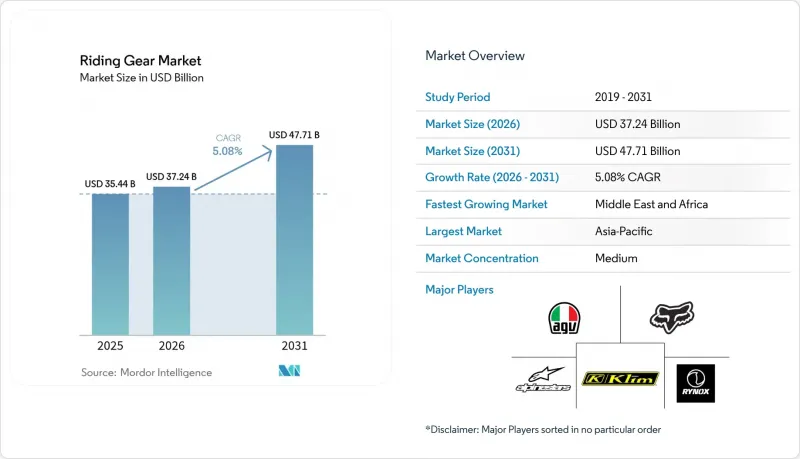
本報告按產品類型(夾克、頭盔等)、材質(皮革、紡織品等)、銷售管道(線上和線下)、最終用戶(公路騎行、越野/摩托車越野賽等)、價格區間(高階、中階、經濟型)和地區進行細分。市場預測以美元計價。
全球騎行裝備市場趨勢及洞察
新興市場摩托車擁有量增加
都市化、收入成長和擁擠的公共交通正促使印度、印尼、泰國和越南數百萬摩托車新手選擇摩托車作為主要交通工具。隨著用戶群的擴大,每輛新車的購買都會帶動對認證頭盔、夾克、手套和靴子的需求——這些裝備現在已被許多國家的政府強制要求在車輛登記時佩戴。摩托車製造商正透過拓展銷售網路加速這一循環。光是Royal Enfield一家在印度就擁有超過900家經銷商,這使得新手騎士更容易在貸款和保險套餐中購買防護裝備。社群媒體社群進一步強化了安全訊息,使防護衣不再只是可有可無的配件,而是成為擁有摩托車的必備品。由此形成了一個自我強化的良性循環:摩托車擁有量的增加擴大了防護服產品的目標市場,而防護裝備在城市地區的可見度提高又鼓勵新手騎手從第一次騎行開始就使用認證產品。
更嚴格的全球安全法規強制要求使用防護設備。
FIM FRHPhe-02頭盔標準將於2026年起強制應用於所有官方認可的賽事,這一標準產生了“光環效應”,促使消費者對公路頭盔提出類似的要求。歐洲ECE 22.06法規新增了旋轉衝擊和固定性測試,迫使製造商重新設計頭盔外殼形狀、內襯和麵罩,從而提高了其所有產品線的技術標準。零售商越來越依賴認證標誌,以便快速驗證產品質量,並且只銷售完全符合標準的型號。沒有內部測試實驗室的小規模品牌被迫與獨立測試機構合作,否則將面臨停產的風險。這種轉變使得市場佔有率集中在技術實力雄厚的老牌製造商手中。在預測期內,日益提高的標準化程度將降低跨國銷售的核准流程,進一步推動騎乘裝備市場的全球化。
經認證的高級防護裝備高成本
在許多新興市場,頂級複合佈料騎行服、碳纖維外殼和電子氣囊系統的價格都高於平均每月收入。分期付款和小額信貸雖然可以緩解高價帶來的衝擊,但也延長了更換週期,增加了違約風險。為了彌補這一缺口,一些品牌推出了可改裝到現有騎行服上的模組化護具套件,但這類套件的普及率仍然很低。外匯波動進一步加劇了零售定價的複雜性,迫使經銷商對沖庫存成本並限制其產品範圍。除非規模經濟和材料技術的突破性進步能夠降低單位成本,否則價格仍將是阻礙騎乘裝備市場充分發揮潛力的因素。
細分市場分析
到2025年,頭盔將佔騎乘裝備市場佔有率的25.01%,鞏固其作為基本安全裝備的地位。同時,氣囊夾克和背心的複合年成長率達到5.44%,反映出市場對主動防護的需求正在成長。各大品牌透過將電子感測器與無需訂閱的演算法相結合,使氣囊成為通勤者和週末旅行愛好者的理想選擇。另一方面,傳統夾克則加入了透氣護具口袋和快拆內襯,在不增加電子元件複雜性的前提下,增強了對氣候的適應性。手套、靴子和各種護具是對全身防護的補充,它們以模組化附加組件的形式銷售,逐步提升騎乘者的安全性能。
這款碳複合材料頭盔外殼整合了藍牙連接功能和可下拉式有色遮陽板,滿足了日益成長的互聯需求。靴子採用源自超級摩托車賽車的樞軸鉸鍊和腳趾滑塊,經過重新設計,更適合都市區騎行,提升了行走舒適度和抗衝擊性。防彈衣內襯採用黏彈性泡棉材料,遭遇衝擊會變硬,即使在休閒外套下也能提供隱密的保護。這些創新技術重新定義了傳統產品類別,並透過迭代式的增值,而非激進的變革,為騎乘裝備市場注入了新的活力。
預計到2025年,皮革製品將佔據騎乘裝備市場54.32%的佔有率,這主要得益於其耐磨性和經典美學。同時,碳纖維複合材料的複合年成長率達到5.47%,因為輕量化已成為頭盔和背板的關鍵賣點。多軸碳纖維編織技術能夠打造輕薄的外殼,在不增加體積的情況下分散衝擊能量,從而減輕長時間騎行時頸部的壓力。醯胺纖維增強紡織品和層壓材料目前已達到CE 2級抗衝擊標準,使其成為潮濕多雨氣候下皮革的可靠替代品。
混合材料中網狀面板的運用提升了透氣性,進一步促進了熱帶地區騎乘者對防護裝備的採用。儘管環保意識的增強推動了人們對植物來源和再生合成材料的興趣,但商業性生產仍處於試驗階段。各大品牌正著重宣傳無水鞣革工藝和可追溯皮革,以減少人們對動物福利的質疑。碳纖維和芳香聚醯胺供應商正尋求與原始設備製造商 (OEM)夥伴關係以擴大生產規模,並提供可根據頭盔模具和防護裝備形狀量身定做的預浸料。這種材料研發領域的競爭推動了產品差異化,確保騎乘裝備市場始終是紡織科學創新的沃土。
區域分析
預計到2025年,亞太地區將佔據全球騎行裝備市場39.21%的佔有率,主要得益於印度、印尼和泰國龐大的摩托車保有量。這些國家的政府正在加強頭盔法規的監管,並考慮為認證產品提供補貼,從而鼓勵首次購買者購買符合標準的裝備。國內製造商正在擴大自動化成型和機器人縫紉技術的應用,以滿足國內需求和出口契約,進一步鞏固了該地區的成本優勢。同時,中國電動滑板車的蓬勃發展也帶動了對輕便、都市型頭盔和防水通勤夾克的需求,從而拓展了該地區可用的產品材料範圍。
歐洲和北美地區擁有較高的可支配收入和嚴格的安全標準,是高性能裝備成熟且盈利的市場。 ECE 22.06 和 DOT 認證標籤是強制性要求,推動了透氣性、隔音性和整合通訊模組等領域的創新。旅行文化、賽道愛好者和通勤族催生了多個細分市場,每個細分市場都對產品性能提出了特定的要求。由於經銷商整合,大型連鎖店憑藉其不斷增強的採購能力佔據優勢,而小規模品牌則被迫透過線上品牌故事和客製化尺寸服務來脫穎而出。美元和歐元外匯的波動會略微影響進口成本趨勢,但不會影響潛在需求。
中東和非洲地區正經歷最高的複合年成長率(CAGR),達到5.59%,這主要得益於都市化、基礎設施建設和可支配收入的成長,從而帶動了摩托車購買量的顯著成長,尤其是在低收入群體中。波灣合作理事會(GCC)成員國加強了頭盔強制佩戴規定,並對未佩戴頭盔者處以現場罰款,這促進了認證頭盔的銷售,吸引了外籍勞工和年輕公民。當地氣候多樣,從沙漠酷熱到沿海濕潤,都推動了對透氣布料和吸濕排汗內襯的需求。儘管仿冒品的檢測力道仍然不足,但宣傳宣傳活動正逐步引導消費者傾向於從授權經銷商購買產品。隨著經銷商採用小額信貸和電子商務來觸達偏遠地區的客戶,全部區域的騎行裝備市場正在挖掘巨大的潛在需求。
其他好處:
- Excel格式的市場預測(ME)表
- 3個月的分析師支持
目錄
第1章:引言
- 研究假設和市場定義
- 調查範圍
第2章:調查方法
第3章執行摘要
第4章 市場狀況
- 市場概覽
- 市場促進因素
- 新興市場摩托車擁有量增加
- 加強全球安全法規,強制使用防護工具。
- 探險旅行和長途騎行文化的蓬勃發展
- 隨著價格下降,帶有內置安全氣囊的夾克衫正迅速受到歡迎。
- 摩托車品牌拓展OEM生活風格產品
- 越來越多的女性騎士正在尋找能夠滿足她們特定需求的服裝。
- 市場限制因素
- 經認證的高品質防護工具高成本
- 仿冒品的氾濫正在損害消費者信任。
- 寒冷地區受季節性因素影響,需求放緩
- 對動物源皮革材料的永續性問題的抵制
- 價值供應鏈分析
- 監理情勢
- 技術展望
- 波特五力模型
第5章 市場規模與成長預測
- 依產品類型
- 夾克
- 頭盔
- 手套
- 褲子/褲子
- 靴子/鞋子
- 防彈衣和防護裝置
- 安全氣囊外套和背心
- 材料
- 皮革
- 紡織品
- 網
- 碳纖維複合材料
- 克維拉/芳香聚醯胺混合物
- 其他材料
- 透過分銷管道
- 線上
- 離線
- 最終用戶
- 在公共道路上行駛
- 越野/摩托車越野賽
- 探險與旅遊
- 通勤者
- 按價格範圍
- 優質的
- 中階
- 經濟
- 按地區
- 北美洲
- 美國
- 加拿大
- 其他北美國家
- 南美洲
- 巴西
- 阿根廷
- 其他南美國家
- 歐洲
- 德國
- 英國
- 法國
- 義大利
- 西班牙
- 俄羅斯
- 其他歐洲國家
- 亞太地區
- 中國
- 日本
- 印度
- 韓國
- 其他亞太國家
- 中東和非洲
- 阿拉伯聯合大公國
- 沙烏地阿拉伯
- 土耳其
- 埃及
- 南非
- 其他中東和非洲國家
- 北美洲
第6章 競爭情勢
- 市場集中度
- 策略趨勢
- 市佔率分析
- 公司簡介
- AGV
- Alpinestars SpA
- Dainese SpA
- Fox Racing Inc.
- Klim Technical Riding Gear
- REV'IT!Sport International
- ScorpionEXO
- Icon Motorsports
- Royal Enfield Gear
- HJC Helmets
- Shoei Co., Ltd.
- Arai Helmet Ltd.
- Bell Helmets
- Rynox Gears India Pvt. Ltd.
- Spartan ProGear Co.
- Kushitani Co., Ltd.
- Held GmbH
- Sena Technologies Inc.
- LS2 Helmets
- Studds Accessories Ltd.
- Komine Co., Ltd.
- Oxford Products Ltd.
- Thor MX
第7章 市場機會與未來展望
According to Mordor Intelligence, the riding gear market size is projected to expand from USD 35.44 billion in 2025 and USD 37.24 billion in 2026 to USD 47.71 billion by 2031, registering a 5.08% CAGR between 2026 and 2031.
This report is Segmented by Product Type (Jackets, Helmets, and More), Material (Leather, Textile, and More), Distribution Channel (Online and Offline), End-User (On-Road Riding, Off-road/Motocross, and More), Price Range (Premium, Mid-Range, and Economy), and Geography. The Market Forecasts are Provided in Terms of Value (USD).
Global Riding Gear Market Trends and Insights
Rising Motorcycle Ownership in Emerging Markets
Urbanization, income growth, and congested public transit systems are propelling millions of first-time riders in India, Indonesia, Thailand, and Vietnam to choose two-wheelers for daily mobility. As this installed base swells, each new vehicle purchase triggers follow-on demand for certified helmets, jackets, gloves, and boots that many governments now require at the point of registration. Motorcycle brands accelerate the cycle by adding retail capacity. Royal Enfield alone operates more than 900 dealerships across India, making it easier for novice riders to bundle protective gear with finance or insurance packages. Social-media communities further amplify safety messaging, normalizing protective apparel as an integral part of ownership rather than a discretionary add-on. The net effect is a self-reinforcing loop: higher motorcycle penetration expands the addressable apparel audience, and widespread gear visibility on city streets nudges successive cohorts to adopt certified products from their very first ride.
Stricter Global Safety Regulations Mandating Protective Gear
FIM's FRHPhe-02 helmet protocol became compulsory for all sanctioned racing in 2026, creating a halo effect that pushes consumers to seek the same specification in street helmets. Europe's ECE 22.06 regulation, which adds rotational-impact and retention testing, forces manufacturers to redesign shell geometries, liners, and visors, raising the technical baseline across product ranges. Retailers increasingly stock only fully compliant models, using certification badges as quick visual assurances of quality. Small brands without in-house test labs now partner with independent facilities or risk delisting, a shift that consolidates share toward technically capable incumbents. Over the forecast horizon, converging standards will lower approval complexity for cross-border sales, further globalizing the riding gear market.
High Cost Of Certified Premium Protective Gear
Top-tier laminated touring suits, carbon shells, and electronic airbag systems command prices that eclipse average monthly wages in many emerging economies. Although installment plans and micro-credit mitigate sticker shock, they also lengthen replacement cycles and amplify default risk. To bridge the gap, some brands introduce modular armor kits that retrofit into existing jackets, yet uptake remains niche. Currency volatility further complicates retail pricing, prompting distributors to hedge inventory costs and limit product breadth. Unless scale economies or material breakthroughs compress unit costs, price will stay a friction point that tempers the riding gear market's full potential.
Other drivers and restraints analyzed in the detailed report include:
- Boom In Adventure-Touring And Long-Distance Riding Culture
- Rapid Adoption of Airbag-Integrated Jackets After Price Drop
- Proliferation Of Counterfeit Ce-Marked Products Eroding Trust
For complete list of drivers and restraints, kindly check the Table Of Contents.
Segment Analysis
Helmets contributed 25.01% of the riding gear market share in 2025, confirming their status as non-negotiable safety basics, while airbag jackets and vests are growing at a 5.44% CAGR, reflecting a shift toward active protection. Brands pair electronic sensors with subscription-free algorithms, making airbags attractive to commuters and weekend tourers alike. Meanwhile, traditional jackets incorporate ventilated armor pockets and quick-detach liners that widen climate adaptability without electronic complexity. Gloves, boots, and standalone protectors round out full-body coverage, marketed as modular add-ons that upscale rider safety in stages.
Carbon-composite helmet shells integrate Bluetooth comms and tinted drop-down visors, aligning with rising demand for connectivity. Boots feature pivot hinges and toe sliders that originate in superbike racing, now repurposed for urban riding to improve walkability and crash resilience. Body armor inserts employ viscoelastic foams that harden on impact, offering stealth protection under casual outerwear. Collectively, these innovations reinvent familiar categories, sustaining the riding gear market through iterative value-add rather than wholesale upheaval.
Leather captured 54.32% of the riding gear market in 2025, driven by abrasion performance and classic aesthetics, while carbon-fiber composites posted a 5.47% CAGR as weight reduction becomes a selling point for helmets and back plates. Multi-axial carbon weaves permit thinner shell profiles that dissipate energy without bulk, easing neck strain on long rides. Aramid-reinforced textiles and laminated membranes now achieve CE level-2 impact ratings, making them credible leather alternatives in humid and wet climates.
Mesh-panel hybrids push airflow farther, inviting riders in tropical zones into the protective gear fold. Eco-concerns spur interest in plant-based and recycled synthetics, though commercial volumes remain exploratory. Brands advertise waterless tanning and traceable hides to offset animal-welfare critiques. Carbon and aramid suppliers court OEM partnerships to secure scale, offering pre-preg sheets tailored to helmet molds and armor shapes. This material arms race fuels continuous differentiation, ensuring the riding gear market remains fertile ground for breakthroughs in textile science.
Complete Report Scope:
- By Product Type
- Jackets
- Helmets
- Gloves
- Pants / Trousers
- Boots / Shoes
- Body Armor & Protectors
- Airbag Jackets & Vests
- By Material
- Leather
- Textile
- Mesh
- Carbon-Fiber Composites
- Kevlar / Aramid Blends
- Other Materials
- By Distribution Channel
- Online
- Offline
- By End-user
- On-road Riding
- Off-road / Motocross
- Adventure & Touring
- Commuter
- By Price Range
- Premium
- Mid-range
- Economy
- By Geography
- North America
- United States
- Canada
- Rest of North America
- South America
- Brazil
- Argentina
- Rest of South America
- Europe
- Germany
- United Kingdom
- France
- Italy
- Spain
- Russia
- Rest of Europe
- Asia-Pacific
- China
- Japan
- India
- South Korea
- Rest of Asia-Pacific
- Middle East and Africa
- United Arab Emirates
- Saudi Arabia
- Turkey
- Egypt
- South Africa
- Rest of Middle East and Africa
- North America
Geography Analysis
Asia-Pacific accounted for 39.21% of the riding gear market share in 2025, underpinned by high two-wheeler ownership in India, Indonesia, and Thailand. Governments intensify helmet enforcement and explore subsidies for certified products, nudging first-time buyers toward regulated gear. Domestic manufacturers scale up automated molding and robotic stitching to serve both local demand and export contracts, reinforcing regional cost advantages. Meanwhile, China's electric scooter boom fuels appetite for lightweight, urban-flavored helmets and waterproof commuter jackets, broadening the region's material palette.
Europe and North America together represent a mature yet lucrative arena for high-feature gear because discretionary incomes and stringent safety standards converge. ECE 22.06 and DOT labeling make certification table stakes, pushing innovation into ventilation, acoustics, and integration of communication modules. Touring culture, track-day hobbyists, and year-round commuters sustain multiple sub-segments, each craving specialized performance attributes. Dealer consolidation in both regions gives larger chains buying leverage, pressuring smaller brands to differentiate through online storytelling or bespoke sizing services. Currency fluctuations between USD and EUR slightly reshape import cost dynamics but leave underlying demand intact.
The Middle East and Africa region posts the quickest 5.59% CAGR as urbanization, infrastructure build-out, and rising disposable incomes lift motorcycle purchases from a low base. Gulf Cooperation Council countries tighten helmet mandates with on-the-spot fines, stimulating sales of certified helmets among expatriate workers and young nationals alike. Local climates, ranging from desert heat to coastal humidity, spur demand for ventilated textiles and moisture-wicking liners. Counterfeit detection remains uneven, but public awareness campaigns are beginning to shift preferences toward authorized outlets. As distributors add micro-financing and e-commerce to reach remote customers, the riding gear market unlocks substantial latent volume across the region.
- AGV
- Alpinestars S.p.A.
- Dainese S.p.A.
- Fox Racing Inc.
- Klim Technical Riding Gear
- REV'IT! Sport International
- ScorpionEXO
- Icon Motorsports
- Royal Enfield Gear
- HJC Helmets
- Shoei Co., Ltd.
- Arai Helmet Ltd.
- Bell Helmets
- Rynox Gears India Pvt. Ltd.
- Spartan ProGear Co.
- Kushitani Co., Ltd.
- Held GmbH
- Sena Technologies Inc.
- LS2 Helmets
- Studds Accessories Ltd.
- Komine Co., Ltd.
- Oxford Products Ltd.
- Thor MX
Additional Benefits:
- The market estimate (ME) sheet in Excel format
- 3 months of analyst support
TABLE OF CONTENTS
1 Introduction
- 1.1 Study Assumptions & Market Definition
- 1.2 Scope of the Study
2 Research Methodology
3 Executive Summary
4 Market Landscape
- 4.1 Market Overview
- 4.2 Market Drivers
- 4.2.1 Rising Motorcycle Ownership in Emerging Markets
- 4.2.2 Stricter Global Safety Regulations Mandating Protective Gear
- 4.2.3 Boom in Adventure-Touring and Long-Distance Riding Culture
- 4.2.4 Rapid Adoption of Airbag-Integrated Jackets After Price Drop
- 4.2.5 OEM Lifestyle Merchandise Expansion by Motorcycle Brands
- 4.2.6 Growing Female Rider Segment Demanding Tailored Apparel
- 4.3 Market Restraints
- 4.3.1 High Cost of Certified Premium Protective Gear
- 4.3.2 Proliferation of Counterfeit CE-Marked Products Eroding Trust
- 4.3.3 Seasonality Dampening Demand in Cold Regions
- 4.3.4 Sustainability Backlash Against Animal-Based Leather Materials
- 4.4 Value / Supply-Chain Analysis
- 4.5 Regulatory Landscape
- 4.6 Technological Outlook
- 4.7 Porter's Five Forces
- 4.7.1 Threat of New Entrants
- 4.7.2 Bargaining Power of Buyers/Consumers
- 4.7.3 Bargaining Power of Suppliers
- 4.7.4 Threat of Substitute Products
- 4.7.5 Intensity of Competitive Rivalry
5 Market Size & Growth Forecasts (Value (USD))
- 5.1 By Product Type
- 5.1.1 Jackets
- 5.1.2 Helmets
- 5.1.3 Gloves
- 5.1.4 Pants / Trousers
- 5.1.5 Boots / Shoes
- 5.1.6 Body Armor & Protectors
- 5.1.7 Airbag Jackets & Vests
- 5.2 By Material
- 5.2.1 Leather
- 5.2.2 Textile
- 5.2.3 Mesh
- 5.2.4 Carbon-Fiber Composites
- 5.2.5 Kevlar / Aramid Blends
- 5.2.6 Other Materials
- 5.3 By Distribution Channel
- 5.3.1 Online
- 5.3.2 Offline
- 5.4 By End-user
- 5.4.1 On-road Riding
- 5.4.2 Off-road / Motocross
- 5.4.3 Adventure & Touring
- 5.4.4 Commuter
- 5.5 By Price Range
- 5.5.1 Premium
- 5.5.2 Mid-range
- 5.5.3 Economy
- 5.6 By Geography
- 5.6.1 North America
- 5.6.1.1 United States
- 5.6.1.2 Canada
- 5.6.1.3 Rest of North America
- 5.6.2 South America
- 5.6.2.1 Brazil
- 5.6.2.2 Argentina
- 5.6.2.3 Rest of South America
- 5.6.3 Europe
- 5.6.3.1 Germany
- 5.6.3.2 United Kingdom
- 5.6.3.3 France
- 5.6.3.4 Italy
- 5.6.3.5 Spain
- 5.6.3.6 Russia
- 5.6.3.7 Rest of Europe
- 5.6.4 Asia-Pacific
- 5.6.4.1 China
- 5.6.4.2 Japan
- 5.6.4.3 India
- 5.6.4.4 South Korea
- 5.6.4.5 Rest of Asia-Pacific
- 5.6.5 Middle East and Africa
- 5.6.5.1 United Arab Emirates
- 5.6.5.2 Saudi Arabia
- 5.6.5.3 Turkey
- 5.6.5.4 Egypt
- 5.6.5.5 South Africa
- 5.6.5.6 Rest of Middle East and Africa
- 5.6.1 North America
6 Competitive Landscape
- 6.1 Market Concentration
- 6.2 Strategic Moves
- 6.3 Market Share Analysis
- 6.4 Company Profiles (Includes Global Level Overview, Market Level Overview, Core Segments, Financials as Available, Strategic Information, Market Rank/Share for Key Companies, Products and Services, SWOT Analysis, and Recent Developments)
- 6.4.1 AGV
- 6.4.2 Alpinestars S.p.A.
- 6.4.3 Dainese S.p.A.
- 6.4.4 Fox Racing Inc.
- 6.4.5 Klim Technical Riding Gear
- 6.4.6 REV'IT! Sport International
- 6.4.7 ScorpionEXO
- 6.4.8 Icon Motorsports
- 6.4.9 Royal Enfield Gear
- 6.4.10 HJC Helmets
- 6.4.11 Shoei Co., Ltd.
- 6.4.12 Arai Helmet Ltd.
- 6.4.13 Bell Helmets
- 6.4.14 Rynox Gears India Pvt. Ltd.
- 6.4.15 Spartan ProGear Co.
- 6.4.16 Kushitani Co., Ltd.
- 6.4.17 Held GmbH
- 6.4.18 Sena Technologies Inc.
- 6.4.19 LS2 Helmets
- 6.4.20 Studds Accessories Ltd.
- 6.4.21 Komine Co., Ltd.
- 6.4.22 Oxford Products Ltd.
- 6.4.23 Thor MX
7 Market Opportunities & Future Outlook
- 7.1 White-space & Unmet-need Assessment

 摩托車防護騎行裝備市場-2026-2032年全球市場預測
 拉力運動騎乘裝備市場機會、成長促進因素、產業趨勢分析及2026-2035年預測
 摩托車騎乘裝備市場-全球產業規模、佔有率、趨勢、機會與預測:按產品類型、通路、地區和競爭格局分類,2021-2031年
 固定齒輪自行車市場:按應用、車架材料和地區分類
 摩托車騎行裝備市場規模、佔有率及成長分析(按產品、應用和地區分類)-2026-2033年產業預測
 全球拉力賽騎乘裝備市場
 摩托車防護騎乘裝備市場:全球2025-2029
 摩托車騎乘裝備市場規模、佔有率、趨勢分析報告:按產品、通路、地區、細分市場預測,2025-2030 年
 摩托車騎行裝備市場,按產品、按材料、按配銷通路、按國家和地區 - 2024-2032 年行業分析、市場規模、市場佔有率和預測