


 |
市場調查報告書
商品編碼
2120713
行銷分析市場:市場佔有率分析、產業趨勢與統計、成長預測(2026-2031 年)Marketing Analytics - Market Share Analysis, Industry Trends & Statistics, Growth Forecasts (2026 - 2031) |
||||||

※ 本網頁內容可能與最新版本有所差異。詳細情況請與我們聯繫。
預計行銷分析市場將從 2025 年的 71.2 億美元成長到 2026 年的 80.2 億美元,然後在 2031 年達到 145.5 億美元,2026 年至 2031 年的複合年成長率為 12.65%。
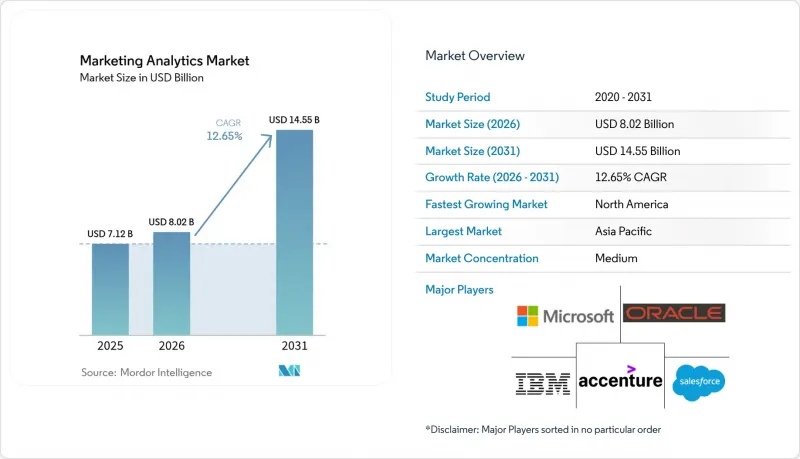
本報告按部署類型(雲端和本地部署)、應用領域(線上行銷、電子郵件行銷、內容行銷、社群媒體行銷等)、最終用戶(零售、銀行和金融服務、教育、醫療保健、製造業、旅遊和酒店業等)以及地區(北美、歐洲、亞太地區等)進行細分。市場預測以美元(USD)為單位。
全球行銷分析市場趨勢與洞察
人工智慧驅動的預測性洞察可提高行銷投資報酬率
目前,機器學習演算法可在毫秒內評估購買趨勢、客戶生命週期價值和流失機率,在受控測試中準確率超過 85%。 Google Analytics 4 於 2024 年 7 月發布的自主洞察卡片表明,內建人工智慧無需人工進行細分,即可將預算重新分配給盈利更高的用戶群體,從而將採用該技術的企業的投資回報率提高 15% 至 25%。預測能力曾經僅限於數位原生企業,如今已成為必需品,這給傳統供應商帶來了越來越大的壓力,迫使他們要么採用類似的模型,要么面臨被市場淘汰的風險。
加速雲端原生分析平台
企業正轉向無伺服器架構,查詢架構能夠彈性擴展查詢工作負載,並將資源調配週期從數週縮短至數分鐘。 2025年1月,微軟將Clarity行為日誌與Google Ads資料集整合,展示了先前在本地環境中難以實現的跨平台整合。因此,提供低程式碼API的供應商在行銷分析市場中越來越受歡迎,讓不具備技術專長的行銷人員無需等待IT部門的請求即可進行實驗。
總擁有成本 (TCO) 高且整合複雜
資料整合、模式協調和品質保證的成本總合,平台使用費僅佔整個專案總成本的一小部分。對於擁有傳統技術堆疊的公司而言,整合可能需要 6 到 12 個月,而三年的持續維護成本很容易使初始預算翻倍。因此,沒有專職資料工程師的中型公司往往傾向於選擇功能較為輕量的 SaaS 套件,但這會限制其可用功能。
細分市場分析
預計到2025年,雲端模式將佔據行銷分析市場61.58%的佔有率,並在2031年之前以12.96%的複合年成長率成長。因此,受雲端部署驅動的行銷分析市場規模預計將在預測期內翻倍。企業選擇雲端服務是為了取得GPU加速的AI服務,並利用付費使用制,進而避免資本投入。在金融和醫療保健行業,由於資料主權規則要求在本地進行處理,本地部署仍然佔據主導地位,但即使是這些行業也在嘗試混合模式,將匿名資料傳輸到雲端進行建模。
「雲端優先」的支出模式反映了一種轉向自助式分析的文化趨勢。行銷團隊現在可以無需等待 IT 部門的待辦事項,即可推出無需 SQL 的儀表板、執行提升測試,並在跨媒體平台上啟用細分受眾。 Adobe 與 Snowflake 和 Google BigQuery 的合作,使客戶能夠直接在其分析工作區內查詢Petabyte級資料集。這種「可組合性」為未來的創新奠定了基礎,從即時廣告競標到生成式 AI 驅動的文案最佳化,無所不包。
區域分析
到2025年,北美將佔據行銷分析市場41.12%的收入佔有率。儘管數位廣告的高度成熟、充裕的創業投資資金和強大的人才儲備為技術的成熟應用提供了支持,但Cookie的逐步淘汰正迫使企業加快採用第一方資料收集和隱私保護型歸因分析。為響應《加州消費者隱私法案》(CCPA)而訂定的州級立法正在擴大合規範圍,並延長實施前置作業時間。
亞太地區正引領最高的成長速度,預計2031年將維持13.31%的複合年成長率。到2025年,該地區的數位廣告支出將超過2000億美元,這得益於18億行動網路用戶透過超級應用程式瀏覽和購物。中國和印度構成了市場規模的基礎,而東南亞市場正在經歷多語言洞察和跨境支付的興起。隱私法規的差異迫使供應商提供精細化的在地化和零資料導出方案。
在歐洲,GDPR帶來的迫切性正推動第一方資料庫和聯合分析的投資。德國、法國和英國正在推行“隱私設計”,但語言的多樣性和監管方面的細微差別使得針對特定區域的諮詢支援變得必不可少。在中東、非洲和南美洲,重點正從試點階段轉向大規模部署,優先考慮行動和社交商務指標以及適合頻寬限制的低延遲儀表板。
其他好處:
- Excel格式的市場預測(ME)表
- 3個月的分析師支持
目錄
第1章:引言
- 研究假設和市場定義
- 調查範圍
第2章:調查方法
第3章執行摘要
第4章 市場狀況
- 市場概覽
- 市場促進因素
- 全通路宣傳活動追蹤的普及
- 需要即時分析來最佳化客戶體驗。
- 加速採用雲端原生分析平台
- 人工智慧驅動的預測分析可提高行銷投資報酬率。
- 隱私沙箱正在迫使人們增加第一方資料分析的投資。
- 可組合 CDP 的普及,實現了模組化分析。
- 市場限制因素
- 總擁有成本高且整合複雜
- 免費和免費增值模式的分析工具非常豐富。
- 嚴格的資料管治和隱私法規(GDPR、CCPA)
- 行銷和資料科學人才短缺
- 產業價值鏈分析
- 監理情勢
- 宏觀經濟因素的影響
- 技術展望
- 波特五力分析
第5章 市場規模與成長預測
- 不同的發展
- 雲
- 現場
- 透過使用
- 網路行銷
- 電子郵件行銷
- 內容行銷
- 社群媒體行銷
- 其他用途
- 最終用戶
- 零售
- 銀行和金融服務
- 教育
- 衛生保健
- 製造業
- 旅遊與飯店
- 其他最終用戶
- 按地區
- 北美洲
- 美國
- 加拿大
- 墨西哥
- 南美洲
- 巴西
- 阿根廷
- 其他南美國家
- 歐洲
- 英國
- 德國
- 法國
- 義大利
- 西班牙
- 俄羅斯
- 其他歐洲國家
- 亞太地區
- 中國
- 日本
- 印度
- 韓國
- 澳洲和紐西蘭
- 東南亞
- 其他亞太國家
- 中東
- 阿拉伯聯合大公國
- 沙烏地阿拉伯
- 土耳其
- 其他中東國家
- 非洲
- 南非
- 奈及利亞
- 埃及
- 其他非洲國家
- 北美洲
第6章 競爭情勢
- 市場集中度
- 策略趨勢
- 市佔率分析
- 公司簡介
- Adobe Inc.
- Salesforce Inc.
- Oracle Corporation
- SAS Institute Inc.
- IBM Corporation
- Microsoft Corporation
- Teradata Corporation
- HubSpot Inc.
- Google LLC
- SAP SE
- Neustar Inc.
- Pegasystems Inc.
- Tableau Software LLC
- Alteryx Inc.
- Mixpanel Inc.
- Amplitude Inc.
- Sprinklr Inc.
- Hootsuite Inc.
- Marketo Inc.
- Experian plc
- Clarabridge Inc.
第7章 市場機會與未來展望
According to Mordor Intelligence, the marketing analytics market size is expected to grow from USD 7.12 billion in 2025 to USD 8.02 billion in 2026 and is forecast to reach USD 14.55 billion by 2031 at 12.65% CAGR over 2026-2031.
This report is Segmented by Deployment (Cloud, and On-Premise), Application (Online Marketing, Email Marketing, Content Marketing, Social Media Marketing, and More), End User (Retail, Banking and Financial Service, Education, Healthcare, Manufacturing, Travel and Hospitality, and More), and Geography (North America, Europe, Asia Pacific, and More). The Market Forecasts are Provided in Terms of Value (USD).
Global Marketing Analytics Market Trends and Insights
AI-Powered Predictive Insights Improving Marketing ROI
Machine-learning algorithms now assess purchase propensity, lifetime value, and churn probability in milliseconds, with accuracy above 85% in controlled tests. Google Analytics 4's release of autonomous insight cards in July 2024 shows how embedded AI eliminates manual segmentation and reallocates spend toward high-yield cohorts, lifting ROI by 15-25% for adopters. Predictive capabilities once limited to digital-native firms are therefore becoming table stakes, intensifying pressure on legacy vendors to infuse comparable models or risk displacement.
Acceleration of Cloud-Native Analytics Platforms
Enterprises are migrating to serverless stacks that elastically scale query workloads and cut provisioning cycles from weeks to minutes. Microsoft's January 2025 linkage of Clarity behavioral logs to Google Ads datasets demonstrates cross-platform synthesis that was previously impractical on-premise. The marketing analytics market consequently favors vendors that expose low-code APIs, enabling non-technical marketers to pin up experiments without IT queues.
High Total Cost of Ownership and Integration Complexity
Platform fees represent a fraction of full program costs once data unification, schema harmonization, and quality assurance are tallied. Integration timelines stretch six to twelve months for firms saddled with legacy stacks, and ongoing maintenance often doubles original budgets over a three-year horizon. Mid-market companies without dedicated data engineers therefore gravitate toward lighter SaaS suites, narrowing accessible functionality.
Other drivers and restraints analyzed in the detailed report include:
- Widespread Adoption of Omnichannel Campaign Tracking
- Demand for Real-Time Analytics to Optimize Customer Journeys
- Stringent Data Governance and Privacy Regulations
For complete list of drivers and restraints, kindly check the Table Of Contents.
Segment Analysis
Cloud models captured 61.58% marketing analytics market share in 2025 and are projected to grow at 12.96% CAGR through 2031. The marketing analytics market size for cloud deployment is therefore on track to almost double during the forecast window. Enterprises choose cloud to access GPU-accelerated AI services and pay-as-you-use pricing that sidesteps capital outlays. On-premise installations persist in finance and healthcare where sovereignty rules demand local processing, but even these industries experiment with hybrid models that pipe de-identified data to the cloud for modeling.
Cloud-first spending patterns mirror a cultural pivot toward self-service analytics. Marketing teams now launch SQL-less dashboards, run uplift tests, and activate segments in media platforms without waiting for IT backlogs. Adobe's partnership with Snowflake and Google BigQuery lets clients query petabyte-scale datasets directly inside analytics workspaces. This composability anchors future innovation, from real-time ad bidding to generative-AI copy optimization.
Complete Report Scope:
- By Deployment
- Cloud
- On-Premise
- By Application
- Online Marketing
- Email Marketing
- Content Marketing
- Social Media Marketing
- Other Applications
- By End User
- Retail
- Banking and Financial Services
- Education
- Healthcare
- Manufacturing
- Travel and Hospitality
- Other End Users
- By Geography
- North America
- United States
- Canada
- Mexico
- South America
- Brazil
- Argentina
- Rest of South America
- Europe
- United Kingdom
- Germany
- France
- Italy
- Spain
- Russia
- Rest of Europe
- Asia Pacific
- China
- Japan
- India
- South Korea
- Australia and New Zealand
- Southeast Asia
- Rest of Asia Pacific
- Middle East
- United Arab Emirates
- Saudi Arabia
- Turkey
- Rest of Middle East
- Africa
- South Africa
- Nigeria
- Egypt
- Rest of Africa
- North America
Geography Analysis
North America held 41.12% revenue share of the marketing analytics market in 2025. Deep digital-advertising maturity, ample venture funding, and dense talent pools sustain sophisticated deployments, yet cookie deprecation pushes firms to accelerate first-party data capture and privacy-preserving attribution. State-level bills echoing CCPA broaden compliance scope, extending implementation lead times.
Asia Pacific drives the highest expansion at 13.31% CAGR through 2031. Regional digital-ad spend surpasses USD 200 billion in 2025, underwritten by 1.8 billion mobile internet users who browse and buy via super-apps. China and India anchor scale, while Southeast Asian markets embrace multi-language insights and cross-border payments. Variability in privacy statutes compels vendors to deliver granular localization and zero-data-export designs.
Europe benefits from GDPR-sparked urgency to cultivate first-party databases and invest in federated analytics. Germany, France, and the United Kingdom champion privacy-by-design, but fragmented language and regulatory nuances necessitate region-specific consultative support. Middle East and Africa and South America progress from exploratory pilots to scaled rollouts, prioritizing mobile social commerce metrics and low-latency dashboards that fit bandwidth constraints.
- Adobe Inc.
- Salesforce Inc.
- Oracle Corporation
- SAS Institute Inc.
- IBM Corporation
- Microsoft Corporation
- Teradata Corporation
- HubSpot Inc.
- Google LLC
- SAP SE
- Neustar Inc.
- Pegasystems Inc.
- Tableau Software LLC
- Alteryx Inc.
- Mixpanel Inc.
- Amplitude Inc.
- Sprinklr Inc.
- Hootsuite Inc.
- Marketo Inc.
- Experian plc
- Clarabridge Inc.
Additional Benefits:
- The market estimate (ME) sheet in Excel format
- 3 months of analyst support
TABLE OF CONTENTS
1 INTRODUCTION
- 1.1 Study Assumptions and Market Definition
- 1.2 Scope of the Study
2 RESEARCH METHODOLOGY
3 EXECUTIVE SUMMARY
4 MARKET LANDSCAPE
- 4.1 Market Overview
- 4.2 Market Drivers
- 4.2.1 Widespread adoption of omnichannel campaign tracking
- 4.2.2 Demand for real-time analytics to optimize customer journeys
- 4.2.3 Acceleration of cloud-native analytics platforms
- 4.2.4 AI-powered predictive insights improving marketing ROI
- 4.2.5 Privacy sandbox forcing first-party data analytics investments
- 4.2.6 Proliferation of composable CDPs enabling modular analytics
- 4.3 Market Restraints
- 4.3.1 High total cost of ownership and integration complexity
- 4.3.2 Abundance of free and freemium analytics tools
- 4.3.3 Stringent data governance and privacy regulations (GDPR, CCPA)
- 4.3.4 Shortage of marketing data-science talent
- 4.4 Industry Value Chain Analysis
- 4.5 Regulatory Landscape
- 4.6 Impact of Macroeconomic Factors
- 4.7 Technological Outlook
- 4.8 Porter's Five Forces Analysis
- 4.8.1 Bargaining Power of Suppliers
- 4.8.2 Bargaining Power of Buyers
- 4.8.3 Threat of New Entrants
- 4.8.4 Threat of Substitutes
- 4.8.5 Intensity of Competitive Rivalry
5 MARKET SIZE AND GROWTH FORECASTS (VALUE)
- 5.1 By Deployment
- 5.1.1 Cloud
- 5.1.2 On-Premise
- 5.2 By Application
- 5.2.1 Online Marketing
- 5.2.2 Email Marketing
- 5.2.3 Content Marketing
- 5.2.4 Social Media Marketing
- 5.2.5 Other Applications
- 5.3 By End User
- 5.3.1 Retail
- 5.3.2 Banking and Financial Services
- 5.3.3 Education
- 5.3.4 Healthcare
- 5.3.5 Manufacturing
- 5.3.6 Travel and Hospitality
- 5.3.7 Other End Users
- 5.4 By Geography
- 5.4.1 North America
- 5.4.1.1 United States
- 5.4.1.2 Canada
- 5.4.1.3 Mexico
- 5.4.2 South America
- 5.4.2.1 Brazil
- 5.4.2.2 Argentina
- 5.4.2.3 Rest of South America
- 5.4.3 Europe
- 5.4.3.1 United Kingdom
- 5.4.3.2 Germany
- 5.4.3.3 France
- 5.4.3.4 Italy
- 5.4.3.5 Spain
- 5.4.3.6 Russia
- 5.4.3.7 Rest of Europe
- 5.4.4 Asia Pacific
- 5.4.4.1 China
- 5.4.4.2 Japan
- 5.4.4.3 India
- 5.4.4.4 South Korea
- 5.4.4.5 Australia and New Zealand
- 5.4.4.6 Southeast Asia
- 5.4.4.7 Rest of Asia Pacific
- 5.4.5 Middle East
- 5.4.5.1 United Arab Emirates
- 5.4.5.2 Saudi Arabia
- 5.4.5.3 Turkey
- 5.4.5.4 Rest of Middle East
- 5.4.6 Africa
- 5.4.6.1 South Africa
- 5.4.6.2 Nigeria
- 5.4.6.3 Egypt
- 5.4.6.4 Rest of Africa
- 5.4.1 North America
6 COMPETITIVE LANDSCAPE
- 6.1 Market Concentration
- 6.2 Strategic Moves
- 6.3 Market Share Analysis
- 6.4 Company Profiles (includes Global level Overview, Market level overview, Core Segments, Financials as available, Strategic Information, Market Rank/Share for key companies, Products and Services, and Recent Developments)
- 6.4.1 Adobe Inc.
- 6.4.2 Salesforce Inc.
- 6.4.3 Oracle Corporation
- 6.4.4 SAS Institute Inc.
- 6.4.5 IBM Corporation
- 6.4.6 Microsoft Corporation
- 6.4.7 Teradata Corporation
- 6.4.8 HubSpot Inc.
- 6.4.9 Google LLC
- 6.4.10 SAP SE
- 6.4.11 Neustar Inc.
- 6.4.12 Pegasystems Inc.
- 6.4.13 Tableau Software LLC
- 6.4.14 Alteryx Inc.
- 6.4.15 Mixpanel Inc.
- 6.4.16 Amplitude Inc.
- 6.4.17 Sprinklr Inc.
- 6.4.18 Hootsuite Inc.
- 6.4.19 Marketo Inc.
- 6.4.20 Experian plc
- 6.4.21 Clarabridge Inc.
7 MARKET OPPORTUNITIES AND FUTURE OUTLOOK
- 7.1 White-space and unmet-need assessment

 美國行銷分析:市場佔有率分析、產業趨勢與統計、成長預測(2026-2031)
 行銷分析市場:全球市場預測(2026-2032)行銷資料管理:市場佔有率分析、產業趨勢與統計、成長預測(2026-2031)
 潛在客戶開發軟體市場規模、佔有率和成長分析:按組件、部署類型、組織規模、應用、最終用戶和地區分類-2026-2033年產業預測潛在客戶開發軟體市場:2026-2032年全球市場預測(潛在客戶開發管道、組件類型、組織規模、部署模式及最終用戶產業分類)
 資料仲介市場規模、佔有率和成長分析:按資料類別、資料結構類型、收入和定價模式、最終用戶產業和地區分類-2026-2033年產業預測資料仲介市場:2026-2032年全球市場預測(按資料類型、交付方式、部署模式、應用程式和最終用戶產業分類)
 2026年全球PI到雲端資料仲介解決方案市場報告2026年全球潛在客戶開發軟體市場報告2026年全球數據仲介市場報告