


 |
市場調查報告書
商品編碼
2118198
行銷資料管理:市場佔有率分析、產業趨勢與統計、成長預測(2026-2031)Marketing Data Management - Market Share Analysis, Industry Trends & Statistics, Growth Forecasts (2026 - 2031) |
||||||

※ 本網頁內容可能與最新版本有所差異。詳細情況請與我們聯繫。
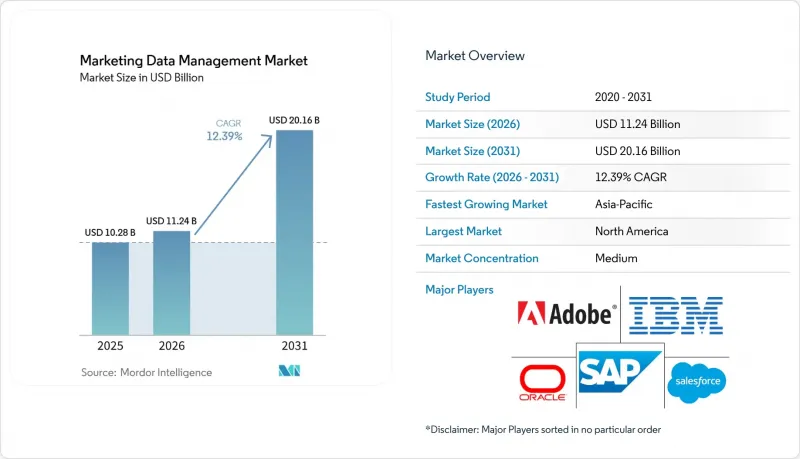
據 Mordor Intelligence 稱,行銷資料管理市場預計將從 2025 年的 102.8 億美元成長到 2026 年的 112.4 億美元,到 2031 年達到 201.6 億美元,預計 2026 年至 2031 年的複合年成長率為 12.39%。
本報告按解決方案(資料管理平台、客戶資料平台、資料整合和管治解決方案等)、部署類型(雲端、本地部署、混合部署)、組織規模(大型企業、中小企業)、最終用戶產業(零售和電子商務、銀行、金融服務和保險等)以及地區進行細分。市場預測以美元計價。
全球行銷數據管理市場趨勢與洞察
整合客戶資料管治的需求日益成長
多年來,客戶資料分散在客戶關係管理系統、電商平台、廣告工具和線下記錄中,導致難以清楚了解每位使用者。如今,隨著企業需要一個治理管治的資料環境來支援合規性和日常宣傳活動執行,行銷資料管理市場正從中受益。隨著歐洲的《一般資料保護規範》(GDPR)、印度的《數位個人資料保護法》以及其他地區類似框架的訂定,管治已成為平台設計的核心要素。 Salesforce 於 2025 年 11 月完成對 Informatica 的收購,進一步強化了這一趨勢,將整合、資料品質、隱私、元資料和主資料管理整合到單一的平台堆疊中。此外,法國國家資訊與自由銷售團隊(CNIL) 於 2026 年 1 月正式啟動了關於行銷資料處理的同意認證標準的討論,凸顯了可審計管治工具在歐洲的重要性。
人工智慧驅動的受眾細分技術的廣泛應用。
隨著對更清晰的第一方數據的需求日益成長,人工智慧主導的受眾細分正從試點階段走向行銷營運的常規環節。 HubSpot 預測,到 2026 年,87% 的負責人將在至少一個常規工作流程中使用生成式人工智慧,其中 40.8% 將其用於受眾細分。行銷資料管理市場正受益於此轉變,因為基於包含已識別身分和同意資訊的客戶記錄的細分模型表現較佳。 Salesforce 在 2026 年 3 月的公佈財報表示,其資料雲將擁有 12,000 家企業客戶,凸顯了大型企業將人工智慧用例快速整合到其統一客戶資料環境中的速度。歐盟人工智慧法案將於 2026 年 8 月 2 日起分階段實施,加強用於使用者畫像和定向的人工智慧系統的文件記錄、透明度和監管要求。
傳統行銷技術堆疊的整合複雜性
隨著許多公司經營獨立的歸因、個人化、宣傳活動管理和資料利用系統,企業行銷技術堆疊的管理變得越來越困難。這給行銷資料管理市場帶來了挑戰,因為每增加一個連接,當來源系統發生變化時,模式漂移、監控和恢復工作量都會增加。 IBM 的一項研究發現,將 Salesforce 連接到外部平台的企業獲得卓越業務成果的可能性是其他企業的三倍左右,這凸顯了整合品質對實際收入的巨大影響。傳統的 ETL 環境尤其難以現代化,因為它們通常依賴柔軟性的資料邏輯,一旦 API 或來源欄位發生變化,這些邏輯就會失效。因此,許多買家持謹慎態度,他們需要仔細權衡提高資料完整性的價值與遷移所需時間、營運中斷以及漫長的引進週期之間的關係。
細分市場分析
到2025年,資料管理平台(DMP)將佔據28.41%的最大市場佔有率,成為行銷資料管理市場解決方案組成的領先類別。這一地位源於DMP在管理程序化廣告和跨站定向的匿名受眾群體方面長期以來發揮的重要作用。然而,隨著企業從DMP主導的工作流程轉向以第一方客戶身分為中心的系統,DMP的核心地位正在減弱。客戶數據平台(CDP)預計到2031年將以15.82%的複合年成長率成長,這預示著新的需求方向。這種成長與整合行為數據、交易數據和CRM數據的需求密切相關,這些數據能夠支援跨管道個性化、歸因分析和人工智慧主導的激活。
此外,行銷資料管理產業對資料整合和管治工具的需求日益成長。這是因為企業希望幫助其行銷團隊利用更清晰、資料處理歷程可追溯的數據,而無需完全依賴IT主導的營運模式。 Salesforce和Informatica的整合進一步強化了這一趨勢,擴展了管治管道和元資料管理在行銷營運中的應用情境。銷售團隊解析解決方案在零售媒體和金融服務業越來越受歡迎,因為在這些產業中,將線上、應用程式和線下行為關聯到單一、持久的客戶記錄至關重要。雖然宣傳活動資料編配目前仍是營收中佔比最小的部分,但它具有很高的策略價值,因為它是上游資料投資轉化為可衡量業務成果的關鍵環節。 Treasure AI在IDC MarketScape 2026年7月的估值也表明,解決方案領導者越來越依賴在單一架構中整合第一方身分、AI驅動的決策和多通路執行。
在2025年的行銷資料管理市場中,雲端部署模式持續保持其主導地位,佔據64.73%的市場。這一主導地位反映了雲端的結構性優勢,例如可擴展性、合規性管理以及與Snowflake、BigQuery和Databricks等平台的快速整合。此外,企業青睞雲端的另一個原因是,當需要快速增加新的資料來源時,雲端可以減輕內部工程團隊的部分負擔。這使得雲端對於那些希望在多個管道擴展客戶資料運營,而無需徹底重組內部流程的企業來說,成為一個極具吸引力的選擇。因此,雲端仍然是大多數新部署活動的預設營運模式。
在金融服務和醫療保健行業,由於資料儲存位置、安全策略和傳統基礎設施的法規限制,本地部署仍然至關重要,阻礙了全面遷移。混合環境預計到 2031 年將以 14.29% 的複合年成長率成長,這表明許多公司更傾向於分階段遷移而非完全切換。在行銷資料管理產業,隨著企業尋求在保持與舊有系統整合的同時,將啟動和分析功能更緊密地整合到現代雲端環境中,混合解決方案的重要性日益凸顯。 Adobe 於 2026 年 3 月透過擴展其對 Salesforce CRM、Microsoft Dynamics 和 Marketo Engage 的變更資料擷取(CDC) 支持,進一步強化了此模式,從而簡化了混合環境的維護。可組合的 CDP 架構允許儲存核心客戶資料。
區域分析
2025年,北美成為行銷數據管理市場的領頭羊,佔36.82%的最大市場。大部分收入來自美國,這得益於企業軟體支出高、供應商基礎密集、系統整合商生態系統成熟。加拿大也受惠於企業數位轉型措施帶來的穩定需求。同時,墨西哥雖然規模較小,但作為跨境電商市場,其需求持續成長。此外,美國各州的隱私法規意味著管治和同意處理仍然是採購方面的關鍵挑戰。北美在行銷數據管理市場表現最為強勁,主要歸功於其較早採用整合客戶數據和人工智慧驅動的行銷系統。
歐洲佔據了顯著的第二大市場佔有率,這主要得益於GDPR將客戶資料處理的管治納入了法律和營運要求。歐盟人工智慧法案新增了一層合規要求,對用於用戶畫像和受眾定向的人工智慧引入了分階段的義務,該法案將於2026年8月2日生效。德國和英國仍然是該地區最大的市場中心。法國也受惠於法國國家資訊自由委員會(CNIL)於2026年1月就同意認證標準進行的磋商,推動了對跨通路可審計同意追蹤的需求,從而增強了法國市場的活力。南美洲的市場規模仍然較小,但巴西依然表現突出,零售、金融服務和媒體公司在巴西個人資料保護法(LGPD)的框架下繼續投資於第一方資料基礎設施。
預計到2031年,亞太地區將以14.81%的複合年成長率(CAGR)實現最高成長,成為行銷資料管理市場的主要成長引擎。由於電子商務的擴張和企業行銷技術預算的增加,印度、東南亞、韓國和日本的需求正在成長。根據Treasure Data預測,日本國內客戶資料平台(CDP)市場規模預計將從2020年的170億日圓(1.13億美元)成長到2025年的490億日圓(3.245億美元)(採用2025年美國國稅局平均外匯),並持續成長至2027年的750億日圓。此外,由於對在地化、資料傳輸規則和授權架構的期望存在差異,中國、印度、越南和新加坡正面臨日益複雜的區域合規性挑戰。儘管中東和非洲仍然是最小的區域市場,但在正在進行數位轉型並投資於企業客戶參與基礎設施的經濟體中,CDP的採用進展順利。
其他好處:
- Excel格式的市場預測(ME)表
- 3個月的分析師支持
目錄
第1章:引言
- 研究假設和市場定義
- 調查範圍
第2章:調查方法
第3章執行摘要
第4章 市場狀況
- 市場概覽
- 市場促進因素
- 統一客戶資料管治的需求日益成長
- 人工智慧驅動的受眾細分技術的廣泛應用。
- 擴展全通路宣傳活動編配
- Cookie 停用後,第一方資料貨幣化的壓力日益增大。
- 對所有數位觸點進行即時個人化的需求。
- 基於同意的品牌安全和數據使用
- 市場限制因素
- 整合整個傳統行銷技術堆疊的複雜性
- 跨境資料使用面臨高合規負擔
- 數據工程和行銷技術營運領域人才短缺
- 封閉式行銷資料生態系統中供應商鎖定的風險
- 宏觀經濟因素對市場的影響
- 產業價值鏈分析
- 技術展望
- 監理情勢
- 波特五力分析
第5章 市場規模與成長預測
- 透過解決方案
- 資料管理平台
- 客戶數據平台
- 資料整合和管治解決方案
- 身份匹配解決方案
- 宣傳活動數據編配解決方案
- 部署模式
- 雲
- 現場
- 混合
- 按組織規模
- 大公司
- 小型企業
- 按最終用戶行業分類
- 零售與電子商務
- BFSI
- 醫療保健和生命科學
- 資訊科技/通訊
- 媒體與娛樂
- 工業製造
- 政府和公共行政
- 其他終端用戶產業
- 按地區
- 北美洲
- 美國
- 加拿大
- 墨西哥
- 南美洲
- 巴西
- 阿根廷
- 其他南美國家
- 歐洲
- 德國
- 英國
- 法國
- 義大利
- 西班牙
- 俄羅斯
- 其他歐洲國家
- 亞太地區
- 中國
- 印度
- 日本
- 韓國
- 澳洲
- 其他亞太國家
- 中東和非洲
- 中東
- 沙烏地阿拉伯
- 阿拉伯聯合大公國
- 其他中東國家
- 非洲
- 南非
- 奈及利亞
- 其他非洲國家
- 中東
- 北美洲
第6章 競爭情勢
- 市場集中度
- 策略趨勢
- 市佔率分析
- 公司簡介
- Adobe Inc.
- Salesforce, Inc.
- Oracle Corporation
- SAP SE
- IBM Corporation
- SAS Institute Inc.
- Tealium, Inc.
- Treasure Data, Inc.
- mParticle, Inc.
- Acquia, Inc.
- Bloomreach, Inc.
- Insider, Inc.
- Teradata Corporation
- Informatica Inc.
- Braze, Inc
- Acoustic, LP
- ActionIQ, Inc.
- Snowflake Inc
- Amperity, Inc.
- Lotame Solutions, Inc.
第7章 市場機會與未來展望
According to Mordor Intelligence, the marketing data management market size is expected to increase from USD 10.28 billion in 2025 to USD 11.24 billion in 2026 and reach USD 20.16 billion by 2031, growing at a CAGR of 12.39% over 2026-2031.
This report is Segmented by Solutions (Data Management Platforms, Customer Data Platforms, Data Integration and Governance Solutions, and More), Deployment Mode (Cloud, On-Premises, and Hybrid), Organization Size (Large Enterprises, and Small and Medium Enterprises), End-User Industry (Retail and E-Commerce, BFSI, and More), and Geography. The Market Forecasts are Provided in Terms of Value (USD).
Global Marketing Data Management Market Trends and Insights
Growing Need for Unified Customer Data Governance
Customer data has long been scattered across CRM systems, commerce platforms, ad tools, and offline records, limiting a clear view of each user. The Marketing Data Management Market is benefiting because enterprises now need governed data environments that can support both regulatory compliance and daily campaign execution. GDPR in Europe, the Digital Personal Data Protection Act in India, and similar frameworks across other regions have pushed governance into the center of platform design. Salesforce reinforced this direction in November 2025 when it completed the acquisition of Informatica, bringing integration, data quality, privacy, metadata, and master data management into a single platform stack. France's CNIL also opened a formal consultation in January 2026 on consent proof standards for marketing data processing, which raised the importance of auditable governance tools across Europe.
Rising Adoption of AI-Driven Audience Segmentation
AI-led audience segmentation has moved from pilot use into regular marketing operations, increasing the need for cleaner first-party data. HubSpot reported that 87% of marketing professionals were using generative AI in at least 1 recurring workflow in 2026, while 40.8% were using it for audience segmentation. The Marketing Data Management Market is benefiting from this shift because segmentation models perform better when they rely on identity-resolved, consent-aware customer records. Salesforce said Data Cloud had 12,000 enterprise customers as of its March 2026 earnings call, highlighting how quickly large organizations were aligning AI use cases with unified customer data environments. The EU AI Act will apply phased requirements from August 2, 2026, increasing documentation, transparency, and supervision requirements for AI systems used for profiling and targeting.
Integration Complexity Across Legacy Marketing Stacks
Enterprise marketing stacks have become harder to manage because many companies run separate systems for attribution, personalization, campaign management, and data activation. The Marketing Data Management Market faces friction here because every extra connection can increase schema drift, monitoring work, and recovery effort when source systems change. IBM found that organizations connecting Salesforce to external platforms were nearly 3 times more likely to report highly successful business outcomes, underscoring how strongly integration quality shapes actual returns. Older ETL environments are especially difficult to modernize because they often depend on rigid data logic that breaks when APIs or source fields change. This makes many buyers cautious because the value of better data unification must still be weighed against migration time, operational disruption, and long implementation cycles.
Other drivers and restraints analyzed in the detailed report include:
- First-Party Data Monetization Pressure After Cookie Deprecation
- Expansion of Omnichannel Campaign Orchestration
- High Compliance Burden for Cross-Border Data Use
For complete list of drivers and restraints, kindly check the Table Of Contents.
Segment Analysis
Data management platforms held the largest share by solutions at 28.41% in 2025, making them the leading category within the Marketing Data Management Market by solution mix. Their position came from a long-established role in managing anonymous audience segments for programmatic advertising and cross-site targeting. Even so, their centrality is weakening as enterprises shift from DMP-led workflows to systems built around first-party customer identity. Customer data platforms are projected to expand at a 15.82% CAGR through 2031, which shows where new demand is moving. This growth is tied to the need for unified behavioral, transactional, and CRM data that can support personalization, attribution, and AI-led activation across channels.
The Marketing Data Management industry is also seeing rising demand for data integration and governance tools, as enterprises seek to enable marketing teams to work with cleaner, lineage-tracked data without relying entirely on IT-led operating models. The Salesforce and Informatica combination strengthened this direction by broadening the use case for governed pipelines and metadata management inside marketing operations. Identity resolution solutions are gaining traction in retail media and financial services, where linking online, app, and offline behavior into a single durable customer record is essential. Campaign data orchestration remains the smallest segment by current revenue, but it carries high strategic value because it is the layer where upstream data investments become measurable business outcomes. Treasure AI's July 2026 recognition in the IDC MarketScape also showed that solution leadership increasingly hinges on combining first-party identity, AI decisioning, and multi-channel execution within a single architecture.
Cloud deployments accounted for 64.73% of the Marketing Data Management Market share in 2025, maintaining their lead as the leading deployment mode. That lead reflected cloud's structural advantages in scalability, managed compliance support, and faster integration with platforms such as Snowflake, BigQuery, and Databricks. Enterprises also favored cloud because it reduced part of the in-house engineering burden when new data sources had to be added quickly. This made the cloud especially attractive for companies trying to scale customer data operations across several channels without rebuilding every internal process. As a result, cloud remained the default operating model for much of the new deployment activity.
On-premises deployment still mattered in financial services and healthcare, where data residency rules, security policies, and legacy infrastructure slowed full migration. Hybrid is projected to grow at a 14.29% CAGR through 2031, which shows that many enterprises prefer a staged transition rather than a full cutover. The Marketing Data Management industry is seeing hybrid solutions gain importance as companies seek to preserve links to legacy systems while moving activation and analytics closer to modern cloud environments. Adobe strengthened this model in March 2026 by expanding Change Data Capture support for Salesforce CRM, Microsoft Dynamics, and Marketo Engage, making mixed deployments easier to maintain. Composable CDP architectures further support hybrid adoption because they allow core customer data
Complete Report Scope:
- By Solutions
- Data Management Platforms
- Customer Data Platforms
- Data Integration and Governance Solutions
- Identity Resolution Solutions
- Campaign Data Orchestration Solutions
- By Deployment Mode
- Cloud
- On-Premises
- Hybrid
- By Organization Size
- Large Enterprises
- Small and Medium Enterprises
- By End-User Industry
- Retail and E-Commerce
- BFSI
- Healthcare and Life Sciences
- IT and Telecom
- Media and Entertainment
- Industrial Manufacturing
- Government and Public Administration
- Other End-User Industries
- By Geography
- North America
- United States
- Canada
- Mexico
- South America
- Brazil
- Argentina
- Rest of South America
- Europe
- Germany
- United Kingdom
- France
- Italy
- Spain
- Russia
- Rest of Europe
- Asia-Pacific
- China
- India
- Japan
- South Korea
- Australia
- Rest of Asia-Pacific
- Middle East and Africa
- Middle East
- Saudi Arabia
- United Arab Emirates
- Rest of Middle East
- Africa
- South Africa
- Nigeria
- Rest of Africa
- Middle East
- North America
Geography Analysis
North America held the largest regional share at 36.82% in 2025, making it the leading region in the Marketing Data Management Market. The United States accounted for most of that revenue because it combines high enterprise software spending, a dense vendor base, and a mature ecosystem of system integrators. Canada added steady demand through enterprise digital transformation activity, while Mexico remained a smaller but growing contributor linked to cross-border e-commerce. State-level privacy regulation in the United States also kept governance and consent handling high on procurement agendas. The Marketing Data Management Market remained strongest in North America because buyers there were earlier adopters of integrated customer data and AI-enabled marketing systems.
Europe held a significant secondary share because GDPR made governing customer data handling both a legal and an operational requirement. The EU AI Act added a second compliance layer by introducing phased obligations for AI used for profiling and audience targeting, effective from August 2, 2026. Germany and the United Kingdom remained the largest market centers in the region. France also added momentum through CNIL's January 2026 consultation on consent proof standards, which increased demand for auditable consent tracking across channels. South America remained smaller in scale, but Brazil continued to stand out as enterprises in retail, financial services, and media invested in first-party data infrastructure under the LGPD framework.
Asia-Pacific is projected to record the fastest regional CAGR of 14.81% through 2031, which makes it the main growth engine for the Marketing Data Management Market. Demand is rising across India, Southeast Asia, South Korea, and Japan as e-commerce expands and enterprise marketing technology budgets deepen. Treasure Data said Japan's domestic CDP market grew from JPY 17 billion, USD 113 million, in 2020 to JPY 49 billion, USD 324.5 million, in 2025, using the 2025 IRS average exchange rate, and growth was expected to continue toward JPY 75 billion by 2027. Regional compliance complexity is also increasing because China, India, Vietnam, and Singapore are shaping different expectations for localization, transfer rules, and consent architecture. Middle East and Africa remained the smallest regional cluster, but adoption responded well in economies that were investing in digital transformation and enterprise customer engagement infrastructure.
- Adobe Inc.
- Salesforce, Inc.
- Oracle Corporation
- SAP SE
- IBM Corporation
- SAS Institute Inc.
- Tealium, Inc.
- Treasure Data, Inc.
- mParticle, Inc.
- Acquia, Inc.
- Bloomreach, Inc.
- Insider, Inc.
- Teradata Corporation
- Informatica Inc.
- Braze, Inc
- Acoustic, L.P.
- ActionIQ, Inc.
- Snowflake Inc
- Amperity, Inc.
- Lotame Solutions, Inc.
Additional Benefits:
- The market estimate (ME) sheet in Excel format
- 3 months of analyst support
TABLE OF CONTENTS
1 INTRODUCTION
- 1.1 Study Assumptions and Market Definition
- 1.2 Scope of the Study
2 RESEARCH METHODOLOGY
3 EXECUTIVE SUMMARY
4 MARKET LANDSCAPE
- 4.1 Market Overview
- 4.2 Market Drivers
- 4.2.1 Growing Need for Unified Customer Data Governance
- 4.2.2 Rising Adoption of AI-Driven Audience Segmentation
- 4.2.3 Expansion of Omnichannel Campaign Orchestration
- 4.2.4 First-Party Data Monetization Pressure After Cookie Deprecation
- 4.2.5 Demand for Real-Time Personalization Across Digital Touchpoints
- 4.2.6 Brand Safety and Consent-Aware Data Activation
- 4.3 Market Restraints
- 4.3.1 Integration Complexity Across Legacy Marketing Stacks
- 4.3.2 High Compliance Burden for Cross-Border Data Use
- 4.3.3 Talent Gap in Data Engineering and MarTech Operations
- 4.3.4 Vendor Lock-In Risks in Closed Marketing Data Ecosystems
- 4.4 Impact of Macroeconomic Factors on the Market
- 4.5 Industry Value Chain Analysis
- 4.6 Technology Outlook
- 4.7 Regulatory Landscape
- 4.8 Porter's Five Forces Analysis
- 4.8.1 Threat of New Entrants
- 4.8.2 Bargaining Power of Suppliers
- 4.8.3 Bargaining Power of Buyers
- 4.8.4 Threat of Substitutes
- 4.8.5 Intensity of Competitive Rivalry
5 MARKET SIZE AND GROWTH FORECASTS (VALUE)
- 5.1 By Solutions
- 5.1.1 Data Management Platforms
- 5.1.2 Customer Data Platforms
- 5.1.3 Data Integration and Governance Solutions
- 5.1.4 Identity Resolution Solutions
- 5.1.5 Campaign Data Orchestration Solutions
- 5.2 By Deployment Mode
- 5.2.1 Cloud
- 5.2.2 On-Premises
- 5.2.3 Hybrid
- 5.3 By Organization Size
- 5.3.1 Large Enterprises
- 5.3.2 Small and Medium Enterprises
- 5.4 By End-User Industry
- 5.4.1 Retail and E-Commerce
- 5.4.2 BFSI
- 5.4.3 Healthcare and Life Sciences
- 5.4.4 IT and Telecom
- 5.4.5 Media and Entertainment
- 5.4.6 Industrial Manufacturing
- 5.4.7 Government and Public Administration
- 5.4.8 Other End-User Industries
- 5.5 By Geography
- 5.5.1 North America
- 5.5.1.1 United States
- 5.5.1.2 Canada
- 5.5.1.3 Mexico
- 5.5.2 South America
- 5.5.2.1 Brazil
- 5.5.2.2 Argentina
- 5.5.2.3 Rest of South America
- 5.5.3 Europe
- 5.5.3.1 Germany
- 5.5.3.2 United Kingdom
- 5.5.3.3 France
- 5.5.3.4 Italy
- 5.5.3.5 Spain
- 5.5.3.6 Russia
- 5.5.3.7 Rest of Europe
- 5.5.4 Asia-Pacific
- 5.5.4.1 China
- 5.5.4.2 India
- 5.5.4.3 Japan
- 5.5.4.4 South Korea
- 5.5.4.5 Australia
- 5.5.4.6 Rest of Asia-Pacific
- 5.5.5 Middle East and Africa
- 5.5.5.1 Middle East
- 5.5.5.1.1 Saudi Arabia
- 5.5.5.1.2 United Arab Emirates
- 5.5.5.1.3 Rest of Middle East
- 5.5.5.2 Africa
- 5.5.5.2.1 South Africa
- 5.5.5.2.2 Nigeria
- 5.5.5.2.3 Rest of Africa
- 5.5.5.1 Middle East
- 5.5.1 North America
6 COMPETITIVE LANDSCAPE
- 6.1 Market Concentration
- 6.2 Strategic Moves
- 6.3 Market Share Analysis
- 6.4 Company Profiles (includes Global Level Overview, Market Level Overview, Core Segments, Financials as available, Strategic Information, Market Rank/Share, Products and Services, Recent Developments)
- 6.4.1 Adobe Inc.
- 6.4.2 Salesforce, Inc.
- 6.4.3 Oracle Corporation
- 6.4.4 SAP SE
- 6.4.5 IBM Corporation
- 6.4.6 SAS Institute Inc.
- 6.4.7 Tealium, Inc.
- 6.4.8 Treasure Data, Inc.
- 6.4.9 mParticle, Inc.
- 6.4.10 Acquia, Inc.
- 6.4.11 Bloomreach, Inc.
- 6.4.12 Insider, Inc.
- 6.4.13 Teradata Corporation
- 6.4.14 Informatica Inc.
- 6.4.15 Braze, Inc
- 6.4.16 Acoustic, L.P.
- 6.4.17 ActionIQ, Inc.
- 6.4.18 Snowflake Inc
- 6.4.19 Amperity, Inc.
- 6.4.20 Lotame Solutions, Inc.
7 MARKET OPPORTUNITIES AND FUTURE OUTLOOK
- 7.1 White-Space and Unmet-Need Assessment

 美國行銷分析:市場佔有率分析、產業趨勢與統計、成長預測(2026-2031)
 行銷分析市場:全球市場預測(2026-2032)行銷分析市場:市場佔有率分析、產業趨勢與統計、成長預測(2026-2031 年)
 潛在客戶開發軟體市場規模、佔有率和成長分析:按組件、部署類型、組織規模、應用、最終用戶和地區分類-2026-2033年產業預測潛在客戶開發軟體市場:2026-2032年全球市場預測(潛在客戶開發管道、組件類型、組織規模、部署模式及最終用戶產業分類)
 資料仲介市場規模、佔有率和成長分析:按資料類別、資料結構類型、收入和定價模式、最終用戶產業和地區分類-2026-2033年產業預測資料仲介市場:2026-2032年全球市場預測(按資料類型、交付方式、部署模式、應用程式和最終用戶產業分類)
 2026年全球PI到雲端資料仲介解決方案市場報告2026年全球潛在客戶開發軟體市場報告2026年全球數據仲介市場報告