


 |
市場調查報告書
商品編碼
2120657
歐洲液體肥料:市場佔有率分析、行業趨勢和統計數據以及成長預測(2026-2031 年)Europe Liquid Fertilizers - Market Share Analysis, Industry Trends & Statistics, Growth Forecasts (2026 - 2031) |
||||||

※ 本網頁內容可能與最新版本有所差異。詳細情況請與我們聯繫。
據 Mordor Intelligence 稱,歐洲液體肥料市場預計到 2026 年價值 50.2 億美元,高於 2025 年的 47.2 億美元,預計到 2031 年將達到 68.1 億美元。
預計 2026 年至 2031 年的複合年成長率為 6.31%。
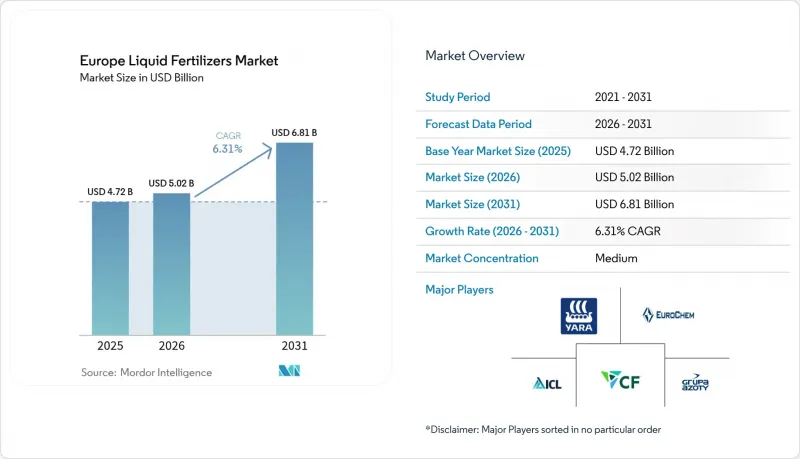
本報告按肥料類型(複合肥和單一肥料)、施用方法(灌溉施肥、葉面噴布和噴霧施肥)、作物類型(田間作物、園藝作物、草坪和觀賞作物)以及地區(法國、德國、義大利、荷蘭、英國、西班牙、英國、烏克蘭和其他歐洲國家)進行細分。市場預測以美元計價。
歐洲液體肥料市場的趨勢與洞察
透過精密農業實現產量最佳化
在歐洲,變數液態肥料施用系統正在改變精密農業,與大面積施用固態肥料相比,氮肥利用率提高了15-20%。將GPS導航噴霧器與即時土壤感測技術結合,可以根據作物吸收模式進行田間精準施肥,最大限度地減少低產區的過度施肥,同時確保高產區獲得最佳養分供應。荷蘭在精密農業的推廣應用方面發揮了先鋒作用,由於土地資源有限以及嚴格的養分徑流環境法規,超過60%的商業農戶採用了這些技術。歐盟委員會的「數位歐洲計畫」已撥款13億歐元(14億美元)用於其2024年的數位轉型(DX)舉措,其中相當一部分將用於支持精準施肥管理的農業數位化計畫。
人均耕地面積減少
由於都市化和氣候變遷導致的生產力下降,歐洲的耕地正以每年0.3%的速度減少,這增加了對高濃度液體肥料的需求,以最大限度地提高每公頃的養分供應量。在西班牙,人均可耕種面積預計將從2020年的0.24公頃減少到2024年的0.25公頃,迫使農民透過強化液體肥料施用方案來最佳化生產力。土地資源的限制促使人們採用每立方米含有超過400公斤氮磷鉀(N+P₂O₅+K₂O)的高濃度液體肥料配方,這種配方既減少了儲存空間,又保持了施用的柔軟性。 2024年,比利時保護性耕作產業的液體肥料消耗量成長了18%,因為生產者正在轉型為依賴液體營養液的無土栽培系統。最大化單位面積利潤的需求持續推動著對高性能液體肥料配方的需求,這些肥料能夠支持集約化種植系統和全年生產。
有機農業的目標面積
根據歐盟的「從農場到餐桌」策略,有機農地的比例目標是從2022年的10.5%提高到2030年的25%。隨著有機生產者轉向生物來源和礦物基營養源,這項轉變對合成液體肥料的需求提出了挑戰。奧地利引領這項轉型,預計到2024年有機農地比例將達到26.5%,瑞典緊追在後,達到20.8%。這表明,大規模向有機農業轉型並減少合成肥料的使用是可行的。轉型為有機農業通常包括為期三年的過渡期,在此期間,農民逐步減少合成肥料的使用,同時提高土壤生物活性,從而導致轉型地區對液體肥料的需求暫時下降。市場淨影響因地區而異,儘管西班牙、法國、德國、義大利和英國等集約化農業地區的有機農業不斷擴張,但對液態肥料的需求依然強勁,而以牧場為主的農業地區的需求下降則更為明顯。
細分市場分析
預計到2025年,氮肥產品將在歐洲液體肥料市場維持44.05%的市場佔有率,凸顯了氮肥管理在穀物和油菜籽生產中的關鍵作用。由於與變數施肥控制器具有廣泛的兼容性,即使通用農業政策(CAP)修訂導致氨排放上限收緊,預計也能確保市場佔有率的穩定。複合肥料受到希望一次施用多種營養元素的混合農場經營者的青睞,而單一微量元素混合肥則用於解決局部微量元素缺乏問題。
隨著土壤檢測日益揭示鋅和硼缺乏對穀物品質的威脅,以8.22%複合年成長率成長的微量元素細分市場預計將進一步擴大。生產商正陸續推出含有螯合鐵和乙二胺四乙酸(EDTA)鋅的液體肥料,這些肥料的價格比通用型肥料高出15-20%,從而推動了歐洲液體肥料市場的價值成長。同樣,旨在控制根部病害的專用亞磷酸鉀產品,除了提供養分外,還具有其他功能性農藝效益,從而擴大了市場覆蓋範圍。這些發展共同鞏固了肥料類型細分市場作為優質化策略關鍵階段的地位,並推動了歐洲液體肥料市場的擴張。
其他好處:
- Excel格式的市場預測(ME)表
- 3個月的分析師支持
目錄
第1章:引言
- 研究假設和市場定義
- 調查範圍
第2章:調查方法
第3章執行摘要
第4章 市場狀況
- 市場概覽
- 市場促進因素
- 透過精密農業實現產量最佳化
- 人均耕地面積減少
- 政府改革通用農業政策(CAP)的獎勵
- 緩釋微劑量系統的激增
- 向低鹽溫室栽培過渡
- 企業淨零排放化肥藍圖
- 市場限制因素
- 有機農業的目標面積
- 散裝液體的物流成本高昂
- 歐盟碳邊境調節稅的風險
- 新興的生物來源葉面噴布
- 監理情勢
- 技術展望
- 波特五力分析
第5章 市場規模與成長預測
- 按肥料類型
- 複合肥
- 單一肥料
- 微量營養素
- 氮基
- 磷肥
- 鉀肥
- 次要宏元素
- 透過應用方法
- 灌溉
- 葉面噴布
- 按作物類型
- 田間作物
- 園藝作物
- 草坪和觀賞作物
- 按地區
- 法國
- 德國
- 義大利
- 荷蘭
- 俄羅斯
- 西班牙
- 英國
- 烏克蘭
- 其他歐洲國家
第6章 競爭情勢
- 市場集中度
- 策略趨勢
- 市佔率分析
- 公司簡介
- Yara International ASA
- EuroChem Group AG
- ICL Group Ltd
- CF Industries Holdings Inc.
- Grupa Azoty SA
- Haifa Chemicals Ltd.
- COMPO Expert GmbH
- SQM SA
- Timac Agro SAS
- OCI Global NV
- Haifa Group
- Tessenderlo Group NV
- Borealis LAT GmbH
- Nutrien Ltd.
- COMPO Expert GmbH
第7章 化肥產業執行長面臨的關鍵策略挑戰
According to Mordor Intelligence, Europe liquid fertilizers market size in 2026 is estimated at USD 5.02 billion, growing from 2025 value of USD 4.72 billion with 2031 projections showing USD 6.81 billion, growing at 6.31% CAGR over 2026-2031.
This report Segments by Fertilizer Type (Complex and Straight), by Mode of Application (Fertigation, Foliar and Application), by Crop Type (Field Crops, Horticultural Crops, Turf and Ornamental Crops), and by Geography (France, Germany, Italy, Netherlands, Russia, Spain, United Kingdom, Ukraine, and Rest of Europe). The Market Forecasts are Provided in Terms of Value (USD).
Europe Liquid Fertilizers Market Trends and Insights
Precision-Farming Yield Optimization
Variable-rate liquid fertilizer application systems are transforming European precision agriculture, delivering nitrogen use efficiency improvements of 15-20% compared to broadcast solid applications. The combination of GPS-guided sprayers with real-time soil sensing technology enables field-specific nutrient application that aligns with crop uptake patterns, minimizing over-application in low-productivity zones while maintaining optimal nutrition in high-yield areas. The Netherlands leads in precision farming adoption, with over 60% of commercial growers implementing these technologies due to land constraints and strict environmental regulations on nutrient losses. The European Commission's Digital Europe Programme has allocated EUR 1.3 billion (USD 1.4 billion) for digital transformation initiatives in 2024, with substantial funding directed toward agricultural digitalization projects supporting precision fertilizer management.
Shrinking Arable Land Per Capita
The European agricultural land base is declining by 0.3% annually due to urbanization and climate-related productivity losses, increasing the demand for high-analysis liquid fertilizers to maximize nutrient delivery per hectare. In Spain, arable land per capita decreased from 0.24 hectares in 2020 to 0.25 hectares in 2024, compelling farmers to optimize productivity through intensive liquid fertilization programs. These land constraints drive the adoption of concentrated liquid formulations containing over 400 kg N+P2O5+K2O per cubic meter, which reduces storage needs while maintaining application flexibility. In 2024, Belgium's protected horticulture sector increased its liquid fertilizer consumption by 18% as growers transitioned to soilless production systems that depend on liquid nutrient solutions. The need to maximize returns per unit area continues to generate demand for high-performance liquid formulations that support intensive cropping systems and year-round production.
Organic-Farming Acreage Targets
Under the European Union's Farm to Fork Strategy, the target for organic farmland has been set to rise from 10.5% in 2022 to 25% by 2030. This shift poses challenges for the demand for synthetic liquid fertilizers, as organic producers turn to biological and mineral-based nutrition sources. Austria leads this transition with 26.5% organic acreage in 2024, followed by Sweden at 20.8%, demonstrating the feasibility of large-scale organic conversion that reduces synthetic fertilizer consumption. The organic transition process typically involves a 3-year conversion period during which farmers gradually reduce synthetic inputs while building soil biological activity, creating temporary demand destruction for liquid fertilizers in converting regions. The net market impact varies by region, with intensive agricultural areas like Spain, France, Germany, Italy, and the United Kingdom maintaining strong liquid fertilizer demand despite organic expansion, while extensive farming regions experience more pronounced demand reduction.
Other drivers and restraints analyzed in the detailed report include:
- Government Common Agriculture Practices (CAP) Reform Incentives
- Surge In Controlled-Release Micro-Dosing Systems
- High Logistics Costs for Bulk Liquids
For complete list of drivers and restraints, kindly check the Table Of Contents.
Segment Analysis
The nitrogenous category retained 44.05% of the 2025 market share within the Europe liquid fertilizers market, underscoring the centrality of nitrogen management to cereal and rapeseed output. Extensive compatibility with variable-rate controllers assures ongoing share stability even as CAP (Common Agricultural Policy) revisions tighten ammonia-emission caps. Complex liquids appeal to mixed farms looking for one-pass nutrient delivery, while straight micronutrient blends tackle localized trace-element gaps.
As soil tests increasingly reveal zinc and boron deficiencies threatening grain quality, the micronutrient niche, growing at an 8.22% CAGR, stands to gain. Producers are rolling out chelated iron and Ethylenediaminetetraacetic acid (EDTA)-zinc liquids that command 15-20% price premiums over commodity grades, buoying value growth within the Europe liquid fertilizers market size. Specialty potassium phosphite lines are similarly targeting root-disease suppression, adding functional agronomy benefits that extend market reach beyond nutrition alone. Collectively, these advances cement the fertilizer-type segment as a prime arena for premiumization strategies that enlarge the Europe liquid fertilizers market.
Complete Report Scope:
- By Fertilizer Type
- Complex
- Straight
- Micronutrients
- Nitrogenous
- Phosphatic
- Potassic
- Secondary Macronutrients
- By Mode of Application
- Fertigation
- Foliar Application
- By Crop Type
- Field Crops
- Horticultural Crops
- Turf and Ornamental Crops
- By Geography
- France
- Germany
- Italy
- Netherlands
- Russia
- Spain
- United Kingdom
- Ukraine
- Rest of Europe
List of Companies Covered in this Report:
- Yara International ASA
- EuroChem Group AG
- ICL Group Ltd
- CF Industries Holdings Inc.
- Grupa Azoty S.A.
- Haifa Chemicals Ltd.
- COMPO Expert GmbH
- SQM S.A.
- Timac Agro SAS
- OCI Global N.V.
- Haifa Group
- Tessenderlo Group NV
- Borealis L.A.T. GmbH
- Nutrien Ltd.
- COMPO Expert GmbH
Additional Benefits:
- The market estimate (ME) sheet in Excel format
- 3 months of analyst support
TABLE OF CONTENTS
1 Introduction
- 1.1 Study Assumptions and Market Definition
- 1.2 Scope of the Study
2 Research Methodology
3 Executive Summary
4 Market Landscape
- 4.1 Market Overview
- 4.2 Market Drivers
- 4.2.1 Precision-farming yield optimization
- 4.2.2 Shrinking arable land per capita
- 4.2.3 Government CAP (Common Agricultural Policy) reform incentives
- 4.2.4 Surge in controlled-release micro-dosing systems
- 4.2.5 Pivot to low-salt greenhouse nutrition
- 4.2.6 Corporate net-zero fertilizer road-maps
- 4.3 Market Restraints
- 4.3.1 Organic-farming acreage targets
- 4.3.2 High logistics costs for bulk liquids
- 4.3.3 European Union carbon-border adjustment levy risk
- 4.3.4 Emerging biologic foliar alternatives
- 4.4 Regulatory Landscape
- 4.5 Technological Outlook
- 4.6 Porter's Five Forces Analysis
- 4.6.1 Bargaining Power of Suppliers
- 4.6.2 Bargaining Power of Buyers
- 4.6.3 Threat of New Entrants
- 4.6.4 Threat of Substitute Products
- 4.6.5 Intensity of Competitive Rivalry
5 Market Size and Growth Forecasts (Value)
- 5.1 By Fertilizer Type
- 5.1.1 Complex
- 5.1.2 Straight
- 5.1.2.1 Micronutrients
- 5.1.2.2 Nitrogenous
- 5.1.2.3 Phosphatic
- 5.1.2.4 Potassic
- 5.1.2.5 Secondary Macronutrients
- 5.2 By Mode of Application
- 5.2.1 Fertigation
- 5.2.2 Foliar Application
- 5.3 By Crop Type
- 5.3.1 Field Crops
- 5.3.2 Horticultural Crops
- 5.3.3 Turf and Ornamental Crops
- 5.4 By Geography
- 5.4.1 France
- 5.4.2 Germany
- 5.4.3 Italy
- 5.4.4 Netherlands
- 5.4.5 Russia
- 5.4.6 Spain
- 5.4.7 United Kingdom
- 5.4.8 Ukraine
- 5.4.9 Rest of Europe
6 Competitive Landscape
- 6.1 Market Concentration
- 6.2 Strategic Moves
- 6.3 Market Share Analysis
- 6.4 Company Profiles (includes Global level Overview, Market Level Overview, Core Segments, Financials As Available, Strategic Information, Market Rank/Share for Key Companies, Products and Services, and Recent Developments)
- 6.4.1 Yara International ASA
- 6.4.2 EuroChem Group AG
- 6.4.3 ICL Group Ltd
- 6.4.4 CF Industries Holdings Inc.
- 6.4.5 Grupa Azoty S.A.
- 6.4.6 Haifa Chemicals Ltd.
- 6.4.7 COMPO Expert GmbH
- 6.4.8 SQM S.A.
- 6.4.9 Timac Agro SAS
- 6.4.10 OCI Global N.V.
- 6.4.11 Haifa Group
- 6.4.12 Tessenderlo Group NV
- 6.4.13 Borealis L.A.T. GmbH
- 6.4.14 Nutrien Ltd.
- 6.4.15 COMPO Expert GmbH
7 KEY STRATEGIC QUESTIONS FOR FERTILIZER CEOS

 液體肥料市場:2026-2032年全球市場預測(依產品類型、作物、生產流程、應用及通路分類)
 液體肥料:市場佔有率分析、行業趨勢和統計數據、成長預測(2026-2031)
 液體肥料市場報告:按產品類型、生產流程、作物、應用方法和地區分類(2026-2034 年)
 全球液體肥料市場規模、佔有率、趨勢和成長分析報告(2026-2034年)北美液體肥料市場:市場佔有率分析、產業趨勢與統計及成長預測(2026-2031 年)
 液體肥料市場:按作物類型、成分、類型、應用和地區分類液體肥料市場規模、佔有率、成長及全球產業分析:按類型、應用和地區分類的洞察,2026-2034 年預測
 全球液體肥料市場報告(2026 年)按作物類型、包裝規格、應用、最終用途和銷售管道的多元素水溶性液體肥料市場—2026-2032年全球預測
 液態肥料市場規模、佔有率及成長分析(依作物類型、化合物、應用、類型及地區分類)-2026-2033年產業預測