


 |
市場調查報告書
商品編碼
2073608
液體肥料:市場佔有率分析、行業趨勢和統計數據、成長預測(2026-2031)Liquid Fertilizers - Market Share Analysis, Industry Trends & Statistics, Growth Forecasts (2026 - 2031) |
||||||

※ 本網頁內容可能與最新版本有所差異。詳細情況請與我們聯繫。
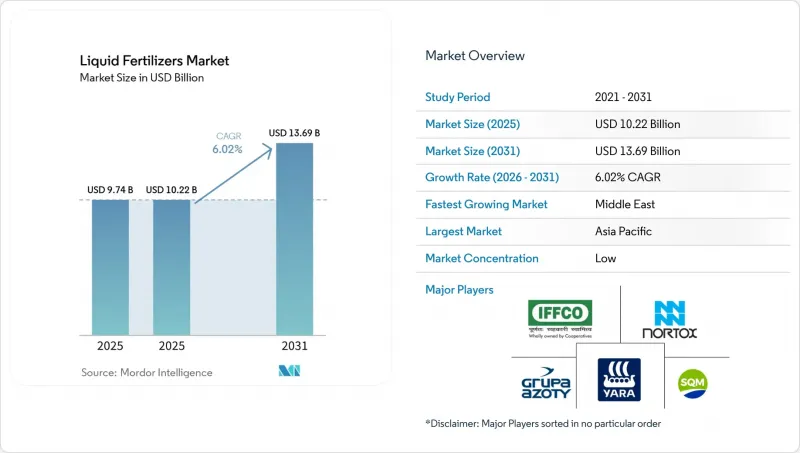
據 Mordor Intelligence 稱,2025 年液態肥料市場價值為 97.4 億美元,預計將從 2026 年的 102.2 億美元成長到 2031 年的 136.9 億美元,預測期(2026-2031 年)的複合年成長率為 6.02%。
本報告按類型(複合肥和單質肥)、施用方法(施肥、灌溉和葉面噴布)、作物(田間作物、園藝作物等)和地區(亞太地區、歐洲、北美、南美以及中東和非洲)進行細分。市場預測以價值(美元)和數量(公噸)表示。
全球液體肥料市場趨勢及洞察
精準灌溉的推廣應用正在加速對液態肥料的需求。
在水資源短缺的背景下,滴灌和微噴灌技術的應用日益普及。與顆粒肥料相比,結合水溶性液體肥料的灌溉施肥系統可減少高達30%的養分浪費。滴灌和微噴灌系統的廣泛應用實現了水和養分的協調供應,使農民能夠從顆粒肥料的追肥過渡到灌溉施肥。這種方法減少了徑流和淋溶。美國農業部的「2024年肥料生產擴建計畫」已撥款5億美元用於提升肥料產能,將直接惠及精準灌溉用戶。這反映出大眾普遍認可液體肥料在養分利用效率方面提高了15%至30%。由於液體肥料能夠瞬間溶解,因此避免了顆粒肥料在狹窄管道中溶解時可能出現的發送器堵塞問題。
快速過渡到均衡作物營養計劃
“4R”管理框架強調適當的“來源”、“用量”、“施用時間和地點”,而多營養素液體肥料只需一次施用即可提供均衡的營養成分。目前,美國和法國的農業推廣人員建議根據作物生長階段分階段施用氮、磷和微量元素,以提高吸收效率。對於那些採用單一營養素方案後產量曲線趨於平緩的種植者而言,均衡的液體肥料是進一步提高產量的下一步。農藝師也指出,與反覆施用尿素顆粒相比,液體肥料能夠抑制土壤酸化,進而維持田間長期生產力。液體肥料市場正從中受益,因為重新混合的產品利潤率高,同時又能滿足下游食品品牌對永續性指標的要求。
溫暖氣候下揮發性高且滲濾液損失大
可溶性氮在30 度C以上會迅速釋放氨氣,季風雨會在數小時內將根際以下的未固定硝酸鹽沖走。越南和加納的研究表明,氮肥利用率比溫帶地區低15%至25%。生產者正透過限制液態肥料的使用(僅限於溫室和保護性栽培)來應對這一問題,導致銷售量成長停滯。雖然抑制劑添加劑可以減少損失,但會使每噸肥料的成本增加50至80美元,從而縮小了與包衣顆粒肥料的成本差距。除非生物基抑制劑的價格下降,否則它們在溫暖潮濕地區的推廣應用將會十分緩慢。
細分市場分析
到2025年,單一成分液體肥料將佔據液體肥料市場58.7%的佔有率,成為最大的產品類型。其主導地位源於單組分液體肥料在可變施肥方案中的廣泛應用,使種植者能夠透過施用單一養分來更精準地解決特定的養分缺乏問題。氮基液體肥料仍然是單一成分產品需求的重要組成部分,尤其是在糧食生產系統中。此外,單組分液體肥料的現場混合特性也提高了在各種種植環境下的操作柔軟性。
預計2026年至2031年間,複合肥料的複合年成長率將達到7.7%,成為成長最快的細分市場。在果園、園藝和特種作物種植系統中,一次施用即可提供均衡營養的多營養素複合肥的應用正在不斷擴大。螯合肥和特殊營養混合物的持續研發正在推動其在高附加價值農業中的應用。此外,複合肥料技術的進步也提高了其與最新施肥灌溉系統和精準營養管理系統的兼容性。
區域分析
亞太地區是最大的區域市場,預計到2025年將佔全球液態肥料市場佔有率的39.9%。這主要得益於印度滴灌補貼的大幅成長以及中國精密農業的進步。在日本和韓國,為了符合嚴格的排水法規,溫室蔬菜生產中正在使用營養液循環系統。在澳洲廣大的糧食產區,人們正在進行試驗,利用電導率掃描產生的可變施肥量液態肥料地圖,旨在減少田間產量差異。雖然孟加拉、巴基斯坦和越南的液態肥料絕對採用率仍然較低,但透過國家推廣計畫實施的示範田,水稻和蔬菜種植者的知識差距正在縮小。
中東地區經濟正以8.1%的複合年成長率成長,預計到2031年將實現這一目標,而這一切都始於小規模生產。奈及利亞的番茄生產群集和肯亞的酪梨農場都已建立了社區肥料和灌溉中心,並利用不銹鋼儲存槽來克服資本投資障礙。南非的葡萄酒和柑橘出口商則依靠鐵和鋅螯合劑來滿足歐洲的殘留物標準,他們的成功經驗正在生產者網路中迅速傳播。
在北美和歐洲,人們的關注點正從擴大耕地面積轉向透過實施物聯網最佳化的施肥系統來改善現有農地。在美國,玉米和大豆種植者正在利用即時空拍照片來調整生長中期液態氮的施用量,從而減少可能超過州養分限值的過度施用。在歐洲,硝酸鹽指令正在推動對符合170公斤氮/公頃限值的精準液體肥料的需求,荷蘭和丹麥等國已顯著採用此類肥料。東歐市場由於農場規模小規模以及缺乏施肥和灌溉基礎設施而面臨挑戰。然而,歐盟的碳關稅可能為提高效率提供資金籌措支持。南美洲正在經歷顯著成長,這得益於巴西甘蔗種植的施肥和灌溉措施以及阿根廷特色水果的出口。
其他好處:
- Excel格式的市場預測(ME)表
- 3個月的分析師支持
目錄
第1章:引言
- 研究假設和市場定義
- 調查範圍
- 調查方法
第2章:本報告的內容
第3章:執行摘要和主要發現
第4章:主要產業趨勢
- 主要農作物種植面積
- 田間作物
- 園藝作物
- 平均施肥量
- 微量營養素
- 田間作物
- 園藝作物
- 主要營養素
- 田間作物
- 園藝作物
- 次要營養元素
- 田間作物
- 園藝作物
- 微量營養素
- 配備灌溉設施的農田
- 法律規範
- 價值鍊和通路分析
- 市場促進因素
- 精準灌溉技術的日益普及將促進液體藥劑的吸收。
- 快速過渡到均衡作物營養計劃
- 政府補貼以支持施肥和灌溉解決方案
- 基於無人機的微噴施和施肥平台
- 一種農場物聯網混合系統,可即時混合。
- 透過電解氨生產硝酸鹽來降低生產成本。
- 市場限制因素
- 溫暖氣候下高波動性和淋溶作用造成的損失
- 儲存和處理腐蝕性物質的基礎設施成本
- 對特定螯合劑中全氟烷基和多氟烷基物質 (PFAS) 污染的調查
- 由於貨櫃重量規定更加嚴格,運費正在上漲。
第5章 市場規模與成長預測
- 類型
- 複雜類型
- 直的
- 按營養成分
- 微量營養素
- 氮基
- 磷酸鹽基
- 鉀基
- 次要營養元素
- 按營養成分
- 使用方法
- 施肥和灌溉
- 葉面噴布
- 作物類型
- 田間作物
- 園藝作物
- 草坪和觀賞植物
- 地區
- 亞太地區
- 澳洲
- 孟加拉
- 中國
- 印度
- 印尼
- 日本
- 巴基斯坦
- 菲律賓
- 泰國
- 越南
- 其他亞太國家
- 歐洲
- 法國
- 德國
- 義大利
- 荷蘭
- 俄羅斯
- 西班牙
- 烏克蘭
- 英國
- 其他歐洲國家
- 中東
- 沙烏地阿拉伯
- 阿拉伯聯合大公國
- 土耳其
- 其他中東國家
- 北美洲
- 加拿大
- 墨西哥
- 美國
- 其他北美國家
- 南美洲
- 巴西
- 其他南美國家
- 非洲
- 南非
- 奈及利亞
- 其他非洲國家
- 亞太地區
第6章 競爭情勢
- 關鍵策略趨勢
- 市佔率分析
- 企業狀況
- 公司簡介
- Yara International ASA
- Sociedad Quimica y Minera de Chile SA
- Indian Farmers Fertiliser Cooperative Limited(IFFCO)
- Grupa Azoty SA
- Nortox SA
- ICL Group
- BMS Micro-Nutrients NV(Floridienne SA)
- Haifa Group
- Nutrien Ltd
- CF Industries Holdings, Inc.
- Kugler Company
- AgroLiquid
- Tessenderlo Kerley Inc(Tessenderlo Group)
- JR Simplot Company
- EuroChem Group
第7章:化肥產業執行長面臨的關鍵策略挑戰
According to Mordor Intelligence, the liquid fertilizers market size was valued at USD 9.74 billion in 2025 and is estimated to grow from USD 10.22 billion in 2026 to USD 13.69 billion by 2031, at a CAGR of 6.02% during the forecast period (2026-2031).
This report is Segmented by Type (Complex and Straight), by Application Mode (Fertigation and Foliar), by Crop Type (Field Crops, Horticultural Crops, and More), and by Geography (Asia-Pacific, Europe, North America, South America, Middle East, and Africa). The Market Forecasts are Provided in Terms of Value (USD) and Volume (Metric Tons).
Global Liquid Fertilizers Market Trends and Insights
Precision Irrigation Adoption Accelerates Liquid Uptake
Water scarcity is propelling drip and micro-sprinkler rollouts, and fertigation lines paired with soluble liquids reduce nutrient waste by up to 30% compared with granular broadcasting. The extensive use of drip and micro-sprinkler systems aligns water and nutrient delivery, allowing farmers to shift from granular top-dressing to in-line fertigation. This approach reduces runoff and leaching. The United States Department of Agriculture 2024 Fertilizer Production Expansion Program has allocated USD 500 million to enhance capacity, directly benefiting precision irrigation users. This reflects public acknowledgment of the 15-30% nutrient-use efficiency improvements achieved with liquid fertilizers . Liquids dissolve instantly, eliminating emitter clogging that undermines granular solubility in narrow lines.
Rapid Shift Toward Balanced Crop Nutrition Programs
The 4R stewardship framework emphasizes right source, rate, time, and placement, and multi-nutrient liquids deliver balanced blends in a single pass. Extension agents in the United States and France now recommend split nitrogen-phosphorus-micronutrient applications tied to crop growth stages, boosting uptake efficiency. Growers facing plateauing yield curves for single-nutrient programs view balanced liquids as the next lever for incremental gains. Agronomists also note that liquids lower soil acidification relative to repeated urea granule use, preserving long-term field productivity. The liquid fertilizers market benefits because reformulated blends earn premium margins while meeting sustainability metrics demanded by downstream food brands.
High Volatilization and Leaching Losses in Warm Climates
Soluble nitrogen faces rapid ammonia gas release above 30 °C, and monsoon rains wash unfixed nitrate below root zones within hours. Trials in Vietnam and Ghana showed nitrogen-use efficiency 15% to 25% lower than at temperate sites. Growers respond by limiting liquid use to greenhouses or protected horticulture, thereby capping volume growth. Inhibitor additives reduce losses but add USD 50-80 per metric ton, narrowing the cost gap with coated granules. Unless bio-based inhibitors become cheaper, adoption will lag in warm, humid regions.
Other drivers and restraints analyzed in the detailed report include:
- Government Subsidies Favoring Fertigation Solutions
- Drone-Based Micro-Spray Fertilization Platforms
- Stricter Container-Weight Rules Raising Freight Expense
For complete list of drivers and restraints, kindly check the Table Of Contents.
Segment Analysis
Straight fertilizers accounted for 58.7% of the liquid fertilizers market share in 2025, establishing them as the largest product category. Their dominance is attributed to their extensive use in variable-rate nutrient programs, which enable growers to address specific nutrient deficiencies with greater precision through individual nutrient applications. Nitrogenous liquid fertilizers remain a key component of straight-product demand, particularly in cereal production systems. Additionally, on-farm blending capabilities enhance their operational flexibility across various cropping environments.
Complex fertilizers are anticipated to be the fastest-growing segment, with a projected CAGR of 7.7% during 2026-2031. Multi-nutrient formulations are increasingly utilized in orchard, horticultural, and specialty crop systems, where a single application provides balanced nutrition. The ongoing development of chelated and specialty nutrient blends is driving their adoption in high-value agriculture. Furthermore, advancements in formulation technology are improving their compatibility with modern fertigation and precision nutrient management systems.
Complete Report Scope:
- Type
- Complex
- Straight
- By Nutrient
- Micronutrients
- Nitrogenous
- Phosphatic
- Potassic
- Secondary Macronutrients
- By Nutrient
- Application Mode
- Fertigation
- Foliar
- Crop Type
- Field Crops
- Horticultural Crops
- Turf and Ornamental
- Geography
- Asia-Pacific
- Australia
- Bangladesh
- China
- India
- Indonesia
- Japan
- Pakistan
- Philippines
- Thailand
- Vietnam
- Rest of Asia-Pacific
- Europe
- France
- Germany
- Italy
- Netherlands
- Russia
- Spain
- Ukraine
- United Kingdom
- Rest of Europe
- Middle East
- Saudi Arabia
- United Arab Emirates
- Turkey
- Rest of Middle East
- North America
- Canada
- Mexico
- United States
- Rest of North America
- South America
- Brazil
- Rest of South America
- Africa
- South Africa
- Nigeria
- Rest of Africa
- Asia-Pacific
Geography Analysis
Asia-Pacific was the largest regional market, accounting for 39.9% of the liquid fertilizers market in 2025., buoyed by India's surge in drip subsidies and China's precision farming push. Japan and South Korea use recirculating nutrient solutions in greenhouse vegetable production to comply with strict discharge rules. Australia's broadacre cereal belt experiments with variable-rate liquid maps generated from conductivity scans, aiming to close intra-field yield gaps. Bangladesh, Pakistan, and Vietnam trail on absolute penetration, but demonstration plots under state extension programs are narrowing knowledge gaps among rice and vegetable growers.
The Middle East region is growing at an 8.1% CAGR through 2031, from a small base. Nigeria's tomato clusters and Kenya's avocado orchards adopted community fertigation hubs that pool stainless storage to manage capex hurdles. South Africa's wine and citrus exporters rely on iron and zinc chelates to meet European residue standards, and success stories travel quickly through grower networks.
North America and Europe are focusing on upgrading existing agricultural acreage with IoT-optimized dosing systems rather than expanding cultivated areas. In the United States, corn and soybean growers use real-time aerial imagery to calibrate mid-season liquid nitrogen applications, reducing excess use that could exceed state nutrient regulations. In Europe, the Nitrates Directive drives demand for precision liquid fertilizers that comply with the 170 kg N/ha limit, with notable adoption in countries such as the Netherlands and Denmark. Eastern European markets face challenges due to fragmented farms and limited fertigation infrastructure. Nonetheless, European Union carbon border taxes may provide funding opportunities for efficiency improvements. South America is experiencing significant growth rate, driven by Brazil's sugarcane fertigation practices and Argentina's specialty fruit exports.
- Yara International ASA
- Sociedad Quimica y Minera de Chile S.A.
- Indian Farmers Fertiliser Cooperative Limited (IFFCO)
- Grupa Azoty S.A.
- Nortox SA
- ICL Group
- BMS Micro-Nutrients NV (Floridienne SA)
- Haifa Group
- Nutrien Ltd
- CF Industries Holdings, Inc.
- Kugler Company
- AgroLiquid
- Tessenderlo Kerley Inc (Tessenderlo Group)
- J. R. Simplot Company
- EuroChem Group
Additional Benefits:
- The market estimate (ME) sheet in Excel format
- 3 months of analyst support
TABLE OF CONTENTS
1 Introduction
- 1.1 Study Assumptions and Market Definition
- 1.2 Scope of the Study
- 1.3 Research Methodology
2 Report Offers
3 Executive Summary and Key Findings
4 Key Industry Trends
- 4.1 Acreage of Major Crop Types
- 4.1.1 Field Crops
- 4.1.2 Horticultural Crops
- 4.2 Average Nutrient Application Rates
- 4.2.1 Micronutrients
- 4.2.1.1 Field Crops
- 4.2.1.2 Horticultural Crops
- 4.2.2 Primary Nutrients
- 4.2.2.1 Field Crops
- 4.2.2.2 Horticultural Crops
- 4.2.3 Secondary Macronutrients
- 4.2.3.1 Field Crops
- 4.2.3.2 Horticultural Crops
- 4.2.1 Micronutrients
- 4.3 Agricultural Land Equipped for Irrigation
- 4.4 Regulatory Framework
- 4.5 Value Chain and Distribution Channel Analysis
- 4.6 Market Drivers
- 4.6.1 Precision irrigation adoption accelerates liquid uptake
- 4.6.2 Rapid shift toward balanced crop nutrition programs
- 4.6.3 Government subsidies favoring fertigation solutions
- 4.6.4 Drone-based micro-spray fertilization platforms
- 4.6.5 On-farm IoT blending systems enabling just-in-time mixes
- 4.6.6 Nitrate-from-ammonia electrolysis lowering production cost
- 4.7 Market Restraints
- 4.7.1 High volatilization and leaching losses in warm climates
- 4.7.2 Corrosive storage and handling infrastructure costs
- 4.7.3 Per- and polyfluoroalkyl substances (PFAS) contamination scrutiny on certain chelating agents
- 4.7.4 Stricter container-weight rules are raising freight expenses
5 Market Size and Growth Forecasts (Value and Volume)
- 5.1 Type
- 5.1.1 Complex
- 5.1.2 Straight
- 5.1.2.1 By Nutrient
- 5.1.2.1.1 Micronutrients
- 5.1.2.1.2 Nitrogenous
- 5.1.2.1.3 Phosphatic
- 5.1.2.1.4 Potassic
- 5.1.2.1.5 Secondary Macronutrients
- 5.1.2.1 By Nutrient
- 5.2 Application Mode
- 5.2.1 Fertigation
- 5.2.2 Foliar
- 5.3 Crop Type
- 5.3.1 Field Crops
- 5.3.2 Horticultural Crops
- 5.3.3 Turf and Ornamental
- 5.4 Geography
- 5.4.1 Asia-Pacific
- 5.4.1.1 Australia
- 5.4.1.2 Bangladesh
- 5.4.1.3 China
- 5.4.1.4 India
- 5.4.1.5 Indonesia
- 5.4.1.6 Japan
- 5.4.1.7 Pakistan
- 5.4.1.8 Philippines
- 5.4.1.9 Thailand
- 5.4.1.10 Vietnam
- 5.4.1.11 Rest of Asia-Pacific
- 5.4.2 Europe
- 5.4.2.1 France
- 5.4.2.2 Germany
- 5.4.2.3 Italy
- 5.4.2.4 Netherlands
- 5.4.2.5 Russia
- 5.4.2.6 Spain
- 5.4.2.7 Ukraine
- 5.4.2.8 United Kingdom
- 5.4.2.9 Rest of Europe
- 5.4.3 Middle East
- 5.4.3.1 Saudi Arabia
- 5.4.3.2 United Arab Emirates
- 5.4.3.3 Turkey
- 5.4.3.4 Rest of Middle East
- 5.4.4 North America
- 5.4.4.1 Canada
- 5.4.4.2 Mexico
- 5.4.4.3 United States
- 5.4.4.4 Rest of North America
- 5.4.5 South America
- 5.4.5.1 Brazil
- 5.4.5.2 Rest of South America
- 5.4.6 Africa
- 5.4.6.1 South Africa
- 5.4.6.2 Nigeria
- 5.4.6.3 Rest of Africa
- 5.4.1 Asia-Pacific
6 Competitive Landscape
- 6.1 Key Strategic Moves
- 6.2 Market Share Analysis
- 6.3 Company Landscape
- 6.4 Company Profiles (Includes Global Level Overview, Market Level Overview, Core Segments, Financials as Available, Strategic Information, Market Rank/Share for Key Companies, Products and Services, and Recent Developments)
- 6.4.1 Yara International ASA
- 6.4.2 Sociedad Quimica y Minera de Chile S.A.
- 6.4.3 Indian Farmers Fertiliser Cooperative Limited (IFFCO)
- 6.4.4 Grupa Azoty S.A.
- 6.4.5 Nortox SA
- 6.4.6 ICL Group
- 6.4.7 BMS Micro-Nutrients NV (Floridienne SA)
- 6.4.8 Haifa Group
- 6.4.9 Nutrien Ltd
- 6.4.10 CF Industries Holdings, Inc.
- 6.4.11 Kugler Company
- 6.4.12 AgroLiquid
- 6.4.13 Tessenderlo Kerley Inc (Tessenderlo Group)
- 6.4.14 J. R. Simplot Company
- 6.4.15 EuroChem Group
7 Key Strategic Questions for Fertilizer CEOs

 歐洲液體肥料:市場佔有率分析、行業趨勢和統計數據以及成長預測(2026-2031 年)
 液體肥料市場:2026-2032年全球市場預測(依產品類型、作物、生產流程、應用及通路分類)
 液體肥料市場報告:按產品類型、生產流程、作物、應用方法和地區分類(2026-2034 年)
 全球液體肥料市場規模、佔有率、趨勢和成長分析報告(2026-2034年)北美液體肥料市場:市場佔有率分析、產業趨勢與統計及成長預測(2026-2031 年)
 液體肥料市場:按作物類型、成分、類型、應用和地區分類液體肥料市場規模、佔有率、成長及全球產業分析:按類型、應用和地區分類的洞察,2026-2034 年預測
 全球液體肥料市場報告(2026 年)按作物類型、包裝規格、應用、最終用途和銷售管道的多元素水溶性液體肥料市場—2026-2032年全球預測
 液態肥料市場規模、佔有率及成長分析(依作物類型、化合物、應用、類型及地區分類)-2026-2033年產業預測