


 |
市場調查報告書
商品編碼
2120623
手勢姿態辨識:市場佔有率分析、產業趨勢與統計、成長預測(2026-2031)Gesture Recognition - Market Share Analysis, Industry Trends & Statistics, Growth Forecasts (2026 - 2031) |
||||||

※ 本網頁內容可能與最新版本有所差異。詳細情況請與我們聯繫。
根據 Mordor Intelligence 預測,手勢姿態辨識市場規模將從 2025 年的 304.8 億美元成長到 2026 年的 374.1 億美元,然後在 2031 年達到 1041.6 億美元,2026 年至 2031 年的複合年成長率為 22.75%。
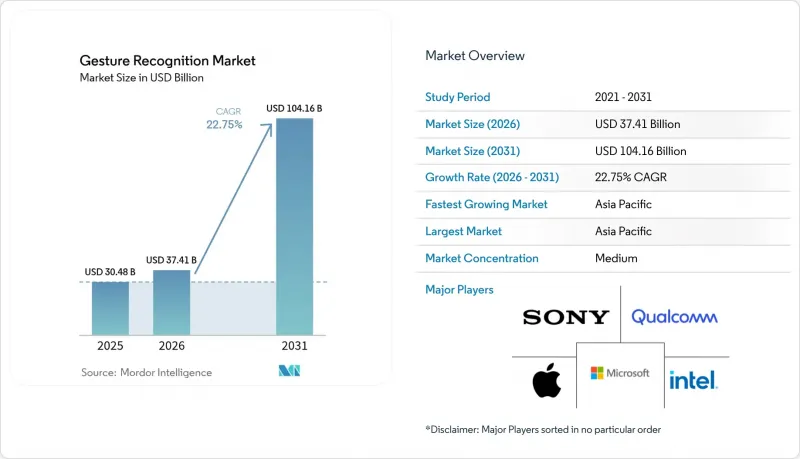
本報告按技術(觸控手勢姿態辨識、非接觸式手勢姿態辨識)、組件(硬體、軟體)、手勢類型(線上動態手勢、離線靜態手勢)、認證方法(生物識別、非生物識別)、終端用戶產業(家用電子電器、汽車、航太與國防等)以及地區進行細分。市場預測以美元計價。
全球手勢姿態辨識市場趨勢及洞察
亞洲旗艦智慧型手機廣泛採用毫米波和飛行時間感測器。
亞洲行動電話廠商目前正將STMicroelectronics的VL53L7CX等多區域ToF模組整合到手機中,從而實現毫米級的深度精度,不受環境光線條件的影響,即使在強光環境下也能可靠地接收空中指令輸入。這一趨勢也透過Ceva的MotionEngine Hex韌體擴展到智慧電視領域,該韌體整合了慣性數據和雷達數據,從而實現對用戶介面的空間控制。隨著ToF晶片組批量生產後單價降至1美元以下,手勢控制正從高階差異化功能轉變為手勢姿態辨識市場的標配功能。
為了滿足 Euro NCAP 的要求,汽車製造商擴大採用基於手勢的車載抬頭顯示器 (HUD)。
將於2024年7月生效的「高級駕駛員分心警告」(ADDW)法規要求汽車製造商降低駕駛員的認知負荷,從而加速了基於攝影機的手勢控制中心在歐洲車型中的應用。 BMW7系列車型已獲得L2/L3級認證,顯示其已做好商業化準備;奧迪的3D駕駛座介面則展示了透過在主機頂部進行手勢滑動來選擇多模態資訊娛樂系統的功能。能夠保證回應時間低於150毫秒且誤報率低於3%的供應商預計將贏得相關項目的訂單,這將進一步鞏固手勢姿態辨識市場的成長動能。
在熱帶地區陽光下,基於視覺的系統假陽性率較高
以攝影機為中心的演算法難以在高照度背景下辨識手部輪廓,導致戶外自助服務終端和叫車等應用場景的辨識錯誤率激增。研究表明,基於雷達的替代方案無論光照條件如何,都能保持90%以上的準確率,這促使系統設計人員在手勢姿態辨識市場中採用多感測器融合技術。
細分市場分析
到2025年,非接觸式解決方案將佔銷售額的57.65%,反映出終端市場對衛生、駕駛安全和身臨其境型娛樂的重視。隨著飛行時間(ToF)、毫米波雷達和超音波陣列等技術的出現降低了組件成本,預計到2031年,非接觸式細分市場將以23.65%的複合年成長率成長,超過整體手勢姿態辨識市場。相較之下,電容式觸控控制在對成本敏感的消費性電子設備中仍然很重要,但其複合年成長率仍處於個位數。京瓷的深度感測器在10公分的範圍內可實現100微米的解析度,使其能夠應用於機器人拾取放置和整形外科定位工具等需要手術級精度的應用領域。向環境互動的穩定轉變表明,非接觸式方法最終將比需要接觸的傳統方法佔據更大的手勢姿態辨識市場佔有率。
非接觸式科技的普及正在改變供應商之間的權力模式。傳統上將晶片商品化的感測器供應商,如今開始將人工智慧韌體、數據模型和開發者入口網站捆綁銷售,不僅獲得了硬體利潤,還獲得了持續的授權費用。這種商品搭售符合原始設備製造商 (OEM) 的優先事項,即優先考慮現場無線 (OTA) 效能提升,並支援手勢姿態辨識市場大規模部署非接觸式技術所需的可擴展經濟模式。
由於鏡頭、雷達前端和微控制器等組件的固有成本,預計到2025年,硬體將佔手勢姿態辨識市場規模的70.85%。然而,能夠實現情境識別、用戶自適應和聯邦學習的軟體平台預計將以23.1%的複合年成長率成長,比硬體成長速度快350個基點以上。英飛凌的「DEEPCRAFT Ready Models」提供針對常見手勢的預訓練神經網路,可將整合時間縮短40%,並提升公司在價值曲線上的地位。同時,ImagineMob基於視覺化圖的機器學習工具可將模型開發週期縮短至數小時,使即使是中型OEM廠商也能輕鬆進行AI最佳化。
收入結構的轉變為服務商品搭售創造了機遇,尤其是在預測性維護、雲端分析以及透過手勢觸發的數位購買進行應用程式內收費等領域。能夠提供整合晶片、韌體和生命週期服務的供應商,在手勢姿態辨識市場中佔據優勢,並有望贏得客戶忠誠度,因為在該市場中,總體擁有成本 (TCO) 比組件定價更為重要。
區域分析
亞太地區的領先地位得益於垂直整合的供應鏈、政府的大力支持以及早期用戶龐大的普及基礎。該地區的行動電話製造商每10-12個月就會推出新款旗艦機型,每款機型都配備更高解析度的飛行時間(ToF)陣列,從而擴大了感測器供應商的手勢姿態辨識市場。日本企業集團透過在汽車焊接和半導體光刻領域採用基於XR(擴增實境)的技能轉移平台,推動了對高精度手勢辨識模型的需求。韓國的晶圓產能確保了零件的穩定供應,而印度智慧電視的普及則透過向中等收入家庭引入非接觸式遙控器,擴大了收入金字塔。
在北美,醫療產業的購買力正推動手術室和診斷中心部署相關技術,從而帶來更高的單一設備效益。已採用空中顯示技術的醫院報告稱,交叉感染事件顯著減少,進而降低了再入院罰款,並提高了手勢操作介面的投資回報率。汽車製造商正在整合基於手勢的駕駛員監控功能,以符合聯邦政府關於2024年後駕駛員分心的指導方針,並逐步提高感測器的搭載率。
歐洲在監管方面處於領先地位。歐洲新車安全評鑑協會(Euro NCAP)的指令強制要求車輛配備防分心駕駛技術,加速了這些技術在豪華車和大眾市場車款中的普及。德國供應商正與國內汽車製造商合作開發手勢控制模組,在硬體採購日益全球化的背景下,不斷提升其區域價值主張。同時,海灣合作理事會(GCC)國家正在推進人工智慧主權舉措,並資助配備非接觸式用戶介面的公共服務亭建設,中東地區的成長勢頭遠超其現有水平。
其他好處:
- Excel格式的市場預測(ME)表
- 3個月的分析師支持
目錄
第1章:引言
- 研究假設和市場定義
- 調查範圍
第2章:調查方法
第3章執行摘要
第4章 市場狀況
- 市場概覽
- 市場促進因素
- 亞洲旗艦智慧型手機廣泛採用毫米波和飛行時間感測器。
- 汽車製造商正在採用車載手勢抬頭顯示器,以滿足 Euro NCAP 關於防止駕駛分心的監管要求。
- 美國和德國的醫院對非接觸式人機互動設備 (HMI) 的需求日益成長,以降低手術室中院內感染 (HAI) 的風險。
- 整合到 XR 穿戴式裝置中,可在工業培訓中實現 6 自由度 (6-DoF) 控制(日本)
- 在價格競爭日益激烈的市場中,智慧電視廠商紛紛推出支援隔空手勢的遙控器,以求脫穎而出。
- 政府智慧城市津貼正在推動公共資訊亭採用基於手勢的使用者介面(GCC)。
- 市場限制因素
- 在熱帶地區,基於視覺的系統在陽光下往往具有較高的誤報率。
- 缺乏開放的互通性標準正在推高原始設備製造商的整合成本。
- 在波長小於 10nm 的移動 SoC 中,「始終開啟」的基於手勢的喚醒詞功能會消耗大量電池電量。
- GDPR 框架下機載影像分析資料隱私合規面臨的挑戰
- 監理展望
- 波特五力分析
第5章 市場規模與成長預測
- 透過技術
- 基於觸摸的手勢姿態辨識
- 2D多點觸控面板
- 電容式和電阻式感測器
- 非接觸式手勢姿態辨識
- 2D相機底座
- 3D深度和飛行時間
- 超音波和毫米波雷達
- 基於觸摸的手勢姿態辨識
- 按組件
- 硬體(感測器、控制器、SoC)
- 軟體(機器學習演算法、SDK、中介軟體)
- 按手勢類型
- 線上動態手勢
- 離線靜態手勢
- 按類型進行身份驗證
- 生物識別(臉部、虹膜、手掌)
- 非生物識別(運動、姿勢)
- 按最終用戶行業分類
- 家用電子產品
- 智慧型手機和平板電腦
- 智慧電視和機上盒
- AR/VR 和穿戴式裝置
- 車
- 駕駛員監控和資訊娛樂
- 航太/國防
- 衛生保健
- 手術室及診斷室
- 遊戲與娛樂
- 工業與機器人
- 其他行業
- 家用電子產品
- 按地區
- 北美洲
- 美國
- 加拿大
- 墨西哥
- 南美洲
- 巴西
- 阿根廷
- 其他南美國家
- 歐洲
- 英國
- 德國
- 法國
- 義大利
- 其他歐洲國家
- 亞太地區
- 中國
- 日本
- 印度
- 韓國
- 紐西蘭和澳大利亞
- 其他亞太國家
- 中東和非洲
- 海灣合作理事會(沙烏地阿拉伯、阿拉伯聯合大公國、卡達)
- 土耳其
- 南非
- 北美洲
第6章 競爭情勢
- 市場集中度
- 策略趨勢
- 市佔率分析
- 公司簡介
- Intel Corporation
- Qualcomm Technologies Inc.
- Apple Inc.
- Microsoft Corp.
- Sony Group Corp.
- Google LLC
- Meta Platforms Inc.
- Ultraleap Ltd.
- Microchip Technology Inc.
- Infineon Technologies AG
- Synaptics Inc.
- Elliptic Laboratories AS
- GestureTek Inc.
- Cognitec Systems GmbH
- Eyesight Technologies Ltd.
- PointGrab Ltd.
- Omron Corporation
- Jabil Inc.
- Leap Motion
第7章 市場機會與未來展望
According to Mordor Intelligence, the gesture recognition market size is expected to grow from USD 30.48 billion in 2025 to USD 37.41 billion in 2026 and is forecast to reach USD 104.16 billion by 2031 at 22.75% CAGR over 2026-2031.
This report is Segmented by Technology (Touch-Based Gesture Recognition, Touchless Gesture Recognition), Component (Hardware, Software), Gesture Type (Online Dynamic Gestures, Offline Static Gestures), Authentication (Biometric, Non-Biometric), End-User Industry (Consumer Electronics, Automotive, Aerospace and Defense and More), and Geography. The Market Forecasts are Provided in Terms of Value (USD).
Global Gesture Recognition Market Trends and Insights
Proliferation of mm-wave and ToF sensors in flagship smartphones across Asia
Asia-based handset OEMs now embed multizone ToF modules such as STMicroelectronics' VL53L7CX to deliver millimeter-level depth accuracy without ambient-light restrictions, enabling reliable mid-air command input even under harsh illumination. The deployment extends to smart-TV handsets through Ceva's MotionEngine Hex firmware, which integrates inertial and radar data to deliver spatial control of user interfaces. As the cost of ToF chipsets falls below USD 1 per unit in volume lots, gesture control is transitioning from a premium differentiator to a default feature in the gesture recognition market.
Automaker adoption of in-cabin gesture HUDs to meet Euro NCAP mandates
The July 2024 Advanced Driver Distraction Warning regulation obliges OEMs to mitigate cognitive load, propelling rapid integration of camera-based gesture hubs in European models. BMW's Level 2/3 certification on the 7 Series demonstrates commercial readiness, while Audi's 3-D cockpit interface showcases multi-modal infotainment selection using above-console hand sweeps. Suppliers that can guarantee sub-150 ms response times and <3% false-trigger rates stand to win program awards, reinforcing the growth trajectory of the gesture recognition market.
High false-positive rates in sunlight for vision-based systems in tropical regions
Camera-centric algorithms struggle to resolve hand contours against high-lux backgrounds, driving error spikes in outdoor kiosks and ride-hailing vehicles. Research indicates radar-based alternatives maintain >90% precision independent of illumination, prompting system designers to adopt multi-sensor fusion in the gesture recognition market.
Other drivers and restraints analyzed in the detailed report include:
- Hospital demand for touch-free HMI to cut HAI risks in surgical suites
- Integration into XR wearables to unlock 6-DoF control for industrial training
- Absence of open interoperability standards inflating OEM integration cost
For complete list of drivers and restraints, kindly check the Table Of Contents.
Segment Analysis
Touchless solutions generated 57.65% of 2025 revenue, reflecting end-market emphasis on hygiene, driver safety, and immersive entertainment. The touchless sub-segment will compound at 23.65% through 2031, outpacing the broader gesture recognition market as ToF, mm-wave radar, and ultrasonic arrays reduce bill-of-materials cost. In contrast, capacitive touch-based controls retain relevance in cost-sensitive consumer devices, yet their CAGR trails at single-digits. Kyocera's depth sensor demonstrates 100 µm resolution within 10 cm, enabling robotic pick-and-place and orthopedic alignment tools that demand surgical-grade accuracy. The steady migration toward ambient interaction implies touchless modalities will ultimately hold a greater gesture recognition market share than their contact-dependent predecessors.
Touchless expansion is altering supplier power dynamics. Sensor vendors that historically commoditized silicon are now bundling AI firmware, data models, and developer portals, capturing recurring license fees on top of hardware margins. This re-bundling aligns with OEM priorities for field-upgradable over-the-air performance improvements and supports the scalable economics required for high-volume touchless adoption within the gesture recognition market.
Hardware contributed 70.85% of gesture recognition market size in 2025, driven by the intrinsic cost of lenses, radar front-ends, and MCUs. However, software platforms that deliver contextual awareness, user adaptation, and federated learning are forecast at a 23.1% CAGR-more than 350 bps above hardware growth. Infineon's DEEPCRAFT Ready Models supply pre-trained neural networks for common gestures, cutting integration time by 40% and repositioning the firm higher on the value curve. Meanwhile, Imagimob's visual graph-based ML tooling compresses model-development cycles to hours, democratizing AI optimization for mid-tier OEMs.
The revenue mix shift creates opportunities for service bundling: predictive maintenance, cloud-based analytics, and in-app monetization through gesture-initiated digital purchases. Suppliers able to orchestrate silicon, firmware, and lifecycle services are poised to command loyalty in the gesture recognition market as total cost of ownership eclipses component price considerations.
Complete Report Scope:
- By Technology
- Touch-based Gesture Recognition
- 2-D Multi-touch Panels
- Capacitive and Resistive Sensors
- Touchless Gesture Recognition
- 2-D Camera-based
- 3-D Depth and ToF
- Ultrasonic and mm-wave Radar
- Touch-based Gesture Recognition
- By Component
- Hardware (Sensors, Controllers, SoCs)
- Software (ML Algorithms, SDKs, Middleware)
- By Gesture Type
- Online Dynamic Gestures
- Offline Static Gestures
- By Authentication
- Biometric (Face, Iris, Palm-vein)
- Non-biometric (Motion, Pose)
- By End-user Industry
- Consumer Electronics
- Smartphones and Tablets
- Smart-TV and Set-top Boxes
- AR/VR and Wearables
- Automotive
- Driver Monitoring and Infotainment
- Aerospace and Defense
- Healthcare
- Surgical and Diagnostic Rooms
- Gaming and Entertainment
- Industrial and Robotics
- Other Industries
- Consumer Electronics
- By Geography
- North America
- United States
- Canada
- Mexico
- South America
- Brazil
- Argentina
- Rest of South America
- Europe
- United Kingdom
- Germany
- France
- Italy
- Rest of Europe
- Asia Pacific
- China
- Japan
- India
- South Korea
- New Zealand and Australia
- Rest of Asia Pacific
- Middle East and Africa
- GCC (Saudi Arabia, UAE, Qatar)
- Turkey
- South Africa
- North America
Geography Analysis
Asia Pacific's dominance rests on vertically integrated supply chains, supportive government funding, and an immense installed base of early-adopter consumers. Regional handset brands release new flagship lines every 10-12 months, each iteration embedding higher-resolution ToF arrays, thereby expanding the gesture recognition market size for sensor vendors. Japanese conglomerates employ XR-based skill-transfer platforms in automotive welding and semiconductor lithography, reinforcing demand for high-precision gesture models. South Korea's wafer capacity secures component continuity, while India's smart-TV expansion introduces touchless remotes into middle-income households, broadening the revenue pyramid.
North America leverages healthcare spending power for surgical suites and diagnostic centers, generating premium revenue per unit. Hospitals adopting mid-air displays report significant reductions in cross-contamination incidents, translating into lower readmission penalties and bolstering ROI for gesture interfaces. Automotive OEMs integrate gesture-based driver monitoring to comply with post-2024 federal guidelines on distracted driving, pushing incremental sensor attach rates.
Europe acts as a regulatory pacesetter. Euro NCAP directives mandate distraction-mitigation technologies, accelerating deployment across both luxury and mass-market vehicle classes. German suppliers co-develop gesture modules with domestic automakers, cementing regional value capture despite globalized hardware sourcing. Meanwhile, GCC nations pursue AI sovereignty initiatives that fund public-service kiosks with touchless UIs, giving the Middle East an outsized growth profile relative to its current base.
- Intel Corporation
- Qualcomm Technologies Inc.
- Apple Inc.
- Microsoft Corp.
- Sony Group Corp.
- Google LLC
- Meta Platforms Inc.
- Ultraleap Ltd.
- Microchip Technology Inc.
- Infineon Technologies AG
- Synaptics Inc.
- Elliptic Laboratories AS
- GestureTek Inc.
- Cognitec Systems GmbH
- Eyesight Technologies Ltd.
- PointGrab Ltd.
- Omron Corporation
- Jabil Inc.
- Leap Motion
Additional Benefits:
- The market estimate (ME) sheet in Excel format
- 3 months of analyst support
TABLE OF CONTENTS
1 INTRODUCTION
- 1.1 Study Assumptions and Market Definition
- 1.2 Scope of the Study
2 RESEARCH METHODOLOGY
3 EXECUTIVE SUMMARY
4 MARKET LANDSCAPE
- 4.1 Market Overview
- 4.2 Market Drivers
- 4.2.1 Proliferation of mm-wave and ToF sensors in flagship smartphones across Asia
- 4.2.2 Automaker adoption of in-cabin gesture HUDs to meet Euro NCAP distraction mandates
- 4.2.3 Hospital demand for touch-free HMI to cut HAI risks in surgical suites (US and Germany)
- 4.2.4 Integration into XR wearables to unlock 6-DoF control for industrial training (Japan)
- 4.2.5 Smart-TV vendors bundling air-gesture remotes to differentiate in price-eroding market
- 4.2.6 Government smart-city grants driving public-kiosk gesture UI roll-outs (GCC)
- 4.3 Market Restraints
- 4.3.1 High false-positive rates in sunlight for vision-based systems in tropical regions
- 4.3.2 Absence of open interoperability standards inflating OEM integration cost
- 4.3.3 "Always-on" gesture wake-word draining battery in sub-10 nm mobile SoCs
- 4.3.4 Data-privacy compliance hurdles for in-cabin video analytics under GDPR
- 4.4 Regulatory Outlook
- 4.5 Porter's Five Forces Analysis
- 4.5.1 Bargaining Power of Suppliers
- 4.5.2 Bargaining Power of Buyers
- 4.5.3 Threat of New Entrants
- 4.5.4 Threat of Substitutes
- 4.5.5 Intensity of Competitive Rivalry
5 MARKET SIZE AND GROWTH FORECASTS (VALUE)
- 5.1 By Technology
- 5.1.1 Touch-based Gesture Recognition
- 5.1.1.1 2-D Multi-touch Panels
- 5.1.1.2 Capacitive and Resistive Sensors
- 5.1.2 Touchless Gesture Recognition
- 5.1.2.1 2-D Camera-based
- 5.1.2.2 3-D Depth and ToF
- 5.1.2.3 Ultrasonic and mm-wave Radar
- 5.1.1 Touch-based Gesture Recognition
- 5.2 By Component
- 5.2.1 Hardware (Sensors, Controllers, SoCs)
- 5.2.2 Software (ML Algorithms, SDKs, Middleware)
- 5.3 By Gesture Type
- 5.3.1 Online Dynamic Gestures
- 5.3.2 Offline Static Gestures
- 5.4 By Authentication
- 5.4.1 Biometric (Face, Iris, Palm-vein)
- 5.4.2 Non-biometric (Motion, Pose)
- 5.5 By End-user Industry
- 5.5.1 Consumer Electronics
- 5.5.1.1 Smartphones and Tablets
- 5.5.1.2 Smart-TV and Set-top Boxes
- 5.5.1.3 AR/VR and Wearables
- 5.5.2 Automotive
- 5.5.2.1 Driver Monitoring and Infotainment
- 5.5.3 Aerospace and Defense
- 5.5.4 Healthcare
- 5.5.4.1 Surgical and Diagnostic Rooms
- 5.5.5 Gaming and Entertainment
- 5.5.6 Industrial and Robotics
- 5.5.7 Other Industries
- 5.5.1 Consumer Electronics
- 5.6 By Geography
- 5.6.1 North America
- 5.6.1.1 United States
- 5.6.1.2 Canada
- 5.6.1.3 Mexico
- 5.6.2 South America
- 5.6.2.1 Brazil
- 5.6.2.2 Argentina
- 5.6.2.3 Rest of South America
- 5.6.3 Europe
- 5.6.3.1 United Kingdom
- 5.6.3.2 Germany
- 5.6.3.3 France
- 5.6.3.4 Italy
- 5.6.3.5 Rest of Europe
- 5.6.4 Asia Pacific
- 5.6.4.1 China
- 5.6.4.2 Japan
- 5.6.4.3 India
- 5.6.4.4 South Korea
- 5.6.4.5 New Zealand and Australia
- 5.6.4.6 Rest of Asia Pacific
- 5.6.5 Middle East and Africa
- 5.6.5.1 GCC (Saudi Arabia, UAE, Qatar)
- 5.6.5.2 Turkey
- 5.6.5.3 South Africa
- 5.6.1 North America
6 COMPETITIVE LANDSCAPE
- 6.1 Market Concentration
- 6.2 Strategic Moves
- 6.3 Market Share Analysis
- 6.4 Company Profiles (includes Global-level Overview, Market-level Overview, Core Segments, Financials as available, Strategic Information, Market Rank/Share, Products and Services, Recent Developments)
- 6.4.1 Intel Corporation
- 6.4.2 Qualcomm Technologies Inc.
- 6.4.3 Apple Inc.
- 6.4.4 Microsoft Corp.
- 6.4.5 Sony Group Corp.
- 6.4.6 Google LLC
- 6.4.7 Meta Platforms Inc.
- 6.4.8 Ultraleap Ltd.
- 6.4.9 Microchip Technology Inc.
- 6.4.10 Infineon Technologies AG
- 6.4.11 Synaptics Inc.
- 6.4.12 Elliptic Laboratories AS
- 6.4.13 GestureTek Inc.
- 6.4.14 Cognitec Systems GmbH
- 6.4.15 Eyesight Technologies Ltd.
- 6.4.16 PointGrab Ltd.
- 6.4.17 Omron Corporation
- 6.4.18 Jabil Inc.
- 6.4.19 Leap Motion
7 MARKET OPPORTUNITIES AND FUTURE OUTLOOK
- 7.1 White-space and Unmet-need Assessment

 手勢手勢姿態辨識軟體市場:全球市場預測,2026-2032年
 手勢姿態辨識市場:按組件類型、最終用戶行業和地區分類手勢姿態辨識市場:按產品、技術、互動類型、檢測範圍、部署方式和應用分類-全球市場預測(2026-2032 年)
 汽車手勢姿態辨識系統:市場佔有率分析、產業趨勢與統計、成長預測(2026-2031)
 2D手勢姿態辨識市場報告:按技術、產業和地區分類(2026-2034年)手勢姿態辨識市場規模、佔有率、趨勢和預測:按技術、終端用戶產業和地區分類,2026-2034 年
 2026年全球汽車手勢姿態辨識市場報告汽車手勢姿態辨識系統市場:按車輛類型、組件、技術、應用和最終用戶分類-2026-2032年全球市場預測
 手勢姿態辨識市場機會、成長要素、產業趨勢分析及2026年至2035年預測2026年全球桌面和可攜式個人電腦(PC)手勢姿態辨識技術市場報告