


 |
市場調查報告書
商品編碼
2097344
汽車手勢姿態辨識系統:市場佔有率分析、產業趨勢與統計、成長預測(2026-2031)Automotive Gesture Recognition Systems - Market Share Analysis, Industry Trends & Statistics, Growth Forecasts (2026 - 2031) |
||||||

※ 本網頁內容可能與最新版本有所差異。詳細情況請與我們聯繫。
據 Mordor Intelligence 稱,2025 年汽車手勢姿態辨識系統市值為 25.5 億美元,預計到 2031 年將從 2026 年的 29.8 億美元成長至 64.9 億美元,複合年成長率為 16.86%。
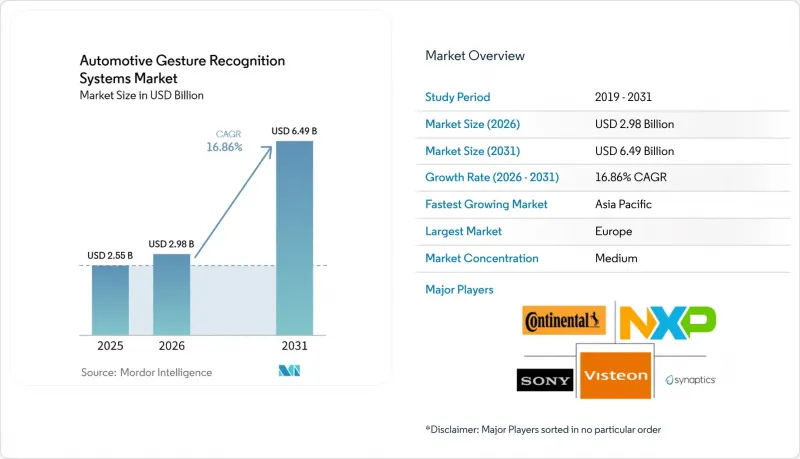
本報告按組件(觸控系統、非接觸式系統)、認證方式(手/指紋、臉部、視覺/虹膜、其他)、應用(多媒體/資訊娛樂/導航、照明系統、其他)、技術(攝影機系統等)和地區(北美等)進行細分。市場預測以美元計價。
全球汽車手勢姿態辨識系統市場趨勢及洞察
對先進人機互動介面的需求正在推動高階汽車的差異化。
在競爭日益激烈的豪華車市場,豪華車製造商正將手勢姿態辨識作為核心差異化優勢。 BMW的「全景iDrive」和賓士的「MBUX智慧人機互動系統」展示了非接觸式操作如何帶來技術優勢。大陸集團在2025年國際生物識別展(CES 2025)上展出的生物識別演示車,配備了一套融合手勢和生物識別的系統,使駕駛員能夠在專注於路面的同時,透過簡單的手勢操作個性化車輛設置。這種整合不僅限於資訊娛樂系統,還包括空調控制、座椅調整和環境燈等功能。捷豹路虎的非接觸式觸控螢幕技術則透過超音波觸覺觸覺回饋。這一趨勢反映出汽車製造商們意識到,手勢控制能夠創造情感互動和創新價值,從而為高價策略提供合理的依據,尤其是在傳統機械差異化在各個細分市場逐漸趨於同質化的今天。
法律規範正在加速駕駛員監控的整合。
歐盟的「高級駕駛員分心警告」(ADDW)法規要求新型重型商用車在2024年7月前必須配備即時駕駛員監控系統,這推動了手勢姿態辨識技術在綜合駕駛員狀態評估系統中的應用。美國國家公路交通安全管理局(NHTSA)關於駕駛員分心的指南以及歐洲新車安全評鑑協會(Euro NCAP)的協議也日益認可手勢操作是比觸控螢幕操作更安全的選擇,前提是滿足一定的注意力閾值並配備故障保護機制。監管的影響不僅限於遵守安全標準,還延伸至資料隱私要求。歐盟《一般資料保護規範》(GDPR)和中國新頒布的資料安全法均要求在設備本身上進行手勢姿態辨識處理,以最大限度地減少個人資料的傳輸。商用車業者的報告顯示,配備手勢功能的駕駛監控系統能夠提供即時回饋,使超速違規行為減少了37%,未繫安全帶的情況減少了56%。這些顯著的安全改進正在推動監管部門的採納。
成本限制阻礙了其在普通市場的廣泛應用。
先進的人工智慧平台會增加系統成本,這可能會延緩價格敏感型市場(尤其是新興市場)的普及,因為新興市場的買家仍然非常注重成本。這些成本源自於多個組件,包括專用攝影機、紅外線感測器、專用處理單元和軟體授權費。基於攝影機的系統還需要高解析度感測器,以便在各種光照條件下可靠運作。此外,整合也會產生額外成本,因為原始設備製造商 (OEM) 必須在數千種用例和環境條件下測試和檢驗手勢姿態辨識系統,以符合汽車安全標準。這些檢驗週期可能比傳統的人機介面 (HMI) 開發週期長 18 到 24 個月。在商用車領域,這種成本挑戰更為突出,因為車隊營運商希望快速獲得投資回報。因此,手勢系統必須展現出可衡量的生產力提升和合規性優勢,才能證明額外成本的合理性。
基於細分市場的分析
到2025年,非接觸式系統將主導汽車手勢姿態辨識市場,佔62.01%的佔有率。預計到2031年,非接觸式系統將以17.23%的複合年成長率成長,其成長速度預計將遠超接觸式系統,這主要得益於人們對衛生問題的關注以及高階和商用車領域對先進人工智慧技術的需求。疫情後人們行為習慣的轉變,以及監管機構為減少駕駛分心所施加的壓力,都推動了非接觸式系統的發展。例如,梅賽德斯-奔馳的MBUX智慧人機互動系統和寶馬的全景iDrive系統等,都顯示消費者已經接受了使用手勢控制資訊娛樂和空調系統的技術。
安波福(Aptiv)基於人工智慧的「高級乘員分類」平台能夠根據身高、體重和體態識別乘員,這預示著非接觸式車輛互動正在向融合,超越手勢姿態辨識,生物識別生物識別訪問和個性化設置。該領域的成長軌跡反映出,原始設備製造商(OEM)正將非接觸式介面策略性地定位為高階差異化優勢,同時解決共享出行應用中駕駛員注意力分散和操作衛生等實際問題。
到2025年,手印和指紋認證將保持48.47%的市場佔有率,這反映了其可靠性和用戶熟悉度。同時,視覺和虹膜辨識正成為成長最快的細分市場,預計到2031年將以19.38%的複合年成長率成長,這得益於一些突破性的合作,例如Smart Eye和Fingerprint Cards之間價值450萬美元的虹膜辨識授權協議。
這種身份驗證趨勢反映了整個汽車行業向個性化和安全化轉型的趨勢,在多人共享出行場景中,基於視覺的身份驗證系統展現出優勢,因為在這些場景中,多位用戶需要快速、衛生且無需物理接觸的身份驗證。梅賽德斯-奔馳的生物識別車輛訪問專利表明,汽車製造商正致力於打造無縫的身份驗證體驗,透過多因素生物識別增強安全性,同時淘汰傳統的基於鑰匙的系統。
區域分析
2025年,歐洲市場佔全球銷售量的34.18%,這主要得益於嚴格的駕駛分心駕駛法規以及高階車型的早期應用。德國憑藉大陸集團、博世和英飛凌提供的垂直整合解決方案,在該地區佔據主導地位。 2025年BMW7系列將配備氣動滑動啟動座椅按摩功能,目前已應用於中配5系列車型,體現了這項技術的下放效應。法國供應商法雷奧正透過為舊款車型加裝雙攝影機後視鏡模組,拓展歐洲售後市場的潛在需求。
亞太地區以18.72%的複合年成長率領跑,主要得益於中國智慧聯網汽車的監管政策以及日本在感測器技術創新方面的持續投入。北京和上海政府為駕駛監控功能提供稅額扣抵獎勵,正迅速推動國內品牌採用手勢辨識系統,以符合出口限制。SONY的目標是到2026會計年度佔據全球汽車影像感測器43%的市場佔有率,其目標客戶是未來對手勢辨識和監控功能的需求。韓國汽車製造商正在將手勢功能整合到5G資訊娛樂系統中,以充分利用串流媒體的日益普及。與此同時,一家印度二輪車新創公司正在電動滑板車上試行一款頭盔式手勢辨識模組,這表明存在一個尚未開發的細分市場。
在北美,隨著商用車隊將安全遠端資訊處理技術置於優先地位,相關技術正穩步發展。 Lytx 和 Netradyne 等公司提供的解決方案,將手勢訊號與人工智慧事件偵測相結合,在最後一公里營運商中獲得了很高的採用率,彌補了乘用車因責任問題而導致的普及延遲。在加拿大,政府為基於手勢的輔助技術提供研發稅額扣抵,以支援加拿大供應商的軟體實驗室。拉丁美洲、中東和非洲目前部署小規模,但隨著 4G 連接和共乘的成熟,預計將實現長期成長,使其成為雲端手勢手勢姿態分析的潛在市場。
其他好處:
- Excel格式的市場預測(ME)表
- 3個月的分析師支持
目錄
第1章:引言
- 市場分析與定義的前提條件
- 分析範圍
第2章 分析方法
第3章執行摘要
第4章 市場狀況
- 市場概覽
- 市場促進因素
- 市場對先進人機互動系統的需求日益成長,旨在提供優質的車內體驗。
- 旨在減少駕駛分心的法規重點
- 透過手勢控制資訊娛樂系統實現OEM差異化
- 商用車輛的衛生和效率要求
- 疫情後偏好非接觸式互動
- 整合人工智慧驅動的車載多模態監測
- 市場限制因素
- 高昂的額外系統成本
- 極端光照和振動條件下的性能極限
- 攝影機監控引發了人們對資料隱私的擔憂
- 缺乏標準化的手勢詞彙
- 價值鏈/供應鏈分析
- 監理情勢
- 技術展望
- 波特五力分析
第5章:預測市場規模與成長率
- 按組件
- 觸控螢幕系統
- 非接觸式系統
- 身份驗證方法
- 手/指紋
- 臉
- 視覺/虹膜辨識
- 其他
- 透過使用
- 多媒體/資訊娛樂/導航
- 照明系統
- 其他
- 透過技術
- 基於攝影機的系統
- 電容式/紅外線接近感測器
- 超音波/雷達手勢感測器
- 人工智慧軟體平台
- 按地區
- 北美洲
- 美國
- 加拿大
- 其他北美國家
- 南美洲
- 巴西
- 阿根廷
- 其他南美國家
- 歐洲
- 英國
- 德國
- 西班牙
- 義大利
- 法國
- 俄羅斯
- 其他歐洲國家
- 亞太地區
- 印度
- 中國
- 日本
- 韓國
- 其他亞太國家
- 中東和非洲
- 阿拉伯聯合大公國
- 沙烏地阿拉伯
- 土耳其
- 埃及
- 南非
- 其他中東和非洲國家
- 北美洲
第6章 競爭情勢
- 市場集中度
- 策略趨勢
- 市佔率分析
- 公司簡介
- Continental AG
- Sony Corporation
- Synaptics Incorporated
- Visteon Corporation
- NXP Semiconductors
- Infineon Technologies AG
- Cipia Vision Ltd.
- Alps Alpine Co., Ltd.
- Panasonic Holdings Corporation
- Hyundai Mobis Co., Ltd.
- Valeo SA
- Harman International(Samsung)
- Aptiv PLC
- Robert Bosch GmbH
- Ultraleap Ltd.
第7章 市場機會與未來展望
According to Mordor Intelligence, the automotive gesture recognition systems market size was valued at USD 2.55 billion in 2025 and is projected to reach USD 6.49 billion by 2031 from USD 2.98 billion in 2026, expanding at a 16.86% CAGR.
This report is Segmented by Component (Touch-Based System, Touchless System), Authentication Type (Hand/Fingerprint, Face, Vision/Iris, Others), Application (Multimedia/Infotainment/Navigation, Lighting System, Others), Technology (Camera-Based Systems, and More), and Geography (North America, and More). The Market Forecasts are Provided in Terms of Value (USD).
Global Automotive Gesture Recognition Systems Market Trends and Insights
Advanced HMI Demand Drives Premium Vehicle Differentiation
Premium vehicle manufacturers are deploying gesture recognition as a core differentiator in increasingly competitive luxury segments, with BMW's Panoramic iDrive and Mercedes MBUX Interior Assist systems demonstrating how touchless controls create perceived technological superiority. Continental's CES 2025 biometric demonstration car showcased integrated gesture and biometric authentication, enabling personalized vehicle settings through simple hand movements while maintaining driver attention on the road. The integration extends beyond infotainment to climate control, seat adjustment, and ambient lighting, with Jaguar Land Rover's contactless touchscreen technology eliminating physical contact while preserving tactile feedback through ultrasonic haptics. This trend reflects OEMs' recognition that gesture control creates emotional engagement and perceived innovation value that justifies premium pricing, particularly as traditional mechanical differentiation becomes commoditized across vehicle segments.
Regulatory Frameworks Accelerate Driver Monitoring Integration
European Union Advanced Driver Distraction Warning (ADDW) regulations mandating real-time driver monitoring in new heavy commercial vehicles by July 2024 have catalyzed gesture recognition adoption as part of comprehensive driver state assessment systems. NHTSA driver distraction guidelines and Euro NCAP protocols increasingly recognize gesture-based controls as safer alternatives to touchscreen interaction, provided they meet specific attention-demand thresholds and incorporate fail-safe mechanisms. The regulatory influence extends beyond safety compliance to data privacy requirements, with GDPR and emerging Chinese data security laws requiring on-device processing for gesture recognition to minimize personal data transmission. Commercial vehicle operators report a 37% reduction in speeding violations and a 56% decrease in seatbelt non-compliance when gesture-enabled driver monitoring systems provide real-time feedback, demonstrating measurable safety improvements that support regulatory adoption.
Cost Constraints Limit Mass Market Penetration
Advanced AI-enabled platforms add incremental system costs that can slow adoption in price-sensitive market segments, especially in emerging markets where buyers remain highly cost-conscious. These costs come from several components, including specialized cameras, infrared sensors, dedicated processing units, and software licensing fees. Camera-based systems also need high-resolution sensors that can perform reliably across varying lighting conditions. Integration adds another layer of cost because OEMs must test and validate gesture recognition systems across thousands of use cases and environmental conditions to comply with automotive safety standards. These validation cycles can take 18-24 months longer than traditional HMI development timelines. The cost challenge becomes more pronounced in commercial vehicle segments, where fleet operators expect a rapid return on investment. Therefore, gesture systems need to show measurable productivity gains or regulatory compliance benefits to justify the additional costs.
Other drivers and restraints analyzed in the detailed report include:
- AI Software Platforms Enable Context-Aware Recognition
- Commercial Vehicle Efficiency Drives Contactless Adoption
- Environmental Performance Limitations Challenge Reliability
For complete list of drivers and restraints, kindly check the Table Of Contents.
Segment Analysis
Touchless systems dominated the automotive gesture recognition market with 62.01% share in 2025 and are projected to expand at 17.23% CAGR through 2031, significantly outpacing touch-based alternatives as hygiene concerns and advanced AI capabilities drive adoption across premium and commercial vehicle segments. The touchless segment benefits from post-pandemic behavioral shifts toward contactless interaction and regulatory pressure for driver distraction reduction, with systems like Mercedes MBUX Interior Assist and BMW Panoramic iDrive demonstrating consumer acceptance of air gesture controls for infotainment and climate functions.
Aptiv's AI-based Advanced Occupancy Classification platform identifies occupants by height, weight, and body position, suggesting convergence toward comprehensive contactless vehicle interaction ecosystems that extend beyond gesture recognition to include biometric access and personalized settings. The segment's growth trajectory reflects OEMs' strategic positioning of touchless interfaces as premium differentiators while addressing practical concerns about driver distraction and operational hygiene in shared mobility applications.
Hand/fingerprint recognition maintained 48.47% market share in 2025, reflecting established reliability and user familiarity, while vision/iris authentication emerges as the fastest-growing segment at 19.38% CAGR through 2031, supported by breakthrough partnerships like Smart Eye's USD 4.5 million iris recognition licensing deal with Fingerprint Cards.
The authentication landscape reflects broader automotive trends toward personalization and security, with vision-based systems offering advantages in shared mobility scenarios where multiple users require rapid, hygienic authentication without physical contact. Mercedes-Benz patents for biometric vehicle access demonstrate OEM commitment to seamless authentication experiences that eliminate traditional key-based systems while enhancing security through multi-factor biometric verification.
Complete Report Scope:
- By Component
- Touch-Based System
- Touchless System
- By Authentication Type
- Hand/Fingerprint
- Face
- Vision/Iris
- Others
- By Application
- Multimedia/Infotainment/Navigation
- Lighting System
- Others
- By Technology
- Camera-Based Systems
- Capacitive/Infra-red Proximity Sensors
- Ultrasonic/Radar Gesture Sensors
- AI Software Platforms
- By Geography
- North America
- United States
- Canada
- Rest of North America
- South America
- Brazil
- Argentina
- Rest of South America
- Europe
- United Kingdom
- Germany
- Spain
- Italy
- France
- Russia
- Rest of Europe
- Asia-Pacific
- India
- China
- Japan
- South Korea
- Rest of Asia-Pacific
- Middle East and Africa
- United Arab Emirates
- Saudi Arabia
- Turkey
- Egypt
- South Africa
- Rest of Middle-East and Africa
- North America
Geography Analysis
Europe commanded 34.18% of 2025 revenue, driven by strict distraction regulations and early premium-segment deployments. Germany anchors regional leadership with Continental, Bosch, and Infineon providing vertically integrated solutions. BMW's 2025 7-Series offers air-swipe seat massage activation, a feature now migrating to mid-range 5-Series trims, signaling trickle-down diffusion. French supplier Valeo embeds dual-camera mirror modules that retrofit older fleets, broadening Europe's aftermarket potential.
Asia-Pacific posts the fastest 18.72% CAGR, fueled by China's intelligent connected vehicle mandate and Japan's sensor innovation pipeline. Government incentives in Beijing and Shanghai grant tax credits for driver-monitoring features, jump-starting gesture system adoption in domestic brands aiming for export compliance. Sony targets 43% global share of automotive image sensors by fiscal 2026, banking on gesture and monitoring demand. Korean OEMs integrate gesture with 5G infotainment to capitalize on high streaming uptake, while Indian two-wheeler startups trial helmet-mounted gesture modules for e-scooters, hinting at untapped niches.
North America progresses steadily as commercial fleets prioritize safety telematics. Lytx and Netradyne packages that knit hand signals with AI event detection enjoy strong uptake among last-mile operators, offsetting slower passenger-car rollout due to liability concerns. Canada funds R&D tax credits for gesture-based assistive tech, supporting suppliers' north-of-border software labs. Latin America, the Middle East, and Africa yield modest volumes today but represent long-range expansion as 4G connectivity and ride-hailing mature, creating fertile ground for cloud-linked gesture analytics.
- Continental AG
- Sony Corporation
- Synaptics Incorporated
- Visteon Corporation
- NXP Semiconductors
- Infineon Technologies AG
- Cipia Vision Ltd.
- Alps Alpine Co., Ltd.
- Panasonic Holdings Corporation
- Hyundai Mobis Co., Ltd.
- Valeo SA
- Harman International (Samsung)
- Aptiv PLC
- Robert Bosch GmbH
- Ultraleap Ltd.
Additional Benefits:
- The market estimate (ME) sheet in Excel format
- 3 months of analyst support
TABLE OF CONTENTS
1 Introduction
- 1.1 Study Assumptions and Market Definition
- 1.2 Scope of the Study
2 Research Methodology
3 Executive Summary
4 Market Landscape
- 4.1 Market Overview
- 4.2 Market Drivers
- 4.2.1 Advanced HMI Demand for Premium In-Vehicle Experience
- 4.2.2 Regulatory Focus on Driver-Distraction Mitigation
- 4.2.3 OEM Differentiation Through Gesture-Controlled Infotainment
- 4.2.4 Commercial-Vehicle Hygiene and Efficiency Requirements
- 4.2.5 Post-Pandemic Preference for Touch-Free Interaction
- 4.2.6 AI-Enabled Multimodal In-Cabin Monitoring Integration
- 4.3 Market Restraints
- 4.3.1 High Incremental System Cost
- 4.3.2 Performance Limits Under Lighting and Vibration Extremes
- 4.3.3 Data-Privacy Concerns With Camera Monitoring
- 4.3.4 Absence of Standardized Gesture Vocabulary
- 4.4 Value/Supply-Chain Analysis
- 4.5 Regulatory Landscape
- 4.6 Technological Outlook
- 4.7 Porter's Five Forces
- 4.7.1 Threat of New Entrants
- 4.7.2 Bargaining Power of Suppliers
- 4.7.3 Bargaining Power of Buyers
- 4.7.4 Threat of Substitutes
- 4.7.5 Competitive Rivalry
5 Market Size and Growth Forecasts (Value (USD))
- 5.1 By Component
- 5.1.1 Touch-Based System
- 5.1.2 Touchless System
- 5.2 By Authentication Type
- 5.2.1 Hand/Fingerprint
- 5.2.2 Face
- 5.2.3 Vision/Iris
- 5.2.4 Others
- 5.3 By Application
- 5.3.1 Multimedia/Infotainment/Navigation
- 5.3.2 Lighting System
- 5.3.3 Others
- 5.4 By Technology
- 5.4.1 Camera-Based Systems
- 5.4.2 Capacitive/Infra-red Proximity Sensors
- 5.4.3 Ultrasonic/Radar Gesture Sensors
- 5.4.4 AI Software Platforms
- 5.5 By Geography
- 5.5.1 North America
- 5.5.1.1 United States
- 5.5.1.2 Canada
- 5.5.1.3 Rest of North America
- 5.5.2 South America
- 5.5.2.1 Brazil
- 5.5.2.2 Argentina
- 5.5.2.3 Rest of South America
- 5.5.3 Europe
- 5.5.3.1 United Kingdom
- 5.5.3.2 Germany
- 5.5.3.3 Spain
- 5.5.3.4 Italy
- 5.5.3.5 France
- 5.5.3.6 Russia
- 5.5.3.7 Rest of Europe
- 5.5.4 Asia-Pacific
- 5.5.4.1 India
- 5.5.4.2 China
- 5.5.4.3 Japan
- 5.5.4.4 South Korea
- 5.5.4.5 Rest of Asia-Pacific
- 5.5.5 Middle East and Africa
- 5.5.5.1 United Arab Emirates
- 5.5.5.2 Saudi Arabia
- 5.5.5.3 Turkey
- 5.5.5.4 Egypt
- 5.5.5.5 South Africa
- 5.5.5.6 Rest of Middle-East and Africa
- 5.5.1 North America
6 Competitive Landscape
- 6.1 Market Concentration
- 6.2 Strategic Moves
- 6.3 Market Share Analysis
- 6.4 Company Profiles (Includes Global Level Overview, Market Level Overview, Core Segments, Financials as Available, Strategic Information, Market Rank/Share for Key Companies, Products and Services, SWOT Analysis, and Recent Developments)
- 6.4.1 Continental AG
- 6.4.2 Sony Corporation
- 6.4.3 Synaptics Incorporated
- 6.4.4 Visteon Corporation
- 6.4.5 NXP Semiconductors
- 6.4.6 Infineon Technologies AG
- 6.4.7 Cipia Vision Ltd.
- 6.4.8 Alps Alpine Co., Ltd.
- 6.4.9 Panasonic Holdings Corporation
- 6.4.10 Hyundai Mobis Co., Ltd.
- 6.4.11 Valeo SA
- 6.4.12 Harman International (Samsung)
- 6.4.13 Aptiv PLC
- 6.4.14 Robert Bosch GmbH
- 6.4.15 Ultraleap Ltd.
7 Market Opportunities and Future Outlook
- 7.1 White-space and Unmet-need Assessment

 手勢手勢姿態辨識軟體市場:全球市場預測,2026-2032年
 手勢姿態辨識:市場佔有率分析、產業趨勢與統計、成長預測(2026-2031)
 手勢姿態辨識市場:按組件類型、最終用戶行業和地區分類手勢姿態辨識市場:按產品、技術、互動類型、檢測範圍、部署方式和應用分類-全球市場預測(2026-2032 年)
 2D手勢姿態辨識市場報告:按技術、產業和地區分類(2026-2034年)手勢姿態辨識市場規模、佔有率、趨勢和預測:按技術、終端用戶產業和地區分類,2026-2034 年
 2026年全球汽車手勢姿態辨識市場報告汽車手勢姿態辨識系統市場:按車輛類型、組件、技術、應用和最終用戶分類-2026-2032年全球市場預測
 手勢姿態辨識市場機會、成長要素、產業趨勢分析及2026年至2035年預測2026年全球桌面和可攜式個人電腦(PC)手勢姿態辨識技術市場報告