


 |
市場調查報告書
商品編碼
2120570
北美炭黑市場:市佔率分析、產業趨勢與統計及成長預測(2026-2031)North America Carbon Black - Market Share Analysis, Industry Trends & Statistics, Growth Forecasts (2026 - 2031) |
||||||

※ 本網頁內容可能與最新版本有所差異。詳細情況請與我們聯繫。
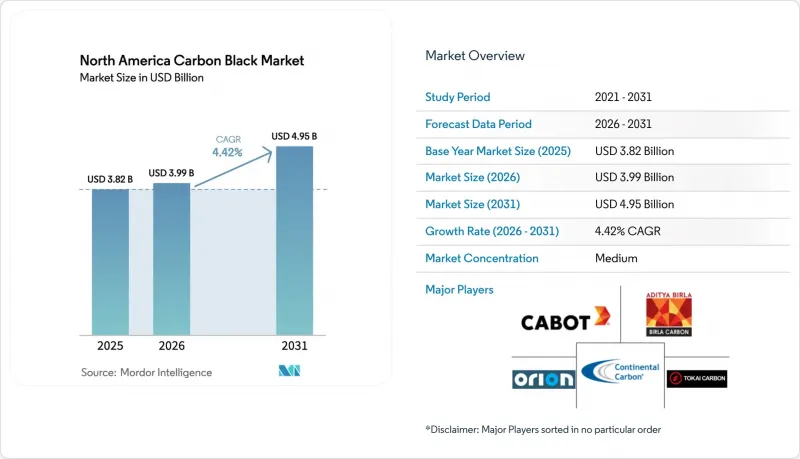
根據 Mordor Intelligence 預測,北美炭黑市場規模將從 2025 年的 49.5 億美元,2026 年至 2031 年的年複合成長率(CAGR)為 4.42%。
本報告按製造流程(爐法黑炭、氣法黑炭等)、等級(標準級、特殊等級等)、應用領域(輪胎和工業橡膠、塑膠等)、終端用戶產業(汽車和運輸、包裝、建築等)以及地區(美國、加拿大、墨西哥)進行細分。市場預測以美元計價。
北美炭黑市場趨勢與洞察
對需要高SA爐黑的寬基電動車輪胎的需求正在激增。
電動車輪胎必須滿足車輛重量增加、瞬時扭力提升和滾動阻力降低的要求。因此,輪胎配方商指定使用比表面積超過100 m²/g的N100和N200系列爐黑,以提高撕裂強度並降低滯後性。預計到2027年,特斯拉、Rivian、底特律集團以及其他新參與企業的美國電動車年產量將超過300萬輛,這將進一步推動對這些高性能輪胎的需求。卡博特公司於2025年推出的PROPEL E8輪胎也證實了市場對這類產品的需求。此外,ZC Rubber位於墨西哥薩爾蒂約的工廠在2025年下半年擴產後,將向該地區供應大量寬基輪胎和電動車原廠輪胎。加拿大的無污染燃料法規也進一步推動了這一趨勢,因為低碳密集型交通運輸方案將加速電氣化進程。這些趨勢加在一起,預計將提高北美炭黑市場的基準成長軌跡,同時也提高平均售價。
低成本離心油的供應提高了生產商的利潤率。
墨西哥灣沿岸流體化媒裂裝置中分離出的原油具有爐黑反應器所需的芳烴含量高、灰分含量低和BMCI指數高等特點。德克薩斯州和路易斯安那州主要煉油廠的產能利用率在2024-2025年期間保持高位,儘管颶風導致部分煉油廠停產,但原料價格仍遠低於十年平均水準。東海碳素公司位於大泉城、博格和阿迪斯的工廠直接受益於此成本優勢,即使輪胎製造商正在協商更嚴格的轉移定價公式,其利潤率仍高於區域平均水平。相較之下,加拿大和墨西哥的這一成本優勢並不明顯,因為這些國家的生產商要么進口分離出的原油,要么依賴規模較小、最佳化程度較低的國內煉油廠。短期來看,這種有利的原料環境正在推動運轉率決策,並支撐著北美炭黑市場的短期健康發展。
由於墨西哥灣沿岸地區停工,原物料價格出現波動。
颶風、計畫性檢修以及原油加工配置的變更經常會抑制FCCU(焦炭黑轉化裝置)的產量,這可能導致分離油的現貨價格在幾週內上漲30%至50%。東海碳素公司在2025年展望報告中指出,原物料價格飆升是導致其營業利潤年減6.1%的主要原因之一。 Orion Engineered Carbons公司沒有長期固定價格契約,因此當原油價格飆升時,價格上漲的影響會落後於其他客戶,從而對利潤率造成壓力。雖然新的煉油廠專案以及從原油加工轉向化學產品加工可能會從2027年起緩解價格波動,但北美炭黑市場仍面臨重大的短期風險。
細分市場分析
2025年,北美炭黑市場中,爐法炭黑佔總市佔率的85.12%。預計到2031年,爐法炭黑市場將以4.73%的複合年成長率成長,這得益於其製程的柔軟性,爐法炭黑可生產N100至N900等級的炭黑,用於輪胎、軟管、皮帶、油墨和塑膠等領域。 Orion Engineered Carbons在德克薩斯州拉波特市擁有一條價值2.159億美元的高比表面積生產線,專門生產電動車輪胎配方炭黑。氣法炭黑、燈法炭黑和熱法炭黑則繼續保持其重要性,在導電塗料、繪畫材料顏料和超潔淨半導體封裝等領域發揮著獨特的作用。
Monolith Materials公司提供突破性的互補技術。其甲烷熱解製程每年可生產14,000噸非石化燃料炭黑,並產生氫氣作為獨立產品,進而達到零範圍1排放。固特異公司已於2025年將此材料應用於輪胎生產。目前,北美炭黑市場有兩種並存的生產路徑:一種是針對成本和規模進行最佳化的傳統爐式反應器,另一種是針對ESG(環境、社會和治理)績效進行最佳化的低碳熱解反應器。展望未來,如果Monolith公司的Olive Creek 2擴建項目能夠成功在2027年實現56,000噸的產能,則有望重新評估碳排放強度方面的競爭基準,並影響現有公司的投資重點。
截至2025年,標準級炭黑佔北美炭黑市場銷售量的77.78%,但特種級、導電級和防靜電級炭黑的成長預計將滯後,到2031年複合年成長率(CAGR)為5.26%。卡博特(Cabot)的「VULCAN XC」和奧利安(Orion)的「PRINTEX」品牌在導電應用領域佔據主導地位,其鋰離子電池正極和半導體托盤的體積電阻率低於1歐姆·厘米。推動市場需求的因素包括電動車電池的快速成長以及需要防靜電基礎設施的超大規模資料中心的建設。
儘管標準產品仍是輪胎行業的主力軍,但隨著新型汽車平臺和自動駕駛感測器陣列的出現,汽車製造商(OEM)即使在主流化合物中也開始指定使用分散性更高、多環芳烴(PAH)含量更低的炭黑。用於食品接觸的特殊產品,例如“BLACK PEARLS 4350”,符合美國FDA規定的苯並[a]芘含量限值5 ppb。隨著跨境電商的蓬勃發展,加工商被迫遵守更嚴格的標準,特種產品的市場滲透率也逐步提高,推動了北美炭黑市場的營收成長。
其他好處:
- Excel格式的市場預測(ME)表
- 3個月的分析師支持
目錄
第1章:引言
- 研究假設和市場定義
- 調查範圍
第2章:調查方法
第3章執行摘要
第4章 市場狀況
- 市場概覽
- 市場促進因素
- 對需要高SA爐黑的寬基電動車輪胎的需求正在激增。
- 低成本脫脂油的供應提高了生產商的利潤率。
- 加拿大輪胎公司的標籤規定正在促進特種輪胎的銷售。
- OEM廠商依ESG要求採用再生炭黑
- 輪胎製造商專用的現場模組化炭黑生產裝置
- 市場限制因素
- 由於墨西哥灣沿岸地區停工,原物料價格出現波動。
- 乘用車胎面中二氧化矽矽烷的替代品
- 與輪胎熱解衍生的填料的競爭
- 價值鏈分析
- 波特五力模型
第5章 市場規模與成長預測
- 依工藝類型
- 爐黑
- 煤炭黑
- 燈黑
- 熱黑
- 按年級
- 標準級炭黑
- 特殊炭黑
- 導電和防靜電炭黑
- 透過使用
- 輪胎和工業橡膠製品
- 塑膠
- 墨粉和列印墨水
- 塗層
- 纖維
- 其他用途
- 按最終用戶行業分類
- 汽車和運輸業
- 包裝
- 建築/施工
- 電氣和電子設備
- 紡織服裝
- 其他
- 按地區
- 美國
- 加拿大
- 墨西哥
第6章 競爭情勢
- 市場集中度
- 策略趨勢
- 市佔率和排名分析
- 公司簡介
- Cabot Corporation
- Birla Carbon
- Orion Engineered Carbons SA
- Continental Carbon Company
- Tokai Carbon Co., Ltd.(including Cancarb)
- Mitsubishi Chemical Corporation
- OMSK Carbon Group
- PCBL Limited
- Imerys
- Monolith Inc.
- Pyrolyx AG
- Koppers Inc.
- Sid Richardson Carbon & Energy Co.
- International China Rubber Investment Holding Co., Ltd.
第7章 市場機會與未來展望
According to Mordor Intelligence, the North America carbon black market size is projected to expand from USD 3.82 billion in 2025 and USD 3.99 billion in 2026 to USD 4.95 billion by 2031, registering a CAGR of 4.42% between 2026 to 2031.
This report is Segmented by Process Type (Furnace Black, Gas Black, and More), Grade (Standard Grade, Specialty, and More), Application (Tires and Industrial Rubber, Plastics, and More), End-User Industry (Automotive and Transportation, Packaging, Building and Construction, and More), and Geography (United States, Canada, Mexico). The Market Forecasts are Provided in Terms of Value (USD).
North America Carbon Black Market Trends and Insights
Surging Demand for Wide-Base EV Tires Needing High-SA Furnace Blacks
Electric-vehicle tires must accommodate heavier curb weight, instant torque, and low rolling-resistance requirements. As a result, compounders specify N100 and N200 series furnace blacks with surface areas above 100 m2/g, which improve tear strength and lower hysteresis. U.S. EV output from Tesla, Rivian, the Detroit Three, and new entrants is set to exceed 3 million units annually by 2027, ratcheting up demand for these high-performance grades. Cabot's PROPEL E8 launch in 2025 validated the commercial pull for such products, and ZC Rubber's Saltillo plant in Mexico will channel large volumes of wide-base and OE EV tires into the region after ramp-up in late 2025. Canada's Clean Fuel Regulations also add momentum because lower carbon-intensity transportation scenarios accelerate electrification. In aggregate, these dynamics raise the baseline growth path for the North America carbon black market while lifting average selling prices.
Low-Cost Decant Oil Availability Elevating Producer Margins
Decant oil from Gulf Coast fluid-catalytic-cracking units delivers the aromatic content, low ash, and high BMCI index required for furnace-black reactors. Utilization across major Texas and Louisiana refineries remained high through 2024-2025, keeping feedstock prices well below the 10-year average despite hurricane-related outages. Tokai Carbon's cluster of Big Spring, Borger, and Addis plants directly benefits from this cost angle, supporting above-regional average margins even as tire OEMs negotiate tougher transfer-price formulas. The cost edge is less pronounced in Canada and Mexico, where producers either import decant oil or rely on smaller, less optimized domestic refineries. Over the short term, the favorable feedstock environment buttresses capacity utilization decisions and underpins the near-term health of the North America carbon black market.
Feedstock Price Volatility on Gulf-Coast Shutdowns
Hurricanes, planned turnarounds, and crude-slate shifts periodically curtail FCCU output, pushing decant-oil spot prices 30-50% higher within weeks. Tokai Carbon's 2025 outlook cited feedstock inflation among the chief reasons operating profit could fall 6.1% year-over-year. Orion Engineered Carbons has no long-term fixed-price contracts, so lagged pass-through mechanisms dent margins when oil spikes. Although new refinery projects and crude-to-chemicals configurations might temper volatility beyond 2027, near-term risk remains material for the North America carbon black market.
Other drivers and restraints analyzed in the detailed report include:
- Canadian Tire-Label Regulations Boosting Specialty Grades
- Recovered Carbon Black Uptake Under OEM ESG Mandates
- Silica-Silane Substitution in Passenger Treads
For complete list of drivers and restraints, kindly check the Table Of Contents.
Segment Analysis
The North America carbon black market size for the furnace-black segment accounted for 85.12% of the total volume in 2025. Growth to 2031 is set at a 4.73% CAGR, buoyed by the process's flexibility in generating N100-N900 grades for tires, hoses, belts, inks, and plastics. Orion Engineered Carbons is capitalizing on a USD 215.9 million high-surface-area line at La Porte, Texas, that targets EV tire compounds. The niche roles of gas, lamp, and thermal blacks in conductive coatings, artist pigments, and ultraclean semiconductor packaging keep them relevant.
Monolith Materials offers a disruptive complement: its methane-pyrolysis route yields 14,000 t per annum of fossil-free carbon black and coproduces hydrogen, eliminating Scope 1 emissions. Goodyear commercialized tires using this material in 2025. The North America carbon black market now features a dual pathway-traditional furnace reactors optimized for cost and scale, and low-carbon pyrolysis units optimized for ESG performance. Over time, the successful scale-up of Monolith's Olive Creek 2 expansion to 56,000 t by 2027 could recalibrate competitive benchmarks on carbon intensity and influence investment priorities among incumbents.
Standard grades represented 77.78% of North America's carbon black market volume in 2025, but specialty, conductive, and ESD grades will capture a larger growth delta by logging a 5.26% CAGR to 2031. Cabot's VULCAN XC and Orion's PRINTEX brands dominate conductive use cases, reaching bulk resistivity below 1 ohm-cm for lithium-ion cathodes and semiconductor trays. Demand tailwinds include rapid EV battery cell expansion and hyperscale data-center build-outs requiring ESD-safe infrastructure.
Standard products remain the tire workhorses, yet new vehicle platforms and autonomous-driving sensor arrays are pushing OEMs to specify higher-dispersion and lower-PAH blacks even in mainstream compounds. Specialty food-contact variants such as BLACK PEARLS 4350 satisfy benzo[a]pyrene limits of 5 ppb set by the U.S. FDA. As cross-border e-commerce pushes converters to harmonize with the stricter standard, specialty penetration inches upward, lifting the revenue mix of the North America carbon black market.
Complete Report Scope:
- By Process Type
- Furnace Black
- Gas Black
- Lamp Black
- Thermal Black
- By Grade
- Standard Grade Carbon Black
- Specialty Carbon Black
- Conductive and ESD Carbon Black
- By Application
- Tires and Industrial Rubber Products
- Plastics
- Toners and Printing Inks
- Coatings
- Textile Fibers
- Other Applications
- By End-User Industry
- Automotive and Transportation
- Packaging
- Building and Construction
- Electrical and Electronics
- Textile and Apparel
- Others
- By Geography
- United States
- Canada
- Mexico
List of Companies Covered in this Report:
- Cabot Corporation
- Birla Carbon
- Orion Engineered Carbons S.A.
- Continental Carbon Company
- Tokai Carbon Co., Ltd. (including Cancarb)
- Mitsubishi Chemical Corporation
- OMSK Carbon Group
- PCBL Limited
- Imerys
- Monolith Inc.
- Pyrolyx AG
- Koppers Inc.
- Sid Richardson Carbon & Energy Co.
- International China Rubber Investment Holding Co., Ltd.
Additional Benefits:
- The market estimate (ME) sheet in Excel format
- 3 months of analyst support
TABLE OF CONTENTS
1 Introduction
- 1.1 Study Assumptions and Market Definition
- 1.2 Scope of the Study
2 Research Methodology
3 Executive Summary
4 Market Landscape
- 4.1 Market Overview
- 4.2 Market Drivers
- 4.2.1 Surging Demand for Wide-Base EV Tires Needing High-SA Furnace Blacks
- 4.2.2 Low-Cost Decant Oil Availability Elevating Producer Margins
- 4.2.3 Canadian Tire-Label Regulations Boosting Specialty Grades
- 4.2.4 Recovered Carbon Black Uptake under OEM ESG Mandates
- 4.2.5 On-Site Modular Carbon Black Units for Tire Makers
- 4.3 Market Restraints
- 4.3.1 Feedstock Price Volatility on Gulf-Coast Shutdowns
- 4.3.2 Silica-Silane Substitution in Passenger Treads
- 4.3.3 Competition from Tire-Pyrolysis Derived Fillers
- 4.4 Value Chain Analysis
- 4.5 Porter's Five Forces
- 4.5.1 Bargaining Power of Suppliers
- 4.5.2 Bargaining Power of Buyers
- 4.5.3 Threat of New Entrants
- 4.5.4 Threat of Substitutes
5 Market Size and Growth Forecasts (Value)
- 5.1 By Process Type
- 5.1.1 Furnace Black
- 5.1.2 Gas Black
- 5.1.3 Lamp Black
- 5.1.4 Thermal Black
- 5.2 By Grade
- 5.2.1 Standard Grade Carbon Black
- 5.2.2 Specialty Carbon Black
- 5.2.3 Conductive and ESD Carbon Black
- 5.3 By Application
- 5.3.1 Tires and Industrial Rubber Products
- 5.3.2 Plastics
- 5.3.3 Toners and Printing Inks
- 5.3.4 Coatings
- 5.3.5 Textile Fibers
- 5.3.6 Other Applications
- 5.4 By End-User Industry
- 5.4.1 Automotive and Transportation
- 5.4.2 Packaging
- 5.4.3 Building and Construction
- 5.4.4 Electrical and Electronics
- 5.4.5 Textile and Apparel
- 5.4.6 Others
- 5.5 By Geography
- 5.5.1 United States
- 5.5.2 Canada
- 5.5.3 Mexico
6 Competitive Landscape
- 6.1 Market Concentration
- 6.2 Strategic Moves
- 6.3 Market Share/Ranking Analysis
- 6.4 Company Profiles (includes Global-level Overview, Market-level Overview, Core Segments, Financials as available, Strategic Information, Products and Services, Recent Developments)
- 6.4.1 Cabot Corporation
- 6.4.2 Birla Carbon
- 6.4.3 Orion Engineered Carbons S.A.
- 6.4.4 Continental Carbon Company
- 6.4.5 Tokai Carbon Co., Ltd. (including Cancarb)
- 6.4.6 Mitsubishi Chemical Corporation
- 6.4.7 OMSK Carbon Group
- 6.4.8 PCBL Limited
- 6.4.9 Imerys
- 6.4.10 Monolith Inc.
- 6.4.11 Pyrolyx AG
- 6.4.12 Koppers Inc.
- 6.4.13 Sid Richardson Carbon & Energy Co.
- 6.4.14 International China Rubber Investment Holding Co., Ltd.
7 Market Opportunities and Future Outlook
- 7.1 White-space and Unmet-Need Assessment
- 7.2 Growth in the Adoption of Electric Cars


