


 |
市場調查報告書
商品編碼
2117279
中東和非洲炭黑市場:市場佔有率分析、行業趨勢和統計數據以及成長預測(2026-2031 年)Middle-East And Africa Carbon Black - Market Share Analysis, Industry Trends & Statistics, Growth Forecasts (2026 - 2031) |
||||||

※ 本網頁內容可能與最新版本有所差異。詳細情況請與我們聯繫。
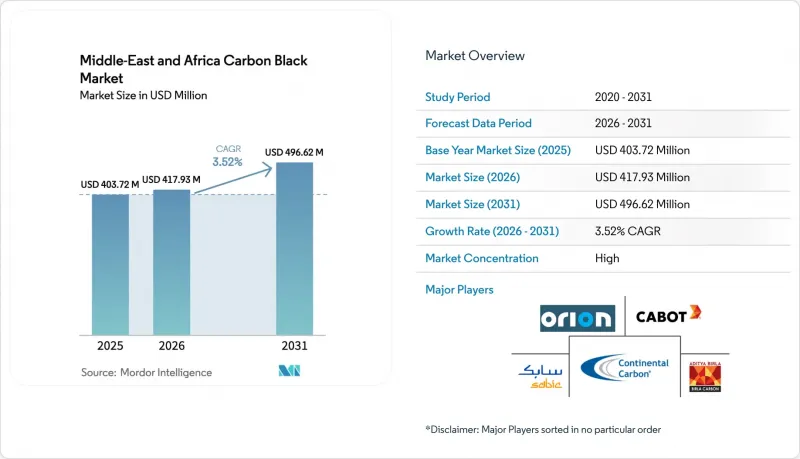
根據 Mordor Intelligence 預測,中東和非洲的炭黑市場規模將從 2025 年的 4.0372 億美元成長到 2026 年的 4.1793 億美元,然後在 2031 年達到 4.9662 億美元,2026 年至 2031 年的複合年成長率為 3.5%。
本報告按工藝類型(爐法制黑、氣法制黑、燈法制黑及其他)、應用領域(輪胎及工業橡膠製品、塑膠、墨粉及印刷油墨、油漆及塗料及其他)及地區(沙烏地阿拉伯、阿拉伯聯合大公國、卡達、科威特、土耳其、南非、埃及、奈及利亞及其他)進行細分。市場預測以美元計價。
中東和非洲炭黑市場的趨勢和洞察
在紡織業的應用不斷擴展
先進的纖維改質技術現已將炭黑顏料融入纖維中,賦予纖維抗菌特性,有效對抗金黃色葡萄球菌和大腸桿菌,使當地紡紗廠能夠生產醫用和衛生級紡織品。土耳其正受益於將這些技術與其第十二個發展計畫的環境目標結合,而埃及的石化企業則從中獲得了上游原料。將炭黑添加到尼龍、聚酯纖維和腈綸纖維中,正推動市場需求從普通服裝轉向高價值功能性紡織品。隨著品牌尋求可追溯且永續性的原料,特種黑色炭黑的價格優勢日益凸顯,並贏得了長期合約。
汽車和輪胎產業的擴張
倍耐力在沙烏地阿拉伯阿卜杜拉國王經濟城投資5.5億美元興建的工廠將於2026年投產,年產350萬條乘用車輪胎,從而保障未來20年爐用級炭黑的需求。當地的生產也不斷拓展,涵蓋電動車機殼、電池組件和密封系統等領域,這些產品均採用客製化炭黑分散體。土耳其正利用其毗鄰歐盟的地理優勢,供應符合排放氣體法規的輪胎產品線;而阿拉伯聯合大公國則將石化中間體轉化為合成橡膠。沿岸地區和非洲的建築和採礦項目進一步擴大了對非公路輪胎的需求,從而促進了用於增強耐磨性的炭黑的穩定出貨。這些趨勢共同作用,即使車輛電氣化改變了材料成分,也能維持長期穩定的基本消費。
加速向矽基「綠色」輪胎過渡
受汽車製造商(OEM)降低滾動阻力需求的驅動,炭黑正被沉澱二氧化矽和矽烷偶合劑所取代,後者可降低高達7%的油耗。雖然二氧化矽能改善濕地抓地力,但它會增加輪胎回收的難度並提高配方成本,迫使土耳其工廠改造混煉機並調整採購物流。這種轉變威脅到海灣合作理事會(GCC)地區乘用車胎面用炭黑的基準需求。為因應這項挑戰,製造商正合作開發混合填料體系,並拓展至用於胎側和內襯的專用炭黑領域,以維持其增強性能。
細分市場分析
預計到2025年,爐法黑將佔區域銷售額的71.62%,並在2031年之前以4.31%的複合年成長率成長,這主要得益於旨在回收廢熱和減少硫氧化物排放的工廠維修。沙烏地阿拉伯和阿拉伯聯合大公國的生產商利用其從蒸汽裂解裝置獲得的原料,維持著連續生產和嚴格的粒度控制。氣法黑在高光澤油墨和鋰離子電池電極領域佔據獨特的市場地位,但由於反應器的複雜性,其供應仍受到限制。受電子商務推動,金屬包裝油墨和塗料領域的需求穩定成長,這主要得益於易拉罐產量的增加。熱法黑和乙炔碳黑為電線電纜絕緣材料提供了特殊的導電特性。目前的生產流程有利於能夠將副產品貨幣化並滿足日益嚴格的排放法規要求的綜合煉油企業。
其他好處
- Excel格式的市場預測(ME)表
- 3個月的分析師支持
目錄
第1章:引言
- 研究假設和市場定義
- 調查範圍
第2章:調查方法
第3章執行摘要
第4章 市場狀況
- 市場概覽
- 市場促進因素
- 在紡織業的應用不斷擴展
- 汽車和輪胎產業的擴張
- 鋰離子電池超級工廠對導電炭黑的需求正在激增。
- 在循環經濟道路計畫中利用再生炭黑
- 提高特種黑色產品的市場滲透率
- 市場限制因素
- 加速向矽基「綠色」輪胎過渡
- 原物料價格波動與供應風險
- 來自亞洲低價進口商品的競爭
- 價值鏈分析
- 波特五力模型
第5章 市場規模與成長預測
- 依工藝類型
- 爐黑
- 煤炭黑
- 燈黑
- 熱黑
- 六亞甲四胺
- 透過使用
- 輪胎和工業橡膠製品
- 塑膠
- 薄膜
- 壓力管道
- 模製零件
- 墨粉和列印墨水
- 油漆和塗料
- 纖維
- 尼龍
- 聚酯纖維
- 丙烯酸纖維
- 其他用途(儲能材料等)
- 按地區
- 沙烏地阿拉伯
- 阿拉伯聯合大公國
- 卡達
- 科威特
- 土耳其
- 南非
- 埃及
- 奈及利亞
- 摩洛哥
- 其他中東和非洲國家
第6章 競爭情勢
- 市場集中度
- 策略趨勢
- 市佔率和排名分析
- 公司簡介
- ADNOC(Abu Dhabi National Oil Co.)
- Balkrishna Industries Ltd.
- Birla Carbon
- Cabot Corporation
- Continental Carbon Company
- Datwyler Holding Inc.
- Epsilon Carbon Private Limited.
- Himadri Speciality Chemicals Limited
- Imerys
- Omsk Carbon Group
- Orion SA
- PCBL Chemical Limited
- SABIC
第7章 市場機會與未來展望
According to Mordor Intelligence, the middle-East and Africa Carbon Black Market size is expected to grow from USD 403.72 million in 2025 to USD 417.93 million in 2026 and is forecast to reach USD 496.62 million by 2031 at 3.52% CAGR over 2026-2031.
This report is Segmented by Process Type (Furnace Black, Gas Black, Lamp Black, and More), Application (Tires and Industrial Rubber Products, Plastics, Toners and Printing Inks, Paints and Coatings, and More), and Geography (Saudi Arabia, United Arab Emirates, Qatar, Kuwait, Turkey, South Africa, Egypt, Nigeria, and More). The Market Forecasts are Provided in Terms of Value (USD).
Middle-East And Africa Carbon Black Market Trends and Insights
Growing Application in Fiber and Textile Industries
Advanced fiber-modification techniques now embed carbon black pigments that deliver antimicrobial protection against Staphylococcus aureus and Escherichia coli, helping regional mills supply healthcare and hygiene fabrics. Turkey benefits by aligning these technologies with its Twelfth Development Plan green mandates, while Egypt's petrochemical complex secures upstream feedstock. The integration of carbon black in nylon, polyester, and acrylic fibers spreads demand beyond commodity apparel into higher-value technical textiles. As brands pursue traceable and sustainable inputs, specialty black grades gain pricing power and longer contracts.
Expansion of Automotive and Tire Sector
Saudi Arabia's USD 550 million Pirelli plant in King Abdullah Economic City will roll out 3.5 million passenger tires annually from 2026, locking in furnace-grade volumes for two decades. Localization extends into electric-vehicle housings, battery components, and sealing systems, all of which employ tailored carbon black dispersions. Turkey leverages EU proximity to supply emission-compliant tire lines, while the United Arab Emirates channels petrochemical intermediates into synthetic rubber. Construction and mining projects across the Gulf and Africa further enlarge off-highway tire demand, reinforcing steady shipments of abrasion-resistant reinforcement blacks. Collectively, these dynamics anchor long-term baseline consumption even as vehicle electrification reshapes materials mixes.
Accelerating Switch to Silica-Based "Green" Tires
OEM mandates for lower rolling resistance drive the replacement of carbon black with precipitated silica and silane coupling agents that cut fuel consumption by as much as 7%. While silica improves wet grip, it complicates tire recycling and raises compounding costs, forcing Turkish plants to retrofit mixers and sourcing logistics. The transition threatens baseline demand for furnace blacks used in passenger car treads across the GCC. Producers respond by co-developing hybrid filler systems and expanding into specialty blacks for sidewalls and inner liners that retain reinforcement roles.
Other drivers and restraints analyzed in the detailed report include:
- Surge in Conductive Carbon Black for Li-ion Battery Gigafactories
- Recovered Carbon Black Uptake in Circular-Economy Road Projects
- Volatile Feedstock Pricing and Supply Risk
For complete list of drivers and restraints, kindly check the Table Of Contents.
Segment Analysis
Furnace Black contributed 71.62% of regional revenue in 2025 and is projected to expand at 4.31% CAGR through 2031, supported by retrofits that recover waste heat and lower SOx emissions. Producers in Saudi Arabia and the United Arab Emirates leverage captive feedstock from steam crackers to maintain continuous operations and tight particle-size control. Gas Black retains niche status for high-jetness inks and Li-ion electrodes, yet supply remains constrained by reactor complexity. Lamp Black grows steadily in inks and coatings for metal packaging, benefiting from e-commerce-driven canning volumes. Thermal Black and Acetylene Black provide specialty conductivity in wire and cable insulation. The process landscape favors integrated refiners able to monetize by-product streams while meeting tightening emission caps.
Complete Report Scope:
- By Process Type
- Furnace Black
- Gas Black
- Lamp Black
- Thermal Black
- Hexamine
- By Application
- Tires and Industrial Rubber Products
- Plastics
- Films and Sheets
- Pressure Pipes
- Molded Parts
- Toners and Printing Inks
- Paints and Coatings
- Textile Fibres
- Nylon
- Polyester
- Acrylic
- Other Applications (Energy Storage Materials, etc.)
- By Geography
- Saudi Arabia
- United Arab Emirates
- Qatar
- Kuwait
- Turkey
- South Africa
- Egypt
- Nigeria
- Morocco
- Rest of Middle-East and Africa
- Saudi Arabia
List of Companies Covered in this Report:
- ADNOC (Abu Dhabi National Oil Co.)
- Balkrishna Industries Ltd.
- Birla Carbon
- Cabot Corporation
- Continental Carbon Company
- Datwyler Holding Inc.
- Epsilon Carbon Private Limited.
- Himadri Speciality Chemicals Limited
- Imerys
- Omsk Carbon Group
- Orion S.A
- PCBL Chemical Limited
- SABIC
Additional Benefits:
- The market estimate (ME) sheet in Excel format
- 3 months of analyst support
TABLE OF CONTENTS
1 Introduction
- 1.1 Study Assumptions and Market Definition
- 1.2 Scope of the Study
2 Research Methodology
3 Executive Summary
4 Market Landscape
- 4.1 Market Overview
- 4.2 Market Drivers
- 4.2.1 Growing Application in Fiber and Textile Industries
- 4.2.2 Expansion of Automotive and Tire Sector
- 4.2.3 Surge in Conductive Carbon Black for Li-ion Battery Gigafactories
- 4.2.4 Recovered Carbon Black Uptake in Circular-Economy Road Projects
- 4.2.5 Increasing Market Penetration of Specialty Black
- 4.3 Market Restraints
- 4.3.1 Accelerating Switch to Silica-Based "Green" Tires
- 4.3.2 Volatile Feedstock Pricing and Supply Risk
- 4.3.3 Competition from Low-Cost Asian Imports
- 4.4 Value Chain Analysis
- 4.5 Porter's Five Forces
- 4.5.1 Bargaining Power of Suppliers
- 4.5.2 Bargaining Power of Buyers
- 4.5.3 Threat of New Entrants
- 4.5.4 Threat of Substitutes
- 4.5.5 Degree of Competition
5 Market Size and Growth Forecasts (Value)
- 5.1 By Process Type
- 5.1.1 Furnace Black
- 5.1.2 Gas Black
- 5.1.3 Lamp Black
- 5.1.4 Thermal Black
- 5.1.5 Hexamine
- 5.2 By Application
- 5.2.1 Tires and Industrial Rubber Products
- 5.2.2 Plastics
- 5.2.2.1 Films and Sheets
- 5.2.2.2 Pressure Pipes
- 5.2.2.3 Molded Parts
- 5.2.3 Toners and Printing Inks
- 5.2.4 Paints and Coatings
- 5.2.5 Textile Fibres
- 5.2.5.1 Nylon
- 5.2.5.2 Polyester
- 5.2.5.3 Acrylic
- 5.2.6 Other Applications (Energy Storage Materials, etc.)
- 5.3 By Geography
- 5.3.1 Saudi Arabia
- 5.3.1.1 United Arab Emirates
- 5.3.1.2 Qatar
- 5.3.1.3 Kuwait
- 5.3.1.4 Turkey
- 5.3.1.5 South Africa
- 5.3.1.6 Egypt
- 5.3.1.7 Nigeria
- 5.3.1.8 Morocco
- 5.3.1.9 Rest of Middle-East and Africa
- 5.3.1 Saudi Arabia
6 Competitive Landscape
- 6.1 Market Concentration
- 6.2 Strategic Moves
- 6.3 Market Share(%)/Ranking Analysis
- 6.4 Company Profiles (includes Global level Overview, Market level overview, Core Segments, Financials as available, Strategic Information, Market Rank/Share, Products and Services, Recent Developments)
- 6.4.1 ADNOC (Abu Dhabi National Oil Co.)
- 6.4.2 Balkrishna Industries Ltd.
- 6.4.3 Birla Carbon
- 6.4.4 Cabot Corporation
- 6.4.5 Continental Carbon Company
- 6.4.6 Datwyler Holding Inc.
- 6.4.7 Epsilon Carbon Private Limited.
- 6.4.8 Himadri Speciality Chemicals Limited
- 6.4.9 Imerys
- 6.4.10 Omsk Carbon Group
- 6.4.11 Orion S.A
- 6.4.12 PCBL Chemical Limited
- 6.4.13 SABIC
7 Market Opportunities and Future Outlook
- 7.1 White-space and Unmet-Need Assessment
- 7.2 Growth in the Adoption of Electric Cars and Self-driving Cars


