


 |
市場調查報告書
商品編碼
2120484
電動汽車電池系統:市場佔有率分析、產業趨勢與統計、成長預測(2026-2031)Battery Systems For Electric Vehicle - Market Share Analysis, Industry Trends & Statistics, Growth Forecasts (2026 - 2031) |
||||||

※ 本網頁內容可能與最新版本有所差異。詳細情況請與我們聯繫。
據 Mordor Intelligence 稱,電動車電池系統的市場規模預計在 2026 年達到 1,285.5 億美元,高於 2025 年的 1,149.2 億美元,預計到 2031 年將達到 2,251.7 億美元。
預計 2026 年至 2031 年的複合年成長率為 11.86%。
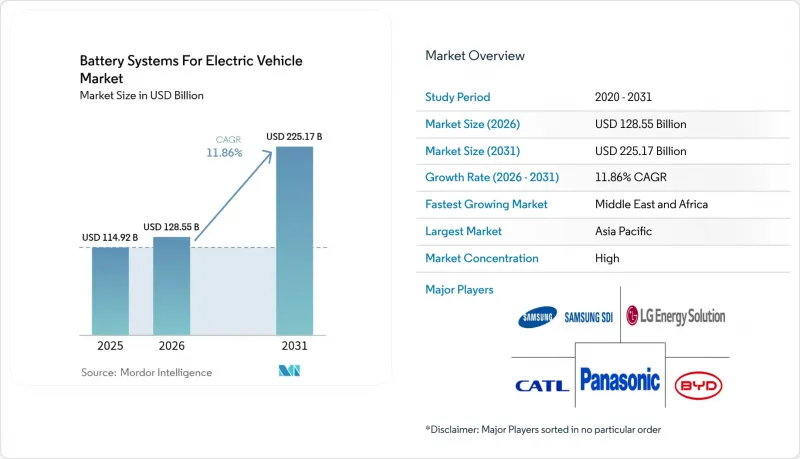
本報告按電池類型(鋰離子電池、鎳氫電池等)、電池化學成分(NMC、NCA、LFP等)、車輛類型(乘用車和商用車)、驅動技術(電池式電動車(PHEV) 等)和地區進行細分。市場預測以價值(美元)和銷售(輛)為單位呈現。
全球電動汽車電池系統趨勢及分析
政府獎勵和零排放法規
法律規範透過設定電動驅動系統的最低銷售目標來加速市場需求。在美國,符合條件的車輛可獲得高達7500美元的稅額扣抵抵免,並且國產零件的使用基準值逐年提高。加州的「先進清潔汽車II」法規要求汽車製造商在2025年實現22%的零排放汽車銷量,到2035年實現100%的零排放汽車銷量。英國規定到2030年電動車銷量必須佔總銷量的80%,而加拿大則力爭2035年實現100%的電動車銷量。由於違反這些法規將面臨巨額罰款,大多數汽車製造商都簽訂了多年期的電池回收協議,這為電池製造商提供了穩定的銷售量和清晰的現金流前景。
鋰離子電池成本更低、能量密度更高
由於學習曲線效應和材料替代,成本持續下降。多家領先的電池製造商的目標是將電池組成本從2024年的每千瓦時118美元降至2026年的每千瓦時60美元以下。富矽負極可提高比容量25%至50%,進而提升能量密度;而磷酸鋰鐵正透過改進正極塗層來提高體積能量密度。成本的快速下降正在將目標市場拓展至入門級乘用車、摩托車以及對成本敏感的商用車隊。
重要礦產的供應和價格波動
上游精煉製程的集中化使製造商面臨地緣政治風險。中國精煉了全球80%的磷酸鐵鋰正極材料,並生產了國內大部分鈷。儘管預計到2030年鋰需求將增加五倍,但採礦開發許可批准的延誤導致價格波動,對電池製造商的利潤率帶來壓力。多元化供應來源的努力需要數年時間才能見效,這將導致製造商長期依賴主要供應商,並使價格預測難以預測。
細分市場分析
到2025年,鋰離子電池技術將佔據電動車電池系統市場93.78%的佔有率,預計到2031年,其銷量領先地位仍將維持。電池組層面的快速技術創新正推動電池能量密度朝向300 Wh/kg邁進,同時將成本控制在每千瓦時60美元以下。該領域成熟的製造生態系統正在提升材料、電池結構和回收流程等方面的規模經濟效益,同時也降低了新車製造商的准入門檻。
固態電池採用陶瓷隔膜,有效抑制枝晶生長,並將1000次循環後的容量衰減限制在5%以內,其複合年成長率(CAGR)已達到創紀錄的37.85%。固態電池卓越的儲能性能使其能夠實現緊湊的電池組設計,從而增加車內空間並減輕車輛重量。這些對於高性能和增程型車型至關重要。實現固態電池實用化的關鍵在於自動化燒結和高壓層壓生產線,這將使生產成本在本世紀末降低到與傳統鋰離子電池相同的水平。
預計到2025年,鎳錳鈷電池將佔電動車電池系統總量的60.85%,鞏固其在豪華轎車和輕型卡車領域的地位,因為這些車型對續航里程的要求極高。鈷含量的持續降低以及富含錳的配方的引入,正在緩解人們對價格上漲和原料採購倫理問題的擔憂。
由於其安全性高、原料供應充足且成本低廉,磷酸鋰鐵鋰電池正經歷快速成長,並被廣泛應用於低價位車型和重型商用車領域。鈉離子電池以41.90%的複合年成長率成長,可在低至-40 度C的低溫環境下運行,並能承受頻繁的快速充電循環。其近乎零鋰含量降低了價格風險,即使在鋰蘊藏量有限的地區也能利用國內資源。鈉離子和鋰離子混合電池組在保持性能的同時最佳化了成本,並構建了一種過渡方案,為能量密度達到200Wh/kg時向鈉離子電池的全面過渡奠定了基礎。
區域分析
亞太地區預計到2025年將維持63.74%的電動車電池系統市場佔有率,這得益於其涵蓋從礦物加工到電池組裝和汽車製造的完整供應鏈。預計到2030年,中國將實現顯著成長,這主要得益於強勁的國內需求和出口激增,尤其是對東南亞和拉丁美洲的出口。日本正在推進固態固態電池的研究,而韓國則將重點轉向高錳化學電池以應對競爭。政府獎勵的協調統一和基礎設施投資的統籌推進,持續增強區域生態系統。
北美擁有全球第二大市場規模,得益於《通膨控制法案》提供的3,690億美元清潔能源資金,以及關鍵礦產基準值的逐步提高,一系列新的超級工廠和中游精煉項目正在蓬勃發展。同樣,在綠色新政政策和歐洲電池聯盟的推動下,歐洲的清潔能源市場也以9.18%的複合年成長率成長。在策略自力更生的背景下,正極材料的在地化生產和電池組裝正在穩步推進,並由公私合營企業提供資金支持。德國正主導富矽負極材料研發的夥伴關係研究,而西班牙和法國則專注於大眾市場的磷酸鐵鋰電池。
中東和非洲地區是所有地區中成長最快的,年複合成長率達15.21%。沙烏地阿拉伯正投資60億美元建造綜合電池生產基地,旨在實現經濟多元化並確保下游汽車製造業的發展。阿拉伯聯合大公國(阿拉伯聯合大公國)的目標是到2035年實現25%的電動車普及率,並正在推動各酋長國之間高速公路沿線的充電走廊建設。加納、摩洛哥和盧安達的早期計畫正受益於發展機構提供的優惠融資和技術援助,這正推動非洲大陸為摩托車和輕型商用車的本地化電氣化做好準備。
其他好處:
- Excel格式的市場預測(ME)表
- 3個月的分析師支持
目錄
第1章:引言
- 研究假設和市場定義
- 調查範圍
第2章:調查方法
第3章執行摘要
第4章 市場狀況
- 市場概覽
- 市場促進因素
- 政府獎勵和零排放法規
- 鋰離子電池成本更低、能量密度更高
- OEM超級工廠建設及供應協議
- 快速充電網路的擴展
- 車輛到電網(V2G)計畫旨在實現電池貨幣化
- 基於電池狀況分析的保險費折扣
- 市場限制因素
- 必需礦物質的供應和價格波動
- 因熱失控引發的召回以及對安全問題的認知不足
- 貿易壁壘和擾亂供應鏈的在地採購規則
- 回收 LFP/鈉離子電池的經濟可行性存在不確定性。
- 價值供應鏈分析
- 監理情勢
- 技術展望
- 電池產能分析
- 電池回收和二次利用分析
- 波特五力模型
第5章 市場規模與成長預測
- 依電池類型
- 鋰離子
- 鎳氫電池
- 鉛酸
- 超級電容器
- 固態電池及其他
- 電池化學成分
- NMC
- NCA
- LFP
- LMO
- 鈉離子與新興技術
- 車輛類型
- 搭乘用車
- 商用車輛
- 透過推進技術
- 電池式電動車(BEV)
- 插電式混合動力車(PHEV)
- 混合動力電動車(HEV)
- 按地區
- 北美洲
- 美國
- 加拿大
- 其他北美國家
- 南美洲
- 巴西
- 阿根廷
- 其他南美國家
- 歐洲
- 德國
- 英國
- 法國
- 義大利
- 西班牙
- 荷蘭
- 俄羅斯
- 其他歐洲國家
- 亞太地區
- 中國
- 日本
- 韓國
- 印度
- 澳洲
- 泰國
- 中東和非洲
- 沙烏地阿拉伯
- 阿拉伯聯合大公國
- 土耳其
- 南非
- 埃及
- 其他中東和非洲國家
- 北美洲
第6章 競爭情勢
- 市場集中度
- 策略趨勢
- 市佔率分析
- 公司簡介
- Contemporary Amperex Technology Co., Limited.(CATL)
- BYD Co. Ltd.
- LG Energy Solution Ltd.
- Panasonic Holdings Corporation
- Samsung SDI Co., Ltd.
- SK On Co., Ltd.
- AESC Group Ltd.
- CALB
- Gotion High-tech Co., Ltd.
- EVE Energy Co., Ltd.
- Farasis Energy Europe GmbH
- Northvolt AB
- ProLogium Technology Co., Ltd
- QuantumScape Battery, Inc.
- Solid Power Inc.
- StoreDot
- SES AI Corp.
- Hitachi Energy Ltd.
- Johnson Controls International plc
第7章 市場機會與未來展望
According to Mordor Intelligence, battery systems for electric vehicles market size in 2026 is estimated at USD 128.55 billion, growing from 2025 value of USD 114.92 billion with 2031 projections showing USD 225.17 billion, growing at 11.86% CAGR over 2026-2031.
This report is Segmented by Battery Type (Lithium-Ion, Nickel-Metal Hydride, and More), Battery Chemistry (NMC, NCA, LFP, and More), Vehicle Type (Passenger Cars and Commercial Vehicles), Propulsion Technology (Battery Electric Vehicle (BEV), Plug-In Hybrid Electric Vehicle (PHEV), and More), and Geography. The Market Forecasts are Provided in Terms of Value (USD) and Volume (Units).
Global Battery Systems For Electric Vehicle Market Trends and Insights
Government Incentives and Zero-Emission Mandates
Regulatory frameworks accelerate demand by anchoring minimum sales volumes for electric drivetrains. The United States offers tax credits up to USD 7,500 per qualifying vehicle and escalates domestic-content thresholds each year. California's Advanced Clean Cars II rule obliges automakers to reach 22% zero-emission sales in 2025 and 100% by 2035. The United Kingdom mandates 80% electric sales by 2030, while Canada targets 100% by 2035. Because non-compliance triggers sizable penalties, most vehicle makers lock in multi-year battery offtake contracts, providing cell manufacturers with volume security and cash-flow visibility.
Declining Li-ion Costs and Energy Density Gains
Learning-curve effects and materials substitution continue to drive cost trajectories downward. Several top-tier cell makers aim to push pack costs below USD 60 per kWh by 2026, versus USD 118 per kWh in 2024. Energy density climbs through silicon-rich anodes that raise specific capacity by 25-50%, while lithium iron phosphate improves volumetric density with refined cathode coatings. Rapid cost declines widen the total addressable market into entry-level passenger cars, two-wheelers, and cost-sensitive commercial fleets.
Critical-Mineral Supply and Price Volatility
Concentration in upstream refining exposes manufacturers to geopolitical risk. China refines 80% of global lithium iron phosphate cathode material, while one country produces the majority of cobalt. Demand for lithium is expected to grow five-fold by 2030, yet mine approvals lag, forcing price swings that compress cell-maker margins. Diversification efforts require several years to materialize, extending dependence on dominant suppliers and undermining price visibility.
Other drivers and restraints analyzed in the detailed report include:
- OEM Giga-factory Build-outs and Supply Pacts
- Fast-charging Network Expansion
- Thermal-Runaway Recalls and Safety Perception
For complete list of drivers and restraints, kindly check the Table Of Contents.
Segment Analysis
Lithium-ion technology held 93.78% of the battery systems for electric vehicles market share in 2025 and remains the volume leader through 2031. Rapid pack-level innovation drives gravimetric densities toward 300 Wh/kg while trimming cost below USD 60 per kWh. The segment's entrenched manufacturing ecosystem spans materials, cell formats, and recycling streams, reinforcing scale advantages and lowering entry barriers for new vehicle OEMs.
Solid-state cells record the highest 37.85% CAGR, propelled by ceramic separators that curb dendrite growth and cut capacity fade to 5% after 1,000 cycles. Their superior energy storage enables compact pack designs that free cabin space and trim curb weight, key factors in high-performance or extended-range models. Commercial readiness hinges on automated sintering and high-pressure lamination lines that slash production cost to parity with conventional lithium-ion by the late decade.
Nickel manganese cobalt chemistry accounted for 60.85% of the battery systems for the electric vehicles market size in 2025, anchoring its position in premium passenger cars and light trucks that demand maximum range. Continuous cobalt-content reduction and manganese-rich formulations cut exposure to price spikes and ethical sourcing concerns.
Lithium iron phosphate rises sharply on the back of robust safety, abundant raw material supply, and lower cost, attracting budget segments and heavy-duty commercial vehicles. Sodium-ion cells, growing at 41.90% CAGR, unlock cold-temperature operation down to -40 °C and tolerate frequent fast-charge cycles. Their near-zero lithium content buffers price risk and allows domestic resource utilization in regions lacking lithium reserves. Hybrid packs combining sodium-ion and lithium-ion optimize cost while maintaining performance, creating an architecture bridge toward full sodium-ion transition once density reaches 200 Wh/kg.
Complete Report Scope:
- By Battery Type
- Lithium-ion
- Nickel-metal-hydride
- Lead-acid
- Ultracapacitors
- Solid-state and others
- By Battery Chemistry
- NMC
- NCA
- LFP
- LMO
- Sodium-ion and emerging
- By Vehicle Type
- Passenger Cars
- Commercial Vehicles
- By Propulsion Technology
- Battery Electric Vehicle (BEV)
- Plug-in Hybrid Electric Vehicle (PHEV)
- Hybrid Electric Vehicle (HEV)
- By Geography
- North America
- United States
- Canada
- Rest of North America
- South America
- Brazil
- Argentina
- Rest of South America
- Europe
- Germany
- United Kingdom
- France
- Italy
- Spain
- Netherlands
- Russia
- Rest of Europe
- Asia-Pacific
- China
- Japan
- South Korea
- India
- Australia
- Thailand
- Middle East and Africa
- Saudi Arabia
- United Arab Emirates
- Turkey
- South Africa
- Egypt
- Rest of Middle East and Africa
- North America
Geography Analysis
Asia-Pacific maintained 63.74% share of the battery systems for electric vehicles market in 2025, anchored by an integrated supply chain that stretches from mineral processing through cell assembly to vehicle manufacturing. China alone supports a significant growth through 2030 as domestic demand remains strong and exports surge, particularly to Southeast Asia and Latin America. Japan advances solid-state research while Korea pivots toward high-manganese chemistries to regain competitiveness. Government incentive alignment and coordinated infrastructure spending continue to reinforce the regional ecosystem.
North America registers the second-largest market, the Inflation Reduction Act channels USD 369 billion in clean-energy funding and sets escalating critical-mineral thresholds, creating a robust pipeline of new gigafactories and mid-stream refining projects. Similarly, Europe advances at 9.18% CAGR on the back of its Green Deal policies and the European Battery Alliance. Strategic autonomy drives localized cathode production and cell assembly funded by public-private joint ventures. Germany leads research partnerships that push silicon-rich anodes, whereas Spain and France focus on mass-market lithium iron phosphate.
The Middle East & Africa region posts the highest regional growth at 15.21% CAGR. Saudi Arabia invests USD 6 billion in an integrated battery complex to diversify its economy and secure downstream automotive manufacturing. The United Arab Emirates targets 25% electric vehicle penetration by 2035, anchoring charging-corridor build-outs along inter-emirate highways. Early-stage projects in Ghana, Morocco, and Rwanda benefit from concessional finance and development-agency technical assistance, positioning the continent for localized two-wheeler and light-commercial electrification.
- Contemporary Amperex Technology Co., Limited. (CATL)
- BYD Co. Ltd.
- LG Energy Solution Ltd.
- Panasonic Holdings Corporation
- Samsung SDI Co., Ltd.
- SK On Co., Ltd.
- AESC Group Ltd.
- CALB
- Gotion High-tech Co., Ltd.
- EVE Energy Co., Ltd.
- Farasis Energy Europe GmbH
- Northvolt AB
- ProLogium Technology Co., Ltd
- QuantumScape Battery, Inc.
- Solid Power Inc.
- StoreDot
- SES AI Corp.
- Hitachi Energy Ltd.
- Johnson Controls International plc
Additional Benefits:
- The market estimate (ME) sheet in Excel format
- 3 months of analyst support
TABLE OF CONTENTS
1 Introduction
- 1.1 Study Assumptions and Market Definition
- 1.2 Scope of the Study
2 Research Methodology
3 Executive Summary
4 Market Landscape
- 4.1 Market Overview
- 4.2 Market Drivers
- 4.2.1 Govt incentives and zero-emission mandates
- 4.2.2 Declining Li-ion costs and energy density gains
- 4.2.3 OEM giga-factory build-outs and supply pacts
- 4.2.4 Fast-charging network expansion
- 4.2.5 Vehicle-to-grid programs monetizing batteries
- 4.2.6 Insurance discounts linked to battery-health analytics
- 4.3 Market Restraints
- 4.3.1 Critical-mineral supply and price volatility
- 4.3.2 Thermal-runaway recalls and safety perception
- 4.3.3 Trade barriers and local-content rules disrupting supply chains
- 4.3.4 Uncertain recycling economics for LFP / Na-ion chemistries
- 4.4 Value / Supply-Chain Analysis
- 4.5 Regulatory Landscape
- 4.6 Technological Outlook
- 4.7 Battery Manufacturing Capacity Analysis
- 4.8 Battery Recycling and Second-Life Analysis
- 4.9 Porter's Five Forces
- 4.9.1 Threat of New Entrants
- 4.9.2 Bargaining Power of Buyers
- 4.9.3 Bargaining Power of Suppliers
- 4.9.4 Threat of Substitutes
- 4.9.5 Intensity of Competitive Rivalry
5 Market Size and Growth Forecasts
- 5.1 By Battery Type
- 5.1.1 Lithium-ion
- 5.1.2 Nickel-metal-hydride
- 5.1.3 Lead-acid
- 5.1.4 Ultracapacitors
- 5.1.5 Solid-state and others
- 5.2 By Battery Chemistry
- 5.2.1 NMC
- 5.2.2 NCA
- 5.2.3 LFP
- 5.2.4 LMO
- 5.2.5 Sodium-ion and emerging
- 5.3 By Vehicle Type
- 5.3.1 Passenger Cars
- 5.3.2 Commercial Vehicles
- 5.4 By Propulsion Technology
- 5.4.1 Battery Electric Vehicle (BEV)
- 5.4.2 Plug-in Hybrid Electric Vehicle (PHEV)
- 5.4.3 Hybrid Electric Vehicle (HEV)
- 5.5 By Geography
- 5.5.1 North America
- 5.5.1.1 United States
- 5.5.1.2 Canada
- 5.5.1.3 Rest of North America
- 5.5.2 South America
- 5.5.2.1 Brazil
- 5.5.2.2 Argentina
- 5.5.2.3 Rest of South America
- 5.5.3 Europe
- 5.5.3.1 Germany
- 5.5.3.2 United Kingdom
- 5.5.3.3 France
- 5.5.3.4 Italy
- 5.5.3.5 Spain
- 5.5.3.6 Netherlands
- 5.5.3.7 Russia
- 5.5.3.8 Rest of Europe
- 5.5.4 Asia-Pacific
- 5.5.4.1 China
- 5.5.4.2 Japan
- 5.5.4.3 South Korea
- 5.5.4.4 India
- 5.5.4.5 Australia
- 5.5.4.6 Thailand
- 5.5.5 Middle East and Africa
- 5.5.5.1 Saudi Arabia
- 5.5.5.2 United Arab Emirates
- 5.5.5.3 Turkey
- 5.5.5.4 South Africa
- 5.5.5.5 Egypt
- 5.5.5.6 Rest of Middle East and Africa
- 5.5.1 North America
6 Competitive Landscape
- 6.1 Market Concentration
- 6.2 Strategic Moves
- 6.3 Market Share Analysis
- 6.4 Company Profiles (Includes Global Level Overview, Market Level Overview, Core Segments, Financials as Available, Strategic Information, Market Rank/Share for Key Companies, Products and Services, SWOT Analysis, and Recent Developments)
- 6.4.1 Contemporary Amperex Technology Co., Limited. (CATL)
- 6.4.2 BYD Co. Ltd.
- 6.4.3 LG Energy Solution Ltd.
- 6.4.4 Panasonic Holdings Corporation
- 6.4.5 Samsung SDI Co., Ltd.
- 6.4.6 SK On Co., Ltd.
- 6.4.7 AESC Group Ltd.
- 6.4.8 CALB
- 6.4.9 Gotion High-tech Co., Ltd.
- 6.4.10 EVE Energy Co., Ltd.
- 6.4.11 Farasis Energy Europe GmbH
- 6.4.12 Northvolt AB
- 6.4.13 ProLogium Technology Co., Ltd
- 6.4.14 QuantumScape Battery, Inc.
- 6.4.15 Solid Power Inc.
- 6.4.16 StoreDot
- 6.4.17 SES AI Corp.
- 6.4.18 Hitachi Energy Ltd.
- 6.4.19 Johnson Controls International plc
7 Market Opportunities and Future Outlook
- 7.1 White-space and Unmet-need Assessment

 全球電動車全固態電池市場預測(至 2034 年):按電池類型、電池化學成分、電池設計和配置、電池性能、推進方式、技術、應用、最終用戶和地區分類。
 電動滑板車電池市場:規模、佔有率、成長、全球產業分析、區域趨勢及2026年至2034年預測
 汽車電池卷對卷曝光系統市場:全球市場預測,2026-2032年全球電動汽車電池機殼市場規模、佔有率及成長預測(2026-2031年)電動車電池市場:預測至2034年-全球分析(按電池類型、電池組件、電池容量、驅動系統、車輛類型、電池形狀、電池組類型、銷售管道、應用和地區分類)電動車電池市場:按電池類型、電池容量、電芯形狀、最終用途和應用分類-全球市場預測(2026-2032 年)
 針對兩輪和三輪電動車電池組的市場分析和預測(至2035年):類型、產品、技術、組件、應用、材料類型、最終用戶、功能、安裝類型、解決方案電動車電池市場分析及預測(至2035年):類型、產品類型、技術、組件、應用、材料類型、最終用戶、功能、安裝配置、解決方案電動車電池市場到 2035 年的分析和預測:按類型、產品、技術、組件、應用、材料類型、最終用戶、功能、安裝類型和解決方案。
 電動車電池市場:依電池類型、車輛類型、驅動系統、電池容量、國家及地區分類-產業分析、市場規模、市場佔有率及2026年至2033年預測