


 |
市場調查報告書
商品編碼
2120444
數位鑑識:市場佔有率分析、產業趨勢與統計、成長預測(2026-2031)Digital Forensics - Market Share Analysis, Industry Trends & Statistics, Growth Forecasts (2026 - 2031) |
||||||

※ 本網頁內容可能與最新版本有所差異。詳細情況請與我們聯繫。
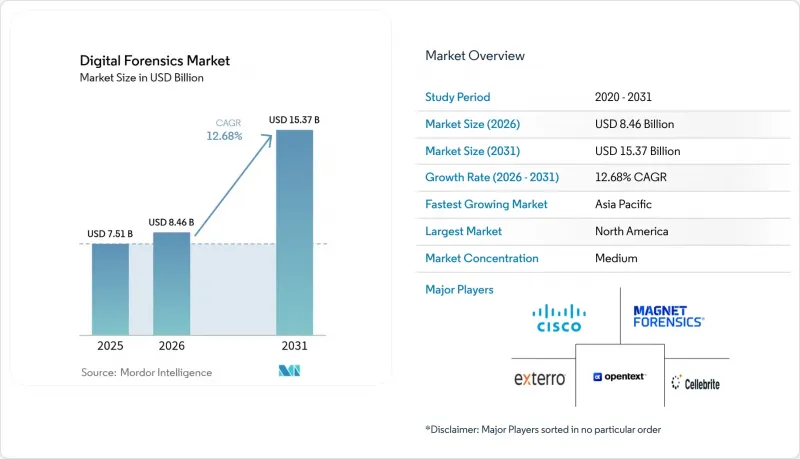
根據 Mordor Intelligence 預測,數位鑑識市場規模將從 2025 年的 75.1 億美元和 2026 年的 84.6 億美元成長到 2031 年的 153.7 億美元,2026 年至 2031 年的年複合成長率(CAGR)為 12.68%。
本報告按組件(硬體、軟體、服務)、類型(網路取證、雲端取證、資料庫取證、其他)、工具(取證資料分析、審查和報告創建、其他)、組織規模(大型企業、中小企業)、最終用戶行業(醫療保健、教育、其他)和地區進行細分。市場預測以美元(USD)為單位。
全球數位鑑識市場趨勢與洞察
雲端原生SaaS的快速普及催生了對雲端取證的需求。
美國網路安全與基礎設施安全局 (CISA) 等機構現已強制要求對所有聯邦雲端工作負載進行持續的取證資料收集,並敦促全球企業採用類似方法。由於容器和無伺服器函數的易變性會導致日誌在幾分鐘內消失,各組織正在採用能夠建立記憶體簡介、重建 Kubernetes Pod 狀態並永久保存資料痕蹟的平台。 Okta 和 Snowflake 等 SaaS 服務洩漏事件凸顯了合約缺陷,並促使製定新的服務等級協議 (SLA) 以確保證據的保存。 ISO 27050 雲端電子電子訊息披露附錄將成為 2026 年審計的重點,不合規的公司將面臨更嚴厲的處罰。因此,數位取證市場正在轉向能夠與 AWS、Azure 和 Google Cloud 無縫整合的承包雲端代理。
利用深度造假進行的詐騙激增,推動了對高階多媒體分析的需求不斷成長。
根據美國聯邦貿易委員會 (FTC) 預測,到 2025 年,金融機構將因使用深度造假音訊和影片進行的欺詐性轉帳而遭受 123 億美元的損失。銀行和保險公司目前正在部署人工智慧驅動的取證過濾器,以檢測不自然的音素轉換和呼吸停頓,從而識別合成媒體。歐盟的《人工智慧法案》將深度造假生成軟體列為高風險軟體,並強制要求可追溯性,這推動了對即時檢測 API 的需求。取證實驗室正在投資能夠高速處理 4K 幀的 GPU叢集,美國國家標準與技術實驗室 (NIST) 也推出了準確性基準測試,以檢驗供應商的說法。這些努力正在提升多媒體取證在數位鑑識市場的重要性。
iOS 和 Android 的預設加密增加了資料檢索的複雜性和成本。
蘋果的 iOS 18 和谷歌的 Android 15 會自動啟用安全飛地密鑰,導致邏輯資料提取失效,迫使執法機構採用基於漏洞的方法,而這些方法存在證據在法庭上被污染的風險。預計到 2025 年,高階行動資料提取站的成本將幾乎加倍,達到 85,000 美元,這將加重市政預算的負擔。加州和紐約州的法院都對未披露的零日漏洞證據的可採性提出了質疑。數位取證市場正在透過投資研發抗量子攻擊的暴力破解破解處理設備,並將複雜的資料提取任務外包給託管服務供應商來應對這項挑戰。
細分市場分析
到2031年,服務板塊將以13.27%的複合年成長率持續成長,穩步縮小與軟體板塊在數位取證市場47.23%佔有率的差距(預計2025年軟體板塊的佔有率將達到47.23%)。託管式服務合約將資料收集工具、違規分析和專家證人證詞整合到單一訂閱服務中,使企業能夠將資本支出重新分配到營運預算中。雖然專業服務(諮詢、培訓和現場支援)在2025年仍佔據大部分收入,但透過雲端交付的事件回應合約目前正經歷著以金額為準最快的成長。硬體市場佔有率仍然最小,但其專門設計的成像工作站、遮光罩和堅固耐用的現場工具包將繼續為執法機關流程提供支援。
軟體成長正受到功能整合的抑制,供應商開放API,允許檢測平台按需呼叫取證功能。企業擴大僅購買核心分析引擎的許可,並將常規證據處理外包給承諾24小時內出具報告的服務供應商。這一趨勢導致硬體更新周期放緩,而服務利潤率卻在提高,這印證了數位取證市場正從永久授權模式轉向基於結果的模式。能夠將軟體、硬體和專業知識整合到單一帳單中的供應商有望引領下一輪支出週期。
預計到2031年,雲取證將以13.84%的複合年成長率成長,超過電腦取證。電腦取證在2025年仍佔數位鑑識市場32.44%的佔有率。目前,各組織正在部署代理程序,將短期容器日誌、無伺服器追蹤和SaaS元資料儲存在不可變物件儲存中,以減少資料波動導致的證據遺失。電腦鑑識在涉及Windows和Linux終端機的入侵調查中仍然發揮著至關重要的作用,但隨著終端偵測工具現在能夠處理以前由傳統磁碟映像完成的大部分工作,其成長速度正在放緩。
行動裝置取證約佔公共部門預算的三分之一,但隨著加密技術的日益普及,各機構正轉向託管在安全雲平台上的提取即服務 (EaaS)。網路取證正在復甦,因為資料包擷取現在可以識別供應鏈攻擊中的橫向移動;而物聯網和資料庫取證則在關鍵基礎設施和財務帳簿中需要進行交易級檢驗的領域蓬勃發展。總體而言,由於雲端工作負載的擴展和終端的多樣化,數位取證市場預計將保持兩位數的成長。
區域分析
預計到2025年,北美將佔據數位鑑識市場41.37%的佔有率。這得歸功於聯邦政府12億美元的網路調查資金,這些資金幫助實驗室升級了資料提取和雲端取證工具。由於加州、紐約州和德克薩斯州的資料外洩通知法規日益嚴格,美國公司正將證據收集連接器常規地整合到其安全架構中。在加拿大,修訂後的個人資料保護法規定的更嚴格的揭露期限迫使銀行和電信公司加強取證準備。墨西哥的需求雖然小規模,但隨著跨境犯罪調查中對行動裝置成像能力的需求不斷成長,市場需求正在上升。在全部區域,為了應對人才短缺問題,買家顯然更傾向於選擇託管式服務協議而非永久授權。
亞太地區預計將成為成長最快的地區,到2031年複合年成長率將達到13.66%,該地區的數位鑑識市場預計將以高於其他任何地區的速度擴張。在印度,數千名新的取證專家已獲得認證;在日本,政府已累計85億日元用於升級專門從事高級行動資料提取的縣級實驗室。中國的資料居住政策迫使跨國公司在國內建立取證基礎設施,這實際上分散了全球事件回應工作流程。澳洲的關鍵基礎設施法規正在推動網路和雲端取證領域的新支出,而韓國的銀行、金融服務和保險(BFSI)行業正在延長證據數據的保留期限,以打擊支付詐騙。這些舉措共同推動了全部區域的長期成長。
歐洲持續做出重要貢獻,GDPR 和網路資訊安全指令強制要求進行依賴取證技術的正式違規評估,儘管該地區的成長速度慢於亞太地區。在中東和非洲,支出集中在阿拉伯聯合大公國和沙烏地阿拉伯,因為這些國家的智慧城市和政府雲端專案都需要監管鏈。在南美洲,巴西和阿根廷處於領先地位,正在升級警務取證實驗室以打擊有組織的網路犯罪和腐敗。儘管一些新興市場的預算有限,但由於勒索軟體的興起和監管壓力的增加,數位鑑識市場的潛在規模仍在持續擴大。
其他福利
- Excel格式的市場預測(ME)表
- 3個月的分析師支持
目錄
第1章:引言
- 研究假設和市場定義
- 調查範圍
第2章:調查方法
第3章執行摘要
第4章 市場狀況
- 市場概覽
- 市場促進因素
- 雲端原生SaaS的快速普及催生了對雲端取證的需求。
- 利用深度造假進行的詐騙激增,推動了對高階多媒體分析的需求不斷成長。
- 由於增強型檢測與響應(XDR)技術的引入,對整合式數位取證與事件回應(DFIR)平台的需求日益成長。
- 美國和歐盟的法規強制要求執法機關從行動裝置中資料提取。
- 透過使用基於區塊鏈的證據來儲存歷史管理(監管鏈)的概念驗證實驗,加速取證軟體的升級。
- 由於聯邦政府加大網路安全投資和監管合規要求,取證工作得到更廣泛的應用。
- 市場限制因素
- iOS 和 Android 的預設加密增加了資料檢索的複雜性和成本。
- 一線城市以外地區法院認證的檢查員短缺
- 由於工具之間缺乏互通性,中小企業的總擁有成本增加。
- 限制跨境證據轉移的資料居住規則(例如中國的《雲端安全法》)
- 宏觀經濟因素對市場的影響
- 產業價值鏈分析
- 監理展望
- 技術展望
- 波特五力分析
第5章 市場規模與成長預測
- 按組件
- 硬體
- 取證系統、設備和遮光器
- 影像處理及影印設備
- 其他
- 軟體
- 法醫數據分析與視覺化
- 審核和報告撰寫
- 法證解密
- 其他軟體
- 服務
- 專業服務
- 事件回應和違規分析
- 諮詢和培訓
- 託管取證服務
- 專業服務
- 硬體
- 按類型
- 電腦取證
- 行動裝置取證
- 網路取證
- 雲取證
- 資料庫取證
- 物聯網和嵌入式設備取證
- 工具
- 數據採集和存儲
- 資料恢復與重建
- 法醫數據分析
- 審核和報告撰寫
- 取證解密與密碼破解
- 按組織規模
- 大公司
- 小型企業
- 按最終用戶行業分類
- 政府和執法機關
- BFSI
- IT/通訊
- 衛生保健
- 零售與電子商務
- 能源與公共產業
- 製造業
- 運輸/物流
- 國防/航太
- 教育
- 按地區
- 北美洲
- 美國
- 加拿大
- 墨西哥
- 南美洲
- 巴西
- 阿根廷
- 其他南美國家
- 歐洲
- 英國
- 德國
- 法國
- 義大利
- 其他歐洲國家
- 亞太地區
- 中國
- 日本
- 印度
- 韓國
- 其他亞太國家
- 中東和非洲
- 中東
- 阿拉伯聯合大公國
- 沙烏地阿拉伯
- 其他中東國家
- 非洲
- 南非
- 埃及
- 其他非洲地區
- 中東
- 北美洲
第6章 競爭情勢
- 市場集中度
- 策略趨勢
- 市佔率分析
- 公司簡介
- OpenText Corporation
- Cellebrite DI Ltd.
- Exterro Inc.
- Magnet Forensics Inc.
- Cisco Systems Inc.
- Mandiant Inc.
- LogRhythm Inc.
- KLDiscovery Inc.
- Paraben Corporation
- MSAB AB
- Oxygen Forensics Inc.
- Kroll LLC
- Hexagon AB
- ADF Solutions Inc.
- BAE Systems plc
- Broadcom Inc.
- Micro Systemation AB
- Digital Detective Group
- Nuix Pty Ltd
- Passware Inc.
第7章 市場機會與未來展望
According to Mordor Intelligence, the digital forensics market size is projected to expand from USD 7.51 billion in 2025 and USD 8.46 billion in 2026 to USD 15.37 billion by 2031, registering a 12.68% CAGR between 2026 and 2031.
This report is Segmented by Component (Hardware, Software, Services), Type (Network Forensics, Cloud Forensics, Database Forensics, and More), Tool (Forensic Data Analysis, Review and Reporting, and More), Organization Size (Large Enterprises, and Small and Medium Enterprises), End-User Vertical (Healthcare, Education, and More), and Geography. The Market Forecasts are Provided in Terms of Value (USD).
Global Digital Forensics Market Trends and Insights
Rapid Proliferation of Cloud-Native SaaS Creating Demand for Cloud Forensics
Agencies such as CISA now require continuous forensic data collection for every federal cloud workload, pushing enterprises worldwide to adopt a similar posture. Volatile containers and serverless functions expire logs within minutes, so organizations have adopted platforms that snapshot memory, reconstruct Kubernetes pod states, and store artifacts immutably. SaaS breaches at Okta and Snowflake underscored contractual gaps, prompting new service-level agreements that guarantee evidence preservation. ISO 27050 annexes on cloud e-discovery became an audit focal point in 2026, and non-compliant firms face escalating penalties. The digital forensics market is consequently pivoting toward turnkey cloud agents that integrate seamlessly with AWS, Azure, and Google Cloud.
Surge in Deepfake-Enabled Fraud Driving Advanced Multimedia Analysis Needs
Deepfake audio and video cost financial institutions USD 12.3 billion in fraudulent transfers during 2025, according to the Federal Trade Commission. Banks and insurers now embed AI-powered forensic filters that look for unnatural phoneme transitions and skipped breaths to flag synthetic media. The European Union's AI Act classifies deepfake generation software as high-risk and mandates traceability, spurring demand for real-time detection APIs. Forensic labs are investing in GPU clusters that process 4K frames quickly, and the U.S. National Institute of Standards and Technology launched accuracy benchmarks to validate vendor claims. These initiatives elevate the importance of multimedia forensics in the digital forensics market.
Encryption-by-Default on iOS/Android Elevating Acquisition Complexity and Cost
Apple iOS 18 and Google Android 15 automatically activate secure-enclave keys, making logical extractions ineffective and forcing agencies toward exploit-based techniques that risk evidence contamination in court. The cost of a high-end mobile-extraction station nearly doubled to USD 85,000 in 2025, straining municipal budgets. Courts in California and New York questioned the admissibility of evidence when zero-day exploits remain undisclosed. The digital forensics market compensates by investing in quantum-resistant brute-force rigs and outsourcing complex extractions to managed service providers.
Other drivers and restraints analyzed in the detailed report include:
- Extended Detection and Response Adoption Necessitating Integrated DFIR Platforms
- Legislated Mobile Device Extraction Mandates in U.S. and EU Law-Enforcement
- Shortage of Court-Certified Examiners Outside Tier-1 Cities
For complete list of drivers and restraints, kindly check the Table Of Contents.
Segment Analysis
Services are advancing at a 13.27% CAGR through 2031, steadily closing the gap with software's 47.23% share of the digital forensics market in 2025. Managed retainers bundle acquisition tools, breach analysis, and expert witness testimony under a single subscription, allowing enterprises to shift capital expenses to operating budgets. Professional services consulting, training, and on-site support formed the bulk of 2025 revenue, but cloud-delivered incident-response contracts now account for the fastest dollar growth. Hardware remained the smallest slice, yet purpose-built imaging workstations, write blockers, and rugged field kits continue to anchor law-enforcement workflows.
Software growth is tempered by feature convergence, as vendors expose open APIs that let detection platforms call forensic functions on demand. Enterprises increasingly license only core parsing engines, then outsource routine evidence processing to service providers that promise 24-hour report delivery. This dynamic sustains hardware refreshes at a slower cadence while lifting service margins, confirming that the digital forensics market is pivoting toward outcomes rather than perpetual licenses. Providers that merge software, hardware, and expertise into a single invoice are positioned to lead the next spending cycle.
Cloud forensics is projected to grow at a 13.84% CAGR through 2031, outpacing computer forensics, which still accounted for 32.44% of the digital forensics market in 2025. Organizations now deploy agents that preserve short-lived container logs, serverless traces, and SaaS metadata in immutable object stores, reducing evidence gaps caused by volatility. Computer forensics remains foundational in breach investigations involving Windows and Linux endpoints, yet its growth slows as endpoint detection tools ingest many classic disk-imaging tasks.
Mobile-device forensics accounts for roughly one-third of public-sector budgets, but the rise of encryption is steering agencies toward extraction-as-a-service offerings hosted in secure clouds. Network forensics rebounds as packet capture pinpoints lateral movement in supply-chain attacks, while IoT and database forensics emerge wherever critical infrastructure and financial ledgers demand transaction-level validation. Collectively, expanding cloud workloads and diversified endpoints will ensure continued double-digit growth in the digital forensics market.
Complete Report Scope:
- By Component
- Hardware
- Forensic Systems, Devices and Write Blockers
- Imaging and Duplication Devices
- Other Hardwares
- Software
- Forensic Data Analysis and Visualization
- Review and Reporting
- Forensic Decryption
- Other Softwares
- Services
- Professional Services
- Incident Response and Breach Analysis
- Consulting and Training
- Managed Forensic Services
- Professional Services
- Hardware
- By Type
- Computer Forensics
- Mobile Device Forensics
- Network Forensics
- Cloud Forensics
- Database Forensics
- IoT and Embedded Device Forensics
- By Tool
- Data Acquisition and Preservation
- Data Recovery and Reconstruction
- Forensic Data Analysis
- Review and Reporting
- Forensic Decryption and Password Cracking
- By Organization Size
- Large Enterprises
- Small and Medium Enterprises
- By End-user Vertical
- Government and Law Enforcement Agencies
- BFSI
- IT and Telecom
- Healthcare
- Retail and E-commerce
- Energy and Utilities
- Manufacturing
- Transportation and Logistics
- Defense and Aerospace
- Education
- By Geography
- North America
- United States
- Canada
- Mexico
- South America
- Brazil
- Argentina
- Rest of South America
- Europe
- United Kingdom
- Germany
- France
- Italy
- Rest of Europe
- Asia Pacific
- China
- Japan
- India
- South Korea
- Rest of Asia Pacific
- Middle East and Africa
- Middle East
- United Arab Emirates
- Saudi Arabia
- Rest of Middle East
- Africa
- South Africa
- Egypt
- Rest of Africa
- Middle East
- North America
Geography Analysis
North America commanded 41.37% of the 2025 digital forensics market share, supported by USD 1.2 billion in federal cyber-investigation funding that helped laboratories upgrade extraction and cloud-forensic tools. Enterprises in the United States face strict breach notification rules in California, New York, and Texas, so they routinely embed evidence-capture connectors into their security stacks. Canada tightened disclosure timelines under its revised privacy law, prompting banks and telecom operators to enhance forensic readiness. Mexico's demand is smaller but rising as cross-border crime investigations require mobile-device imaging capabilities. Across the region, buyers show a clear preference for managed retainers over perpetual licenses as a hedge against talent shortages.
Asia-Pacific is projected to post the fastest 13.66% CAGR through 2031, lifting the regional digital forensics market size at a pace unmatched elsewhere. India is certifying thousands of new examiners, and Japan has budgeted JPY 8.5 billion for upgrades to prefectural labs focused on advanced mobile extractions. China's data-residency rules force multinationals to build in-country forensic infrastructure, effectively segmenting global incident-response workflows. Australia's critical infrastructure mandates are driving fresh spending on network and cloud forensics, while South Korea's BFSI sector is expanding artifact retention to counter payment fraud. These national initiatives collectively underpin long-run growth across the region.
Europe remains a robust contributor as GDPR and the Network and Information Security Directive require formal breach assessments that rely on forensics, yet the region's expansion is steadier than that of Asia-Pacific. The Middle East and Africa concentrate spending in the United Arab Emirates and Saudi Arabia, where smart-city and government cloud programs demand chain-of-custody controls. South America centers on Brazil and Argentina, which are upgrading police laboratories to address organized cybercrime and corruption. Although budgets in several emerging markets are limited, rising ransomware and regulatory pressure continue to broaden the addressable digital forensics market.
- OpenText Corporation
- Cellebrite DI Ltd.
- Exterro Inc.
- Magnet Forensics Inc.
- Cisco Systems Inc.
- Mandiant Inc.
- LogRhythm Inc.
- KLDiscovery Inc.
- Paraben Corporation
- MSAB AB
- Oxygen Forensics Inc.
- Kroll LLC
- Hexagon AB
- ADF Solutions Inc.
- BAE Systems plc
- Broadcom Inc.
- Micro Systemation AB
- Digital Detective Group
- Nuix Pty Ltd
- Passware Inc.
Additional Benefits:
- The market estimate (ME) sheet in Excel format
- 3 months of analyst support
TABLE OF CONTENTS
1 INTRODUCTION
- 1.1 Study Assumptions and Market Definition
- 1.2 Scope of the Study
2 RESEARCH METHODOLOGY
3 EXECUTIVE SUMMARY
4 MARKET LANDSCAPE
- 4.1 Market Overview
- 4.2 Market Drivers
- 4.2.1 Rapid Proliferation of Cloud-Native SaaS Creating Demand for Cloud Forensics
- 4.2.2 Surge in Deepfake-Enabled Fraud Driving Advanced Multimedia Analysis Needs
- 4.2.3 Extended Detection and Response (XDR) Adoption Necessitating Integrated DFIR Platforms
- 4.2.4 Legislated Mobile Device Extraction Mandates in U.S. and EU Law-Enforcement
- 4.2.5 Blockchain-Based Evidence Chain-of-Custody Pilots Boosting Forensic Software Upgrades
- 4.2.6 Federal Cybersecurity Investments and Regulatory Compliance Requirements Expanding Forensic Deployments
- 4.3 Market Restraints
- 4.3.1 Encryption-by-Default on iOS/Android Elevating Acquisition Complexity and Cost
- 4.3.2 Shortage of Court-Certified Examiners Outside Tier-1 Cities
- 4.3.3 Fragmented Tool Inter-Operability Increasing Total Cost of Ownership for SMEs
- 4.3.4 Data-Residency Rules Limiting Cross-Border Evidence Transfers (e.g., China CSL)
- 4.4 Impact of Macroeconomic Factors on the Market
- 4.5 Industry Value Chain Analysis
- 4.6 Regulatory Outlook
- 4.7 Technological Outlook
- 4.8 Porter's Five Forces Analysis
- 4.8.1 Bargaining Power of Buyers
- 4.8.2 Bargaining Power of Suppliers
- 4.8.3 Threat of New Entrants
- 4.8.4 Threat of Substitutes
- 4.8.5 Intensity of Competitive Rivalry
5 MARKET SIZE AND GROWTH FORECASTS (VALUE)
- 5.1 By Component
- 5.1.1 Hardware
- 5.1.1.1 Forensic Systems, Devices and Write Blockers
- 5.1.1.2 Imaging and Duplication Devices
- 5.1.1.3 Other Hardwares
- 5.1.2 Software
- 5.1.2.1 Forensic Data Analysis and Visualization
- 5.1.2.2 Review and Reporting
- 5.1.2.3 Forensic Decryption
- 5.1.2.4 Other Softwares
- 5.1.3 Services
- 5.1.3.1 Professional Services
- 5.1.3.1.1 Incident Response and Breach Analysis
- 5.1.3.1.2 Consulting and Training
- 5.1.3.2 Managed Forensic Services
- 5.1.3.1 Professional Services
- 5.1.1 Hardware
- 5.2 By Type
- 5.2.1 Computer Forensics
- 5.2.2 Mobile Device Forensics
- 5.2.3 Network Forensics
- 5.2.4 Cloud Forensics
- 5.2.5 Database Forensics
- 5.2.6 IoT and Embedded Device Forensics
- 5.3 By Tool
- 5.3.1 Data Acquisition and Preservation
- 5.3.2 Data Recovery and Reconstruction
- 5.3.3 Forensic Data Analysis
- 5.3.4 Review and Reporting
- 5.3.5 Forensic Decryption and Password Cracking
- 5.4 By Organization Size
- 5.4.1 Large Enterprises
- 5.4.2 Small and Medium Enterprises
- 5.5 By End-user Vertical
- 5.5.1 Government and Law Enforcement Agencies
- 5.5.2 BFSI
- 5.5.3 IT and Telecom
- 5.5.4 Healthcare
- 5.5.5 Retail and E-commerce
- 5.5.6 Energy and Utilities
- 5.5.7 Manufacturing
- 5.5.8 Transportation and Logistics
- 5.5.9 Defense and Aerospace
- 5.5.10 Education
- 5.6 By Geography
- 5.6.1 North America
- 5.6.1.1 United States
- 5.6.1.2 Canada
- 5.6.1.3 Mexico
- 5.6.2 South America
- 5.6.2.1 Brazil
- 5.6.2.2 Argentina
- 5.6.2.3 Rest of South America
- 5.6.3 Europe
- 5.6.3.1 United Kingdom
- 5.6.3.2 Germany
- 5.6.3.3 France
- 5.6.3.4 Italy
- 5.6.3.5 Rest of Europe
- 5.6.4 Asia Pacific
- 5.6.4.1 China
- 5.6.4.2 Japan
- 5.6.4.3 India
- 5.6.4.4 South Korea
- 5.6.4.5 Rest of Asia Pacific
- 5.6.5 Middle East and Africa
- 5.6.5.1 Middle East
- 5.6.5.1.1 United Arab Emirates
- 5.6.5.1.2 Saudi Arabia
- 5.6.5.1.3 Rest of Middle East
- 5.6.5.2 Africa
- 5.6.5.2.1 South Africa
- 5.6.5.2.2 Egypt
- 5.6.5.2.3 Rest of Africa
- 5.6.5.1 Middle East
- 5.6.1 North America
6 COMPETITIVE LANDSCAPE
- 6.1 Market Concentration
- 6.2 Strategic Moves
- 6.3 Market Share Analysis
- 6.4 Company Profiles (includes Global Level Overview, Market Level Overview, Core Segments, Financials as available, Strategic Information, Market Rank/Share, Products and Services, Recent Developments)
- 6.4.1 OpenText Corporation
- 6.4.2 Cellebrite DI Ltd.
- 6.4.3 Exterro Inc.
- 6.4.4 Magnet Forensics Inc.
- 6.4.5 Cisco Systems Inc.
- 6.4.6 Mandiant Inc.
- 6.4.7 LogRhythm Inc.
- 6.4.8 KLDiscovery Inc.
- 6.4.9 Paraben Corporation
- 6.4.10 MSAB AB
- 6.4.11 Oxygen Forensics Inc.
- 6.4.12 Kroll LLC
- 6.4.13 Hexagon AB
- 6.4.14 ADF Solutions Inc.
- 6.4.15 BAE Systems plc
- 6.4.16 Broadcom Inc.
- 6.4.17 Micro Systemation AB
- 6.4.18 Digital Detective Group
- 6.4.19 Nuix Pty Ltd
- 6.4.20 Passware Inc.
7 MARKET OPPORTUNITIES AND FUTURE OUTLOOK
- 7.1 White-space and Unmet-Need Assessment

 數位調查解決方案市場:全球市場預測,2026-2032年
 歐洲數位鑑識:市場佔有率分析、產業趨勢與統計及成長預測(2026-2031 年)
 2026-2030年全球數位鑑識市場品牌活化服務:市場佔有率分析、產業趨勢與統計、成長預測(2026-2031)
 數位取證市場報告:按組件、類型、工具、最終用戶和地區分類(2026-2034 年)
 數位取證市場:按取證類型、組件、工具、產業和地區分類
 數位取證工具市場預測至2034年:按組件、取證類型、部署模式、組織規模、應用、最終用戶和地區分類的全球分析
 數位取證市場分析及預測(至2035年):按類型、產品類型、服務、技術、組件、應用、設備、流程、部署模式和最終用戶分類數位取證市場:2026-2032年全球市場預測(按解決方案、取證類型、應用、部署模式和最終用戶產業分類)
 2026年全球數位鑑識市場報告