


 |
市場調查報告書
商品編碼
2098514
品牌活化服務:市場佔有率分析、產業趨勢與統計、成長預測(2026-2031)Brand Activation Services - Market Share Analysis, Industry Trends & Statistics, Growth Forecasts (2026 - 2031) |
||||||

※ 本網頁內容可能與最新版本有所差異。詳細情況請與我們聯繫。
根據 Mordor Intelligence 預測,品牌活化服務市場規模將從 2025 年的 92 億美元成長到 2026 年的 100.7 億美元,然後在 2031 年達到 152.2 億美元,2026 年至 2031 年的複合年成長率為 8.62%。
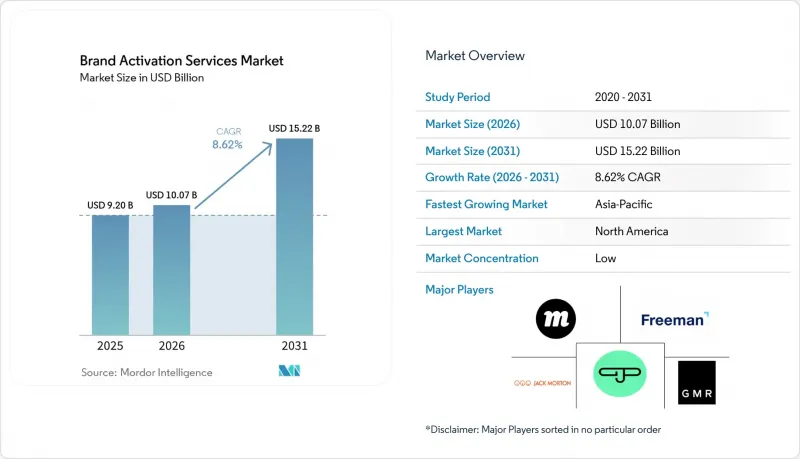
本報告按服務類型(策略和宣傳活動策劃等)、終端用戶行業(零售和消費品、食品飲料、美容和個人護理、汽車、科技和電信、銀行、金融服務和保險、醫療保健和製藥等)、通路(線下和現場活動等)以及地區進行細分。市場預測以價值(美元)表示。
全球品牌活化服務市場趨勢與洞察
將預算重新分配給可衡量的體驗式支出
行銷團隊正將更多預算分配給那些能夠實際提升用戶參與度、線索品質和購買意願的項目。這一趨勢在品牌活化服務市場尤為顯著,因為品牌活化不再被視為大規模宣傳活動的一次性支援活動。隨著品牌將品牌活化定位為持續性管道,它與媒體採購一樣受到嚴格的管治,包括採購審查、報告規則和多年規劃。這種轉變提升了能夠將活動與專有受眾數據和後續商業性行動結合的代理商的價值。此外,能夠支援大規模、可複製專案的供應商,而非僅能提供一次性活動的供應商,在品牌活化服務市場也更具優勢。
對第一方資料收集和基於同意的互動方式的需求日益成長。
線下和線上互動活動正日益增多,因為它們能夠產生直接的、更容易記錄的同意訊號,而這些訊號並非來自租用的數位受眾。 2025年2月,Adobe在美國推出了即時客戶資料平台(CDP)協作平台,使廣告商和發布商能夠在不直接揭露個人識別資訊的情況下,利用基於同意的第一方資料。 2025年7月,加州隱私權保護部批准了一項規則制定方案的最終草案,該方案涵蓋自動化決策技術、風險評估和年度網路安全審計。這些變更提高了資料密集型活動項目的合規標準,使擁有更完善的同意獲取和資料處理流程的合作夥伴更具優勢。因此,品牌激活服務市場正受益於客戶對可衡量且注重隱私的受眾獲取方式日益成長的需求。
投資報酬率 (ROI) 歸因和衡量方面的挑戰
歸因分析仍是快速成長支出的最大障礙。許多行銷活動會追蹤出席人數、掃描量或即時潛在客戶,但卻無法將這些訊號與數週後出現的購買行為清晰地連結起來。在品牌活化服務市場,這造成了報告的空白,使得財務部門不願意快速增加預算。如果品牌先規劃體驗活動,後才進行效果評估,這個問題會更加嚴重。那些從一開始就將用戶許可獲取、行為追蹤和客戶關係管理(CRM)整合納入方案的機構,在品牌激活服務市場中擁有顯著的預算優勢。
細分市場分析
到2025年,「製作與執行」將佔品牌活化服務市場32.92%的佔有率,成為最大的服務細分市場。這一主導地位反映了物流、製作、人員配備和現場管理在大規模活化專案中持續的重要性。由於許多全球客戶仍需要在多個場地和市場進行一致的執行,因此該細分市場仍然至關重要。 「策略與宣傳活動規劃」以及「創新與體驗設計」也將繼續佔據重要地位,因為客戶在製作開始前需要更強大的諮詢能力。
「技術與數位層面的整合」預計將在2026年至2031年間以9.42%的複合年成長率成長,成為品牌活化服務市場中成長最快的服務類型。這項轉變的驅動力在於身臨其境型數位層面、互動工具和受眾數據系統在現場活動中的日益普及。喬治·P·約翰遜發布的NRF 2026報告指出,技術主導的體驗設計正逐漸成為品牌活化實施的核心組成部分,而不再只是附加功能。數位元素也在改變服務結構,因為它們能夠將單一線下活動的價值擴展到多個內容和受眾管道。預計這一趨勢將進一步提昇技術整合在品牌活化服務市場中的作用。
區域分析
到2025年,北美將佔據品牌活化服務市場34.92%的佔有率,成為領先的區域市場。該地區充分利用自身優勢,包括高密度的代理商網路、成熟的贊助文化、高品質的活動基礎設施以及大規模的企業客戶群。美國仍然是主要的需求中心,其全年重要的體育、娛樂和企業活動日程推動著品牌活化計畫的發展。因此,北美在品牌激活服務市場的多市場交易中繼續佔據核心地位。
預計2026年至2031年,亞太地區品牌活化服務市場將以9.73%的複合年成長率成長,成為該市場成長最快的地區。該地區受益於都市區消費者的擴張、行動優先的購物行為以及創作者生態系統與主導體驗之間聯繫的加強等因素。根據中國資訊通訊研究院統計,截至2025年11月,中國體驗經濟規模已達18.4兆元人民幣(約2.56兆美元)。如此龐大的規模支撐著零售和消費者互動領域對體驗主導模式的廣泛需求。因此,亞太地區仍將是品牌活化服務市場的重要成長引擎。
歐洲是一個成熟且注重隱私的地區,其合規要求規範了活動中第一方資料的收集方式。加州隱私法規的製定以及Adobe以用戶同意為中心的合作模式,都反映了更廣泛的商業性趨勢,即加強對受眾資料使用的管治。在南美洲,消費者領域正重拾成長勢頭,而非洲雖然仍是規模最小的地區,但在模組化、具成本效益的活化模式方面已初見成效。因此,品牌活化服務市場呈現出成熟監管地區與快速成長的新興地區並存的格局。
其他好處:
- Excel格式的市場預測(ME)表
- 3個月的分析師支持
目錄
第1章:引言
- 研究假設和市場定義
- 調查範圍
第2章:調查方法
第3章執行摘要
第4章 市場狀況
- 市場概覽
- 市場促進因素
- 將預算重新分配給可衡量的體驗式支出
- 對第一方資料收集和基於同意的互動方式的需求日益成長。
- 混合和數位放大層的擴展
- 親身參與能增強品牌信任度與知名度。
- 零售媒體與創作者電商的融合正在推動消費者激活預算的成長。
- 微型活化和模組化彈出式設計提高了單位經濟效益。
- 市場限制因素
- 投資報酬率 (ROI) 的因素分析與測量差距
- 不斷上漲的製作成本、場地費用、人事費用和物流成本。
- 資料豐富啟動過程中的隱私合規摩擦
- 零售媒體的分散化增加了執行的複雜性。
- 產業價值鏈分析
- 宏觀經濟因素對市場的影響
- 監理情勢
- 技術展望
- 波特五力分析
第5章 市場規模與成長預測
- 按服務類型
- 策略和宣傳活動規劃
- 創新與體驗設計
- 生產和激活
- 科技與數位層的融合
- 按最終用途行業分類
- 零售和消費品
- 食品/飲料
- 美容及個人護理
- 車
- 科技與通訊
- 醫療和藥品
- BFSI
- 媒體與娛樂
- 旅遊與飯店
- 其他終端用戶產業
- 通道特異性
- 線下及本地推廣活動
- 線上和數位激活
- 混合激活
- 按地區
- 北美洲
- 美國
- 加拿大
- 墨西哥
- 南美洲
- 巴西
- 阿根廷
- 其他南美國家
- 歐洲
- 德國
- 英國
- 法國
- 義大利
- 西班牙
- 其他歐洲國家
- 亞太地區
- 中國
- 印度
- 日本
- 韓國
- 東南亞
- 其他亞太國家
- 中東
- 阿拉伯聯合大公國
- 沙烏地阿拉伯
- 其他中東國家
- 非洲
- 南非
- 埃及
- 奈及利亞
- 其他非洲國家
- 北美洲
第6章 競爭情勢
- 市場集中度
- 策略趨勢
- 市佔率分析
- 公司簡介
- Jack Morton Worldwide
- George P. Johnson Company
- Momentum Worldwide, LLC
- GMR Marketing LLC
- TRO Group Ltd.
- Freeman Expositions, Inc.
- Sparks, a Freeman Company
- Impact XM, LLC
- FIRST Agency, Inc.
- INVNT Group, Inc.
- NVE Experience Agency, Inc.
- Opus Agency, LLC
- Auditoire Group
- Imagination Ltd.
- Mosaic Sales Solutions US Operating Co., LLC
- Inspira Marketing Group, LLC
- Cheil Worldwide Inc.
- INNOCEAN Worldwide, Inc.
- MKTG, Inc.
- Pico Far East Holdings Limited
第7章 市場機會與未來展望
According to Mordor Intelligence, the brand activation services market size is expected to grow from USD 9.20 billion in 2025 to USD 10.07 billion in 2026 and is forecast to reach USD 15.22 billion by 2031 at 8.62% CAGR over 2026-2031.
This report is Segmented by Service Type ( Strategy and Campaign Planning, and More), End-Use Industry (Retail and Consumer Goods, Food and Beverage, Beauty and Personal Care, Automotive, Technology and Telecommunications, BFSI, Healthcare and Pharmaceuticals, and More), Channel (Offline and On-Ground Activations, and More), and Geography. The Market Forecasts are Provided in Terms of Value (USD).
Global Brand Activation Services Market Trends and Insights
Budget Reallocation Toward Measurable Experiential Spend
Marketing teams are allocating more budget to programs that clearly connect to engagement, lead quality, and purchase intent. In the brand activation services market, this matters because activation is no longer being treated as a one-off support activity for large campaigns. Once brands classify activation as an ongoing channel, they apply the same governance as media buying, including procurement reviews, reporting rules, and multi-year planning. That shift is raising the value of agencies that can connect event activity with owned audience data and downstream commercial actions. It is also making the brand activation services market more favorable to vendors that can support large, repeatable programs instead of isolated events.
Rising Demand for First-Party Data Capture and Consent-Based Engagement
Live and live-digital activation formats are gaining value because they generate direct consent signals that are easier to document than those from rented digital audiences. In February 2025, Adobe launched Real-Time CDP Collaboration in the United States, enabling advertisers and publishers to work with consent-driven first-party data without directly exposing identifiable customer information. In July 2025, the California Privacy Protection Agency approved final text for a rulemaking package covering automated decision-making technology, risk assessments, and annual cybersecurity audits. These changes are raising the compliance standard for data-rich event programs and giving an advantage to activation partners with stronger consent and data-handling processes. As a result, the brand activation services market is benefiting from a wider client need for audience acquisition that is both measurable and privacy-aware.
Return on Investment Attribution and Measurement Gaps
Attribution remains the clearest limit on faster spending growth. Many activation programs still capture attendance, scans, or immediate leads, but they do not connect those signals cleanly to purchase behavior that appears weeks later. In the brand activation services market, this creates a reporting gap that makes finance teams less willing to expand budgets at pace. The problem becomes larger when brands plan the experience first and add measurement only after the event is complete. Agencies that build consent capture, behavioral tracking, and CRM linkage into the brief from the start are better placed to protect spending in the brand activation services market.
Other drivers and restraints analyzed in the detailed report include:
- Expansion of Hybrid and Digital Amplification Layers
- Higher Brand Trust and Recall From In-Person Participation
- Rising Production, Venue, Labor, and Logistics Costs
For complete list of drivers and restraints, kindly check the Table Of Contents.
Segment Analysis
Production and Activation Execution held 32.92% of the brand activation services market share in 2025, making it the largest service line. That lead reflects the continuing importance of logistics, fabrication, staffing, and on-site management in large-scale activation programs. The segment remains central because many global clients still need consistent execution across multiple venues and markets. Strategy and Campaign Planning, along with Creative and Experience Design, continue to matter because clients want stronger advisory input before production begins.
Technology and Digital Layer Integration is projected to expand at a 9.42% CAGR from 2026 to 2031, making it the fastest-growing service type in the brand activation services market. The shift is supported by the growing use of immersive digital layers, interactive tools, and audience data systems in live programs. George P. Johnson's NRF 2026 work reflects how technology-led experience design is becoming part of core activation delivery rather than a peripheral add-on. This changes the service mix because digital components can extend the value of a single physical event across multiple content and audience channels. Over time, that trend should continue to elevate the role of technology integration in the brand activation services market.
Complete Report Scope:
- By Service Type
- Strategy and Campaign Planning
- Creative and Experience Design
- Production and Activation Execution
- Technology and Digital Layer Integration
- By End-use Industry
- Retail and Consumer Goods
- Food and Beverage
- Beauty and Personal Care
- Automotive
- Technology and Telecommunications
- Healthcare and Pharmaceuticals
- BFSI
- Media and Entertainment
- Travel and Hospitality
- Other End-use Industries
- By Channel
- Offline and On-Ground Activations
- Online and Digital Activations
- Hybrid Activations
- By Geography
- North America
- United States
- Canada
- Mexico
- South America
- Brazil
- Argentina
- Rest of South America
- Europe
- Germany
- United Kingdom
- France
- Italy
- Spain
- Rest of Europe
- Asia-Pacific
- China
- India
- Japan
- South Korea
- Southeast Asia
- Rest of Asia-Pacific
- Middle East
- United Arab Emirates
- Saudi Arabia
- Rest of the Middle East
- Africa
- South Africa
- Egypt
- Nigeria
- Rest of Africa
- North America
Geography Analysis
North America held 34.92% of the brand activation services market share in 2025, making it the leading regional segment. The region benefits from strong agency density, mature sponsorship culture, premium event infrastructure, and a large base of enterprise clients. The United States remains the main demand center because major sports, entertainment, and corporate calendars support year-round activation planning. This keeps North America at the center of multi-market assignments in the brand activation services market.
Asia-Pacific is projected to grow at a 9.73% CAGR from 2026 to 2031, making it the fastest-growing geography in the brand activation services market. The region is benefiting from urban consumer expansion, mobile-first shopping behavior, and stronger links between creator ecosystems and commerce-led experiences. China's experience economy reached CNY 18.4 trillion (USD 2.56 trillion) by November 2025, according to the China Academy of Information and Communications Technology. That scale is supporting wider demand for experience-led formats in retail and consumer engagement. Asia-Pacific, therefore, remains an important growth engine for the brand activation services market.
Europe is a mature, privacy-conscious region where compliance requirements shape how first-party data is collected at events. The California privacy rulemaking and Adobe's consent-focused collaboration model both reflect the wider commercial direction toward stronger governance in audience data use. South America is recovering as consumer-facing sectors rebuild spending momentum, while Africa remains the smallest region but shows early growth in modular and cost-efficient activation formats. This leaves the brand activation services market with a mix of mature regulated regions and faster-growth emerging regions.
- Jack Morton Worldwide
- George P. Johnson Company
- Momentum Worldwide, LLC
- GMR Marketing LLC
- TRO Group Ltd.
- Freeman Expositions, Inc.
- Sparks, a Freeman Company
- Impact XM, LLC
- FIRST Agency, Inc.
- INVNT Group, Inc.
- NVE Experience Agency, Inc.
- Opus Agency, LLC
- Auditoire Group
- Imagination Ltd.
- Mosaic Sales Solutions US Operating Co., LLC
- Inspira Marketing Group, LLC
- Cheil Worldwide Inc.
- INNOCEAN Worldwide, Inc.
- MKTG, Inc.
- Pico Far East Holdings Limited
Additional Benefits:
- The market estimate (ME) sheet in Excel format
- 3 months of analyst support
TABLE OF CONTENTS
1 INTRODUCTION
- 1.1 Study Assumptions and Market Definition
- 1.2 Scope of the Study
2 RESEARCH METHODOLOGY
3 EXECUTIVE SUMMARY
4 MARKET LANDSCAPE
- 4.1 Market Overview
- 4.2 Market Drivers
- 4.2.1 Budget Reallocation Toward Measurable Experiential Spend
- 4.2.2 Rising Demand for First-Party Data Capture and Consent-Based Engagement
- 4.2.3 Expansion of Hybrid and Digital Amplification Layers
- 4.2.4 Higher Brand Trust and Recall From In-Person Participation
- 4.2.5 Retail Media and Creator Commerce Convergence Expands Shopper Activation Budgets
- 4.2.6 Micro-Activations and Modular Pop-Ups Improve Unit Economics
- 4.3 Market Restraints
- 4.3.1 Return on Investment Attribution and Measurement Gaps
- 4.3.2 Rising Production, Venue, Labor, and Logistics Costs
- 4.3.3 Privacy Compliance Friction in Data-Rich Activations
- 4.3.4 Retail Media Fragmentation Raises Execution Complexity
- 4.4 Industry Value Chain Analysis
- 4.5 Impact of Macroeconomic Factors on the Market
- 4.6 Regulatory Landscape
- 4.7 Technological Outlook
- 4.8 Porter's Five Forces Analysis
- 4.8.1 Threat of New Entrants
- 4.8.2 Bargaining Power of Buyers
- 4.8.3 Bargaining Power of Suppliers
- 4.8.4 Threat of Substitutes
- 4.8.5 Intensity of Competitive Rivalry
5 MARKET SIZE AND GROWTH FORECASTS (VALUE)
- 5.1 By Service Type
- 5.1.1 Strategy and Campaign Planning
- 5.1.2 Creative and Experience Design
- 5.1.3 Production and Activation Execution
- 5.1.4 Technology and Digital Layer Integration
- 5.2 By End-use Industry
- 5.2.1 Retail and Consumer Goods
- 5.2.2 Food and Beverage
- 5.2.3 Beauty and Personal Care
- 5.2.4 Automotive
- 5.2.5 Technology and Telecommunications
- 5.2.6 Healthcare and Pharmaceuticals
- 5.2.7 BFSI
- 5.2.8 Media and Entertainment
- 5.2.9 Travel and Hospitality
- 5.2.10 Other End-use Industries
- 5.3 By Channel
- 5.3.1 Offline and On-Ground Activations
- 5.3.2 Online and Digital Activations
- 5.3.3 Hybrid Activations
- 5.4 By Geography
- 5.4.1 North America
- 5.4.1.1 United States
- 5.4.1.2 Canada
- 5.4.1.3 Mexico
- 5.4.2 South America
- 5.4.2.1 Brazil
- 5.4.2.2 Argentina
- 5.4.2.3 Rest of South America
- 5.4.3 Europe
- 5.4.3.1 Germany
- 5.4.3.2 United Kingdom
- 5.4.3.3 France
- 5.4.3.4 Italy
- 5.4.3.5 Spain
- 5.4.3.6 Rest of Europe
- 5.4.4 Asia-Pacific
- 5.4.4.1 China
- 5.4.4.2 India
- 5.4.4.3 Japan
- 5.4.4.4 South Korea
- 5.4.4.5 Southeast Asia
- 5.4.4.6 Rest of Asia-Pacific
- 5.4.5 Middle East
- 5.4.5.1 United Arab Emirates
- 5.4.5.2 Saudi Arabia
- 5.4.5.3 Rest of the Middle East
- 5.4.6 Africa
- 5.4.6.1 South Africa
- 5.4.6.2 Egypt
- 5.4.6.3 Nigeria
- 5.4.6.4 Rest of Africa
- 5.4.1 North America
6 COMPETITIVE LANDSCAPE
- 6.1 Market Concentration
- 6.2 Strategic Moves
- 6.3 Market Share Analysis
- 6.4 Company Profiles (includes Global Level Overview, Market Level Overview, Core Segments, Financials as available, Strategic Information, Market Rank/Share, Products and Services, Recent Developments)
- 6.4.1 Jack Morton Worldwide
- 6.4.2 George P. Johnson Company
- 6.4.3 Momentum Worldwide, LLC
- 6.4.4 GMR Marketing LLC
- 6.4.5 TRO Group Ltd.
- 6.4.6 Freeman Expositions, Inc.
- 6.4.7 Sparks, a Freeman Company
- 6.4.8 Impact XM, LLC
- 6.4.9 FIRST Agency, Inc.
- 6.4.10 INVNT Group, Inc.
- 6.4.11 NVE Experience Agency, Inc.
- 6.4.12 Opus Agency, LLC
- 6.4.13 Auditoire Group
- 6.4.14 Imagination Ltd.
- 6.4.15 Mosaic Sales Solutions US Operating Co., LLC
- 6.4.16 Inspira Marketing Group, LLC
- 6.4.17 Cheil Worldwide Inc.
- 6.4.18 INNOCEAN Worldwide, Inc.
- 6.4.19 MKTG, Inc.
- 6.4.20 Pico Far East Holdings Limited
7 MARKET OPPORTUNITIES AND FUTURE OUTLOOK
- 7.1 White-Space and Unmet-Need Assessment

 數位調查解決方案市場:全球市場預測,2026-2032年
 歐洲數位鑑識:市場佔有率分析、產業趨勢與統計及成長預測(2026-2031 年)數位鑑識:市場佔有率分析、產業趨勢與統計、成長預測(2026-2031)
 2026-2030年全球數位鑑識市場
 數位取證市場報告:按組件、類型、工具、最終用戶和地區分類(2026-2034 年)
 數位取證市場:按取證類型、組件、工具、產業和地區分類
 數位取證工具市場預測至2034年:按組件、取證類型、部署模式、組織規模、應用、最終用戶和地區分類的全球分析
 數位取證市場分析及預測(至2035年):按類型、產品類型、服務、技術、組件、應用、設備、流程、部署模式和最終用戶分類數位取證市場:2026-2032年全球市場預測(按解決方案、取證類型、應用、部署模式和最終用戶產業分類)
 2026年全球數位鑑識市場報告