


 |
市場調查報告書
商品編碼
2120352
汽車領域3D列印:市場佔有率分析、產業趨勢與統計及成長預測(2026-2031年)Automotive 3D Printing - Market Share Analysis, Industry Trends & Statistics, Growth Forecasts (2026 - 2031) |
||||||

※ 本網頁內容可能與最新版本有所差異。詳細情況請與我們聯繫。
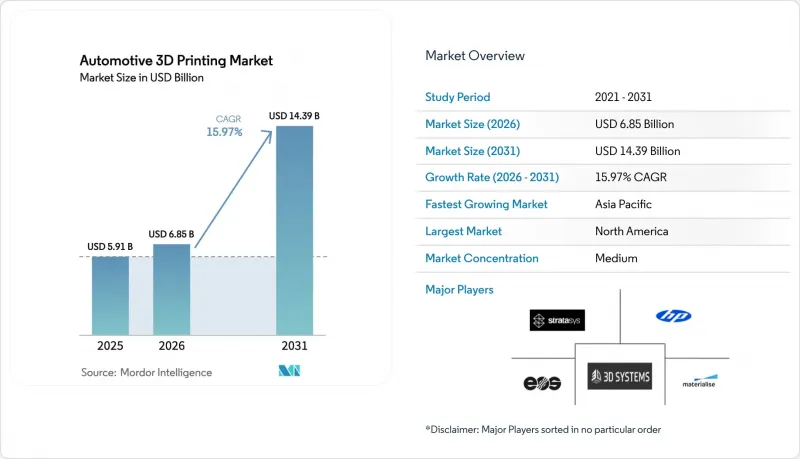
據 Mordor Intelligence 稱,2025 年汽車 3D 列印市場價值為 59.1 億美元,預計到 2031 年將從 2026 年的 68.5 億美元成長至 143.9 億美元,預測期(2026-2031 年)的複合年成長率為 15.97%。
本報告按技術類型(例如,選擇性雷射燒結 (SLS)、立體光刻技術(SLA))、組件類型(硬體、軟體、服務)、材料類型(例如,金屬、聚合物)、應用類型(例如,生產、原型製作)和地區進行細分。市場預測以價值(美元)和數量(單位)表示。
全球汽車3D列印市場趨勢及洞察
電動車對輕量化零件的需求
電動車製造商正致力於減輕車身重量,以延長續航里程並滿足排放氣體法規的要求。通用汽車(GM)在凱迪拉克Celestique車型中使用了超過130個3D列印零件,其中包括汽車生產中最大的積層製造鋁製零件。歐洲的歐7排放標準正在加速3D列印技術在煞車盤盤塗層和結構件領域的應用。基於砂型的3D列印技術縮短了模具開發週期,並實現了在保持公差目標的同時減輕重量的鑄造設計。為了抵消電池重量,製造商們迫切獎勵在所有車輛平台上實現即使一克的減重。
透過快速原型製作降低成本
透過在設計迭代的早期階段採用積層製造而非機械加工,企業已報告原型前置作業時間縮短了高達 90%,並顯著降低了單一零件的成本。立體光刻技術(SLS) 的高尺寸精度使其成為熔模鑄造的低成本替代方案,而人工智慧驅動的建造參數最佳化則提高了首次成型的成功率。售價低於 3000 美元的桌上型 SLS 印表機的出現,正在擴大中小型供應商的參與範圍,並加速亞太地區製造群的創新週期。
金屬印表機高成本
工業級SLS印表機的標價在12,000美元至33,000美元之間,而特種金屬粉末的平均價格為每公斤300美元至600美元,這限制了注重成本的供應商的採用。氦氣噴塗是目前最永續的粉末生產方法,但其初始投資仍然很高。生命週期分析表明,粉末層熔融技術對於高度複雜的零件來說經濟高效,但高昂的初始投資負擔仍然阻礙了其廣泛應用。低成本金屬絲材製程降低了准入門檻,但後處理複雜性的增加導致汽車3D列印市場的複合年成長率下降了2.4個百分點。
細分市場分析
熔融沈積成型(FDM)技術憑藉其低廉的系統成本和廣泛的材料選擇,在2025年佔據了汽車3D列印市場37.74%的佔有率。隨著高性能尼龍和複合材料列印技術的日益普及,以及桌上型粉末層系統成本低於3000美元,選擇性雷射燒結(SLS)技術預計到2031年將以18.02%的複合年成長率成長。奈米級光聚合技術的進步使立體光刻技術能夠達到每秒100微米、解析度為100奈米的水平,從而拓展了其在微流體和光學領域的應用。數位光處理(DLP)技術正擴大應用於珠寶和牙科模型的製造,而電子束熔融技術則被用於航太領域鈦合金零件的製造。隨著電動車製造商採用耐用的尼龍齒輪和引擎室組件,基於SLS技術的汽車3D列印零件市場預計將快速成長。
混合製造技術結合了積層製造和機械加工技術,正日益普及。熔融沈積成型(FDM)工具路徑採用連續纖維增強,無需二次加工即可提高拉伸強度。全像立體列印技術透過同時固化整個層,固化速度提升高達20倍,在汽車內裝件的大規模生產方面具有巨大潛力。製程模擬軟體的不斷改進減少了原型製作的迭代次數,即使選擇性雷射燒結(SLS)設備的數量不斷增加,FDM的重要性仍然不減。
硬體(包括印表機、後處理工作站和掃描器)在2025年佔銷售額的56.61%。然而,隨著機器學習演算法降低缺陷率並最佳化多個工廠的設備運行,軟體市場正以18.21%的複合年成長率快速成長。貝克休斯公司實施的製造營運平台將監控時間減少了98%,廢品率降低了18%。當汽車製造商將特殊材料或小批量生產外包,而這些生產項目又不足以支持資本投資時,服務機構就會蓬勃發展。
人工智慧驅動的建模參數引擎將工程工作量減少了 80%,從而提升了軟體在汽車 3D 列印市場的佔有率。基於瀏覽器的協作套件支援跨洲設計迭代,實現了同步工程和快速投產。隨著雲端連線的擴展,訂閱收入為供應商帶來了高利潤的經常性收入,競爭的焦點也從機器轉向了數位生態系統。
區域分析
北美憑藉在美國航太和電動車供應鏈中的主導地位,預計到2025年將以38.02%的市佔率引領汽車3D列印市場。通用電氣航空航太公司對積層製造設施的10億美元投資,反映了對國內生產的長期信心。製造業回流以及《通膨控制法案》的實施,正在推動在地化生產,並加速汽車業各層級對3D列印機的採用。加拿大和墨西哥正利用跨境貿易框架,透過輕型卡車零件和航太鑄造模具為市場做出貢獻。
亞太地區預計將成為成長最快的地區,到2031年複合年成長率將達到18.96%,這主要得益於中國製造業的數位轉型以及印度生物列印新創企業的湧現。積層製造在中國五年規劃中被定位為戰略支柱,正加速在汽車產業中心和電池工廠的應用。在印度,EOS與Godley的合作正加速積層製造在航太領域的應用,同時,公私合營的研發中心也在推動技能發展。日本和韓國正在引領材料創新,開發適用於混合動力動力傳動系統的耐熱聚合物。在東南亞的電子產業叢集,政府的稅收優惠政策正在推動3D列印技術應用於模具製造。
歐洲佔據了巨大的市場佔有率,其中德國是核心,大多數製造商都已採用積層製造流程。在該地區,積層製造公司將30.6%的收入再投資於研發,鞏固了其在金屬印表機出口領域的領先地位。法國和義大利正在擴大複合材料列印技術在超級跑車領域的應用,而斯堪地那維亞國家則在研究用於汽車內部裝潢建材的生物基聚合物。透過ISO/ASTM標準實現的法規協調,有助於列印零件的跨境認證,並促進供應鏈的順暢流通。南美和中東等新興地區的積層製造技術也不斷多元化發展。沙烏地阿拉伯正在向中小企業推廣入門級印表機,以降低金屬加工的能耗。在巴西,針對農業機械的積層製造維修中心試點計畫正在進行中,這表明這項技術正在向高收入經濟體以外的地區推廣。
其他好處:
- Excel格式的市場預測(ME)表
- 3個月的分析師支持
目錄
第1章:引言
- 研究假設和市場定義
- 調查範圍
第2章:調查方法
第3章執行摘要
第4章 市場狀況
- 市場概覽
- 市場促進因素
- 電動車對輕量化零件的需求
- 透過快速原型製作降低成本
- 客製化模具
- 數位化備件庫存
- 多材料積層製造的整合
- 促進供應鏈回流
- 市場限制因素
- 金屬印表機成本高昂
- 材料認證要求不一致
- 高耗能雷射系統
- 對智慧財產權安全的擔憂
- 價值供應鏈分析
- 監理情勢
- 技術展望
- 波特五力模型
第5章 市場規模與成長預測
- 依技術類型
- 選擇性雷射燒結(SLS)
- 立體光刻技術(SLA)
- 數位光處理(DLP)
- 電子束熔化(EBM)
- 選擇性雷射熔融(SLM)
- 熔融沈積成型(FDM)
- 依組件類型
- 硬體
- 軟體
- 服務
- 依材料類型
- 金屬
- 聚合物
- 陶瓷製品
- 複合材料
- 按應用程式類型
- 生產
- 原型製作
- 工具和夾具
- 備件/MRO
- 按地區
- 北美洲
- 美國
- 加拿大
- 其他北美國家
- 南美洲
- 巴西
- 阿根廷
- 其他南美國家
- 歐洲
- 德國
- 英國
- 法國
- 義大利
- 西班牙
- 俄羅斯
- 其他歐洲國家
- 亞太地區
- 中國
- 日本
- 印度
- 韓國
- 其他亞太國家
- 中東和非洲
- 阿拉伯聯合大公國
- 沙烏地阿拉伯
- 南非
- 埃及
- 其他中東和非洲國家
- 北美洲
第6章 競爭情勢
- 市場集中度
- 策略趨勢
- 市佔率分析
- 公司簡介
- Stratasys Ltd
- 3D Systems Corporation
- EOS GmbH
- HP Inc.
- Materialise NV
- GE Additive(Arcam AB)
- Desktop Metal(ExOne)
- Ultimaker BV
- Voxeljet AG
- Carbon Inc.
- Hoganos AB
- EnvisionTEC GmbH
- SLM Solutions Group AG
- Renishaw plc
- BASF Forward AM
- Markforged Inc.
- Sindoh Co. Ltd
- XYZprinting Inc.
- Moog Inc.
第7章 市場機會與未來展望
According to Mordor Intelligence, the automotive 3D printing market size was valued at USD 5.91 billion in 2025 and estimated to grow from USD 6.85 billion in 2026 to reach USD 14.39 billion by 2031, at a CAGR of 15.97% during the forecast period (2026-2031).
This report is Segmented by Technology Type (Selective Laser Sintering (SLS), Stereo Lithography (SLA), and More ), Component Type (Hardware, Software, and Service), Material Type (Metal, Polymer, and More), Application Type (Production, Prototyping, and More), and Geography. The Market Forecasts are Provided in Terms of Value (USD) and Volume (Units).
Global Automotive 3D Printing Market Trends and Insights
EV Lightweight-Parts Demand
Electric vehicle makers pursue weight optimization to extend their range and comply with emissions standards. General Motors integrates more than 130 printed parts in the Cadillac Celestiq, including the largest additively manufactured aluminum component in automotive production. Europe's Euro 7 norms accelerate adoption for brake-disc coatings and structural elements. Sand-based 3D printing shortens mold-development cycles, enabling casting designs that reduce mass while preserving tolerance targets. The need to offset battery weight intensifies competitive incentives to remove every gram across vehicle platforms.
Rapid Prototyping Cost-Cuts
Enterprises report up to 90% reductions in prototype lead times and sharp declines in single-part costs as additive manufacturing replaces machining for early-stage design iterations. Stereolithography's high dimensional accuracy supports low-cost investment casting alternatives, while AI-based build-parameter optimization elevates first-time-right success rates. Desktop SLS printers priced below USD 3,000 broaden access for small and midsize suppliers, compressing innovation cycles across Asia-Pacific manufacturing clusters.
High Cost of Metal Printers
Industrial SLS printers list between USD 12,000 and USD 33,000, while specialty metal powders average USD 300-600 per kg, limiting adoption among cost-sensitive suppliers. Helium-atomized powder production offers the most sustainable route, yet capital outlays remain steep. Lifecycle analyses show powder-bed fusion is economical for high-complexity components, but up-front capital still deters wide deployment. Lower-cost metal-filament processes mitigate entry barriers but add post-processing complexity, reducing the Automotive 3D printing market CAGR by 2.4 percentage points
Other drivers and restraints analyzed in the detailed report include:
- Custom Production Tooling
- Digital Spare-Parts Inventory
- Material-Qualification Gaps
For complete list of drivers and restraints, kindly check the Table Of Contents.
Segment Analysis
FDM accounted for 37.74% of the Automotive 3D printing market share in 2025, owing to low system costs and broad material selection. SLS is projected to grow at an 18.02% CAGR through 2031 as desktop powder-bed systems below USD 3,000 democratize high-performance nylon and composite printing. Advances in nanoscale photopolymerization have pushed stereolithography resolution to 100 nm at 100 µm per second, extending its use into microfluidic and optics applications. Digital Light Processing (DLP) increasingly supports jewelry and dental models, while electron-beam melting serves aerospace titanium parts. The Automotive 3D printing market size for SLS-based parts is forecast to expand sharply as EV manufacturers adopt durable nylon gears and under-hood components.
Hybrid manufacturing that blends additive and subtractive techniques is gaining ground. FDM toolpaths integrate continuous-fiber reinforcement, improving tensile strength without secondary operations. Holographic volumetric printing demonstrates up-to-20-fold speed gains by curing entire layers simultaneously, holding promise for high-volume automotive interiors. Continual improvements in process simulation software reduce trial iterations, ensuring FDM retains relevance even as the SLS installed base rises.
Hardware captured 56.61% of 2025 revenue, encompassing printers, post-processing stations, and scanners. However, software is expanding at 18.21% CAGR as machine-learning algorithms cut defect rates and orchestrate multi-factory fleets. Manufacturing operations platforms deployed at Baker Hughes trimmed monitoring time by 98% and scrap by 18%. Service bureaus flourish when automakers outsource specialty materials or small production runs that do not justify capital spending.
AI-driven build-parameter engines reduce engineering labor by 80%, contributing to a rising software share within the Automotive 3D printing market. Browser-based collaboration suites allow design iterations across continents, enabling simultaneous engineering and rapid release to production. As cloud connectivity scales, subscription revenue offers vendors a high-margin annuity, shifting the competitive balance from machines to digital ecosystems
Complete Report Scope:
- By Technology Type
- Selective Laser Sintering (SLS)
- Stereolithography (SLA)
- Digital Light Processing (DLP)
- Electron Beam Melting (EBM)
- Selective Laser Melting (SLM)
- Fused Deposition Modeling (FDM)
- By Component Type
- Hardware
- Software
- Service
- By Material Type
- Metal
- Polymer
- Ceramic
- Composite
- By Application Type
- Production
- Prototyping
- Tooling and Fixtures
- Spare-Parts / MRO
- Geography
- North America
- United States
- Canada
- Rest of North America
- South America
- Brazil
- Argentina
- Rest of South America
- Europe
- Germany
- United Kingdom
- France
- Italy
- Spain
- Russia
- Rest of Europe
- Asia-Pacific
- China
- Japan
- India
- South Korea
- Rest of Asia-Pacific
- Middle East and Africa
- United Arab Emirates
- Saudi Arabia
- South Africa
- Egypt
- Rest of Middle East and Africa
- North America
Geography Analysis
North America leads the Automotive 3D printing market with a 38.02% share in 2025, supported by the United States' dominant aerospace and EV supply chains. GE Aerospace's USD 1 billion investment in additive facilities signals long-term confidence in domestic productio. Reshoring initiatives combined with the Inflation Reduction Act incentivize localized manufacturing, accelerating printer installations across automotive tiers. Canada and Mexico contribute through lightweight truck components and aerospace casting molds, leveraging cross-border trade frameworks.
Asia-Pacific is the fastest-growing region at a 18.96% CAGR through 2031, propelled by China's manufacturing digitalization and India's emerging bioprinting startups. Chinese five-year plans earmark additive manufacturing as a strategic pillar, spurring installation growth across automotive hubs and battery factories. India's collaboration between EOS and Godrej accelerates aerospace applications, while public-private R&D centers foster skill development. Japan and South Korea push materials innovation, developing heat-resistant polymers tailored to hybrid-electric powertrains. Southeast Asian electronics clusters adopt 3D printing for tooling, aided by government tax incentives.
Europe holds a significant share, anchored by Germany where majority of manufacturers deploy additive processes. The region invests 30.6% of AM company turnover back into R&D, reinforcing leadership in metal-printer exports. France and Italy expand composite printing for supercars, while Scandinavia explores bio-based polymers for vehicle interiors. Regulatory alignment through ISO/ASTM standards supports cross-border qualification of printed parts, smoothing supply-chain flows. Emerging regions in South America and the Middle East pursue diversification; Saudi Arabia outfits SMEs with entry-level printers to decrease energy consumption in metal fabrication. Brazil pilots additive repair hubs for agricultural machinery, demonstrating the technology's reach beyond high-income economies.
- Stratasys Ltd
- 3D Systems Corporation
- EOS GmbH
- HP Inc.
- Materialise NV
- GE Additive (Arcam AB)
- Desktop Metal (ExOne)
- Ultimaker BV
- Voxeljet AG
- Carbon Inc.
- Hoganos AB
- EnvisionTEC GmbH
- SLM Solutions Group AG
- Renishaw plc
- BASF Forward AM
- Markforged Inc.
- Sindoh Co. Ltd
- XYZprinting Inc.
- Moog Inc.
Additional Benefits:
- The market estimate (ME) sheet in Excel format
- 3 months of analyst support
TABLE OF CONTENTS
1 Introduction
- 1.1 Study Assumptions & Market Definition
- 1.2 Scope of the Study
2 Research Methodology
3 Executive Summary
4 Market Landscape
- 4.1 Market Overview
- 4.2 Market Drivers
- 4.2.1 EV lightweight-parts demand
- 4.2.2 Rapid prototyping cost-cuts
- 4.2.3 Custom production tooling
- 4.2.4 Digital spare-parts inventory
- 4.2.5 Multi-material AM integration
- 4.2.6 Supply-chain on-shoring push
- 4.3 Market Restraints
- 4.3.1 High cost of metal printers
- 4.3.2 Material-qualification gaps
- 4.3.3 Energy-intensive laser systems
- 4.3.4 IP-security concerns
- 4.4 Value/Supply-Chain Analysis
- 4.5 Regulatory Landscape
- 4.6 Technological Outlook
- 4.7 Porter's Five Forces
- 4.7.1 Bargaining Power of Suppliers
- 4.7.2 Bargaining Power of Buyers
- 4.7.3 Threat of New Entrants
- 4.7.4 Threat of Substitutes
- 4.7.5 Intensity of Competitive Rivalry
5 Market Size & Growth Forecasts (Value (USD) and Volume (Units))
- 5.1 By Technology Type
- 5.1.1 Selective Laser Sintering (SLS)
- 5.1.2 Stereolithography (SLA)
- 5.1.3 Digital Light Processing (DLP)
- 5.1.4 Electron Beam Melting (EBM)
- 5.1.5 Selective Laser Melting (SLM)
- 5.1.6 Fused Deposition Modeling (FDM)
- 5.2 By Component Type
- 5.2.1 Hardware
- 5.2.2 Software
- 5.2.3 Service
- 5.3 By Material Type
- 5.3.1 Metal
- 5.3.2 Polymer
- 5.3.3 Ceramic
- 5.3.4 Composite
- 5.4 By Application Type
- 5.4.1 Production
- 5.4.2 Prototyping
- 5.4.3 Tooling and Fixtures
- 5.4.4 Spare-Parts / MRO
- 5.5 Geography
- 5.5.1 North America
- 5.5.1.1 United States
- 5.5.1.2 Canada
- 5.5.1.3 Rest of North America
- 5.5.2 South America
- 5.5.2.1 Brazil
- 5.5.2.2 Argentina
- 5.5.2.3 Rest of South America
- 5.5.3 Europe
- 5.5.3.1 Germany
- 5.5.3.2 United Kingdom
- 5.5.3.3 France
- 5.5.3.4 Italy
- 5.5.3.5 Spain
- 5.5.3.6 Russia
- 5.5.3.7 Rest of Europe
- 5.5.4 Asia-Pacific
- 5.5.4.1 China
- 5.5.4.2 Japan
- 5.5.4.3 India
- 5.5.4.4 South Korea
- 5.5.4.5 Rest of Asia-Pacific
- 5.5.5 Middle East and Africa
- 5.5.5.1 United Arab Emirates
- 5.5.5.2 Saudi Arabia
- 5.5.5.3 South Africa
- 5.5.5.4 Egypt
- 5.5.5.5 Rest of Middle East and Africa
- 5.5.1 North America
6 Competitive Landscape
- 6.1 Market Concentration
- 6.2 Strategic Moves
- 6.3 Market Share Analysis
- 6.4 Company Profiles (Includes Global Level Overview, Market Level Overview, Core Segments, Financials as Available, Strategic Information, Market Rank/Share for Key Companies, Products and Services, and Recent Developments)
- 6.4.1 Stratasys Ltd
- 6.4.2 3D Systems Corporation
- 6.4.3 EOS GmbH
- 6.4.4 HP Inc.
- 6.4.5 Materialise NV
- 6.4.6 GE Additive (Arcam AB)
- 6.4.7 Desktop Metal (ExOne)
- 6.4.8 Ultimaker BV
- 6.4.9 Voxeljet AG
- 6.4.10 Carbon Inc.
- 6.4.11 Hoganos AB
- 6.4.12 EnvisionTEC GmbH
- 6.4.13 SLM Solutions Group AG
- 6.4.14 Renishaw plc
- 6.4.15 BASF Forward AM
- 6.4.16 Markforged Inc.
- 6.4.17 Sindoh Co. Ltd
- 6.4.18 XYZprinting Inc.
- 6.4.19 Moog Inc.
7 Market Opportunities & Future Outlook

 汽車3D列印市場-2026-2032年全球市場預測
 汽車高性能聚合物市場:預測至2034年-按聚合物類型、車輛類型、應用和地區分類的全球分析
 汽車3D列印市場報告:按零件類型、技術類型、材料類型、應用和地區分類(2026-2034年)
 2026年全球汽車3D列印市場報告
 3D列印汽車市場-全球產業規模、佔有率、趨勢、競爭格局、機會及預測(按材料、技術、應用、地區和競爭情況分類,2021-2031年)汽車3D列印市場-全球產業規模、佔有率、趨勢、機會及預測(依技術、應用、區域及競爭格局分類,2021-2031年)
 汽車3D列印市場規模、佔有率和成長分析(按產品、組件、車輛類型、材料和地區分類)-產業預測(2026-2033年)
 汽車3D列印市場機會、成長促進因素、產業趨勢分析及預測(2026-2035年)
 汽車3D列印市場:2025-2030年預測
 全球汽車3D列印市場