


 |
市場調查報告書
商品編碼
2120290
鋁塑複合板(ACP):市場佔有率分析、產業趨勢與統計、成長預測(2026-2031)Aluminum Composite Panel (ACP) - Market Share Analysis, Industry Trends & Statistics, Growth Forecasts (2026 - 2031) |
||||||

※ 本網頁內容可能與最新版本有所差異。詳細情況請與我們聯繫。
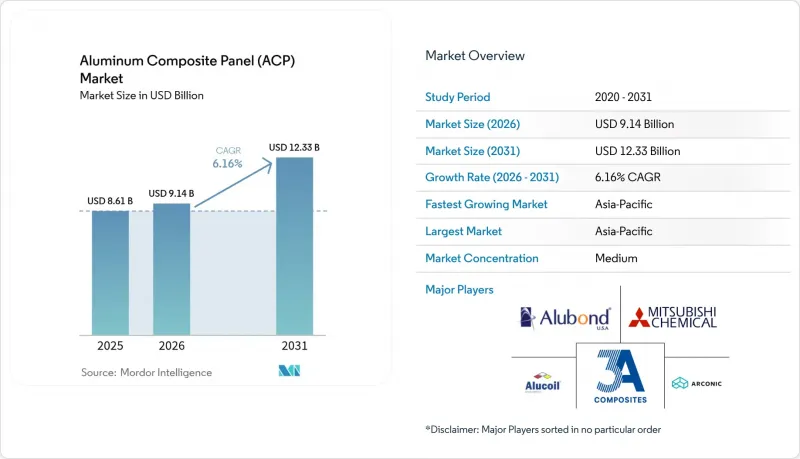
據 Mordor Intelligence 稱,鋁複合板市場預計到 2026 年價值 91.4 億美元,高於 2025 年的 86.1 億美元,預計到 2031 年將達到 123.3 億美元。
預計從 2026 年到 2031 年,其複合年成長率將達到 6.2%。
本報告按面塗層(PE(聚酯)、PVDF(聚二氟亞乙烯)等)、應用領域(室內裝飾、標誌等)、終端用戶行業(建築施工、交通運輸等)和地區(亞太地區、北美地區、歐洲地區等)進行細分。市場預測以美元計價。
全球鋁塑複合板(ACP)市場趨勢與洞察
鋁塑複合板(ACP)是一種用於長壽命外牆的PVDF塗層,其應用範圍正在不斷擴大。
由於其氟聚合物塗層具有優異的抗紫外線、保色性和20-25年的使用壽命,PVDF技術佔據了塗料市場65.89%的佔有率,並以6.70%的複合年成長率持續成長。對於業主而言,這種溢價被視為生命週期價值,因為它無需在使用壽命中期重新塗裝。此外,PVDF配方在火災荷載下產生的有毒氣體量極少,這對於符合北美和歐洲的建築規範至關重要。因此,PVDF正日益成為公共基礎設施、機場和A級商業大樓的性能標準之一。能夠大量生產均勻PVDF塗層的供應商正在獲得更高的利潤率,並與建築師建立長期的合作關係。
建築和交通運輸業對輕質板材的需求不斷成長
與鐵路車輛中傳統的鋼材相比,鋁複合板可減輕30%至50%的結構荷載,進而提高營運效率和載客量。同樣,建築業主也傾向於選擇更輕的覆材,以減輕抗震設計限制並縮短工期。在電動巴士和渡輪領域,鋁複合板的應用正在加速,因為每減輕一公斤重量都能增加電池續航里程和負載容量。這些跨產業的減重優勢正推動鋁複合板穩定滲透到鐵路車輛、船舶上層建築和冷藏拖車外牆等領域,鞏固了鋁複合板市場的中期成長動能。
低成本替代覆材。
纖維水泥、高壓層壓板和工程木板材能夠以更低的材料成本實現許多視覺效果。在中高層住宅專案中,由於消防安全要求相對寬鬆,建築商通常會選擇這些替代材料,這迫使鋁塑複合板供應商強調其生命週期優勢和快速安裝,以維持市場佔有率。新興市場建築商利潤微薄,要求大幅降低價格,進一步加劇了這種壓力。
細分市場分析
到2025年,PVDF塗層產品將佔鋁複合板市場65.20%的銷售額,佔最大的市場佔有率。其卓越的抗紫外線性能可將使用壽命延長至25年,從而降低帷幕牆的整體生命週期成本。這種耐久性對於商業高層建築和沿海基礎設施尤其重要,因為這些場所的劣化會受到強烈的陽光照射、鹽分侵蝕和溫度波動的影響。防火安全法規進一步鞏固了PVDF的地位,因為該塗層能夠承受更高的燃點,同時產生的煙霧更少。隨著礦物芯材逐漸成為高層建築的標準配置,PVDF的優異性能使其能夠保持比同類聚酯產品高出20-30%的溢價。
因此,當專案中指定使用PVDF時,利潤率會提高,從而使那些投資於高產能線圈塗布線和嚴格配色控制的加工商受益。另一方面,聚酯塗層在注重預算的住宅建築中仍然佔據主導地位,維持了鋁複合板市場對價格較低產品的需求。這種雙重層級構造使企業能夠根據性能要求和區域購買力對產品進行細分,從而在不蠶食其旗艦產品PVDF銷售的前提下,最大限度地提高潛在的總需求。
區域分析
預計到2025年,亞太地區將以37.80%的市佔率引領鋁複合板市場,並在2031年之前以6.65%的複合年成長率持續成長。中國擁有超過4127家製造商,提供超過41000種產品,價格在每平方公尺7美元至20美元之間,實現了規模經濟,從而支持國內大型企劃和出口供應。印度的鋁擠型產業規模達112.8億美元,隨著政府大力推動經濟適用住宅和地鐵網路建設,印度的鋁複合板需求也在成長,年增率達7.6%。東南亞的都市化也進一步推動了需求,該地區具有競爭力的成本優勢使其成為全球鋁複合板市場的價格製定者。
北美擁有第二大市場佔有率,其特點是嚴格的防火安全標準,這有利於供應商提供符合 ASTM E-84 和 NFPA 285 標準的組裝產品。 2024 年修訂的《國際建築規範》(IBC) 將進一步促進礦物芯材的應用,並維持符合標準產品的利潤溢價。聖荷西的希爾頓花園酒店等模組化連鎖飯店是典型的例子,展示了預製鋁塑複合板 (ACP) 如何在滿足 A 級阻燃標準的同時縮短室內施工時間。包括 Century Aluminum 公司美國冶煉廠擴建在內的本地冶煉廠,正在部分抵消對進口的依賴,並緩解關稅帶來的不確定性。
在歐洲,永續性是關注的重點,尤其觀點脫碳冶煉和廢棄產品的可回收性。諾貝麗斯(Novelis)正將其所有鋁產品系列中的再生材料含量從33%提高到63%,從而增強這種合金的循環利用性,並支持建築師獲得綠色建築認證。隨著格倫費爾大廈火災後改革的持續推進,強制使用礦物芯材的進程正在加速,歐洲加工商也迅速升級其生產線。南美、中東和非洲的產量雖然落後於歐洲,但基礎建設和更高的安全標準正在推動其成長,並使其超過市場平均水平。例如,阿拉伯聯合大公國的新計畫正在使用覆以鋁複合板(ACP)的模組化房間,以縮短專案工期數月。然而,承包商專業知識的缺乏和高昂的初始投資成本阻礙了鋁複合板的廣泛應用,這些地區的鋁複合板市場仍處於發展階段。
其他好處:
- Excel格式的市場預測(ME)表
- 3個月的分析師支持
目錄
第1章:引言
- 研究假設和市場定義
- 調查範圍
第2章:調查方法
第3章執行摘要
第4章 市場狀況
- 市場概覽
- 市場促進因素
- 鋁塑複合板(ACP)是一種用於長壽命外牆的PVDF塗層,其應用範圍正在不斷擴大。
- 建築和交通運輸業對輕質板材的需求不斷成長。
- 擴大數位印刷技術在廣告看板和標牌上的應用。
- 全球日益嚴格的消防安全標準導致 A2 和礦物芯鋁塑複合板得到更廣泛的應用。
- 異地模組化幕牆製造技術的進步正在加速對鋁塑複合板的需求。
- 市場限制因素
- 低成本替代塗料的可用性
- 鋁價的劇烈波動給加工企業的利潤率帶來了壓力。
- 高層建築維修工程禁止使用PE芯型鋁塑複合板
- 價值鏈分析
- 波特五力分析
第5章 市場規模與成長預測
- 頂塗層類型
- PE(聚酯)
- PVDF(Polyvinylidene氟乙烯)
- 其他塗層
- 透過使用
- 室內裝潢
- 臨時圍欄
- 隔熱材料
- 覆材
- 鐵路車輛
- 柱罩和樑罩
- 其他用途
- 按最終用戶行業分類
- 建築/施工
- 運輸方式(鐵路、公車、拖車、船舶)
- 其他終端用戶產業
- 按地區
- 亞太地區
- 中國
- 印度
- 日本
- 韓國
- 其他亞太國家
- 北美洲
- 美國
- 加拿大
- 墨西哥
- 歐洲
- 德國
- 英國
- 義大利
- 法國
- 其他歐洲國家
- 南美洲
- 巴西
- 阿根廷
- 其他南美國家
- 中東和非洲
- 沙烏地阿拉伯
- 南非
- 其他中東和非洲國家
- 亞太地區
第6章 競爭情勢
- 市場集中度
- 策略趨勢
- 市佔率分析
- 公司簡介
- 3A Composites GmbH
- ALSTONE
- Alstrong Enterprises India Pvt. Ltd
- Alubond USA
- Alucoil(Grupo Aliberico)
- Aludecor Lamination Pvt. Ltd
- Arconic Inc.
- Eurobond
- Fairview Architectural(Vitrabond)
- GUANGZHOU XINGHE ACP Co. Ltd
- Interplast(Harwal)
- Mitsubishi Chemical Corporation
- Mulford ACP
- Multipanel UK(Alupanel)
- Qatar National Aluminium Panel Co.
- Viva
- Yaret Industrial Group
- YingJia Aluminium Co. Ltd
第7章 市場機會與未來展望
According to Mordor Intelligence, aluminum composite panel market size in 2026 is estimated at USD 9.14 billion, growing from 2025 value of USD 8.61 billion with 2031 projections showing USD 12.33 billion, growing at 6.2% CAGR over 2026-2031.
This report is Segmented by Top Coating (PE (Polyester), PVDF (Polyvinylidene Fluoride), and More), Application (Interior Decoration, Hoarding, and More), End-User Industry (Building and Construction, Transportation, and More), and Geography (Asia-Pacific, North America, Europe, and More). The Market Forecasts are Provided in Terms of Value (USD).
Global Aluminum Composite Panel (ACP) Market Trends and Insights
Growing Adoption of PVDF-Coated ACPs for Long-Life Facades
PVDF technology commands 65.89% coating share and is rising at a 6.70% CAGR as its fluoropolymer layer delivers ultraviolet resistance, color retention, and 20-25-year service life. Owners view the premium as life-cycle value, because mid-life recoating is unnecessary. PVDF formulations also exhibit limited toxic fume evolution under fire load, a key attribute for code compliance in North America and Europe. Consequently, public infrastructure, airports, and Grade-A commercial towers increasingly specify PVDF as a performance baseline. Suppliers able to mass-produce uniform PVDF finishes capture higher margins and build durable specification relationships with architects.
Rising Demand for Lightweight Panels in Building & Transport Sectors
Aluminum composite panels reduce structural load by 30-50% in rail carriages versus conventional steel, boosting operating efficiency and passenger capacity. Building owners likewise favor lighter cladding to ease seismic design constraints and shorten installation cycles. Adoption accelerates in electric buses and ferries, where every kilogram saved extends battery range or payload. These cross-industry weight benefits underpin steady penetration into rolling-stock, marine superstructure, and refrigerated trailer skins, cementing medium-term upside for the aluminum composite panel market.
Availability of Lower-Cost Cladding Alternatives
Fiber cement, high-pressure laminates, and engineered wood panels replicate many visual effects at lower material cost. In residential mid-rise projects with modest fire requirements, contractors often select these substitutes, forcing ACP suppliers to lean on lifecycle advantages and faster installation to preserve share. Emerging-market builders, operating on thin margins, amplify this pressure by demanding aggressive price concessions.
Other drivers and restraints analyzed in the detailed report include:
- Expansion of Digital-Printing Hoardings & Signage Applications
- Tightening Global Fire-Safety Codes Boosting A2/Mineral-Core Uptake
- Volatile Aluminum Price Trends Squeezing Converter Margins
For complete list of drivers and restraints, kindly check the Table Of Contents.
Segment Analysis
PVDF-coated products held 65.20% revenue in 2025, the largest slice of the aluminum composite panel market. Superior ultraviolet stability extends service life to 25 years, trimming whole-life facade expenditure. That durability attracts commercial skyscrapers and coastal infrastructure where harsh sun, salt, and temperature swings accelerate aging. Fire-safety regulations further consolidate PVDF's position because the coating withstands higher ignition temperatures while emitting lower smoke density. As mineral-core substrates become the high-rise standard, PVDF's compatibility sustains premium price realisation of 20-30% over polyester rivals.
Margins thus expand when projects specify PVDF, rewarding converters that invest in high-capacity coil-coating lines and tight colour-match control. Simultaneously, budget-focused residential builds still rely on polyester coatings, keeping a value tier alive within the aluminum composite panel market. That two-tier structure allows firms to segment offerings by performance need and regional purchasing power, maximising total addressable demand without cannibalising flagship PVDF sales.
Complete Report Scope:
- By Top Coating
- PE (Polyester)
- PVDF (Polyvinylidene Fluoride)
- Other Coatings
- By Application
- Interior Decoration
- Hoarding
- Insulation
- Cladding
- Railway Carrier
- Column Cover and Beam Wrap
- Other Applications
- By End-User Industry
- Building and Construction
- Transportation (Rail, Bus, Trailer, Marine)
- Other End-User Industries
- By Geography
- Asia-Pacific
- China
- India
- Japan
- South Korea
- Rest of Asia-Pacific
- North America
- United States
- Canada
- Mexico
- Europe
- Germany
- United Kingdom
- Italy
- France
- Rest of Europe
- South America
- Brazil
- Argentina
- Rest of South America
- Middle East and Africa
- Saudi Arabia
- South Africa
- Rest of Middle East and Africa
- Asia-Pacific
Geography Analysis
Asia Pacific led the aluminum composite panel market with a 37.80% share in 2025 and is advancing at a 6.65% CAGR to 2031. China hosts over 4,127 manufacturers offering more than 41,000 product variants priced between USD 7-20 per m2, enabling scale economics that underpin both domestic megaprojects and export supply. Indian demand climbs in tandem with its USD 11.28 billion aluminum extrusions sector, expanding 7.6% annually as government drives affordable housing and metro rail rollouts. Southeast Asian urbanisation adds further uplift, and the region's competitive cost base positions it as the global price setter for the aluminum composite panel market.
North America ranks second, defined by stringent fire-safety codes that reward suppliers certified to ASTM E-84 and NFPA 285 assemblies. The 2024 International Building Code revision reinforces mineral-core adoption and sustains margin premiums for compliant products. Modular hotel chains such as the Hilton Garden Inn in San Jose illustrate how panelised ACP sections speed fit-out times while meeting Class A flame-spread limits. Regional mills, including Century Aluminum's expanded U.S. smelter, partially offset import reliance and dampen tariff uncertainty.
Europe follows with a sustainability lens, spotlighting decarbonised smelting and end-of-life recyclability. Novelis lifted recycled content from 33% to 63% across its aluminium portfolio, reinforcing the alloy's circular credentials and supporting architects striving for green-building certification. Ongoing post-Grenfell fire reforms accelerate mineral-core mandates, prompting rapid line upgrades among European converters. South America plus the Middle East & Africa trail in volume but display above-trend growth where infrastructure buildout intersects with rising safety standards. The UAE's hospitality pipeline, for instance, leverages ACP-clad modular rooms to cut project delivery schedules by months. Nonetheless, limited installer expertise and high capital costs slow wider penetration, keeping these regions in a developmental stage of the aluminum composite panel market.
- 3A Composites GmbH
- ALSTONE
- Alstrong Enterprises India Pvt. Ltd
- Alubond USA
- Alucoil (Grupo Aliberico)
- Aludecor Lamination Pvt. Ltd
- Arconic Inc.
- Eurobond
- Fairview Architectural (Vitrabond)
- GUANGZHOU XINGHE ACP Co. Ltd
- Interplast (Harwal)
- Mitsubishi Chemical Corporation
- Mulford ACP
- Multipanel UK (Alupanel)
- Qatar National Aluminium Panel Co.
- Viva
- Yaret Industrial Group
- YingJia Aluminium Co. Ltd
Additional Benefits:
- The market estimate (ME) sheet in Excel format
- 3 months of analyst support
TABLE OF CONTENTS
1 Introduction
- 1.1 Study Assumptions & Market Definition
- 1.2 Scope of the Study
2 Research Methodology
3 Executive Summary
4 Market Landscape
- 4.1 Market Overview
- 4.2 Market Drivers
- 4.2.1 Growing adoption of PVDF-coated ACPs for long-life facades
- 4.2.2 Rising demand for lightweight panels in building & transport sectors
- 4.2.3 Expansion of digital-printing hoardings & signage applications
- 4.2.4 Tightening global fire-safety codes boosting A2/mineral-core ACP uptake
- 4.2.5 Off-site modular facade fabrication accelerating ACP panelization demand
- 4.3 Market Restraints
- 4.3.1 Availability of lower-cost cladding alternatives
- 4.3.2 Volatile aluminum price trends squeezing converter margins
- 4.3.3 Regulatory bans on PE-core ACPs in high-rise retrofits
- 4.4 Value Chain Analysis
- 4.5 Porter's Five Forces Analysis
- 4.5.1 Bargaining Power of Suppliers
- 4.5.2 Bargaining Power of Buyers
- 4.5.3 Threat of New Entrants
- 4.5.4 Threat of Substitute Products & Services
- 4.5.5 Degree of Competition
5 Market Size & Growth Forecasts (Value)
- 5.1 By Top Coating
- 5.1.1 PE (Polyester)
- 5.1.2 PVDF (Polyvinylidene Fluoride)
- 5.1.3 Other Coatings
- 5.2 By Application
- 5.2.1 Interior Decoration
- 5.2.2 Hoarding
- 5.2.3 Insulation
- 5.2.4 Cladding
- 5.2.5 Railway Carrier
- 5.2.6 Column Cover and Beam Wrap
- 5.2.7 Other Applications
- 5.3 By End-User Industry
- 5.3.1 Building and Construction
- 5.3.2 Transportation (Rail, Bus, Trailer, Marine)
- 5.3.3 Other End-User Industries
- 5.4 By Geography
- 5.4.1 Asia-Pacific
- 5.4.1.1 China
- 5.4.1.2 India
- 5.4.1.3 Japan
- 5.4.1.4 South Korea
- 5.4.1.5 Rest of Asia-Pacific
- 5.4.2 North America
- 5.4.2.1 United States
- 5.4.2.2 Canada
- 5.4.2.3 Mexico
- 5.4.3 Europe
- 5.4.3.1 Germany
- 5.4.3.2 United Kingdom
- 5.4.3.3 Italy
- 5.4.3.4 France
- 5.4.3.5 Rest of Europe
- 5.4.4 South America
- 5.4.4.1 Brazil
- 5.4.4.2 Argentina
- 5.4.4.3 Rest of South America
- 5.4.5 Middle East and Africa
- 5.4.5.1 Saudi Arabia
- 5.4.5.2 South Africa
- 5.4.5.3 Rest of Middle East and Africa
- 5.4.1 Asia-Pacific
6 Competitive Landscape
- 6.1 Market Concentration
- 6.2 Strategic Moves
- 6.3 Market Share Analysis
- 6.4 Company Profiles {(includes Global level Overview, Market level overview, Core Segments, Financials as available, Strategic Information, Market Rank/Share for key companies, Products & Services, and Recent Developments)}
- 6.4.1 3A Composites GmbH
- 6.4.2 ALSTONE
- 6.4.3 Alstrong Enterprises India Pvt. Ltd
- 6.4.4 Alubond USA
- 6.4.5 Alucoil (Grupo Aliberico)
- 6.4.6 Aludecor Lamination Pvt. Ltd
- 6.4.7 Arconic Inc.
- 6.4.8 Eurobond
- 6.4.9 Fairview Architectural (Vitrabond)
- 6.4.10 GUANGZHOU XINGHE ACP Co. Ltd
- 6.4.11 Interplast (Harwal)
- 6.4.12 Mitsubishi Chemical Corporation
- 6.4.13 Mulford ACP
- 6.4.14 Multipanel UK (Alupanel)
- 6.4.15 Qatar National Aluminium Panel Co.
- 6.4.16 Viva
- 6.4.17 Yaret Industrial Group
- 6.4.18 YingJia Aluminium Co. Ltd
7 Market Opportunities & Future Outlook
- 7.1 White-space & Unmet-Need Assessment
- 7.2 Large-scale Investments on Hotels in ASEAN Countries

 歐洲鋁塑複合板:市場佔有率分析、產業趨勢與統計及成長預測(2026-2031)
 2026-2030年全球鋁複合板市場
 鋁塑複合板市場:2026-2032年全球市場預測(按產品、最終用途、分銷管道和最終用途行業分類)
 全球鋁複合板市場
 鋁塑複合板市場規模、佔有率、趨勢和預測:按底漆類型、面板類型、配置、應用和地區分類,2026-2034年
 全球鋁塑複合板市場規模、佔有率、趨勢及成長分析報告(2026-2034年)
 2026年全球鋁塑複合板市場報告
 鋁塑複合板市場-全球產業規模、佔有率、趨勢、機會、預測:按類型、底漆類型、成分、地區和競爭對手分類,2021-2031年
 鋁塑複合板市場規模、佔有率及成長分析(按塗層類型、類型、結構和地區分類):產業預測(2026-2033 年)
 美國鋁複合材料市場規模、佔有率和趨勢分析報告:按應用和細分市場預測,2025-2033 年