


 |
市場調查報告書
商品編碼
2120289
歐洲炭黑:市場佔有率分析、產業趨勢與統計及成長預測(2026-2031)Europe Carbon Black - Market Share Analysis, Industry Trends & Statistics, Growth Forecasts (2026 - 2031) |
||||||

※ 本網頁內容可能與最新版本有所差異。詳細情況請與我們聯繫。
據 Mordor Intelligence 稱,2025 年歐洲炭黑市場價值 53.1 億美元,預計到 2031 年將從 2026 年的 55.9 億美元成長至 72.4 億美元,預測期(2026-2031 年)複合年成長率為 5.31%。
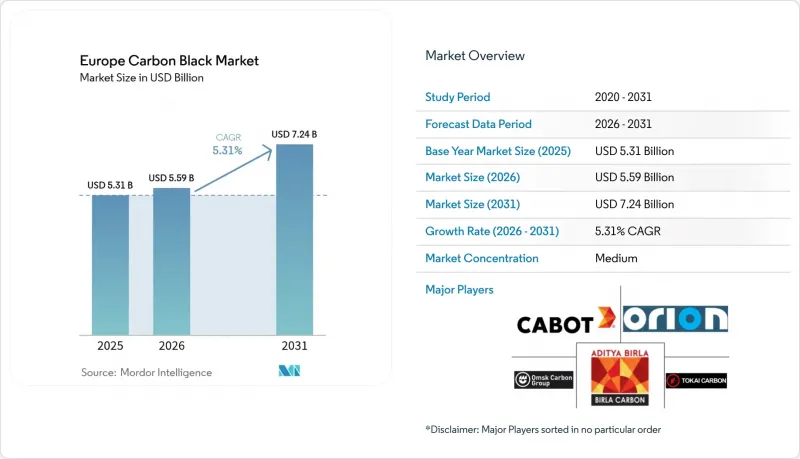
本報告依製造程序(爐法製黑、氣法黑、熱法製黑、燈黑)、應用領域(輪胎及工業橡膠製品、塑膠、墨粉及印刷油墨、塗料、紡織品等)及地區(德國、英國、法國、義大利、俄羅斯及其他歐洲國家)進行細分。市場預測以美元計價。
歐洲炭黑市場的趨勢與洞察
電動車輪胎的需求正在加速低滾動阻力輪胎的使用。
隨著電動車 (EV) 的普及,汽車製造商 (OEM) 將能源效率置於傳統性能標準之上,並重新定義了輪胎配方規格。低滾動阻力輪胎需要精確控制顆粒尺寸分佈和定製表面處理以減少滯後損失,這使得供應商能夠比通用輪胎定價高出 15-20%。歐洲領先的輪胎製造商正在聯合開發生物基和再生炭黑,以在保持抓地力的同時減少能量損失。其中,合作最活躍的地區是德國和法國,這兩個國家的電動車產量成長最為迅速。這些努力正在加強主要輪胎製造商與區域特種炭黑生產商之間的長期供應協議,從而提高了歐洲炭黑市場需求的透明度。
電池機殼應用推動了對特殊炭黑的需求。
鋰離子電池組設計人員目前指定使用低灰分、高導電性的炭黑,以確保電流分佈均勻並屏蔽電磁干擾 (EMI)。伊梅里斯公司已將具有精細調節比表面積的炭黑產品商業化,以支援圓柱形、軟包和棱柱形電池中鋰離子的穩定傳輸。瑞典、德國和波蘭的超級工廠已將在地採購作為供應商評估標準之一,以減少隱含排放,這迫使歐洲特種炭黑生產商提高產能並加快產品認證流程。
在高階市場,以其他材料取代二氧化矽將對市場佔有率構成挑戰。
為了滿足燃油標籤檢視要求,高階乘用車輪胎製造商正在提高二氧化矽增強劑的比例,這導致某些胎面配方中原生炭黑的含量降低了高達15%。二氧化矽與結合了炭黑和二氧化矽的先進混合系統之間的性能差距正在縮小,這給高級產品組合中對普通等級炭黑的需求帶來了壓力。供應商正在快速開發能夠與矽烷偶合劑高效結合的表面改質炭黑,旨在重新奪回這些盈利的細分市場的佔有率。
細分市場分析
到2025年,爐法炭黑將佔據歐洲炭黑市場73.88%的佔有率,凸顯其在增強和顏料應用方面的多功能性。儘管爐法炭黑佔據主導地位,但預計到2031年,其複合年成長率將達到7.72%,這表明市場需求正轉向對色彩鮮豔度和藍色調更為重視的高價值細分市場。爐法炭黑生產商正在拓展產品線,推出低多環芳烴(PAH)和表面改質產品,以滿足2025年生效的REACH法規標準,並在特種應用市場中保持競爭力。
受塗料、電池和塑膠產業持續成長的推動,供應商正投資建造小規模氣相黑色生產線,以獲得高檔顏料所需的超細粒徑。這些投資頗具吸引力,因為塗料產品的價格比輪胎級顏料高出20-30%,而且還能幫助供應商抵禦汽車輪胎更換需求週期性波動的影響。熱熔黑的市佔率穩定但不高,主要應用於密封劑和聚合物改質劑領域,其較大的粒徑可增強減振性能。
其他好處:
- Excel格式的市場預測(ME)表
- 3個月的分析師支持
目錄
第1章:引言
- 研究假設和市場定義
- 調查範圍
第2章:調查方法
第3章執行摘要
第4章 市場狀況
- 市場概覽
- 市場促進因素
- 對低滾動阻力電動車輪胎(例如黑色輪胎)的需求正在激增。
- 原始設備製造商正在轉向使用特殊的黑色來製造鋰離子電池外殼。
- 循環經濟計劃正在推動對再生炭黑(rCB)的需求。
- 富氫裂解裝置的脫氣作用可降低原料成本。
- 工廠向智慧工廠快速維修正在推動市場需求。
- 市場限制因素
- 在高階市場中,二氧化矽可取代綠色輪胎。
- CBFS 和煤焦油瀝青價格波動
- 俄羅斯與歐盟之間的衝突正在擾亂供應鏈。
- 價值鏈分析
- 波特五力模型
第5章 市場規模與成長預測
- 依工藝類型
- 爐黑
- 煤炭黑
- 熱黑
- 燈黑
- 透過使用
- 輪胎和工業橡膠製品
- 塑膠
- 碳粉和列印油墨
- 塗層
- 纖維
- 其他
- 按地區
- 德國
- 英國
- 法國
- 義大利
- 俄羅斯
- 其他歐洲國家
第6章 競爭情勢
- 市場集中度
- 策略趨勢
- 市佔率和排名分析
- 公司簡介
- Birla Carbon(Aditya Birla Group)
- Black Bear Carbon BV
- Cabot Corporation
- Cancarb Limited
- Circtec Ltd.
- Continental Carbon Company
- Imerys Graphite & Carbon
- JSC Nizhnekamskneftekhim Carbon
- Mitsubishi Chemical Corp.
- Omsk Carbon Group
- Orion Engineered Carbons
- PCBL Limited
- Pyrum Innovations
- Scandinavian Enviro Systems
- Tokai Carbon Co., Ltd.
第7章 市場機會與未來展望
According to Mordor Intelligence, the Europe carbon black market size was valued at USD 5.31 billion in 2025 and estimated to grow from USD 5.59 billion in 2026 to reach USD 7.24 billion by 2031, at a CAGR of 5.31% during the forecast period (2026-2031).
This report is Segmented by Process Type (Furnace Black, Gas Black, Thermal Black, and Lamp Black), Application (Tire and Industrial Rubber Product, Plastic, Toner and Printing Ink, Coating, Textile Fiber, and Others), and Geography (Germany, United Kingdom, France, Italy, Russia, and Rest of Europe). The Market Forecasts are Provided in Terms of Value (USD).
Europe Carbon Black Market Trends and Insights
EV-tire demand accelerates low rolling resistance applications
Electric-vehicle adoption is rewriting tire compound specifications as OEMs emphasize energy efficiency over conventional performance criteria. Low rolling resistance tires require narrowly controlled particle size distribution and customized surface treatments that cut hysteresis losses, allowing suppliers to command 15-20% price premiums over commodity grades. Europe's major tire makers are jointly developing bio-based and recycled carbon blacks that retain grip while trimming energy loss, and the collaboration intensity is highest in Germany and France, where EV production scales fastest. These efforts are tightening long-term offtake agreements between tire majors and regional specialty-grade producers, thus improving demand visibility across the European carbon black market.
Battery casing applications drive specialty black demand
Lithium-ion battery pack designers now specify low-ash, high-conductivity carbon blacks to ensure uniform current distribution and electromagnetic interference shielding. Imerys has commercialized grades with finely tuned specific surface areas supporting stable lithium-ion transport in cylindrical, pouch, and prismatic cells. Gigafactories in Sweden, Germany, and Poland stipulate local sourcing as part of supplier scorecards to cut embedded emissions, spurring European specialty producers to add capacity and fast-track product qualification processes.
Silica substitution challenges premium market share
High-end passenger car tire makers are boosting silica reinforcement to satisfy fuel-efficiency labeling, trimming virgin carbon black content by up to 15% in select tread compounds. The performance gap between silica and advanced hybrid carbon black-silica systems is narrowing, pressuring commodity-grade volumes in premium portfolios. Suppliers are racing to engineer surface-modified blacks that bond efficiently with organosilane coupling agents, hoping to restore their share in these profitable niches.
Other drivers and restraints analyzed in the detailed report include:
- Circular-economy regulations mandate recovered carbon black integration
- Hydrogen-rich off-gas reduces feedstock dependencies
- Feedstock price volatility pressures margins
For complete list of drivers and restraints, kindly check the Table Of Contents.
Segment Analysis
Furnace black accounted for 73.88% of the Europe carbon black market share in 2025, underscoring its versatility in both reinforcement and pigment applications. Despite that dominance, lamp black's projected 7.72% CAGR through 2031 signals that demand is fragmenting toward high-value niches where color strength and blue undertone are prized. Furnace producers are extending portfolios with low-PAH and surface-modified variants to meet REACH thresholds due in 2025 and fight specialty encroachment.
Sustained growth in coatings, batteries, and plastics encourages suppliers to allocate fresh capital toward smaller gas-black lines that deliver ultra-fine particle topography required in premium pigments. These investments look attractive because coatings command 20-30% pricing premiums over tire grades, and they insulate suppliers from cyclical swings in automotive tire replacement demand. Thermal black maintains a dependable but modest foothold, mainly in sealants and polymer modification, where its larger particle size enhances damping properties.
Complete Report Scope:
- By Process Type
- Furnace Black
- Gas Black
- Thermal Black
- Lamp Black
- By Application
- Tire and Industrial Rubber Product
- Plastic
- Toner and Printing Ink
- Coating
- Textile Fiber
- Others
- By Geography
- Germany
- United Kingdom
- France
- Italy
- Russia
- Rest of Europe
List of Companies Covered in this Report:
- Birla Carbon (Aditya Birla Group)
- Black Bear Carbon B.V.
- Cabot Corporation
- Cancarb Limited
- Circtec Ltd.
- Continental Carbon Company
- Imerys Graphite & Carbon
- JSC Nizhnekamskneftekhim Carbon
- Mitsubishi Chemical Corp.
- Omsk Carbon Group
- Orion Engineered Carbons
- PCBL Limited
- Pyrum Innovations
- Scandinavian Enviro Systems
- Tokai Carbon Co., Ltd.
Additional Benefits:
- The market estimate (ME) sheet in Excel format
- 3 months of analyst support
TABLE OF CONTENTS
1 Introduction
- 1.1 Study Assumptions and Market Definition
- 1.2 Scope of the Study
2 Research Methodology
3 Executive Summary
4 Market Landscape
- 4.1 Market Overview
- 4.2 Market Drivers
- 4.2.1 Surge in EV-tire demand for low-rolling-resistance blacks
- 4.2.2 OEM shift to specialty blacks for Li-ion battery casings
- 4.2.3 Circular-economy mandates boost recovered carbon black (rCB)
- 4.2.4 Hydrogen-rich cracker off-gas lowers feedstock costs
- 4.2.5 Rapid adoption of smart factory retrofits drives the demand
- 4.3 Market Restraints
- 4.3.1 Green-tire silica substitution in premium segments
- 4.3.2 Volatile CBFS and coal-tar pitch prices
- 4.3.3 Russia-EU conflict disrupts supply chains
- 4.4 Value Chain Analysis
- 4.5 Porter's Five Forces
- 4.5.1 Bargaining Power of Suppliers
- 4.5.2 Bargaining Power of Buyers
- 4.5.3 Threat of New Entrants
- 4.5.4 Threat of Substitutes
- 4.5.5 Degree of Competition
5 Market Size and Growth Forecasts (Value)
- 5.1 By Process Type
- 5.1.1 Furnace Black
- 5.1.2 Gas Black
- 5.1.3 Thermal Black
- 5.1.4 Lamp Black
- 5.2 By Application
- 5.2.1 Tire and Industrial Rubber Product
- 5.2.2 Plastic
- 5.2.3 Toner and Printing Ink
- 5.2.4 Coating
- 5.2.5 Textile Fiber
- 5.2.6 Others
- 5.3 By Geography
- 5.3.1 Germany
- 5.3.2 United Kingdom
- 5.3.3 France
- 5.3.4 Italy
- 5.3.5 Russia
- 5.3.6 Rest of Europe
6 Competitive Landscape
- 6.1 Market Concentration
- 6.2 Strategic Moves
- 6.3 Market Share(%)/Ranking Analysis
- 6.4 Company Profiles (includes Global level Overview, Market level overview, Core Segments, Financials as available, Strategic Information, Market Rank/Share for key companies, Products and Services, and Recent Developments)
- 6.4.1 Birla Carbon (Aditya Birla Group)
- 6.4.2 Black Bear Carbon B.V.
- 6.4.3 Cabot Corporation
- 6.4.4 Cancarb Limited
- 6.4.5 Circtec Ltd.
- 6.4.6 Continental Carbon Company
- 6.4.7 Imerys Graphite & Carbon
- 6.4.8 JSC Nizhnekamskneftekhim Carbon
- 6.4.9 Mitsubishi Chemical Corp.
- 6.4.10 Omsk Carbon Group
- 6.4.11 Orion Engineered Carbons
- 6.4.12 PCBL Limited
- 6.4.13 Pyrum Innovations
- 6.4.14 Scandinavian Enviro Systems
- 6.4.15 Tokai Carbon Co., Ltd.
7 Market Opportunities and Future Outlook
- 7.1 White-space and Unmet-need Assessment


