


 |
市場調查報告書
商品編碼
2120288
金融雲:市場佔有率分析、產業趨勢與統計、成長預測(2026-2031 年)Finance Cloud - Market Share Analysis, Industry Trends & Statistics, Growth Forecasts (2026 - 2031) |
||||||

※ 本網頁內容可能與最新版本有所差異。詳細情況請與我們聯繫。
根據 Mordor Intelligence 預測,金融雲市場規模將從 2025 年的 374.5 億美元成長到 2026 年的 431.7 億美元,然後在 2031 年達到 878.6 億美元,2026 年至 2031 年的複合年成長率為 15.3%。
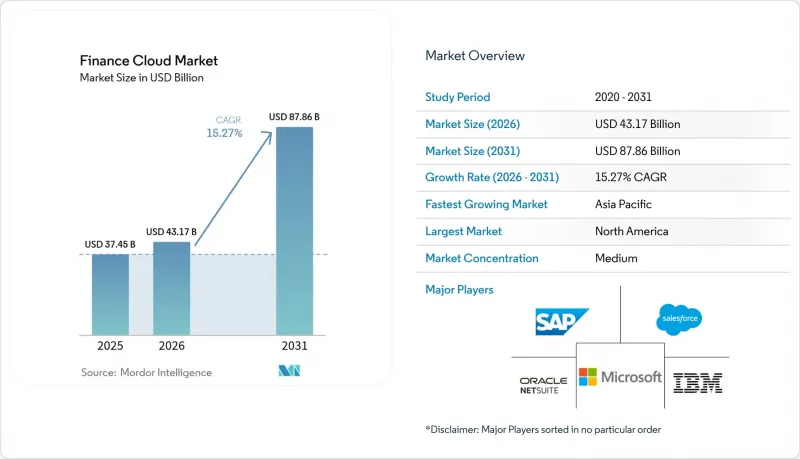
本報告按解決方案(核心會計和總分類帳、財務預測和規劃、其他)、部署模式(公共雲端、私有雲端、混合/多重雲端)、最終用戶(銀行、保險、資本市場、其他)、組織規模(大型企業和中小企業)以及地區進行細分。市場預測以美元計價。
全球金融雲市場趨勢與洞察
客戶關係管理(CRM)改善需求
基於雲端的客戶關係管理 (CRM) 套件為金融機構提供即時行為模式洞察,並支援高度個人化的產品和服務,從而在競爭激烈的市場中提升客戶維繫。亞太地區的銀行正在經營能夠支援數千萬同時會話的雲端平台,例如 AIBank 基於微服務的核心系統,該系統服務超過 1 億客戶。同時,北美地區的金融機構正在整合雲端分析和忠誠度引擎,以降低客戶流失率,而客戶流失率仍影響超過 60% 的傳統金融機構。由於金融資料受到嚴格監管,供應商正透過加密、稽核追蹤和資料居住管理等功能來凸顯自身優勢,從而在滿足監管要求的同時,實現跨通路協作。隨著客戶生命週期價值 (CLV) 成為關鍵績效指標 (KPI),金融雲市場正蓬勃發展,銀行計劃用擴充性的、人工智慧賦能的替代方案取代過時的 CRM 工具。
金融領域對營運效率的需求
將財務工作負載遷移到計量收費模式,可以將資本支出 (CAPEX) 轉化為可變營運支出 (OPEX),從而釋放資金用於產品創新。已完成全面雲端遷移的金融機構報告稱,其月末結算週期縮短了 20-30%,監管報告速度也得到了類似的提升。雲端 ERP 系統原生整合的自動化功能無需手動輸入會計分錄,而無伺服器運算能夠應對結算量不可預測的激增,且不會降低效能。例如,Discover Financial Services 利用混合環境,在季節性支出高峰期間靈活調整資源。隨著利潤率的下降,「成本收入比」現在與收入一起出現在企業儀錶板上,進一步凸顯了效率的重要性,而效率將繼續推動金融雲市場的發展。
基於雲端的網路威脅的興起
金融服務業仍然是複雜攻擊的主要目標,而雲端環境正在擴大威脅的目標範圍。美國監管機構報告稱,勒索軟體的要求數量激增,導致關鍵支付基礎設施中斷,促使銀行加強對零信任架構和可擴展檢測平台的投資。如果遷移敏感資料時沒有採取足夠的安全措施,監管機構可能會處以罰款,罰款金額甚至可能超過金融機構的年度IT預算。雲端服務供應商正在透過機密運算、基於硬體的加密和主權雲端藍圖來應對這一問題,但實施這些控制措施的成本和複雜性正在減緩金融雲端市場的短期成長勢頭。
細分市場分析
到2025年,「財務預測與規劃」板塊將佔總收入的37.70%,這反映出在高度波動的經濟環境下,情境建模的普遍需求。基於雲端的企業績效管理(EPM)套件使財務團隊能夠創建涵蓋數千個成本中心的滾動預測,從而促進數據驅動的決策。整合的促進因素模型能夠在利率和外匯劇烈變化後立即更新利潤預測,進一步凸顯了雲端遷移的迫切性。同時,「風險、合規與監管科技(RegTech)」是成長最快的解決方案領域,在DORA及類似法規的推動下,預計到2031年將以15.62%的複合年成長率成長。供應商正在整合支援API的監管庫,使金融機構能夠透過一鍵式報告向監管機構發送詳細的交易資料。持續的控制監控減少了稽核準備工作量,合規預算也直接推動了金融雲端市場的需求。
核心會計和總分類帳(GL) 平台仍然是所有其他雲端財務模組「記錄系統」的基礎,至關重要。隨著資金籌措市場波動性加劇,即時流動性洞察變得日益重要,財務和現金管理工具正獲得新的發展動力。例如,花旗集團已擴展其基於雲端的財務工作空間,以按分鐘匯總其全球現金部位。薪資核算和人才財務應用程式正受益於財務和人力資源部門之間的緊密協作。 Workday 的最新版本整合了勞動力規劃和支出分析功能,凸顯了整合套件如何加強企業協作。透過將這些功能打包在統一的資料架構下,供應商正在拓展提升銷售管道,並在財務雲端市場中推動永續的收入來源。
在全球超大規模資料中心業者的部署、先進的安全認證以及持續創新藍圖的推動下,預計到2025年,公共雲端將佔總收入的56.90%。銀行通常採用託管式PaaS資料庫來加速新產品的部署,而無需配置硬體。然而,依賴單一供應商會引發容錯的擔憂,從而推動混合雲端和多重雲端的採用,年複合成長率高達16.55%。歐洲金融機構意識到監管機構指出的集中風險,因此擴大將工作負載分佈在至少兩個供應商上,同時在私有雲端上維護超低延遲的交易引擎。 Form3的付款管道就是這項策略的典型例子,它抽象化了路由邏輯,使銀行能夠在發生故障時在不同雲端之間切換端點。
對於那些對效能和資料主權要求極高的應用場景而言,私有雲端仍然至關重要。摩根大通正在投資20億美元建造四個新的私有雲端資料中心,這些資料中心將為延遲敏感型風險運算奠定基礎。整合的可觀測性堆疊和「策略即程式碼」將減少混合環境中的運維摩擦,使混合環境真正實現無縫銜接。隨著監管討論中明確提及“退出策略”,金融機構正擴大採用容器化工作負載和開放API來避免供應商鎖定,這進一步拓展了金融雲市場的潛在商機。
區域分析
北美擁有雄厚的技術預算和清晰的法規環境,加速了雲端轉型,預計到2025年將佔全球收入的40.60%。美國在該區域處於領先地位,光是摩根大通每年就投資170億美元用於技術,並將6,000個應用程式遷移到雲端平台。加拿大正在製定開放銀行指南,以促進安全的API生態系統;墨西哥的銀行正在採用雲端技術以滿足跨境報告標準。公私合作在網路安全和數位身分框架方面的舉措,進一步降低了部署風險,並增強了該地區的金融雲端市場。服務供應商正在利用高密度資料中心網路,以滿足高頻交易者對低於10毫秒延遲的要求。
亞太地區是成長最快的地區,預計到2031年複合年成長率將達到15.96%。政府支持的數位經濟藍圖將雲端運算置於普惠金融的核心地位,支撐著該地區的數位經濟價值,預計2030年將達到1兆美元。中國的人工智慧銀行透過容器化平台為超過1億客戶提供服務,展現了雲端運算的可擴展性。印度的公共雲端政策進一步推動了超大規模資料中心業者雲端服務的應用,讓受監管企業在嚴格的加密金鑰下將核心資料託管在海外。日本和澳洲正在推廣「行業雲」模式,該模式向當地監管機構提供預先認證的合規交付物。加之不斷提高的手續費收入目標(亞太地區的銀行預計到2030年,數位相關業務將佔其利潤的40%),這些趨勢正在確保金融雲市場的持續成長。
在歐洲,基於DORA(資料保護和權利條例)對營運彈性的要求,雲端現代化正在加速推進,影響約22,000家金融機構。在德國、法國和英國,已引入用於模擬網路安全事件的共用測試框架,並正在推廣自動化證據收集平台的應用。主要供應商營運的主權雲端區域正在滿足資料主權要求,並透過多供應商策略降低系統性風險。在南美洲,預計將出現高速成長,這主要得益於巴西的挑戰者銀行(如Nubank)等無分店銀行的推動。 Nubank完全基於雲端基礎設施運營,累計20億美元的利潤。在中東和非洲地區,雲端應用正在迅速擴展,該地區83%的金融機構目前都在運行雲端工作負載,並預計在兩年內每年可節省2,114萬美元的成本。海灣合作理事會 (GCC) 的銀行正在調整其國家雲端採用要求,以配合雄心勃勃的數位轉型藍圖,從而鞏固金融雲端市場的新需求。
其他好處:
- Excel格式的市場預測(ME)表
- 3個月的分析師支持
目錄
第1章:引言
- 研究假設和市場定義
- 調查範圍
第2章:調查方法
第3章執行摘要
第4章 市場狀況
- 市場概覽
- 市場促進因素
- 需要改進客戶關係管理
- 金融領域對營運效率的需求
- 關於即時透明度和報告的監管工作
- 利用 GenAI 進行自助式財務分析
- 實施 FinOps 以最佳化雲端支出
- 面向銀行、金融服務和保險 (BFSI) 行業的產業專用的雲端平台
- 市場限制因素
- 基於雲端的網路威脅的興起
- 傳統核心整合的複雜性
- 雲端運算、財務營運和數據工程領域人才短缺。
- 供應商鎖定和產生式人工智慧的成本超支
- 價值鏈分析
- 監理情勢
- 技術展望
- 波特五力分析
- 評估宏觀經濟趨勢對市場的影響
第5章 市場規模與成長預測
- 透過解決方案
- 核心會計和總分類帳
- 財務預測和計劃
- 風險、合規和監管科技
- 財務和現金管理
- 薪資核算和人力資源財務
- 按部署模式
- 公共雲端
- 私有雲端
- 混合/多重雲端
- 最終用戶
- 銀行
- 保險
- 資本市場
- 金融科技/新銀行
- 按組織規模
- 大公司
- 中小企業
- 按地區
- 北美洲
- 美國
- 加拿大
- 墨西哥
- 歐洲
- 德國
- 英國
- 法國
- 義大利
- 西班牙
- 其他歐洲國家
- 亞太地區
- 中國
- 日本
- 印度
- 韓國
- 澳洲
- 其他亞太國家
- 南美洲
- 巴西
- 阿根廷
- 其他南美國家
- 中東和非洲
- 中東
- 沙烏地阿拉伯
- 阿拉伯聯合大公國
- 土耳其
- 其他中東國家
- 非洲
- 南非
- 埃及
- 奈及利亞
- 其他非洲國家
- 中東
- 北美洲
第6章 競爭情勢
- 市場集中度
- 策略趨勢
- 市佔率分析
- 公司簡介
- Oracle Corporation(Netsuite)
- SAP
- Microsoft
- Salesforce
- IBM
- Workday
- Sage Intacct
- Unit4/FinancialForce
- Intuit
- Anaplan
- Workiva
- BlackLine
- Coupa
- Xero
- FIS
- Fiserv
- Temenos
- Finastra
- Acumatica
- AWS
- Google Cloud
- Huawei
第7章 市場機會與未來展望
According to Mordor Intelligence, the finance cloud market size is expected to grow from USD 37.45 billion in 2025 to USD 43.17 billion in 2026 and is forecast to reach USD 87.86 billion by 2031 at 15.3% CAGR over 2026-2031.
This report is Segmented by Solution (Core Accounting and GL, Financial Forecasting and Planning, and More), Deployment Model (Public Cloud, Private Cloud, and Hybrid / Multi-Cloud), End-User (Banking, Insurance, Capital Markets, and More), Organization Size (Large Enterprises and Small and Medium Enterprises (SMEs)), and Geography. The Market Forecasts are Provided in Terms of Value (USD).
Global Finance Cloud Market Trends and Insights
Need for Improved Customer Relationship Management
Cloud-based CRM suites give financial institutions real-time insight into behavioural patterns, enabling hyper-personalised offers that improve retention in crowded markets. Asia-Pacific banks run cloud platforms capable of supporting tens of millions of concurrent sessions, as illustrated by AIBank's micro-services core that serves more than 100 million customers. In parallel, North American lenders integrate cloud analytics with loyalty engines to cut churn that still affects over 60% of legacy institutions. Because finance data is highly regulated, vendors differentiate through in-platform encryption, audit trails, and data-residency controls that satisfy regulators while still allowing cross-channel orchestration. As customer lifetime value becomes a pivotal KPI, the finance cloud market gains further momentum from banks' willingness to replace ageing CRM tools with elastic, AI-ready alternatives.
Demand for Operational Efficiency in Financial Sector
Moving finance workloads to consumption-based clouds converts capital expenditure into variable operating cost, releasing cash for product innovation. Institutions that completed full cloud migrations report 20-30% reductions in month-end close cycles and similar gains in regulatory reporting speed. Automation natively embedded in cloud ERPs eliminates manual journals, while serverless compute handles unpredictable spikes in payment volumes without performance degradation. Discover Financial Services, for example, relies on a hybrid estate to flex resources during seasonal spending peaks. As margins tighten, cost-to-income ratios now appear on board dashboards alongside revenue, reinforcing the efficiency narrative that will continue to propel the finance cloud market.
Rise of Cloud-based Cyber Threats
Financial services remain the top target for sophisticated attacks, and cloud environments enlarge the threat surface. US regulators report escalating ransom incidents that disrupt critical payment infrastructures, prompting banks to double investments in zero-trust architectures and extended detection platforms. Migrating sensitive data without commensurate security uplift exposes institutions to regulatory fines that can exceed annual IT budgets. Cloud providers answer with confidential computing, hardware-rooted encryption, and sovereign-cloud blueprints, yet implementing these controls adds cost and complexity, muting short-term acceleration in the finance cloud market.
Other drivers and restraints analyzed in the detailed report include:
- Regulatory Push for Real-Time Transparency and Reporting
- GenAI-enabled Self-service Finance Analytics
- Legacy-core Integration Complexity
For complete list of drivers and restraints, kindly check the Table Of Contents.
Segment Analysis
The Financial Forecasting and Planning segment retained 37.70% revenue in 2025, reflecting the universal need for scenario modelling when economic volatility remains high. Cloud-based EPM suites let finance teams generate rolling forecasts across thousands of cost centres, elevating data-driven decision-making. Integrated driver-based models update profit outlooks instantly after rate or FX shocks, reinforcing migration urgency. Concurrently, Risk, Compliance, and RegTech is the fastest-growing solution line, advancing at 15.62% CAGR through 2031 on the back of DORA and comparable regimes. Vendors embed API-ready regulatory libraries so institutions can push granular transaction data to supervisors with one-click reporting. Continuous control monitoring features lower audit-prep workloads, translating compliance budgets directly into demand for the finance cloud market.
Core Accounting and General Ledger platforms remain indispensable, acting as system-of-record anchors for all other cloud finance modules. Treasury and Cash-Management tools gain new momentum as volatile funding markets prioritise real-time liquidity insight. Citigroup, for instance, expanded its cloud treasury workspace to aggregate global cash positions minute-by-minute. Payroll and Workforce Finance applications benefit from tight finance-HR convergence; Workday's latest release bundles headcount planning with spend analytics, underscoring how integrated suites improve enterprise alignment. As vendors package these capabilities under unified data fabrics, upsell pipelines expand, driving sustainable revenue streams within the finance cloud market.
Public clouds controlled 56.90% of 2025 revenue due to hyperscalers' global footprints, advanced security certifications, and continuous innovation roadmaps. Banks routinely adopt managed PaaS databases to accelerate new product rollouts without provisioning hardware. Yet dependence on a single provider raises resilience concerns, propelling Hybrid and Multi-Cloud uptake at 16.55% CAGR. European lenders, mindful of concentration risk outlined by regulators, increasingly split workloads across at least two vendors, while retaining ultra-low-latency trading engines on private clouds. Form3's payment platform exemplifies this strategy, abstracting routing logic so banks can toggle endpoints among clouds during outages.
Private clouds remain vital for use cases with stringent performance or data-sovereignty requirements. JPMorgan Chase is spending USD 2 billion on four new private cloud data centres that anchor latency-sensitive risk computations. Unified observability stacks and policy-as-code reduce operational friction across mixed estates, making hybrid truly seamless. Because regulatory discourse now explicitly references "exit plans," institutions favour containerised workloads and open APIs to avoid lock-in, a development that further broadens addressable opportunity for the finance cloud market.
Complete Report Scope:
- By Solution
- Core Accounting and GL
- Financial Forecasting and Planning
- Risk, Compliance and Reg-Tech
- Treasury and Cash-Management
- Payroll and Workforce Finance
- By Deployment Model
- Public Cloud
- Private Cloud
- Hybrid / Multi-Cloud
- By End-User
- Banking
- Insurance
- Capital Markets
- FinTech / Neo-banks
- By Organisation Size
- Large Enterprises
- Small and Medium Enterprises (SMEs)
- By Geography
- North America
- United States
- Canada
- Mexico
- Europe
- Germany
- United Kingdom
- France
- Italy
- Spain
- Rest of Europe
- Asia-Pacific
- China
- Japan
- India
- South Korea
- Australia
- Rest of Asia-Pacific
- South America
- Brazil
- Argentina
- Rest of South America
- Middle East and Africa
- Middle East
- Saudi Arabia
- United Arab Emirates
- Turkey
- Rest of Middle East
- Africa
- South Africa
- Egypt
- Nigeria
- Rest of Africa
- Middle East
- North America
Geography Analysis
North America retained 40.60% of 2025 revenue thanks to deep technology budgets and regulatory clarity that fosters accelerated migration. The United States anchors the region, with JPMorgan Chase alone allocating USD 17 billion annually to tech and moving 6,000 applications to cloud platforms. Canada follows with open-banking guidelines that encourage secure API ecosystems, while Mexican banks adopt cloud to meet cross-border reporting standards. Public-private collaboration on cybersecurity and digital-identity frameworks further de-risks adoption, strengthening the finance cloud market in the region. Providers leverage dense data-centre footprints to meet sub-10-millisecond latency thresholds demanded by high-frequency traders.
Asia-Pacific is the fastest-growing territory at 15.96% CAGR through 2031. Government-backed digital-economy blueprints place cloud at the centre of financial-inclusion agendas, underpinning a regional digital-economy value expected to reach USD 1 trillion by 2030. China's AIBank demonstrates cloud scalability by serving over 100 million customers on a containerised platform. India's public-cloud policy now allows regulated entities to host core data offshore under strict encryption keys, unlocking broader hyperscaler adoption. Japan and Australia endorse Industry-Cloud models that deliver pre-certified compliance artefacts for local supervisory bodies. Coupled with rising fee-based revenue targets-APAC banks expect digital adjacencies to supply 40% of profit pools by 2030-these trends ensure sustained upside for the finance cloud market.
Europe accelerates cloud modernisation under DORA's operational-resilience mandate, affecting roughly 22,000 financial organisations. Germany, France, and the United Kingdom roll out shared testing frameworks for cyber-incident simulations, incentivising the adoption of platforms that automate evidence collection. Sovereign-cloud regions operated by large providers satisfy data-sovereignty clauses, while multi-vendor strategies mitigate systemic risk. South America charts high growth, powered by Brazil's branchless challenger banks such as Nubank, which posted USD 2 billion profit in 2024 while operating entirely on cloud infrastructure. Middle East and Africa adoption climbs swiftly; 83% of MENA financial firms now run cloud workloads and expect USD 21.14 million in annual savings within two years. Gulf Cooperation Council banks align national cloud mandates with ambitious digital transformation roadmaps, solidifying new demand pockets for the finance cloud market.
- Oracle Corporation(Netsuite)
- SAP
- Microsoft
- Salesforce
- IBM
- Workday
- Sage Intacct
- Unit4 / FinancialForce
- Intuit
- Anaplan
- Workiva
- BlackLine
- Coupa
- Xero
- FIS
- Fiserv
- Temenos
- Finastra
- Acumatica
- AWS
- Google Cloud
- Huawei
Additional Benefits:
- The market estimate (ME) sheet in Excel format
- 3 months of analyst support
TABLE OF CONTENTS
1 INTRODUCTION
- 1.1 Study Assumptions and Market Definition
- 1.2 Scope of the Study
2 RESEARCH METHODOLOGY
3 EXECUTIVE SUMMARY
4 MARKET LANDSCAPE
- 4.1 Market Overview
- 4.2 Market Drivers
- 4.2.1 Need for improved customer relationship management
- 4.2.2 Demand for operational efficiency in financial sector
- 4.2.3 Regulatory push for real-time transparency and reporting
- 4.2.4 GenAI-enabled self-service finance analytics
- 4.2.5 FinOps adoption to optimise cloud spending
- 4.2.6 Industry-cloud platforms for BFSI verticals
- 4.3 Market Restraints
- 4.3.1 Rise of cloud-based cyber threats
- 4.3.2 Legacy-core integration complexity
- 4.3.3 Talent gap in cloud-FinOps and data engineering
- 4.3.4 Vendor lock-in and GenAI cost overruns
- 4.4 Value Chain Analysis
- 4.5 Regulatory Landscape
- 4.6 Technological Outlook
- 4.7 Porter's Five Forces Analysis
- 4.7.1 Bargaining Power of Suppliers
- 4.7.2 Bargaining Power of Consumers
- 4.7.3 Threat of New Entrants
- 4.7.4 Threat of Substitute Products
- 4.7.5 Intensity of Competitive Rivalry
- 4.8 Assessment of the Impact of Macroeconomic Trends on the Market
5 MARKET SIZE AND GROWTH FORECASTS (VALUE)
- 5.1 By Solution
- 5.1.1 Core Accounting and GL
- 5.1.2 Financial Forecasting and Planning
- 5.1.3 Risk, Compliance and Reg-Tech
- 5.1.4 Treasury and Cash-Management
- 5.1.5 Payroll and Workforce Finance
- 5.2 By Deployment Model
- 5.2.1 Public Cloud
- 5.2.2 Private Cloud
- 5.2.3 Hybrid / Multi-Cloud
- 5.3 By End-User
- 5.3.1 Banking
- 5.3.2 Insurance
- 5.3.3 Capital Markets
- 5.3.4 FinTech / Neo-banks
- 5.4 By Organisation Size
- 5.4.1 Large Enterprises
- 5.4.2 Small and Medium Enterprises (SMEs)
- 5.5 By Geography
- 5.5.1 North America
- 5.5.1.1 United States
- 5.5.1.2 Canada
- 5.5.1.3 Mexico
- 5.5.2 Europe
- 5.5.2.1 Germany
- 5.5.2.2 United Kingdom
- 5.5.2.3 France
- 5.5.2.4 Italy
- 5.5.2.5 Spain
- 5.5.2.6 Rest of Europe
- 5.5.3 Asia-Pacific
- 5.5.3.1 China
- 5.5.3.2 Japan
- 5.5.3.3 India
- 5.5.3.4 South Korea
- 5.5.3.5 Australia
- 5.5.3.6 Rest of Asia-Pacific
- 5.5.4 South America
- 5.5.4.1 Brazil
- 5.5.4.2 Argentina
- 5.5.4.3 Rest of South America
- 5.5.5 Middle East and Africa
- 5.5.5.1 Middle East
- 5.5.5.1.1 Saudi Arabia
- 5.5.5.1.2 United Arab Emirates
- 5.5.5.1.3 Turkey
- 5.5.5.1.4 Rest of Middle East
- 5.5.5.2 Africa
- 5.5.5.2.1 South Africa
- 5.5.5.2.2 Egypt
- 5.5.5.2.3 Nigeria
- 5.5.5.2.4 Rest of Africa
- 5.5.5.1 Middle East
- 5.5.1 North America
6 COMPETITIVE LANDSCAPE
- 6.1 Market Concentration
- 6.2 Strategic Moves
- 6.3 Market Share Analysis
- 6.4 Company Profiles (includes Global level Overview, Market level overview, Core Segments, Financials as available, Strategic Information, Market Rank/Share for key companies, Products and Services, and Recent Developments)
- 6.4.1 Oracle Corporation(Netsuite)
- 6.4.2 SAP
- 6.4.3 Microsoft
- 6.4.4 Salesforce
- 6.4.5 IBM
- 6.4.6 Workday
- 6.4.7 Sage Intacct
- 6.4.8 Unit4 / FinancialForce
- 6.4.9 Intuit
- 6.4.10 Anaplan
- 6.4.11 Workiva
- 6.4.12 BlackLine
- 6.4.13 Coupa
- 6.4.14 Xero
- 6.4.15 FIS
- 6.4.16 Fiserv
- 6.4.17 Temenos
- 6.4.18 Finastra
- 6.4.19 Acumatica
- 6.4.20 AWS
- 6.4.21 Google Cloud
- 6.4.22 Huawei
7 MARKET OPPORTUNITIES AND FUTURE OUTLOOK
- 7.1 White-Space and Unmet-Need Assessment

 金融雲市場:2026-2032年全球市場預測(依解決方案類型、服務模式、部署模式、組織規模及最終用戶產業分類)
 全球金融雲市場
 金融雲市場報告:按類型、部署模式、企業規模、應用程式和地區分類(2026-2034 年)
 2026-2030年全球雲端金融營運自動化工具市場
 金融雲市場-2026-2031年預測
 金融雲市場-全球產業規模、佔有率、趨勢、機會與預測:按雲端類型、服務、地區和競爭對手分類,2021-2031年
 FinOps市場預測至2032年:按組件、解決方案類型、服務類型、部署模式、組織規模、最終用戶和地區分類的全球分析
 2025年全球金融雲市場報告
 金融雲市場機會、成長動力、產業趨勢分析及 2025 - 2034 年預測
 金融雲市場規模、佔有率、成長分析(按解決方案、按服務、按部署、按公司規模、按應用、按最終用途、按地區)-2025 年至 2032 年產業預測