


 |
市場調查報告書
商品編碼
2120257
美國發泡聚苯乙烯(EPS):市場佔有率分析、產業趨勢與統計、成長預測(2026-2031)United States Expanded Polystyrene (EPS) - Market Share Analysis, Industry Trends & Statistics, Growth Forecasts (2026 - 2031) |
||||||

※ 本網頁內容可能與最新版本有所差異。詳細情況請與我們聯繫。
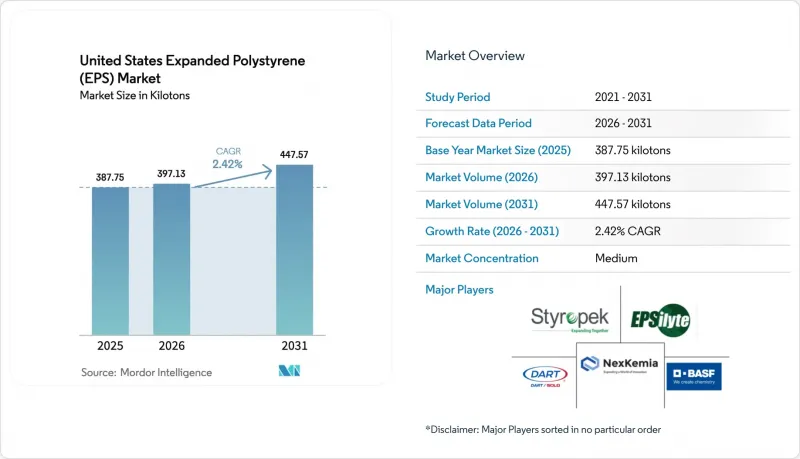
根據 Mordor Intelligence 預測,美國發泡聚苯乙烯市場規模預計將在 2025 年達到 387.75 千噸,2026 年達到 397.13 千噸,到 2031 年達到 447.57 千噸,2026 年至 20312 年的複合年成長率為 20312%。
本報告按類型(白色、灰色、銀色(石墨增強型))和最終用戶(建築和施工、包裝、汽車和運輸、消費性電子)進行細分。市場預測以數量(噸)為單位。
美國發泡聚苯乙烯(EPS)市場的趨勢與洞察
建築業主導隔熱材料需求激增
一項針對隔熱材料的30%聯邦稅額扣抵(每戶最高抵免額為1200美元,有效期至2032年)正在加速2000年以前建造的所有住宅存量的閣樓、牆壁和地下室維修,從而創造了對發泡聚苯乙烯(EPS)市場的新需求。國際節能標準2024和ASHRAE 90.1-2022收緊了鋼骨牆體的U值限制,實際上強制要求如果EPS每英吋隔熱值達到R-4且每板英尺成本低於0.50美元,則必須使用連續的隔熱層。儘管預計2025年住宅開工量將年減6%,但由於半導體和資料中心等大型企劃的推進,非住宅建築的總建設支出卻大幅增加。這些項目都大量使用地工磚來緩解軟土地基的地層下陷。根據美國國家再生能源實驗室 (NREL) 的估計,到 2050 年,住宅占地面積預計將增加 38%,商業占地面積預計將增加 37%,這將確保未來幾十年對硬質發泡材的需求顯著成長。寒冷地區的建築商正在轉向使用石墨 EPS,這種材料的隔熱值 (R 值) 可提高 20-30%。這使得板材可以做得更薄,從而降低木材成本並最大限度地利用室內空間。
電子商務冷鏈需求的爆炸性成長
溫控物流業者依賴EPS(發泡聚苯乙烯)運輸箱,此箱體可將溫度維持在2°C至8°C之間長達72小時。其到岸成本比真空絕熱板低40%至60%,這一顯著優勢正在推動發泡聚苯乙烯包裝材料市場的需求。聯邦快遞的Temp-Assure和UPS的Temperature True計劃到2025年將其服務範圍擴大到美國200多個主要大都會圈,透過將冷藏箱回收環路整合到回收中心,促進包裝整合和再利用。亞馬遜的生鮮部門繼續在全美範圍內推廣EPS箱體,但其在加州和華盛頓州開展的紙基複合材料冷藏箱試點計畫表明,該品牌也考慮到了那些已實施禁令的州。聚苯乙烯回收聯盟計畫在2030年將家庭回收率從32%提高到66%,但由於擔心食物廢棄物的污染,大多數市政計畫仍持謹慎態度。儘管有這些障礙,醫藥、水產品和食材自煮包配送公司相信,EPS 將是 2026 年最後一公里配送最具成本績效和最佳選擇。
可生物分解和紙質替代品
目前,戴爾筆記型電腦和宜家組裝包裝家具使用纖維模塑或蘑菇衍生包裝材料,但這些材料的成本是EPS的兩到三倍,而且由於生物生長週期,前置作業時間可能長達兩週。 Footprint International和Hootamaki正在大力投資纖維托盤和翻蓋式容器,目標是那些在禁止使用EPS的州運營的快餐連鎖店。 Sigma-Aldrich的紙澱粉「Greener Cooler」聲稱其隔熱性能與1.5英寸厚的EPS牆體相同,但現場測試表明,在墨西哥灣沿岸潮濕的環境中存在冷凝問題,凸顯了其在惡劣條件下的性能差距。在建築和地工磚應用領域,防潮性和抗壓強度是主要的選擇標準,到2026年,這些生物替代品的威脅可能微乎其微。
細分市場分析
2025年,白色聚苯乙烯發泡的市佔率維持在71.25%。這主要得益於其每板英尺約0.40至0.50美元的價格,以及其在保護性包裝、地下隔熱材料和地工磚等領域的廣泛應用。石墨增強型聚苯乙烯泡沫塑膠每英吋的R值可達4.7至5,比白色級高出20%至30%。這使得5至8區的建築商能夠使用更薄的牆體來滿足建築規範的要求,這一優勢足以抵消10%至20%的價格溢價。BASF的「Neopor」產品佔據市場主導地位,而歐洲新進企業BEWI則表示,其灰色系列產品的性能比白色級產品高出約20%。隨著氣溫下降,這一差距還會進一步擴大。
預計到2031年,石墨發泡聚苯乙烯(EPS)的市場規模將以3.71%的複合年成長率成長,其應用領域將從商業屋頂轉向多用戶住宅牆體系統。在地工磚和標準包裝應用中,白色EPS仍將佔據主導地位,因為在這些應用中,抗壓強度、防潮性和交付成本比R值更為重要。德克薩斯州交通部(TxDOT)在10號州際公路上的地工磚更換專案與混凝土相比,成本節省超過50%,這表明隔熱在許多土木工程項目中並非主要考慮因素。在冷鏈包裝領域,高價值產品的採用受到限制,因為即使滿足48-72小時的冷藏要求,白色冷藏箱在成本方面仍然優於石墨基產品。
其他好處:
- Excel格式的市場預測(ME)表
- 3個月的分析師支持
目錄
第1章:引言
- 研究假設和市場定義
- 調查範圍
第2章:調查方法
第3章執行摘要
第4章 市場狀況
- 市場概覽
- 市場促進因素
- 受建築業需求的推動,對EPS隔熱材料的需求正在激增。
- 電子商務冷鏈需求的爆炸性成長
- 聯邦節能建築標準
- 擴大地工磚在應對氣候變遷的土木工程項目中的應用
- 人們對3D列印石墨和EPS住宅板材的興趣日益濃厚。
- 市場限制因素
- 可生物分解和紙質替代品
- 州級禁令禁止使用一次性EPS食品容器
- 美國環保署增加了戊烷排放量
- 價值鏈分析
- 波特五力模型
第5章 市場規模與成長預測
- 按類型
- 白色的
- 灰色和銀色(石墨增強型)
- 最終用戶
- 建築/施工
- 包裝
- 汽車和運輸業
- 家用電器/消費品
第6章 競爭情勢
- 市場集中度
- 策略趨勢
- 市佔率和排名分析
- 公司簡介
- Alpek SAB de CV
- BASF
- BEWI
- Cellofoam North America Inc.
- Dart Container Corp.
- Epsilyte LLC
- Alleguard
- Harbor Foam
- NexKemia Petrochemicals Inc.
- NOVA Chemicals Corporate
- Owens Corning
- Ravago
- SABIC
- Sealed Air
- Styrotech, Inc.
- TotalEnergies
第7章 市場機會與未來展望
According to Mordor Intelligence, the United States expanded polystyrene market size is projected to be 387.75 kilotons in 2025, 397.13 kilotons in 2026, and reach 447.57 kilotons by 2031, growing at a CAGR of 2.42% from 2026 to 2031.
This report is Segmented by Type (White, Grey, and Silver (Graphite-Enhanced)) and End-User (Building and Construction, Packaging, Automotive and Transportation, and Appliances and Consumer Goods). The Market Forecasts are Provided in Terms of Volume (Tons).
United States Expanded Polystyrene (EPS) Market Trends and Insights
Construction-Led Insulation Boom
A 30% federal tax credit on insulation, capped at USD 1,200 per household through 2032, has accelerated attic, wall, and basement retrofits across the pre-2000 housing stock, unlocking new tonnage for the expandable polystyrene market. The International Energy Conservation Code 2024 and ASHRAE 90.1-2022 tightened U-factor limits for steel-frame walls, effectively mandating continuous insulating layers where EPS delivers R-4 per inch at installed costs below USD 0.50 per board foot. Although 2025 housing starts dipped 6% year-over-year, nonresidential construction value surged on semiconductor and data-center megaprojects, each specifying high-volume geofoam to curb settlement on soft soils. NREL estimates residential floor area will climb 38% and commercial floor area 37% by 2050, securing a multi-decade runway for rigid-foam demand. Contractors in cold regions are shifting toward graphite EPS, which boosts R-value 20-30%, enabling thinner panels that cut lumber costs and free interior space.
Exploding E-Commerce Cold-Chain Demand
Temperature-controlled logistics providers rely on EPS shippers that maintain 2 °C-8 °C for up to 72 hours at landed costs 40-60% below vacuum-insulated panels, a sizable advantage that sustains packaging volumes in the expandable polystyrene market. FedEx Temp-Assure and UPS Temperature True extended coverage to more than 200 U.S. metros in 2025, embedding cooler take-back loops at consolidation hubs for densification and reuse. Amazon's grocery arm continues to deploy EPS boxes nationwide, although pilots of paper-composite coolers in California and Washington illustrate brand sensitivity in ban-active states. The Polystyrene Recycling Alliance plans to raise curbside access from 32% of the population to as high as 66% by 2030, yet contamination from food residues keeps most municipal programs on the sidelines. Even with these hurdles, pharmaceutical, seafood, and meal-kit shippers view EPS as the best cost-to-performance option for last-mile delivery in 2026.
Biodegradable and Paper-Based Substitutes
Fiber-molded and mushroom-based packaging now lines Dell laptops and IKEA flat-packs, but costs remain 2-3 times higher than EPS and lead times stretch to two weeks because of biological growing cycles. Footprint International and Huhtamaki have invested heavily in fiber trays and clamshells, eyeing fast-food chains operating in ban-active states. Sigma-Aldrich's paper-starch "Greener Cooler" claims identical thermal performance to 1.5-inch EPS walls, yet field trials found condensation failures in Gulf Coast humidity, highlighting performance gaps in extreme conditions. Construction and geofoam uses, where moisture resistance and compressive strength dominate selection criteria, face minimal threat from these bio-alternatives in 2026.
Other drivers and restraints analyzed in the detailed report include:
- Federal Energy-Efficiency Building Codes
- Growing Usage of Geofoam for Climate-Resilient Civil Works
- State Bans on Single-Use EPS Foodware
For complete list of drivers and restraints, kindly check the Table Of Contents.
Segment Analysis
White grades retained a 71.25% expandable polystyrene market share in 2025, anchored by costs near USD 0.40-0.50 per board foot and versatility in protective packaging, below-grade insulation, and geofoam. Graphite-enhanced versions deliver R-4.7-5 per inch, 20-30% higher than white, allowing builders in zones 5-8 to hit code with thinner walls - a benefit that offsets their 10-20% price premium. BASF's Neopor leads supply, and European entrant BEWI reports its grey line outperforms white by roughly 20%, a gap that widens as temperatures drop.
The expandable polystyrene market size tied to graphite grades is projected to rise 3.71% CAGR through 2031 as adoption moves from commercial roofs into multifamily wall systems. White EPS will remain dominant in geofoam and standard packaging where compressive strength, moisture resistance, and delivered cost matter more than R-value. TxDOT's Interstate 10 geofoam replacement saved over 50% versus concrete, underlining why thermal performance is irrelevant in many civil works. In cold-chain packaging, white coolers still beat graphite on cost even while meeting 48-72-hour hold times, limiting premium product penetration.
Complete Report Scope:
- By Type
- White
- Grey and Silver (Graphite-enhanced)
- By End-User
- Building and Construction
- Packaging
- Automotive and Transportation
- Appliances and Consumer Goods
List of Companies Covered in this Report:
- Alpek S.A.B. de C.V.
- BASF
- BEWI
- Cellofoam North America Inc.
- Dart Container Corp.
- Epsilyte LLC
- Alleguard
- Harbor Foam
- NexKemia Petrochemicals Inc.
- NOVA Chemicals Corporate
- Owens Corning
- Ravago
- SABIC
- Sealed Air
- Styrotech, Inc.
- TotalEnergies
Additional Benefits:
- The market estimate (ME) sheet in Excel format
- 3 months of analyst support
TABLE OF CONTENTS
1 Introduction
- 1.1 Study Assumptions and Market Definition
- 1.2 Scope of the Study
2 Research Methodology
3 Executive Summary
4 Market Landscape
- 4.1 Market Overview
- 4.2 Market Drivers
- 4.2.1 Construction-led insulation booming demand for EPS
- 4.2.2 Exploding e-commerce cold-chain demand
- 4.2.3 Federal energy-efficiency building codes
- 4.2.4 Growing usage of geofoam for climate-resilient civil works
- 4.2.5 Increasing empasis on 3-D printed graphite-EPS housing panels
- 4.3 Market Restraints
- 4.3.1 Biodegradable and paper-based substitutes
- 4.3.2 State bans on single-use EPS foodware
- 4.3.3 EPA pentane-emission fee escalation
- 4.4 Value Chain Analysis
- 4.5 Porter's Five Forces
- 4.5.1 Bargaining Power of Suppliers
- 4.5.2 Bargaining Power of Buyers
- 4.5.3 Threat of New Entrants
- 4.5.4 Threat of Substitutes
- 4.5.5 Degree of Competition
5 Market Size and Growth Forecasts (Volume)
- 5.1 By Type
- 5.1.1 White
- 5.1.2 Grey and Silver (Graphite-enhanced)
- 5.2 By End-User
- 5.2.1 Building and Construction
- 5.2.2 Packaging
- 5.2.3 Automotive and Transportation
- 5.2.4 Appliances and Consumer Goods
6 Competitive Landscape
- 6.1 Market Concentration
- 6.2 Strategic Moves
- 6.3 Market Share(%)/Ranking Analysis
- 6.4 Company Profiles {(includes Global level Overview, Market level overview, Core Segments, Financials as available, Strategic Information, Market Rank/Share for key companies, Products and Services, and Recent Developments)}
- 6.4.1 Alpek S.A.B. de C.V.
- 6.4.2 BASF
- 6.4.3 BEWI
- 6.4.4 Cellofoam North America Inc.
- 6.4.5 Dart Container Corp.
- 6.4.6 Epsilyte LLC
- 6.4.7 Alleguard
- 6.4.8 Harbor Foam
- 6.4.9 NexKemia Petrochemicals Inc.
- 6.4.10 NOVA Chemicals Corporate
- 6.4.11 Owens Corning
- 6.4.12 Ravago
- 6.4.13 SABIC
- 6.4.14 Sealed Air
- 6.4.15 Styrotech, Inc.
- 6.4.16 TotalEnergies
7 Market Opportunities and Future Outlook
- 7.1 White-space and Unmet-Need Assessment
- 7.2 Increasing Recycling in EPS industry

 2026年全球發泡聚苯乙烯市場報告
 2026-2030年全球發泡聚苯乙烯市場
 歐洲發泡聚苯乙烯(EPS):市場佔有率分析、行業趨勢和統計數據以及成長預測(2026-2031 年)
 發泡聚苯乙烯市場報告:依產品、終端用途產業及地區分類(2026-2034 年)
 發泡聚苯乙烯市場:依形態、等級、最終用途產業、通路和應用程式分類-2026-2032年全球市場預測發泡聚苯乙烯增密設備市場:按機器類型、操作模式、類別、應用和最終用戶分類 - 全球預測 2026-2032
 發泡聚苯乙烯市場-全球產業規模、佔有率、趨勢、機會及預測(依產品類型、最終用途、地區及競爭格局分類,2021-2031年)發泡聚苯乙烯(EPS):市佔率分析、產業趨勢與統計、成長預測(2026-2031)
 發泡聚苯乙烯包裝市場規模、佔有率和成長分析(按產品類型、最終用途產業、密度、形狀、應用和地區分類)-2026-2033年產業預測
 珠狀聚苯乙烯(EPS)泡沫包裝市場規模、佔有率、成長及全球產業分析:按類型、應用和地區劃分的洞察與預測(2024-2032 年)