


 |
市場調查報告書
商品編碼
2119903
馬來西亞拖車市場:市場佔有率分析、產業趨勢與統計、成長預測(2026-2031)Malaysia Trailer - Market Share Analysis, Industry Trends & Statistics, Growth Forecasts (2026 - 2031) |
||||||

※ 本網頁內容可能與最新版本有所差異。詳細情況請與我們聯繫。
根據 Mordor Intelligence 預測,馬來西亞拖車市場規模預計在 2025 年達到 1.6 億美元,2026 年達到 1.6 億美元,到 2031 年達到 1.9 億美元,2026 年至 2031 年的年複合成長率(CAGR)為 3.01%。
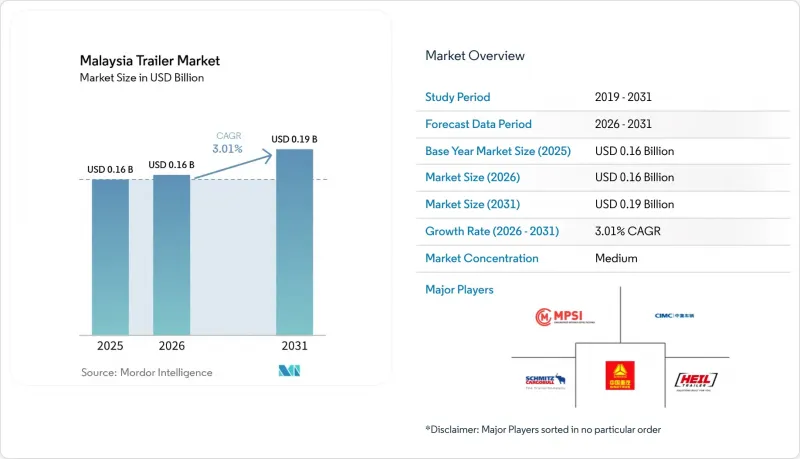
本報告按拖車類型(平板拖車、廂式拖車及其他)、軸型(單軸、雙軸及其他)、載重能力(小型(20噸以下)、中型(21-40噸及其他))和最終用戶(物流運輸公司、建築承包商及其他)進行分類。市場預測以美元計價。
馬來西亞拖車市場的趨勢和洞察
電子商務主導冷鏈和最後一公里配送的擴張
2025年,Shopee和Lazada在馬來西亞處理了海量的小包裹。它們向生鮮食品履約的轉型,增加了對都市區微型樞紐溫控設施的需求。同樣在2025年,沃爾沃卡車馬來西亞公司與FGV運輸公司合作,擴大其冷藏卡車車隊,確保最後一公里配送符合藥品級標準。據小包裹整合商稱,假日高峰期對冷藏卡車的需求激增,推高了短期租賃成本。這一趨勢促使車主投資建造自己的冷藏車隊。隨著主要城市冷鏈樞紐數量的增加,馬來西亞冷藏卡車的周轉率正在加速,這將在短期內推動整體市場成長。
將基礎設施投資與多式聯運連結起來
隨著東海岸鐵路(ECRL)建設進度達到89%,第一期工程計劃於2027年1月投入運營,該鐵路將使關丹至巴生港的運輸時間縮短一半,促使運營商將平闆卡車和貨櫃底盤部署到位於文德甲和龍運的新內陸貨場。同時,泛婆羅洲高速公路使砂拉越的木材和棕櫚油種植園能夠直達港口,從而在美里和民都魯創造了對大型自動卸貨卡車的需求。預計到預測期末,丹戎帕拉帕斯港和檳城港的維修將顯著提升港口處理能力。然而,拖車與牽引車的比例仍受到限制,短期內將限制底盤的採購。這些因素共同推動了馬來西亞拖車市場平闆卡車、低底盤和貨櫃底盤的利用率不斷提高,從而顯著提升了預期的成長率。
疫情後商用車銷售波動
預計2025年,馬來西亞商用車註冊量將年減11.4%,至61,654輛。這主要是由於取消柴油補貼後,燃油價格一夜之間上漲了30%。儘管有跡象顯示市場正在週期性復甦,預計到2026年1月註冊量將成長14.3%,達到3,929輛,但拖車訂單通常比牽引車訂單滯後約兩個季度。因此,融資緊張的企業正在延長拖車的使用壽命,從五年延長至七年,這抑制了新需求,並顯著降低了馬來西亞拖車市場的短期複合年成長率。
細分市場分析
至2025年,封閉式乾貨車將佔馬來西亞拖車市場佔有率的34.12%,主要用於運輸小包裹、日常消費品和托盤貨物。隨著清真食品出口商和生鮮電商企業為運往中東的生鮮食品尋求溫控運輸能力,冷藏車廂的需求正以6.33%的複合年成長率成長。柔佛Boxvan車隊已引入配備遠端資訊處理系統的冷藏拖車,以提供即時溫度記錄,這是與家禽、榴蓮和藥品托運商簽訂的合約要求。平板貨車繼續受益於東海岸鐵路(ECRL)混凝土樑和泛婆羅洲高速公路橋樑建設用鋼材的運輸。油罐車受益於新的自願性建造標準,這些標準為棕櫚油和石化裝運船隻船設定了設計準則,但由於缺乏強制執行,這些標準的採用仍屬自願性質。
來自彭亨州和砂拉越州採石場的自動卸貨卡車訂單源源不絕。同時,低底盤則承擔著重達80噸以上的資料中心和油田模組的非常規運輸任務。簾式貨車在擁擠的都市區碼頭進行側裝卸方面發揮著至關重要的作用,雖然其運輸量僅佔總運輸量的不到十分之一,但隨著電商第三方物流運營商尋求縮短碼頭作業週期,簾式貨車的未來前景十分光明。為此,馬來西亞本土製造商MPSI鋼鐵工業公司在其雪蘭莪州工廠新增了一條快速更換側簾式拖車的生產線。冷藏拖車行業的趨勢也值得關注。過去在齋戒月期間依賴租賃冷藏拖車的營運商,如今正投資購置自有車輛以避免節日附加費,馬來西亞拖車市場的資本投資模式正在重組。
到2025年,雙軸平台將佔馬來西亞拖車市場規模的47.25%,其有效負載容量出色,輪胎稅費也相對可控。然而,軸荷限制的實施正在加速建築和礦業車輛集團向三軸和四軸車輛的轉型,這些公司希望合法運輸重物而無需繳納超載罰款。預計多軸車輛市場將以5.21%的複合年成長率成長,成為成長最快的細分市場。這一趨勢在柔佛港的貨場尤為明顯,40英尺高箱貨櫃的總重量已接近規定的限值,迫使營運商為其車輛加裝額外的車軸,以避免在道路上被攔停。
Telberg Zenith Malaysia正在擴建其本地組裝車間,以生產多軸自動卸貨卡車;CIMC泰國工廠目前正向尋求短程運輸的馬來西亞買家銷售六軸低平闆卡車。單軸車輛擴大用於農村地區的農產品收集和小批量貨物運輸,但隨著托運人擴大整合貨物以降低燃油成本,其市場佔有率正在下降。由於歐V排放法規導致整備質量增加,能夠維持合法負載容量的額外軸組更具吸引力,推動了馬來西亞掛車市場軸數增加的整體趨勢。
其他好處:
- Excel格式的市場預測(ME)表
- 3個月的分析師支持
目錄
第1章:引言
- 研究假設和市場定義
- 調查範圍
第2章:調查方法
第3章執行摘要
第4章 市場狀況
- 市場概覽
- 市場促進因素
- 電子商務主導冷鏈和最後一公里配送的擴張
- 基礎建設投資和多式聯運合作
- 生鮮食品冷鏈物流蓬勃發展。
- 向歐V排放標準的過渡正在推動輕型智慧拖車的升級。
- 資料中心擴張帶動了對低底盤和廂型車的需求。
- 政府的拖車共用政策促進了資產利用。
- 市場限制因素
- 疫情後商用車銷售波動
- 打擊超負荷營運的措施正在增加營運成本。
- 熟練鈑金工人和焊工短缺導致前置作業時間延長。
- 能見度法規的執行不佳,導致事故成本上升。
- 價值供應鏈分析
- 監理情勢
- 技術展望
- 波特五力模型
第5章 市場規模與成長預測
- 依拖車類型
- 平板拖車
- 封閉式(乾貨車廂)拖車
- 冷藏拖車
- 油罐拖車
- 蒂伯特預告片
- 低底盤拖車
- 按軸型
- 單軸
- 雙軸(串聯軸)
- 3軸
- 多軸
- 按載重能力
- 小型(20噸或以下)
- 中型(21-40噸)
- 大型(40噸或以上)
- 最終用戶
- 物流和運輸公司
- 建築承包商
- 農業企業經營者
- 礦業和能源公司
- 零售和分銷
第6章 競爭情勢
- 市場集中度
- 策略趨勢
- 市佔率分析
- 公司簡介
- MPSI Steel Industries Sdn Bhd
- Xin Hwa Holdings Berhad
- CIMC Vehicles(Group)Co., Ltd.
- Sinotruk Malaysia
- Schmitz Cargobull AG
- Firama Engineering Berhad
- Hargon Engineering Sdn Bhd
- Heil Trailer
- Warisan Pustaka Sdn Bhd
- Budiwata Sdn Bhd
- BMI Engineering Sdn. Bhd.
- Terberg Zenith Malaysia
第7章 市場機會與未來展望
According to Mordor Intelligence, the malaysian trailer market was valued at USD 0.16 billion in 2025 and USD 0.16 billion in 2026 and is projected to reach USD 0.19 billion by 2031, registering a CAGR of 3.01% between 2026 and 2031.
This report is Segmented by Trailer Type (Flatbed Trailers, Enclosed (Dry-Van) Trailers, and More), Axle Type (Single Axle, Tandem Axle, and More), Load Capacity (Light Duty (<=20 T), Medium Duty (21-40 T), and More), and End User (Logistics and Transport Companies, Construction Contractors, and More). Market Forecasts are Provided in Value (USD).
Malaysia Trailer Market Trends and Insights
E-Commerce-Led Cold-Chain and Last-Mile Expansion
In 2025, Shopee and Lazada managed a significant volume of parcels in Malaysia. Their shift towards fresh grocery fulfillment now demands temperature-controlled facilities in urban micro hubs. In 2025, Volvo Trucks Malaysia, in collaboration with FGV Transport, expanded its fleet of refrigerated trucks, ensuring last-mile deliveries adhere to pharmacy-grade standards. Parcel integrators note that during festive peaks, the demand for refrigerated (reefer) trucks surges, leading to heightened short-term rental costs. This trend nudges fleet owners to invest in their own refrigerated assets. With the proliferation of cold-chain nodes in major cities, the Malaysian trailer market witnesses a quicker turnover of reefers, boosting its overall contribution to growth in the short term.
Infrastructure Investment and Inter-Modal Connectivity
The ECRL, which is 89% complete and set for Phase 1 commissioning in January 2027, will cut Kuantan-to-Port Klang transit time by half, prompting operators to stage flatbeds and container chassis at new inland depots in Mentakab and Dungun . The Pan-Borneo Highway, meanwhile, is unlocking timber and palm-oil estates in Sarawak for direct port access, creating demand for heavy-duty tippers in Miri and Bintulu. By the forecast period's end, port upgrades at Tanjung Pelepas and Penang are expected to significantly enhance capacity. However, a persistent cap on trailer-to-prime-mover ratios continues to restrict immediate chassis procurement. These initiatives collectively enhance the utilization of flatbeds, lowboys, and container chassis in the Malaysian trailer market, contributing to a significant increase in the projected growth rate.
Commercial-Vehicle Sales Volatility Post-Pandemic
Malaysia's commercial-vehicle registrations fell 11.4% year-on-year to 61,654 units in 2025 as diesel-subsidy removal lifted fuel prices by 30% overnight. January 2026 rebounded 14.3% to 3,929 units, hinting at a cyclical recovery, yet trailer orders usually lag tractor purchases by two quarters. Cash-constrained operators are therefore extending trailer service lives from five to seven years, weighing on new-build demand and trimming significant points from the short-term Malaysia trailer market CAGR.
Other drivers and restraints analyzed in the detailed report include:
- Cold-Chain Logistics Upswing for Perishables
- Euro V Transition Drives Lightweight Smart-Trailer Upgrades
- Crack-Down on Over-Loading Raises Operating Costs
For complete list of drivers and restraints, kindly check the Table Of Contents.
Segment Analysis
Enclosed dry-van equipment held 34.12% of the Malaysian trailer market share in 2025, serving parcel, FMCG, and palletized freight. Demand for refrigerated bodies is rising at a 6.33% CAGR, as halal exporters and grocery e-tailers lock in temperature-controlled capacity for perishables destined for the Middle East. Box-van fleets in Johor added telematics-ready reefers so they can provide real-time temperature logs, a contractual prerequisite for poultry, durian, and pharmaceutical shippers. Flatbeds continue to benefit from concrete-beam moves for the ECRL as well as steel haulage for Pan-Borneo Highway spans. Tankers have gained from a new voluntary construction code that sets design norms for palm-oil and petrochemical carriers, but the absence of enforcement means uptake remains voluntary.
A steady trickle of tipper orders comes from quarry operators in Pahang and Sarawak, while lowboys handle episodic data-center and oil-field modules exceeding 80 tons. Curtainsiders, valued for side-loading in congested urban docks, hover below a tenth of all deliveries yet show promise as e-commerce 3PLs chase faster dock cycles. Domestic builder MPSI Steel Industries has responded by adding a quick-change side-curtain line at its Selangor factory. The refrigerated shift is notable because operators that once relied on rented reefers during Ramadan now fund owned assets to avoid holiday surcharges, reshaping capital-expenditure patterns inside the Malaysian trailer market.
Tandem-axle platforms accounted for 47.25% of the Malaysian trailer market size in 2025, coupling a favorable payload with manageable tire-tax costs. Enforcement of axle-load ceilings, however, has catalyzed migration toward tri-axle and quad-axle rigs among construction and mining fleets eager to legalize heavier consignments without paying overload fines. The multi-axle segment is set to witness the fastest growth of 5.21% CAGR, as the shift is evident at Johor Port depots, where 40-foot high-cube containers push gross weights toward regulatory limits, compelling operators to spec an extra axle rather than risk roadside detention.
Terberg Zenith Malaysia is expanding local assembly space to accommodate multi-axle tippers, and CIMC's Thailand hub now markets six-axle lowbeds to Malaysian buyers seeking shorter shipping distances. Single-axle units increasingly serve farm-gate haulage and small parcel carriers in secondary towns but are losing share as shippers consolidate loads to gain fuel-economy dividends. Rising Euro V tare weights make extra axle groups even more attractive because they preserve legal payload, reinforcing the up-shift trend across the Malaysian trailer market.
Complete Report Scope:
- By Trailer Type
- Flatbed Trailers
- Enclosed (Dry-Van) Trailers
- Refrigerated Trailers
- Tanker Trailers
- Tipper Trailers
- Lowboy Trailers
- By Axle Type
- Single Axle
- Tandem Axle
- Triple Axle
- Multi-Axle
- By Load Capacity
- Light Duty (Less than/Equals 20 t)
- Medium Duty (21-40 t)
- Heavy Duty (Above 40 t)
- By End User
- Logistics and Transport Companies
- Construction Contractors
- Agricultural Operators
- Mining and Energy Companies
- Retail and Distribution
List of Companies Covered in this Report:
- MPSI Steel Industries Sdn Bhd
- Xin Hwa Holdings Berhad
- CIMC Vehicles (Group) Co., Ltd.
- Sinotruk Malaysia
- Schmitz Cargobull AG
- Firama Engineering Berhad
- Hargon Engineering Sdn Bhd
- Heil Trailer
- Warisan Pustaka Sdn Bhd
- Budiwata Sdn Bhd
- B.M.I. Engineering Sdn. Bhd.
- Terberg Zenith Malaysia
Additional Benefits:
- The market estimate (ME) sheet in Excel format
- 3 months of analyst support
TABLE OF CONTENTS
1 Introduction
- 1.1 Study Assumptions & Market Definition
- 1.2 Scope of the Study
2 Research Methodology
3 Executive Summary
4 Market Landscape
- 4.1 Market Overview
- 4.2 Market Drivers
- 4.2.1 E-Commerce-Led Cold-Chain and Last-Mile Expansion
- 4.2.2 Infrastructure Investment and Inter-Modal Connectivity
- 4.2.3 Cold-Chain Logistics Upswing for Perishables
- 4.2.4 Euro V Transition Drives Lightweight Smart-Trailer Upgrades
- 4.2.5 Data-Center Build-Out Spurs Demand for Lowboys and Box Vans
- 4.2.6 Government Trailer-Sharing Policy Boosts Asset Utilization
- 4.3 Market Restraints
- 4.3.1 Commercial-Vehicle Sales Volatility Post-Pandemic
- 4.3.2 Crack-Down on Over-Loading Raises Operating Costs
- 4.3.3 Skilled Fabricator and Welder Shortage Inflates Lead-Times
- 4.3.4 Low Compliance with Conspicuity Rules Fuels Accident Costs
- 4.4 Value / Supply-Chain Analysis
- 4.5 Regulatory Landscape
- 4.6 Technological Outlook
- 4.7 Porter's Five Forces
- 4.7.1 Threat of New Entrants
- 4.7.2 Bargaining Power of Suppliers
- 4.7.3 Bargaining Power of Buyers
- 4.7.4 Threat of Substitutes
- 4.7.5 Competitive Rivalry
5 Market Size & Growth Forecasts (Value, USD)
- 5.1 By Trailer Type
- 5.1.1 Flatbed Trailers
- 5.1.2 Enclosed (Dry-Van) Trailers
- 5.1.3 Refrigerated Trailers
- 5.1.4 Tanker Trailers
- 5.1.5 Tipper Trailers
- 5.1.6 Lowboy Trailers
- 5.2 By Axle Type
- 5.2.1 Single Axle
- 5.2.2 Tandem Axle
- 5.2.3 Triple Axle
- 5.2.4 Multi-Axle
- 5.3 By Load Capacity
- 5.3.1 Light Duty (Less than/Equals 20 t)
- 5.3.2 Medium Duty (21-40 t)
- 5.3.3 Heavy Duty (Above 40 t)
- 5.4 By End User
- 5.4.1 Logistics and Transport Companies
- 5.4.2 Construction Contractors
- 5.4.3 Agricultural Operators
- 5.4.4 Mining and Energy Companies
- 5.4.5 Retail and Distribution
6 Competitive Landscape
- 6.1 Market Concentration
- 6.2 Strategic Moves
- 6.3 Market Share Analysis
- 6.4 Company Profiles (includes Global Level Overview, Market Level Overview, Core Segments, Financials as Available, Strategic Information, Market Rank/Share for Key Companies, Products and Services, SWOT Analysis, and Recent Developments)
- 6.4.1 MPSI Steel Industries Sdn Bhd
- 6.4.2 Xin Hwa Holdings Berhad
- 6.4.3 CIMC Vehicles (Group) Co., Ltd.
- 6.4.4 Sinotruk Malaysia
- 6.4.5 Schmitz Cargobull AG
- 6.4.6 Firama Engineering Berhad
- 6.4.7 Hargon Engineering Sdn Bhd
- 6.4.8 Heil Trailer
- 6.4.9 Warisan Pustaka Sdn Bhd
- 6.4.10 Budiwata Sdn Bhd
- 6.4.11 B.M.I. Engineering Sdn. Bhd.
- 6.4.12 Terberg Zenith Malaysia
7 Market Opportunities & Future Outlook
- 7.1 White-space & Unmet-Need Assessment

 歐洲輕型商用拖車:市場佔有率分析、產業趨勢與統計及成長預測(2026-2031 年)
 低平板拖車(LBT)市場規模:按產品類型、應用、地區和預測分類
 汽車拖車牽引桿市場規模、佔有率和成長分析:按結構類型、牽引能力、車輛應用、銷售管道和地區分類-2026-2033年產業預測
 2026年全球拖車裙板提升輔助設備市場報告
 拖車輔助系統市場:按組件、車輛類型、應用、最終用戶和銷售管道分類-2026-2032年全球市場預測汽車拖車市場:2026-2032年全球市場預測(按拖車類型、載重能力、材質、車軸類型、銷售管道和應用分類)
 汽車拖車牽引桿市場分析與預測(至2035年):類型、產品類型、服務、技術、組件、應用、材料類型、最終用戶、功能、安裝配置牲畜運輸拖車市場分析及預測(至2035年):類型、產品、技術、組件、應用、材質、最終用戶、功能、安裝類型、服務全球汽車拖車市場規模、佔有率、趨勢和成長分析報告(2026-2034)
 拖車輔助系統市場機會、成長要素、產業趨勢分析及2026-2035年預測