


 |
市場調查報告書
商品編碼
2114819
歐洲輕型商用拖車:市場佔有率分析、產業趨勢與統計及成長預測(2026-2031 年)Europe Light Commercial Vehicle Trailer - Market Share Analysis, Industry Trends & Statistics, Growth Forecasts (2026 - 2031) |
||||||

※ 本網頁內容可能與最新版本有所差異。詳細情況請與我們聯繫。
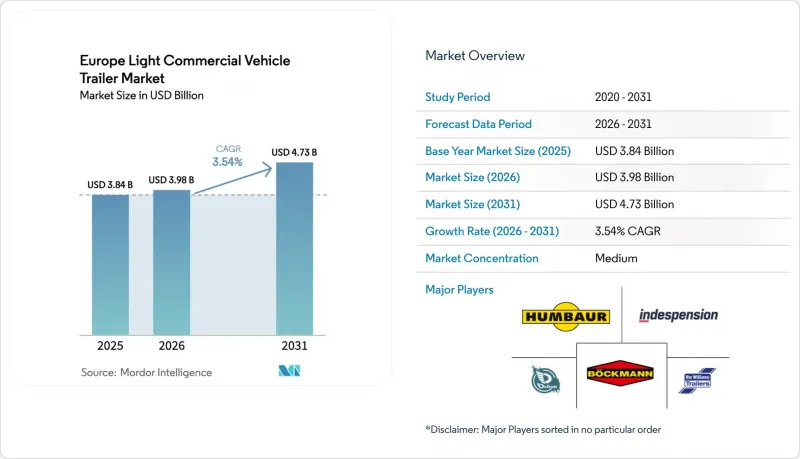
據 Mordor Intelligence 稱,2026 年歐洲輕型商用車拖車市值估計為 39.8 億美元,高於 2025 年的 38.4 億美元,預計到 2031 年將達到 47.3 億美元。
預計從 2026 年到 2031 年,其複合年成長率將達到 3.54%。
本報告按應用領域(廂型車、冷藏車、其他)、車輛總重(GVWR;3.5噸以下、7噸以上)、軸配置(單軸、其他)、所有權模式(車隊所有、其他)、終端用戶行業(小包裹與物流、建築與建材、其他)以及國家/地區進行細分。市場預測以美元計價。
歐洲輕型商用車掛車市場趨勢與洞察
電子商務導致小包裹數量激增
線上銷售的激增正在從根本上改變歐洲各地的配送路線密度和運輸模式。在小包裹配送網路中,移動性和快速裝卸能力如今比大載貨量更為重要,這促使車隊管理人員轉向更適合狹窄都市區走廊的簾式貨車和短廂式貨車。都會區內的微型倉配中心對能夠每天多次往返的小型貨車的需求日益成長。此外,營運商也越來越傾向於使用能夠簡化路線規劃和基於位置的維護的遠端資訊處理服務,這進一步增加了對數位化貨車平台的需求。
更嚴格的二氧化碳排放法規將促進輕質材料的應用。
歐盟第2019/1242號法規要求製造商在2019年的基礎上,2025年將車輛二氧化碳總排放量減少15%,2030年減少30%。為響應此法規,鋁製車身面板、高抗張強度鋼和複合材料面板的應用迅速成長,這些材料可使車輛重量減輕200-300公斤。儘管需求不斷成長,但由於鋁的生產者物價指數持續上漲,成本壓力仍然存在。此外,根據修訂後的歐洲通行費指令,車輛減重還能降低通行費,使得輕型拖車在材料成本飆升的情況下仍具有經濟吸引力。目前關於2040年將排放量減少90%的政策討論,進一步鞏固了輕量化結構在長期發展中的重要性。
鋁和鋼價格飆升
拖車製造商正面臨鋁價波動、利潤率下降以及採購難度日益加劇的困境。原物料成本上漲迫使製造商小幅提高標價。然而,小規模車隊營運商購買力下降限制了價格上漲的幅度,這給整個價值鏈都帶來了壓力。地緣政治因素,特別是歐洲對俄羅斯鋁的製裁,進一步加劇了供應緊張。為了應對這項挑戰,製造商正尋求簽訂長期合約並實現採購管道多元化,但卻帶來了更大的物流補償。
細分市場分析
乾貨廂式拖車仍佔據主導地位,預計到2025年將佔歐洲輕型商用車拖車市場佔有率的36.78%,主要負責從小包裹收集中心到工業中間商的普通貨物運輸。簾式拖車因其側面裝卸的多功能用途而備受歡迎,而平台式拖車和汽車運輸拖車則滿足了建築和汽車物流等特定領域的需求。冷藏拖車的高溢價能力抵消了其高昂的生產成本,使其成為擁有低溫運輸專業知識的製造商的利潤來源。
受藥品和生鮮食品需求激增的推動,預計到2031年,冷藏單元細分市場將以7.68%的複合年成長率成長,成為歐洲輕型商用車拖車市場中成長最快的細分市場。該細分市場受益於直銷生鮮平台和更嚴格的良好分銷規範(GDP)指南,這些指南要求進行溫度檢驗和即時追蹤。諸如Schmitz Cargoble的「S.Ko COOL」等新設計車型,將電池供電冷卻與太陽能充電功能相結合,體現了低溫運輸要求與電氣化需求的融合。
預計到2025年,重量在3.5噸及以下的車輛將佔歐洲輕型商用車拖車市場佔有率的51.85%,並在2031年之前以6.25%的複合年成長率成長。這反映了監管機構大力推動在堵塞收費區域使用更輕型車輛組合。這些拖車與電動貨車完美匹配,電動貨車的型式認證牽引限重很少超過1.6噸,從而降低了德國的MAUT里程收費。 3.5噸至7噸的中型拖車在負載容量和體積方面實現了良好的平衡,適合本地配送,而超過7噸的大型拖車則用於建築工地和跨境散貨運輸。
大都會圈零排放走廊的擴展進一步提升了重量低於3.5噸車輛的商業優勢。此外,許多歐盟成員國免除了輕型車輛組合的C類駕駛執照要求,使車隊營運商能夠享受更低的保險費和更簡化的駕照取得流程。製造商提供的模組化底盤允許在監管區域外使用時進行額定負載調整,從而提高了轉售的柔軟性。
其他好處:
- Excel格式的市場預測(ME)表
- 3個月的分析師支持
目錄
第1章:引言
- 研究假設和市場定義
- 調查範圍
第2章:調查方法
第3章執行摘要
第4章 市場狀況
- 市場概覽
- 市場促進因素
- 電子商務導致小包裹數量激增
- 更嚴格的二氧化碳排放標準正在促進輕質材料的採用。
- 都市區配送和通行法規有利於小型拖車。
- 隨著輕型商用車車隊的電氣化,輕型拖車解決方案的需求日益成長。
- 歐盟範圍內「微型履約」網路的快速成長
- 與OEM無關的遠端資訊處理訂閱和拖車商品搭售
- 市場限制因素
- 鋁和鋼的價格飆升
- 柴油價格波動導致車輛方面的資本投資減少。
- 供應鏈中斷和底盤供不應求
- 鉸接式輕型商用車的保險費正在上漲。
- 價值供應鏈分析
- 監理情勢
- 技術展望
- 波特五力分析
第5章 市場規模與成長預測
- 透過使用
- 窗簾
- 冷凍
- 乾燥箱
- 平板車/平台車
- 自動卸貨卡車
- 汽車運輸車
- 其他用途
- 按拖車總重量
- 3.5噸或以下
- 3.5~7 t
- 7噸或以上
- 按軸配置
- 單軸
- 雙軸
- 多軸
- 自有車型
- 車隊所有權
- 租賃/出租
- 由私人擁有/業主經營
- 按最終用戶行業分類
- 小包裹/物流
- 建材
- 食品/飲料
- 零售和快速消費品
- 農業/畜牧業
- 其他
- 國家
- 英國
- 德國
- 法國
- 義大利
- 西班牙
- 俄羅斯
- 瑞典
- 丹麥
- 愛沙尼亞
- 其他歐洲國家
第6章 競爭情勢
- 市場集中度
- 策略趨勢
- 市佔率分析
- 公司簡介
- Ifor Williams Trailers Ltd.
- Debon Trailers
- Trigano Remorques
- UNSINN Fahrzeugtechnik GmbH
- Eduards Trailer Factory
- Pongratz Trailer-Group GmbH
- Vezeko
- wm meyer Fahrzeugbau AG
- Gaupen-Henger AS
- Bockmann Fahrzeugwerke GmbH
- Indespension Ltd.
- Brian James Trailers
- Humbaur GmbH
- Anssems Trailers BV
- Erde SAS
- Brenderup Group
- Nugent Engineering
- Temared Sp. z oo
- Schmitz Cargobull(Light Division)
第7章 市場機會與未來展望
According to Mordor Intelligence, Europe light commercial vehicle trailer market size in 2026 is estimated at USD 3.98 billion, growing from 2025 value of USD 3.84 billion with 2031 projections showing USD 4.73 billion, growing at 3.54% CAGR over 2026-2031.
This report is Segmented by Application (Curtain, Refrigeration, and More), Trailer GVWR (Up To 3. 5t, and Above 7t), Axle Configuration (Single-Axle, and More), Ownership Model (Fleet-Owned, and More), End-User Industry (Parcel and Logistics, Construction and Building Materials, and More), and Country. The Market Forecasts are Provided in Terms of Value (USD).
Europe Light Commercial Vehicle Trailer Market Trends and Insights
E-Commerce Parcel-Volume Boom
Surging online sales radically reshape route density and shipment profiles across Europe. Parcel networks now value maneuverability and rapid load-unload capability more than bulk cubic capacity, so fleet managers shift toward curtain-sided and short dry-box formats that fit narrow urban corridors. Micro-fulfillment nodes inside metro areas drive demand for small trailers capable of multiple daily turns. Operators also favor telematics subscriptions that streamline route planning and location-based maintenance, reinforcing the need for digitally enabled trailer platforms.
Tightening CO2 standards driving lightweight materials
EU Regulation 2019/1242 obliges manufacturers to cut fleetwide CO2 emissions 15% by 2025 and 30% by 2030 against 2019 baselines. Compliance drives fast adoption of aluminum skins, high-tensile steels, and composite panels that shave 200-300 kg from typical curb weights. Aluminum producer price indices are increasing, sustaining cost pressure even as demand rises. Weight savings also cut toll charges under the revised Eurovignette directive, making lightweight trailers financially attractive despite higher material costs. Ongoing policy discussions to achieve a 90% emission reduction by 2040 further secure the long-run case for lightweight construction.
Soaring Aluminum and Steel Prices
Trailer manufacturers grapple with aluminum price swings, tightening margins, and complicating procurement. As raw material costs rise, producers have slightly hiked list prices. Yet, diminished purchasing power among smaller fleet operators curtails the extent of these price hikes, exerting pressure throughout the value chain. Geopolitical events, notably European sanctions on Russian aluminum, have heightened supply constraints. In response, manufacturers are pursuing long-term contracts and diversifying their sourcing, albeit at the cost of added logistical challenges.
Other drivers and restraints analyzed in the detailed report include:
- Urban Delivery-Access Regulations Favoring Small Trailers
- Electrification of LCV Fleets Requiring Lightweight Trailer Solutions
- Volatile Diesel Costs Reducing Fleet CAPEX
For complete list of drivers and restraints, kindly check the Table Of Contents.
Segment Analysis
Dry Box bodies retained their workhorse status, holding 36.78% of the Europe light commercial vehicle trailers market share in 2025 and serving general freight from parcel hubs to industrial intermediaries. Curtain-siders remain popular in multipurpose operations demanding side loading, whereas platform and car-carrier variants address niche needs tied to construction and automotive logistics. The premium pricing power of refrigerated trailers offsets higher production costs, making the sub-segment a profit pool for builders with cold-chain expertise.
Refrigeration units contributed the fastest expansion to the European light commercial vehicle trailers market, rising at a 7.68% CAGR through 2031 on the back of booming pharmaceutical and fresh-food demand. The segment benefits from direct-to-consumer grocery platforms and stricter Good Distribution Practice guidelines that specify temperature validation and real-time tracking. New designs such as Schmitz Cargobull's S.Ko COOL integrate battery-electric refrigeration and solar-assisted chargers, reflecting the convergence of cold-chain requirements with electrification imperatives.
Units up to 3.5 t commanded 51.85% of the Europe light commercial vehicle trailers market share in 2025 and are projected to grow at a 6.25% CAGR to 2031, reflecting the strong regulatory push for lighter combinations in congestion-charging zones. These trailers align perfectly with electric vans whose homologated towing limits rarely exceed 1.6 t, and they qualify for lower MAUT distance charges in Germany. Mid-weight trailers between 3.5-7 t maintain balanced payload and volume for regional deliveries, while heavy-duty models above 7 t serve construction and cross-border bulk freight.
Growing metropolitan zero-emission corridors intensify the business case for sub-3.5 t rigs. Fleets also appreciate lower insurance premiums and simpler driver licensing, since many EU states exempt lighter combinations from Class C qualification. Builders offer modular chassis that can be re-rated upward when used outside restricted zones, adding resale flexibility.
Complete Report Scope:
- By Application
- Curtain
- Refrigeration
- Dry Box
- Flat-bed / Platform
- Tippers
- Car Transporter
- Other Applications
- By Trailer GVWR
- Up to 3.5 t
- 3.5 - 7 t
- Above 7 t
- By Axle Configuration
- Single-axle
- Tandem-axle
- Multi-axle
- By Ownership Model
- Fleet-owned
- Leased / Rental
- Private / Owner-operator
- By End-user Industry
- Parcel and Logistics
- Construction and Building Materials
- Food and Beverage
- Retail and FMCG
- Agriculture and Livestock
- Others
- By Country
- United Kingdom
- Germany
- France
- Italy
- Spain
- Russia
- Sweden
- Denmark
- Estonia
- Rest of Europe
List of Companies Covered in this Report:
- Ifor Williams Trailers Ltd.
- Debon Trailers
- Trigano Remorques
- UNSINN Fahrzeugtechnik GmbH
- Eduards Trailer Factory
- Pongratz Trailer-Group GmbH
- Vezeko
- wm meyer Fahrzeugbau AG
- Gaupen-Henger AS
- Bockmann Fahrzeugwerke GmbH
- Indespension Ltd.
- Brian James Trailers
- Humbaur GmbH
- Anssems Trailers BV
- Erde SAS
- Brenderup Group
- Nugent Engineering
- Temared Sp. z o.o.
- Schmitz Cargobull (Light Division)
Additional Benefits:
- The market estimate (ME) sheet in Excel format
- 3 months of analyst support
TABLE OF CONTENTS
1 Introduction
- 1.1 Study Assumptions and Market Definition
- 1.2 Scope of the Study
2 Research Methodology
3 Executive Summary
4 Market Landscape
- 4.1 Market Overview
- 4.2 Market Drivers
- 4.2.1 E-Commerce Parcel-Volume Boom
- 4.2.2 Tightening CO2 Standards Driving Lightweight Materials
- 4.2.3 Urban Delivery-Access Regulations Favoring Small Trailers
- 4.2.4 Electrification of LCV Fleets Requiring Lightweight Trailer Solutions
- 4.2.5 Surge in Pan-EU "Micro-Fulfilment" Networks
- 4.2.6 OEM-Agnostic Telematics Subscriptions Bundling Trailers
- 4.3 Market Restraints
- 4.3.1 Soaring Aluminum and Steel Prices
- 4.3.2 Volatile Diesel Costs Reducing Fleet CAPEX
- 4.3.3 Supply-Chain Disruptions and Chassis Shortages
- 4.3.4 Rising Insurance Premiums for Articulated LCVs
- 4.4 Value / Supply-Chain Analysis
- 4.5 Regulatory Landscape
- 4.6 Technological Outlook
- 4.7 Porter's Five Forces Analysis
- 4.7.1 Threat of New Entrants
- 4.7.1.1 Bargaining Power of Buyers
- 4.7.1.2 Bargaining Power of Suppliers
- 4.7.1.3 Threat of Substitutes
- 4.7.1.4 Intensity of Competitive Rivalry
- 4.7.1 Threat of New Entrants
5 Market Size and Growth Forecasts (Value (USD))
- 5.1 By Application
- 5.1.1 Curtain
- 5.1.2 Refrigeration
- 5.1.3 Dry Box
- 5.1.4 Flat-bed / Platform
- 5.1.5 Tippers
- 5.1.6 Car Transporter
- 5.1.7 Other Applications
- 5.2 By Trailer GVWR
- 5.2.1 Up to 3.5 t
- 5.2.2 3.5 - 7 t
- 5.2.3 Above 7 t
- 5.3 By Axle Configuration
- 5.3.1 Single-axle
- 5.3.2 Tandem-axle
- 5.3.3 Multi-axle
- 5.4 By Ownership Model
- 5.4.1 Fleet-owned
- 5.4.2 Leased / Rental
- 5.4.3 Private / Owner-operator
- 5.5 By End-user Industry
- 5.5.1 Parcel and Logistics
- 5.5.2 Construction and Building Materials
- 5.5.3 Food and Beverage
- 5.5.4 Retail and FMCG
- 5.5.5 Agriculture and Livestock
- 5.5.6 Others
- 5.6 By Country
- 5.6.1 United Kingdom
- 5.6.2 Germany
- 5.6.3 France
- 5.6.4 Italy
- 5.6.5 Spain
- 5.6.6 Russia
- 5.6.7 Sweden
- 5.6.8 Denmark
- 5.6.9 Estonia
- 5.6.10 Rest of Europe
6 Competitive Landscape
- 6.1 Market Concentration
- 6.2 Strategic Moves
- 6.3 Market Share Analysis
- 6.4 Company Profiles (Includes Global level Overview, Market level overview, Core Segments, Financials as available, Strategic Information, Market Rank/Share for key companies, Products and Services, and Recent Developments)
- 6.4.1 Ifor Williams Trailers Ltd.
- 6.4.2 Debon Trailers
- 6.4.3 Trigano Remorques
- 6.4.4 UNSINN Fahrzeugtechnik GmbH
- 6.4.5 Eduards Trailer Factory
- 6.4.6 Pongratz Trailer-Group GmbH
- 6.4.7 Vezeko
- 6.4.8 wm meyer Fahrzeugbau AG
- 6.4.9 Gaupen-Henger AS
- 6.4.10 Bockmann Fahrzeugwerke GmbH
- 6.4.11 Indespension Ltd.
- 6.4.12 Brian James Trailers
- 6.4.13 Humbaur GmbH
- 6.4.14 Anssems Trailers BV
- 6.4.15 Erde SAS
- 6.4.16 Brenderup Group
- 6.4.17 Nugent Engineering
- 6.4.18 Temared Sp. z o.o.
- 6.4.19 Schmitz Cargobull (Light Division)
7 Market Opportunities and Future Outlook

 馬來西亞拖車市場:市場佔有率分析、產業趨勢與統計、成長預測(2026-2031)
 低平板拖車(LBT)市場規模:按產品類型、應用、地區和預測分類
 汽車拖車牽引桿市場規模、佔有率和成長分析:按結構類型、牽引能力、車輛應用、銷售管道和地區分類-2026-2033年產業預測
 2026年全球拖車裙板提升輔助設備市場報告
 拖車輔助系統市場:按組件、車輛類型、應用、最終用戶和銷售管道分類-2026-2032年全球市場預測汽車拖車市場:2026-2032年全球市場預測(按拖車類型、載重能力、材質、車軸類型、銷售管道和應用分類)
 汽車拖車牽引桿市場分析與預測(至2035年):類型、產品類型、服務、技術、組件、應用、材料類型、最終用戶、功能、安裝配置牲畜運輸拖車市場分析及預測(至2035年):類型、產品、技術、組件、應用、材質、最終用戶、功能、安裝類型、服務全球汽車拖車市場規模、佔有率、趨勢和成長分析報告(2026-2034)
 拖車輔助系統市場機會、成長要素、產業趨勢分析及2026-2035年預測