


 |
市場調查報告書
商品編碼
2119852
美國第四方物流:市場佔有率分析、產業趨勢與統計、成長預測(2026-2031)United States Fourth-Party Logistics (4PL) - Market Share Analysis, Industry Trends & Statistics, Growth Forecasts (2026 - 2031) |
||||||

※ 本網頁內容可能與最新版本有所差異。詳細情況請與我們聯繫。
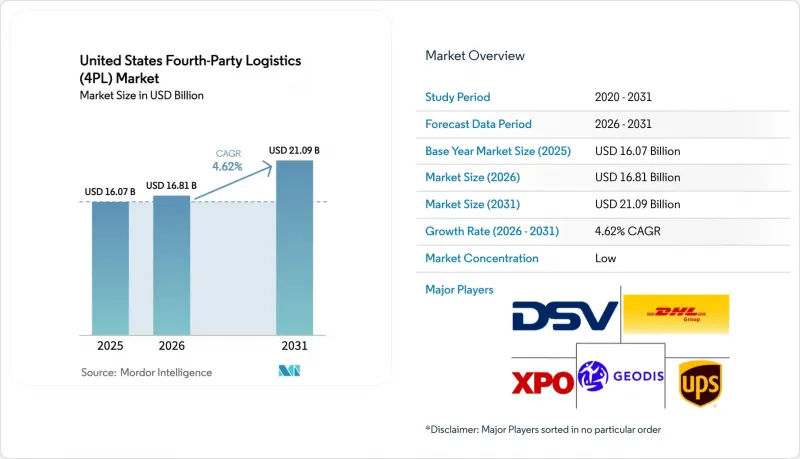
根據 Mordor Intelligence 的數據,2025 年美國 4PL 市值為 160.7 億美元,預計到 2031 年將達到 210.9 億美元,而 2026 年為 168.1 億美元,預測期(2026-2031 年)的複合成長率為 4.62%。
本報告按商業模式(主導物流供應商 (LLP)、解決方案整合商、數位化平台 4PL)、終端用戶產業(快速消費品、零售和電子商務、時尚與生活方式、科技與電子、冷凍與製藥、汽車與旅遊、工業製造、其他)以及美國地區進行細分。市場預測以貨幣價值(美元)表示。
美國第四方物流市場的趨勢與洞察
全通路供應鏈日益複雜
零售商部署全通路策略需要同時同步門市、線上和電商平台的庫存,這帶來的協調需求超出了傳統第三方物流 (3PL) 的能力範圍。沃爾瑪的 AI 驅動網路展示如何利用即時需求感知、動態路線規劃和預測性補貨來減少缺貨,同時保持較低的安全庫存。亞馬遜的入境交叉轉運設施則體現了其致力於建立可擴展的整合式履約網路所需基礎設施的決心。這種複雜性凸顯了利用機器學習進行庫存佈局和訂單調整的數位化平台第四方物流 (4PL) 供應商的重要性。儘管法律規範仍然較為寬鬆,但新興的資料隱私法規可能會限制 4PL 如何整合跨通路的消費者洞察。總而言之,全通路的成長正在鞏固對全國性控制塔解決方案的結構性需求,這些解決方案能夠同時最佳化運輸、勞動力和庫存。
領先的物流供應商(LLP)正擴大採用成本降低模式。
由於通貨膨脹和供應鏈中斷,物流成本管理已成為董事會層面的首要任務。將分散的第三方物流 (3PL) 合約整合為單一主導的物流供應商 (LLP) 契約,可立即實現規模經濟並降低供應商管理成本。一家美國製造商透過採用 LLP 框架,節省了 2.6 億美元的物流成本,並將運輸成本降低了 15%。此外,由於由資產規模最小的供應商承擔運費波動風險,公司資產負債表上的營運資金和運能風險得以消除。雖然汽車和耐用消費品行業的製造商率先採用了 LLP,但如今,LLP 作為一種應對不可預測的運輸運力市場的戰略對沖手段,也開始受到服務業的關注。對於那些因各州勞動法和安全法規差異而苦惱的跨州公司而言,集中化的合規管理更具吸引力。
網路安全和資料所有權問題
供應鏈數位化正在造成嚴重的網路安全漏洞,限制第四方物流(4PL)的普及,尤其是在監管嚴格的產業。世界經濟論壇的報告顯示,54%的大型企業認為其供應鏈是網路韌性的主要障礙,而2024年全球IT系統故障暴露了關鍵的第三方依賴關係。由於4PL供應商無法直接監管其網路中的眾多供應商,因此面臨獨特的挑戰,這造成了潛在的攻擊管道,而傳統的風險管理方法難以有效應對。 2023年7月至2024年7月期間,物流業發生了27起網路安全事件,預計2024年至2037年物流業的網路安全市場將以12%的複合年成長率成長,達到366億美元。由於4PL供應商會匯總來自多個客戶的信息,因此數據所有權問題尤其嚴重,這可能導致專有商業智慧方面的衝突。
細分市場分析
到2025年,主導物流供應商(LLP)將佔據4PL市場42.35%的佔有率。這反映了企業透過與單一供應商建立合作關係來實現全面供應鏈管理的趨勢,而這種合作關係能夠降低複雜性並增強課責。 LLP模式的優點在於,它能夠將營運風險轉移給擁有更深厚物流專業知識的專業供應商,同時透過規模經濟實現成本協同效應。解決方案整合商模式則介於兩者之間,專注於多個物流供應商之間的技術驅動型協調,但不承擔直接的營運責任。數位平台4PL正在崛起為成長最快的細分市場,預計到2031年將維持4.96%的年複合成長率(CAGR),這主要得益於企業對人工智慧驅動的可視性和自主決策能力的需求,而這些能力是傳統模式無法提供的。
數位平台型第四方物流 (4PL) 領域的加速成長反映了 4PL 市場向資料驅動型供應鏈編配的演變,即時分析和預測建模不再只是營運上的錦上添花,而是競爭優勢的關鍵所在。 Blue Yonder 的「網路營運代理」展示了人工智慧代理如何透過預測到達時間、對貨物叢集以及最大化資源利用率,在無需人工干預的情況下自主管理物流運營。隨著純粹的協調功能透過自動化日益商品化,解決方案整合商模式越來越需要透過專業的產業知識和地理覆蓋來實現差異化。監管環境有利於那些能夠在決策流程中展現透明度和可審計性的平台模式,尤其是在資料隱私和演算法課責要求不斷演變的情況下。
其他好處
- Excel格式的市場預測(ME)表
- 3個月的分析師支持
目錄
第1章:引言
- 研究假設和市場定義
- 調查範圍
第2章:調查方法
第3章執行摘要
第4章 市場狀況
- 市場概覽
- 市場促進因素
- 全通路供應鏈日益複雜
- 領先的物流供應商(LLP)正擴大採用成本降低模式。
- 電子商務推動了對全國控制塔進行編配的需求。
- 整合控制塔IT平台(AI/IoT)如今已成為一項基本要求。
- 近岸外包浪潮迫使國內網路重新設計。
- 運費波動正促使托運人轉向輕資產風險轉移模式。
- 市場限制因素
- 網路安全和資料所有權問題
- 實施成本高且變更管理負擔沉重。
- 供應鏈資料科學人員短缺(一個被忽視的問題)
- 與現有主要第三方物流公司的通路競爭(一個被忽視的問題)
- 價值供應鏈分析
- 監理情勢
- 技術展望
- 波特五力分析
- 新冠疫情的影響及疫情後重建
- 通貨膨脹票價週期和離岸外包的影響
第5章 市場規模及成長預測(價值,10億美元)
- 按商業模式
- 首席物流供應商(LLP)
- 解決方案整合商
- 數位平台 4PL
- 按最終用戶行業分類
- FMCG
- 零售與電子商務
- 時尚與生活風格
- 技術與電子
- 冷藏貨物和藥品
- 汽車與出行
- 工業製造
- 其他
- 美國地區登機
- 東北
- 中西部
- 南部
- 西
第6章 競爭情勢
- 市場集中度
- 策略趨勢
- 市佔率分析
- 公司簡介
- United Parcel Service, Inc.
- DSV
- Geodis
- XPO Inc.
- DHL Supply Chain
- CH Robinson
- Kuehne+Nagel
- FedEx
- Ryder Supply Chain Solutions
- Penske Logistics
- CEVA Logistics
- Rhenus Group
- Logistics Plus
- Allyn International Services
- Covenant Logistics Group
- Redwood Logistics
- Odyssey
- Yusen Logistics
- 4PL Central Station Group
- Toll Group
第7章 市場機會與未來展望
According to Mordor Intelligence, the United States fourth-Party logistics market size was valued at USD 16.07 billion in 2025 and estimated to grow from USD 16.81 billion in 2026 to reach USD 21.09 billion by 2031, at a CAGR of 4.62% during the forecast period (2026-2031).
This report is Segmented by Operating Model (Lead Logistics Provider, Solution Integrator, Digital Platform 4PL), End-User Industry (FMCG, Retail & E-Commerce, Fashion & Lifestyle, Technology & Electronics, Refrigerated & Pharma, Automotive & Mobility, Industrial Manufacturing, Others), and Geography. The Market Forecasts are Provided in Terms of Value (USD).
United States Fourth-Party Logistics (4PL) Market Trends and Insights
Rising Complexity of Omnichannel Supply Chains
Retailers deploying omnichannel strategies must synchronize store, online, and marketplace inventory simultaneously, creating orchestration requirements beyond traditional 3PL capabilities. Walmart's AI-driven network shows how real-time demand sensing, dynamic routing, and predictive replenishment cut stock-outs while maintaining low safety inventory. Amazon's inbound cross-dock facilities illustrate infrastructure commitments needed to scale unified fulfillment networks. Such complexity elevates digital platform 4PL providers that leverage machine learning for inventory placement and order orchestration. Regulatory frameworks remain permissive, yet emerging data-privacy statutes may constrain how 4PLs aggregate shopper insights across channels. Overall, omnichannel growth locks in structural demand for nationwide control-tower solutions that optimize transport, labor, and inventory concurrently.
Increasing Adoption of Lead-Logistics-Provider Cost-Out Models
Inflation and supply-chain disruption make logistics cost control a board-level priority. Consolidating disparate 3PL contracts under a single LLP generates immediate scale efficiencies and reduces vendor-management overhead. A U.S. manufacturer documented USD 260 million in logistics savings and a 15% cut in transportation spend by embracing an LLP framework. Asset-light providers also shoulder freight-rate volatility, shifting working-capital and capacity risks off corporate balance sheets. Manufacturing firms in automotive and durable goods are leading adopters, but services sectors now view LLPs as strategic hedges against unpredictable capacity markets. Centralized compliance management further appeals to multistate operators wrestling with fragmented labor and safety rules.
Cyber-security and Data-ownership Concerns
Supply chain digitization creates significant cybersecurity vulnerabilities that constrain fourth party logistics adoption, especially in regulated industries. The World Economic Forum reports 54% of large organizations cite supply chains as major barriers to cyber resilience, with the 2024 global IT outage exposing critical third-party dependencies. Fourth-party logistics providers face unique challenges because they operate without direct oversight of many vendors in their networks, creating potential attack vectors that traditional risk management approaches cannot adequately address. The logistics sector experienced 27 cyber incidents between July 2023 and July 2024, with the cybersecurity market in logistics projected to grow at 12% CAGR from 2024 to 2037, reaching USD 36.6 billion. Data ownership concerns become particularly acute when 4PL providers aggregate information across multiple clients, creating potential conflicts over proprietary business intelligence.
Other drivers and restraints analyzed in the detailed report include:
- E-commerce-Driven Demand for Nationwide Control-Tower Orchestration
- Integrated Control-Tower IT Platforms (AI/IoT) Become Table-Stakes
- High Implementation Cost and Change-Management Burden
For complete list of drivers and restraints, kindly check the Table Of Contents.
Segment Analysis
Lead Logistics Provider (LLP) commanded 42.35% of the fourth party logistics market size in 2025, reflecting enterprises' preference for comprehensive supply chain management through single-provider relationships that reduce complexity and enhance accountability. The LLP model's dominance stems from its ability to deliver cost synergies through economies of scale while transferring operational risk to specialized providers with deeper logistics expertise. Solution Integrator models occupy the middle ground, focusing on technology-enabled coordination across multiple logistics providers without assuming direct operational responsibility. Digital Platform 4PL emerges as the fastest-growing segment at 4.96% CAGR through 2031, driven by enterprises seeking AI-powered visibility and autonomous decision-making capabilities that traditional models cannot deliver.
The Digital Platform 4PL segment's growth acceleration reflects the fourth party logistics market evolution toward data-driven supply chain orchestration, where real-time analytics and predictive modeling become competitive differentiators rather than operational luxuries. Blue Yonder's Network Ops Agent demonstrates how AI agents can autonomously manage logistics operations, predicting arrival times, clustering shipments, and maximizing resource utilization without human intervention. Solution Integrator models face increasing pressure to differentiate through specialized industry expertise or geographic coverage, as pure coordination functions become commoditized through automation. The regulatory landscape favors platform models that can demonstrate transparency and auditability in their decision-making processes, particularly as data privacy and algorithmic accountability requirements evolve.
Complete Report Scope:
- By Operating Model
- Lead Logistics Provider (LLP)
- Solution Integrator
- Digital Platform 4PL
- By End-User Industry
- FMCG
- Retail and E-commerce
- Fashion and Lifestyle
- Technology and Electronics
- Refrigerated and Pharma
- Automotive and Mobility
- Industrial Manufacturing
- Others
- By US Region
- Northeast
- Midwest
- South
- West
List of Companies Covered in this Report:
- United Parcel Service, Inc.
- DSV
- Geodis
- XPO Inc.
- DHL Supply Chain
- C.H. Robinson
- Kuehne + Nagel
- FedEx
- Ryder Supply Chain Solutions
- Penske Logistics
- CEVA Logistics
- Rhenus Group
- Logistics Plus
- Allyn International Services
- Covenant Logistics Group
- Redwood Logistics
- Odyssey
- Yusen Logistics
- 4PL Central Station Group
- Toll Group
Additional Benefits:
- The market estimate (ME) sheet in Excel format
- 3 months of analyst support
TABLE OF CONTENTS
1 Introduction
- 1.1 Study Assumptions and Market Definition
- 1.2 Scope of the Study
2 Research Methodology
3 Executive Summary
4 Market Landscape
- 4.1 Market Overview
- 4.2 Market Drivers
- 4.2.1 Rising complexity of omnichannel supply chains
- 4.2.2 Increasing adoption of Lead-Logistics-Provider cost-out models
- 4.2.3 E-commerce-driven demand for nationwide control-tower orchestration
- 4.2.4 Integrated control-tower IT platforms (AI/IoT) become table-stakes
- 4.2.5 Near-shoring wave requires domestic network re-design
- 4.2.6 Freight-rate volatility pushes shippers toward asset-light risk transfer
- 4.3 Market Restraints
- 4.3.1 Cyber-security and data-ownership concerns
- 4.3.2 High implementation cost and change-management burden
- 4.3.3 Scarcity of supply-chain data-science talent for control towers (under-radar)
- 4.3.4 Channel conflict with large incumbent 3PLs (under-radar)
- 4.4 Value / Supply-Chain Analysis
- 4.5 Regulatory Landscape
- 4.6 Technological Outlook
- 4.7 Porter's Five Forces Analysis
- 4.7.1 Threat of New Entrants
- 4.7.2 Bargaining Power of Buyers
- 4.7.3 Bargaining Power of Suppliers
- 4.7.4 Threat of Substitutes
- 4.7.5 Competitive Rivalry
- 4.8 Impact of COVID-19 and Post-Pandemic Reset
- 4.9 Impact of Inflationary Freight Cycles and Near-shoring
5 Market Size and Growth Forecasts (Value, USD Bn)
- 5.1 By Operating Model
- 5.1.1 Lead Logistics Provider (LLP)
- 5.1.2 Solution Integrator
- 5.1.3 Digital Platform 4PL
- 5.2 By End-User Industry
- 5.2.1 FMCG
- 5.2.2 Retail and E-commerce
- 5.2.3 Fashion and Lifestyle
- 5.2.4 Technology and Electronics
- 5.2.5 Refrigerated and Pharma
- 5.2.6 Automotive and Mobility
- 5.2.7 Industrial Manufacturing
- 5.2.8 Others
- 5.3 By US Region
- 5.3.1 Northeast
- 5.3.2 Midwest
- 5.3.3 South
- 5.3.4 West
6 Competitive Landscape
- 6.1 Market Concentration
- 6.2 Strategic Moves
- 6.3 Market Share Analysis
- 6.4 Company Profiles (includes Global-level Overview, Market-level Overview, Core Segments, Financials as available, Strategic Information, Market Rank/Share, Products and Services, Recent Developments)
- 6.4.1 United Parcel Service, Inc.
- 6.4.2 DSV
- 6.4.3 Geodis
- 6.4.4 XPO Inc.
- 6.4.5 DHL Supply Chain
- 6.4.6 C.H. Robinson
- 6.4.7 Kuehne + Nagel
- 6.4.8 FedEx
- 6.4.9 Ryder Supply Chain Solutions
- 6.4.10 Penske Logistics
- 6.4.11 CEVA Logistics
- 6.4.12 Rhenus Group
- 6.4.13 Logistics Plus
- 6.4.14 Allyn International Services
- 6.4.15 Covenant Logistics Group
- 6.4.16 Redwood Logistics
- 6.4.17 Odyssey
- 6.4.18 Yusen Logistics
- 6.4.19 4PL Central Station Group
- 6.4.20 Toll Group
7 Market Opportunities and Future Outlook
- 7.1 White-space and Unmet-need Assessment

 對 2035 年前的 4PL(物流)市場進行分析和預測:按類型、服務、技術、組件、應用、流程、部署、最終用戶和解決方案分類。
 第四方物流 (4PL) 市場機會、成長要素、產業趨勢分析及 2026-2035 年預測
 2026年全球多模態物流市場報告2026年全球第四方物流(4PL)市場報告
 物流市場:依服務類型、合約類型、營運能力、產業和組織規模分類-2026-2032年全球預測
 4PL(Fourth Party Logistics)的美國市場:依類型、最終用戶、模式、地區、機會及預測,2018-2032
 第四方物流市場-全球產業規模、佔有率、趨勢、機會和預測(按模式、類型、應用、地區和競爭細分,2020-2030 年)
 拉丁美洲 4PL(第四方物流)-市場佔有率分析、行業趨勢和統計、成長預測(2025-2030 年)4PL (第四方物流) 市場評估:類型·終端用戶·方式·各地各國的機會及預測 (2017-2031年)印度的4PL(第四方物流)市場:各類型,各終端用戶,模式別,各地區,機會,預測,2018年~2032年