


 |
市場調查報告書
商品編碼
2119771
中東工業氣體:市場佔有率分析、產業趨勢與統計及成長預測(2026-2031 年)Middle-East Industrial Gases - Market Share Analysis, Industry Trends & Statistics, Growth Forecasts (2026 - 2031) |
||||||

※ 本網頁內容可能與最新版本有所差異。詳細情況請與我們聯繫。
根據 Mordor Intelligence 預測,中東工業氣體市場規模將從 2025 年的 5,717 萬噸成長到 2026 年的 5,909 萬噸,到 2031 年將達到 6,968 萬噸,2026 年至 2031 年的複合年成長率為 3.36%。
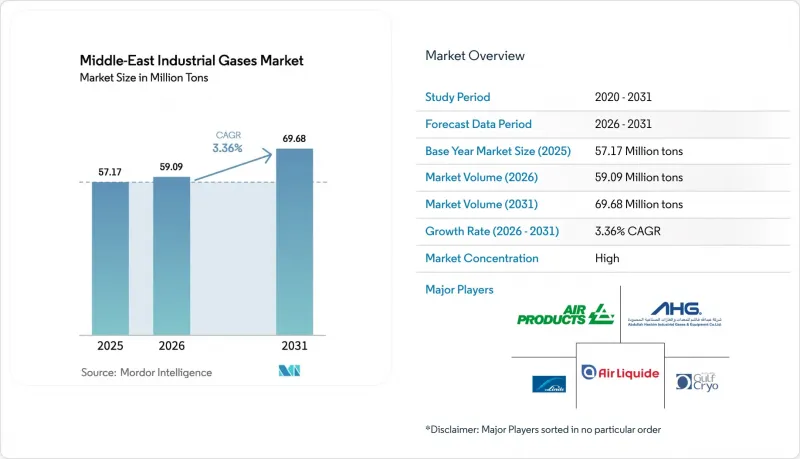
本報告按產品類型(氮氣、氧氣、二氧化碳等)、終端用戶產業(化學加工和精煉、電子和半導體、食品和飲料加工等)以及地區(沙烏地阿拉伯、阿拉伯聯合大公國等)進行細分。市場預測以數量(噸)為單位。
中東工業氣體市場趨勢與洞察
上游和中游油氣作業需求激增
生產技術的進步、酸性氣體處理以及新建液化天然氣(LNG)工廠的運作,正推動高純度氮氣、氫氣和二氧化碳(CO₂)需求的成長。沙烏地阿美和阿布達比國家石油公司(ADNOC)正在增建分離裝置,用於注入氮氣以維持壓力,並為加氫裂化提供氫氣,使每桶原油的天然氣用量加倍。預計到2030年,卡達原油產量將達2,440億立方米,工業氣體需求將額外增加830億立方米,增幅達57%。哈伊勒和加薩等海上計畫每年需要捕捉150萬噸二氧化碳,因而帶動了煉油設備需求的成長。因此,上游領域的持續活躍正輻射到整個價值鏈的現場供應合約中。
擴大區域石化和煉油資本投資計劃
沙烏地阿拉伯耗資110億美元的阿米拉爾綜合體等項目整合了煉油和化學產業,導致單位原料的天然氣需求增加。該綜合體計劃年產165萬噸乙烯,需要大量的氮氣用於惰性,氧氣用於氧化,以及氫氣用於加氫處理。新建設正將生產重心轉向特種聚合物,而特種聚合物的生產需要超高純度氣體進行混合和品管。這些工廠內安裝的碳捕集模組增加了對煉油和壓縮設備的需求,需要在實現環保目標的同時提高營運效率。
更嚴格的環境、健康與安全法規與合規成本
區域性法律正逐步與國際標準接軌,要求進行詳細的環境影響評估並制定更嚴格的燃燒限制。阿拉伯聯合大公國聯邦第24號法律強制要求在從生產到處置的整個生命週期內進行排放報告,衛星影像顯示監管機構正在嚴厲打擊非法排放。英國廣播公司(BBC)的一項調查揭露了沿岸地區多家設施上空瀰漫著有毒煙霧,這加速了封閉式燃燒和高效捕集系統的應用。為滿足99%或更高的二氧化碳純度儲存要求,小規模供應商的資本和營運成本不斷增加,促使擁有完善合規體系的公司進行整合。
細分市場分析
2025年,氧氣在中東工業氣體市場佔比達28.74%,主要受鋼鐵製造商、石化企業和鋁提煉的需求驅動。預計到2031年,氮氣將以4.44%的複合年成長率成為成長最快的氣體,這主要得益於食品包裝、電子焊接以及石油開採中惰性應用領域氮氣需求的不斷成長。二氧化碳的出貨量成長主要歸功於提高採收率(EOR)和飲料碳酸化技術的應用,而氫氣的需求則受益於煉油廠設備的升級改造和電力燃料需求的成長。氬氣用於支援大型專案的焊接作業,而氦氣的需求則主要來自磁振造影(MRI)和半導體光刻技術。液化空氣集團在卡達建造的氦氣液化工廠旨在緩解長期存在的供不應求。林德集團強調,已轉向分散式生產模式,並透過2024年運作59座小規模現場製氮製氧裝置來加強與客戶的合作。
該領域的演變反映了市場需求從以銷售主導的通用氣體供應轉向以純度主導的特種氣體需求。建築、能源和消費品產業推動了氧氣和二氧化碳的銷售,而無污染燃料、電子產品和包裝食品產業則促進了氮氣和氫氣的成長。在中東工業氣體市場,能夠為終端用戶提供穩定供應和成本保障的現場供應模式正在不斷發展壯大。
其他好處:
- Excel格式的市場預測(ME)表
- 3個月的分析師支持
目錄
第1章:引言
- 研究假設和市場定義
- 調查範圍
第2章:調查方法
第3章執行摘要
第4章 市場狀況
- 市場概覽
- 市場促進因素
- 上游和中游油氣作業需求激增
- 擴大區域石化和煉油廠資本投資計劃
- 醫療基礎設施(醫用氣體)的發展正在加速。
- 政府支持的綠色氫能大型企劃興起
- 被稱為「超級工程」(例如 NEOM)的大規模建設項目正在推高對焊接和切割氣體的需求。
- 市場限制因素
- 加強環境、健康與安全 (EH&S) 法規及合規成本
- 原油價格波動抑制了新的工業投資。
- 該地區缺乏二氧化碳捕獲和淨化基礎設施
- 價值鏈分析
- 波特五力分析
第5章 市場規模與成長預測
- 依產品類型
- 氮
- 氧
- 二氧化碳
- 氫
- 氦
- 氬氣
- 氨
- 甲烷
- 丙烷
- 丁烷
- 其他產品類型(氟、氧化亞氮、氖、氙)
- 按最終用戶行業分類
- 化學處理與提純
- 電子和半導體
- 食品/飲料加工
- 石油和天然氣
- 金屬生產和加工
- 醫療和製藥
- 汽車和運輸業
- 能源和發電
- 其他產業(航太、用水和污水處理)
- 按地區
- 沙烏地阿拉伯
- 阿拉伯聯合大公國
- 卡達
- 科威特
- 以色列
- 其他中東國家
第6章 競爭情勢
- 市場集中度
- 策略性舉措(併購、合資、合作)
- 市佔率分析
- 公司簡介
- AHG
- Air Liquide
- Air Products and Chemicals Inc.
- BASF
- Buzwair Industrial Gases Factories
- Dubai Industrial Gases
- EIG
- Gulf Cryo
- Iwatani Corporation
- Linde PLC
- Messer SE & Co. KGaA
- PURE GAS SUPPLY LLC
- SABIC
- Sipchem Company
第7章 市場機會與未來展望
According to Mordor Intelligence, the Middle-East industrial gases market size is expected to grow from 57.17 Million tons in 2025 to 59.09 Million tons in 2026 and is forecast to reach 69.68 Million tons by 2031 at 3.36% CAGR over 2026-2031.
This report is Segmented by Product Type (Nitrogen, Oxygen, Carbon Dioxide, and More), End-User Industry (Chemical Processing and Refining, Electronics and Semiconductor, Food and Beverage Processing, and More), and Geography (Saudi Arabia, United Arab Emirates, and More). The Market Forecasts are Provided in Terms of Volume (Tons).
Middle-East Industrial Gases Market Trends and Insights
Surging Demand from Upstream and Mid-Stream Oil and Gas Operations
Enhanced recovery, sour-gas treatment, and new LNG trains are lifting usage of high-purity nitrogen, hydrogen, and CO2. Saudi Aramco and ADNOC add separation plants that inject nitrogen for pressure maintenance and hydrogen for hydrocracking, multiplying gas intensity per barrel processed. Qatar expects output to reach 244 billion m3 by 2030 with an extra 83 billion m3 of industrial gas needs, equal to 57% of forecast growth. Offshore projects such as Hail and Ghasha require 1.5 million t of captured CO2 each year, sharpening demand for purification units. Continuous upstream activities therefore cascade into on-site supply contracts across the value chain.
Expanding Regional Petrochemicals and Refinery CAPEX Pipeline
Projects like the USD 11 billion Amiral complex in Saudi Arabia integrate refining with chemicals, lifting gas demand per feedstock unit. The complex targets 1.65 million t of ethylene annually, calling for large volumes of nitrogen for inerting, oxygen for oxidation, and hydrogen for hydrotreating. New builds move product slates toward specialty polymers, which need ultra-high purity gases in compounding and quality control. Carbon capture modules inside these plants raise the call for purification and compression equipment, aligning environmental targets with operational efficiency.
Tightening EH&S Regulations and Compliance Costs
Regional laws are aligning with international benchmarks, requiring detailed environmental impact reviews and strict flaring limits. The UAE's Federal Law 24 mandates cradle-to-grave emission reporting, and satellite imagery shows regulators increasing enforcement against illegal venting. BBC investigations uncovered toxic plumes over several Gulf facilities, prompting faster adoption of sealed combustion and high-efficiency capture systems. Meeting >99% CO2 purity for storage elevates capital and operating costs for small suppliers, encouraging consolidation among firms with robust compliance infrastructure.
Other drivers and restraints analyzed in the detailed report include:
- Accelerated Build-Out of Healthcare Infrastructure (Medical Gases)
- Rise of Government-Backed Green-Hydrogen Mega-Projects
- Crude-Oil Price Volatility Curbing New Industrial Investments
For complete list of drivers and restraints, kindly check the Table Of Contents.
Segment Analysis
Oxygen accounted for 28.74% of Middle-East industrial gases market share in 2025, driven by steel mills, petrochemicals, and aluminum smelting. Nitrogen is set to grow fastest at a 4.44% CAGR to 2031 on expanded use in food packaging, electronics soldering, and inerting for oil recovery. Carbon dioxide volumes rise with enhanced oil recovery and beverage carbonation, while hydrogen sees tailwinds from refinery upgrades and electro-fuels. Argon supports welding during giga-project construction, and helium demand stems from MRI and semiconductor lithography. Air Liquide's helium liquefaction build in Qatar aims to ease chronic shortages. Linde commissioned 59 small on-site nitrogen and oxygen plants in 2024, highlighting a shift toward distributed production that tightens customer integration.
The segment's evolution shows a pivot from volume-driven commodity supply to purity-driven specialty demand. Construction, energy, and consumer goods shape oxygen and carbon dioxide sales, while clean fuels, electronics, and packaged food tilt growth toward nitrogen and hydrogen. The Middle-East industrial gases market continues to deepen on-site models that provide steady offtake and cost certainty for end users.
Complete Report Scope:
- By Product Type
- Nitrogen
- Oxygen
- Carbon Dioxide
- Hydrogen
- Helium
- Argon
- Ammonia
- Methane
- Propane
- Butane
- Other Product Types (Fluorine, Nitrous Oxide, Neon, Xenon)
- By End-User Industry
- Chemical Processing and Refining
- Electronics and Semiconductor
- Food and Beverage Processing
- Oil and Gas
- Metal Production and Fabrication
- Medical and Pharmaceutical
- Automotive and Transportation
- Energy and Power Generation
- Other Industries (Aerospace and Water and Waste Water Treatment)
- By Geography
- Saudi Arabia
- United Arab Emirates
- Qatar
- Kuwait
- Israel
- Rest of Middle East
List of Companies Covered in this Report:
- AHG
- Air Liquide
- Air Products and Chemicals Inc.
- BASF
- Buzwair Industrial Gases Factories
- Dubai Industrial Gases
- EIG
- Gulf Cryo
- Iwatani Corporation
- Linde PLC
- Messer SE & Co. KGaA
- PURE GAS SUPPLY LLC
- SABIC
- Sipchem Company
Additional Benefits:
- The market estimate (ME) sheet in Excel format
- 3 months of analyst support
TABLE OF CONTENTS
1 Introduction
- 1.1 Study Assumptions & Market Definition
- 1.2 Scope of the Study
2 Research Methodology
3 Executive Summary
4 Market Landscape
- 4.1 Market Overview
- 4.2 Market Drivers
- 4.2.1 Surging demand from upstream & mid-stream oil-and-gas operations
- 4.2.2 Expanding regional petrochemicals and refinery CAPEX pipeline
- 4.2.3 Accelerated build-out of healthcare infrastructure (medical gases)
- 4.2.4 Rise of government-backed green-hydrogen mega-projects
- 4.2.5 Large construction "giga-projects" (e.g., NEOM) boosting welding & cutting gases
- 4.3 Market Restraints
- 4.3.1 Tightening EH&S regulations and compliance costs
- 4.3.2 Crude-oil price volatility curbing new industrial investments
- 4.3.3 Scarce regional CO2-capture & purification infrastructure
- 4.4 Value Chain Analysis
- 4.5 Porter's Five Forces Analysis
- 4.5.1 Bargaining Power of Suppliers
- 4.5.2 Bargaining Power of Buyers
- 4.5.3 Threat of New Entrants
- 4.5.4 Threat of Substitute Products & Services
- 4.5.5 Degree of Competition
5 Market Size & Growth Forecasts (Volume)
- 5.1 By Product Type
- 5.1.1 Nitrogen
- 5.1.2 Oxygen
- 5.1.3 Carbon Dioxide
- 5.1.4 Hydrogen
- 5.1.5 Helium
- 5.1.6 Argon
- 5.1.7 Ammonia
- 5.1.8 Methane
- 5.1.9 Propane
- 5.1.10 Butane
- 5.1.11 Other Product Types (Fluorine, Nitrous Oxide, Neon, Xenon)
- 5.2 By End-User Industry
- 5.2.1 Chemical Processing and Refining
- 5.2.2 Electronics and Semiconductor
- 5.2.3 Food and Beverage Processing
- 5.2.4 Oil and Gas
- 5.2.5 Metal Production and Fabrication
- 5.2.6 Medical and Pharmaceutical
- 5.2.7 Automotive and Transportation
- 5.2.8 Energy and Power Generation
- 5.2.9 Other Industries (Aerospace and Water and Waste Water Treatment)
- 5.3 By Geography
- 5.3.1 Saudi Arabia
- 5.3.2 United Arab Emirates
- 5.3.3 Qatar
- 5.3.4 Kuwait
- 5.3.5 Israel
- 5.3.6 Rest of Middle East
6 Competitive Landscape
- 6.1 Market Concentration
- 6.2 Strategic Moves (M&A, JVs, Alliances)
- 6.3 Market Share Analysis
- 6.4 Company Profiles (includes Global level Overview, Market level overview, Core Segments, Financials as available, Strategic Information, Market Rank/Share, Products & Services, Recent Developments)
- 6.4.1 AHG
- 6.4.2 Air Liquide
- 6.4.3 Air Products and Chemicals Inc.
- 6.4.4 BASF
- 6.4.5 Buzwair Industrial Gases Factories
- 6.4.6 Dubai Industrial Gases
- 6.4.7 EIG
- 6.4.8 Gulf Cryo
- 6.4.9 Iwatani Corporation
- 6.4.10 Linde PLC
- 6.4.11 Messer SE & Co. KGaA
- 6.4.12 PURE GAS SUPPLY LLC
- 6.4.13 SABIC
- 6.4.14 Sipchem Company
7 Market Opportunities & Future Outlook
- 7.1 White-space & Unmet-need Assessment

 美國工業氣體:市場佔有率分析、行業趨勢和統計數據以及成長預測(2026-2031 年)工業氣體:市場佔有率分析、產業趨勢與統計、成長預測(2026-2031)
 2026-2030年全球工業氣體市場
 工業氣體市場預測至2034年-按氣體類型、分銷方式、應用、最終用戶和地區分類的全球分析
 美國工業氣體市場規模、佔有率和趨勢分析報告:按產品、應用和細分市場預測(2026-2033 年)
 塑膠和橡膠產業工業氣體市場:2026-2032年全球市場預測(按氣體類型、應用、供應形式、包裝、純度等級和分銷管道分類)工業氣體市場:按類型、相態、供應形式、應用和最終用戶分類-2026-2032年全球市場預測
 工業氣體市場:依類型、供應類型、終端用戶產業和地區劃分 - 全球預測至 2036 年
 工業氣體市場分析及預測(至2035年):類型、產品類型、應用、技術、最終用戶、形式、製程、服務、設備、解決方案
 工業氣體市場規模、佔有率、趨勢及預測(按類型、應用、供應類型及地區分類),2026-2034年