


 |
市場調查報告書
商品編碼
2119709
電子書閱讀器:市場佔有率分析、行業趨勢和統計數據以及成長預測(2026-2031 年)E-Reader - Market Share Analysis, Industry Trends & Statistics, Growth Forecasts (2026 - 2031) |
||||||

※ 本網頁內容可能與最新版本有所差異。詳細情況請與我們聯繫。
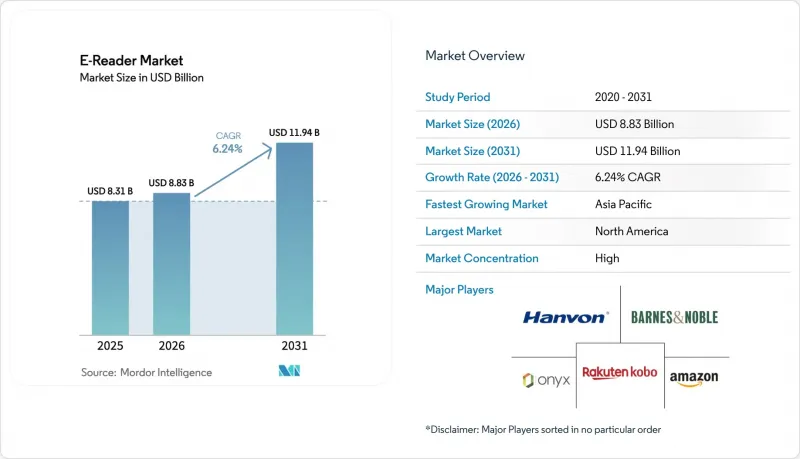
根據 Mordor Intelligence 預測,電子閱讀器市場規模將從 2025 年的 83.1 億美元成長到 2026 年的 88.3 億美元,然後在 2031 年達到 119.4 億美元,2026 年至 2031 年的複合年成長率為 6.24%。
本報告按螢幕大小(6英寸以下、6-8英寸、8英寸以上)、顯示技術(E-Ink Carta、E-Ink Kaleido Colour、Sipix及其他)、連接方式(僅Wi-Fi、Wi-Fi+蜂窩網路及其他)、配銷通路(線上零售、線下零售及其他)、最終用戶(學生/教育機構等專業人士/區域市場預測以美元計價。
全球電子閱讀器市場趨勢及洞察
數位學習參與者人數增加
線上和混合式教學模式的擴展正迫使大學和中小學採用與專用閱讀器相容的數位教科書。採購負責人更傾向於使用支援手寫筆輸入的大螢幕型號,以便進行註釋和筆記。與背光液晶平板電腦相比,彩色電子墨水螢幕有助於科學和數學教師減輕眼部疲勞,同時保持視覺清晰度。人工智慧翻譯和文字轉語音功能進一步提升了這些設備在多語言課堂中的效用。預算負責人也指出,數位教科書的整體擁有成本更低,因為它們無需每年重印。
價格低於100美元的入門級經濟型機型
成本最佳化的機型採用最少的硬體配置,並受益於日益成熟的電子墨水屏技術,這使得東南亞和拉丁美洲的電子閱讀器市場拓展至首次購機用戶。當地業者透過補貼硬體,換取限時內容訂閱服務,從而確保持續的收入。價格競爭迫使高階品牌加快其中端產品線的更新換代,縮短產品週期,並促進模組化組件的再利用。入門級產品的普及也刺激了二手市場的發展,延長了設備的使用壽命,並擴大了使用者群體。
與平板電腦和大螢幕智慧型手機的競爭
如今,6吋電子閱讀器與6.7吋智慧型手機競爭,後者能夠進行影片串流、遊戲和網頁瀏覽。平板電腦製造商正透過引入「護眼模式」來減少藍光造成的眼部疲勞,並採用可變刷新率顯示螢幕,從而縮小與智慧型手機在人體工學方面的差距。高所得地區的消費者通常同時擁有智慧型手機和平板電腦,因此對單一功能設備的需求降低。正因如此,零售商的促銷策略不再將電子閱讀器定位為通用資訊娛樂設備,而是將其作為專注閱讀的輔助工具。品牌訊息也開始強調無需集中注意力的閱讀環境和長達數週的電池續航力,以此凸顯電子閱讀器的獨特優勢。
細分市場分析
到2025年,6-8吋尺寸的電子閱讀器將佔據67.10%的市場。這是因為該尺寸範圍在便攜性和閱讀體驗之間取得了良好的平衡,尤其適合閱讀大多數不含插圖的虛構和非虛構類內容。中等價位和豐富的配件生態系統進一步鞏固了該尺寸範圍的市場主導地位。目前,8吋以上尺寸的電子閱讀器正吸引需要充足邊距進行批註的相關人員和專業。 10吋機型的彩色顯示器和手寫輸入功能增強了與教科書的互動性,並提高了互動的清晰度。隨著面板良率的提高,平均售價正在下降,預計未來五年大尺寸顯示器的複合年成長率將達到8.18%。 6吋以下的機型正逐漸失去市場佔有率,因為智慧型手機的螢幕大小已經超越了它們,抵消了其便攜性的優勢。
蓬勃發展的售後市場,包括保護套和鍵盤套,鞏固了這款大螢幕閱讀器作為混合筆記平板電腦的地位。企業培訓部門非常欣賞其透過安全企業伺服器同步文件的功能,避免了整個安卓和iOS生態系統帶來的各種干擾風險。手寫筆和雲端儲存套餐的捆綁銷售帶來了持續的收入,也讓用戶繼續使用其專有的註釋格式。由於能夠處理大尺寸玻璃基板物流的競爭對手數量有限,利潤率依然可觀。Epson和夏普提供特殊的觸控層,即使在低刷新率下也能保持筆觸的精準度。
2025年,E-ink Carta電子墨水屏仍佔出貨量的70.95%。這是因為該單色平台以適合大眾市場的價格,提供出色的對比度和數週的電池續航時間。規模經濟使得其促銷價格低於100美元,從而維持了大規模的用戶群。雖然2025年彩色電子閱讀器的市場佔有率仍然小規模,但E-ink Kaleido電子墨水屏預計到2031年將保持9.23%的複合年成長率,這主要得益於學校平板電腦替代產品的試點部署以及漫畫出版商對舊書目錄的數位化。採用薄膜彩色濾光片的Gallery 3面板解決了最初的亮度衰減問題,但其更新率仍落後於LCD。 SiPix及相關技術正被應用於指示牌和工業工作流程中,在這些應用中,生物穩定性和超低功耗比像素密度更為重要。
目前,設備製造商正在整合環境光感測器,以調節頭燈的色溫,使其與礦物紙的色溫相匹配,從而提升模擬閱讀體驗。韌體升級引入了局部色彩刷新功能,以降低能耗。一些公司正在考慮推出客製化的頭燈導光板,即使在LED路燈照射下,也能保持戶外現場手冊的色彩還原度。這些特殊需求正在催生規模雖小但利潤豐厚的細分市場,並進一步拓展了組件供應商的收入來源。
區域分析
北美仍然是最大的區域貢獻者,預計到2025年將佔據電子閱讀器市場46.05%的佔有率。這得益於北美消費者較高的自由裁量權以及將設備銷售與龐大的內容庫連接起來的整合內容平台。 Kindle的早期普及培養了用戶偏好使用專用閱讀器閱讀長篇內容的良好習慣。公共圖書館聯盟共同經營一套自動到期的數位借閱系統,在大幅降低納稅人回購成本的同時,也維持了借閱量的成長。零售商的補助金和以舊換新計畫維持了設備的更新換代週期,保護了電子閱讀器市場免受平板電腦的衝擊。
預計亞太地區將實現最快成長,到2031年複合年成長率將達到7.62%。在中國、印度和印度尼西亞,市場擴張得益於中產階級收入的成長以及全國範圍內提升數位素養的努力。像Onyx Boox這樣的本土品牌正利用本地生產的稅收優惠政策來提供具有競爭力的價格,而全球公司則與電信巨頭合作,捆綁銷售商店積分。日本成熟的電子書生態系統預計到2024年將達到6,703億日圓(942億美元),顯示消費者願意為專為漫畫最佳化的優質彩色設備買單。印度和印尼政府對偏遠鄉村圖書館的補助進一步擴大了農村地區的電子書普及率。
在歐洲,受歐盟《一般產品安全規範》(GDPR)的推動,電子閱讀器市場呈現穩定的個位數成長,該規範優先考慮環保硬體。機構買家在簽約前會仔細考慮產品的生命週期排放量和可維修性評分。歐盟的森林砍伐法規也鼓勵出版商採用「數位優先」的發行模式,間接促進了電子閱讀器市場的擴張。斯堪地那維亞的學校正在試點全區範圍內的終端部署計劃,以淘汰紙質工作簿,而德國公司則將安全閱讀器整合到教學工作流程中。拉丁美洲和非洲仍然是新興市場,硬體價格的下降和4G網路覆蓋範圍的擴大為新的目標受眾群體開闢了道路。在這些地區,本地語言內容和微型金融方案的合作正在蓬勃發展。
其他好處:
- Excel格式的市場預測(ME)表
- 3個月的分析師支持
目錄
第1章:引言
- 研究假設和市場定義
- 調查範圍
第2章:調查方法
第3章執行摘要
第4章 市場狀況
- 市場概覽
- 市場促進因素
- 數位學習參與者人數增加
- 售價低於 100 美元的入門級經濟型設備
- 自助出版和數位領先出版的擴展
- K-12 內容彩色電子墨水的商業化。
- 機構減少紙張使用量的永續性要求
- 行動電信商銷售包含設備和內容的捆綁套餐。
- 市場限制因素
- 來自平板電腦和大螢幕智慧型手機的競爭
- 電子墨水硬體的多功能性有限。
- 電子墨水顯示模組單一供應商供貨瓶頸
- 限制性的DRM生態系統阻礙了其在本地社區的普及。
- 產業價值鏈分析
- 監理情勢
- 技術展望
- 波特五力分析
第5章 市場規模與成長預測
- 按螢幕尺寸
- 小於6英寸
- 6-8英寸
- 8吋或更大
- 顯示技術
- E-ink Carta
- 電子墨水 Kaleido(彩色)
- SiPix 和其他
- 連結性別
- 僅限 Wi-Fi
- Wi-Fi + 蜂窩網路
- 僅藍牙/離線同步
- 透過分銷管道
- 線上零售
- 線下零售
- 機構/批量採購
- 最終用戶
- 學生和教育機構
- 專家/公司
- 休閒和一般消費者
- 按地區
- 北美洲
- 美國
- 加拿大
- 墨西哥
- 歐洲
- 英國
- 德國
- 法國
- 義大利
- 其他歐洲國家
- 亞太地區
- 中國
- 日本
- 印度
- 韓國
- 其他亞洲國家
- 中東
- 以色列
- 沙烏地阿拉伯
- 阿拉伯聯合大公國
- 土耳其
- 其他中東國家
- 非洲
- 南非
- 埃及
- 其他非洲國家
- 南美洲
- 巴西
- 阿根廷
- 其他南美國家
- 北美洲
第6章 競爭情勢
- 市場集中度
- 策略趨勢
- 市佔率分析
- 公司簡介
- Amazon .com, Inc.
- Rakuten Group, Inc.(Kobo)
- Barnes and Noble, LLC
- PocketBook International SA
- Onyx International Inc.(BOOX)
- Hanvon Technology Co., Ltd.
- Bookeen SAS
- ECTACO Inc.
- Sony Group Corporation
- Apple Inc.
- ReMarkable AS
- Boyue Shenzhen Technology Co., Ltd.
- Fujitsu Limited
- Huawei Technologies Co., Ltd.
- Xiaomi Corporation
- Bigme Corporation
- Dasung Tech Co., Ltd.
- Tolino Alliance GmbH and Co. KG
- Energy Sistem Technology, SA
- Arta Tech sp. z oo
第7章 市場機會與未來展望
According to Mordor Intelligence, the e-Reader market size is expected to grow from USD 8.31 billion in 2025 to USD 8.83 billion in 2026 and is forecast to reach USD 11.94 billion by 2031 at 6.24% CAGR over 2026-2031.
This report is Segmented by Screen Size (Below 6 Inch, 6-8 Inch, Above 8 Inch), Display Technology (E-Ink Carta, E-Ink Kaleido Colour, Sipix and Others), Connectivity (Wi-Fi Only, Wi-Fi + Cellular and More), Distribution Channel (Online Retail, Offline Retail, and More), End-User (Students and Education, Professionals/Enterprise, and More), and Geography. The Market Forecasts are Provided in Terms of Value (USD).
Global E-Reader Market Trends and Insights
Rising e-learning enrolments
Expanding online and hybrid programs push universities and K-12 districts to adopt digital textbooks that pair well with dedicated readers. Procurement teams favour large-format models that accept stylus input for annotation and note-taking. Colour e-ink helps science and math teachers retain visual fidelity while lowering eye strain compared with backlit LCD tablets. AI translation and text-to-speech functions further increase device utility for multilingual classrooms. Budget holders also point to the lower total cost of ownership because digital textbooks remain current without annual reprints.
Affordable entry-level devices below USD 100
Cost-optimized models rely on stripped-down hardware and maturing E-ink supply, bringing the E-Reader market to first-time buyers in Southeast Asia and Latin America. Local telecom operators subsidize hardware in exchange for fixed-term content subscriptions that guarantee recurring revenue. Price competition puts pressure on premium brands to refresh mid-tier lineups more quickly, shortening product cycles and encouraging modular component reuse. Entry-level penetration also feeds second-hand markets, prolonging device lifespans and enlarging the overall user base.
Competition from tablets and large-screen smartphones
Six-inch readers now compete with 6.7-inch phones that stream video, run games, and browse the web. Tablet makers rolled out eye-comfort modes and variable refresh displays that mitigate blue-light fatigue, narrowing the ergonomic gap. Consumers in high-income regions often own both a phone and a tablet, lowering the perceived need for a single-purpose device. Retail promotions, therefore, pitch readers as complementary tools for deep reading rather than general infotainment. Brand messaging now emphasizes distraction-free focus and weeks-long battery life to differentiate.
Other drivers and restraints analyzed in the detailed report include:
- Expansion of self-publishing ecosystems
- Commercialization of colour e-ink for K-12 content
- Hardware limitations constrain feature development
For complete list of drivers and restraints, kindly check the Table Of Contents.
Segment Analysis
The 6-8-inch tier represented 67.10% of the E-Reader market size in 2025 because it balances portability with legibility for most fiction and non-illustrated non-fiction content. Mid-range pricing and broad accessory ecosystems reinforce its dominance. The above 8-inch category now attracts academic and professional buyers who need wide margins for annotation. Colour and handwriting layers on 10-inch models enhance textbook interaction and diagram clarity. As panel yields improve, average selling prices decline, supporting an 8.18% five-year CAGR for large displays. Below 6-inch models lose share as phone screen growth eclipses their size and nullifies portability advantages.
A thriving aftermarket of protective folios and keyboard sleeves positions large readers as hybrid note-taking tablets. Corporate training departments appreciate that files sync over secure enterprise servers without the distraction risk of full Android or iOS ecosystems. Bundled stylus and cloud storage packages drive recurring revenue and tie users into proprietary annotation formats. Margins remain healthy because few competitors can navigate the logistics of big glass substrates. Epson and Sharp supply specialty touch layers that maintain pen precision even at lower refresh rates.
E-ink Carta retained 70.95% of 2025 shipments because the monochrome platform delivers superior contrast and multi-week battery life at cost points suitable for mass market devices. Economies of scale allow aggressive promotional pricing below USD 100, maintaining a sizable installed base. The E-Reader market share for colour remained small in 2025, yet the E-ink Kaleido segment is forecast to clock 9.23% CAGR through 2031 as schools pilot tablet replacements and comics publishers digitize back catalogues. Gallery 3 panels with film-based colour filters solve early brightness loss problems, though refresh rates still trail LCD. SiPix and fringe technologies serve signage and industrial workflows where biostability and ultra-low power matter more than pixel density.
Device makers now integrate ambient light sensors that tune front-light warmth to mineral-paper colour temperatures, reinforcing the analog reading feel. Firmware upgrades push partial colour refresh options that cap energy drain. Enterprises explore custom front-light waveguides that preserve colour fidelity under LED street lighting conditions for outdoor field manuals. Such specialized requirements create smaller but higher margin niches that further diversify revenue streams for component suppliers.
Complete Report Scope:
- By Screen Size
- Below 6 inch
- 6-8 inch
- Above 8 inch
- By Display Technology
- E-ink Carta
- E-ink Kaleido (Colour)
- SiPix and Others
- By Connectivity
- Wi-Fi only
- Wi-Fi + Cellular
- Bluetooth-only / Offline sync
- By Distribution Channel
- Online Retail
- Offline Retail
- Institutional / Bulk Procurement
- By End-user
- Students and Education
- Professionals / Enterprise
- Leisure and General Public
- By Geography
- North America
- United States
- Canada
- Mexico
- Europe
- United Kingdom
- Germany
- France
- Italy
- Rest of Europe
- Asia-Pacific
- China
- Japan
- India
- South Korea
- Rest of Asia
- Middle East
- Israel
- Saudi Arabia
- United Arab Emirates
- Turkey
- Rest of Middle East
- Africa
- South Africa
- Egypt
- Rest of Africa
- South America
- Brazil
- Argentina
- Rest of South America
- North America
Geography Analysis
North America remained the largest regional contributor with a 46.05% 2025 share of the E-Reader market, buoyed by high discretionary spending and integrated content platforms that couple device sales with vast catalogues. Early Kindle adoption fostered an entrenched user culture that favours dedicated readers for long-form content. Public library consortia syndicate digital loans that automatically expire, saving taxpayers substantial restocking costs and sustaining circulation growth. Retail subsidies and trade-in programs keep upgrade cycles brisk, cushioning the market against tablet cannibalization.
Asia-Pacific delivers the fastest growth at a 7.62% CAGR through 2031. Rising middle-class income intersects with nationwide digital literacy campaigns in China, India, and Indonesia. Domestic brands such as Onyx Boox leverage local manufacturing tax incentives to price competitively, while global players partner with telecom giants to bundle storefront credits. Japan's mature e-book ecosystem, valued at JPY 670.3 billion (USD 94.2 billion) in 2024, illustrates a willingness to pay for premium colour devices with manga-optimized layouts. Government subsidies for remote village libraries in India and Indonesia further widen rural adoption.
Europe shows steady mid-single digit expansion under the influence of the EU General Product Safety Regulation, which prioritizes environmentally responsible hardware. Institutional buyers weigh lifecycle emissions and repairability scores before awarding contracts. The EU Deforestation Regulation also nudges publishers toward digital first distribution, indirectly expanding the E-Reader market. Scandinavian school systems pilot district wide device programs that eliminate printed workbooks, while German corporates integrate secure readers into board meeting workflows. Latin America and Africa remain emerging opportunities, where falling hardware prices and expanding 4G coverage unlock new addressable segments. Local language content partnerships and micro-financing options gain traction in these regions.
- Amazon .com, Inc.
- Rakuten Group, Inc. (Kobo)
- Barnes and Noble, LLC
- PocketBook International SA
- Onyx International Inc. (BOOX)
- Hanvon Technology Co., Ltd.
- Bookeen SAS
- ECTACO Inc.
- Sony Group Corporation
- Apple Inc.
- ReMarkable AS
- Boyue Shenzhen Technology Co., Ltd.
- Fujitsu Limited
- Huawei Technologies Co., Ltd.
- Xiaomi Corporation
- Bigme Corporation
- Dasung Tech Co., Ltd.
- Tolino Alliance GmbH and Co. KG
- Energy Sistem Technology, S.A.
- Arta Tech sp. z o.o.
Additional Benefits:
- The market estimate (ME) sheet in Excel format
- 3 months of analyst support
TABLE OF CONTENTS
1 INTRODUCTION
- 1.1 Study Assumptions and Market Definition
- 1.2 Scope of the Study
2 RESEARCH METHODOLOGY
3 EXECUTIVE SUMMARY
4 MARKET LANDSCAPE
- 4.1 Market Overview
- 4.2 Market Drivers
- 4.2.1 Rising e-Learning enrolments
- 4.2.2 Affordable entry-level devices below US$100
- 4.2.3 Expansion of self-publishing and digital-first titles
- 4.2.4 Commercialisation of colour e-ink for K-12 content
- 4.2.5 Institutional paper-reduction sustainability mandates
- 4.2.6 Device-content subscription bundles by telecoms
- 4.3 Market Restraints
- 4.3.1 Competition from tablets and large-screen smartphones
- 4.3.2 Limited multifunction capability of e-ink hardware
- 4.3.3 Single-supplier bottleneck for e-ink display modules
- 4.3.4 Restrictive DRM ecosystems curbing regional uptake
- 4.4 Industry Value-Chain Analysis
- 4.5 Regulatory Landscape
- 4.6 Technological Outlook
- 4.7 Porter's Five Forces Analysis
- 4.7.1 Bargaining Power of Buyers
- 4.7.2 Bargaining Power of Suppliers
- 4.7.3 Threat of New Entrants
- 4.7.4 Threat of Substitutes
- 4.7.5 Intensity of Competitive Rivalry
5 MARKET SIZE AND GROWTH FORECASTS (VALUE)
- 5.1 By Screen Size
- 5.1.1 Below 6 inch
- 5.1.2 6-8 inch
- 5.1.3 Above 8 inch
- 5.2 By Display Technology
- 5.2.1 E-ink Carta
- 5.2.2 E-ink Kaleido (Colour)
- 5.2.3 SiPix and Others
- 5.3 By Connectivity
- 5.3.1 Wi-Fi only
- 5.3.2 Wi-Fi + Cellular
- 5.3.3 Bluetooth-only / Offline sync
- 5.4 By Distribution Channel
- 5.4.1 Online Retail
- 5.4.2 Offline Retail
- 5.4.3 Institutional / Bulk Procurement
- 5.5 By End-user
- 5.5.1 Students and Education
- 5.5.2 Professionals / Enterprise
- 5.5.3 Leisure and General Public
- 5.6 By Geography
- 5.6.1 North America
- 5.6.1.1 United States
- 5.6.1.2 Canada
- 5.6.1.3 Mexico
- 5.6.2 Europe
- 5.6.2.1 United Kingdom
- 5.6.2.2 Germany
- 5.6.2.3 France
- 5.6.2.4 Italy
- 5.6.2.5 Rest of Europe
- 5.6.3 Asia-Pacific
- 5.6.3.1 China
- 5.6.3.2 Japan
- 5.6.3.3 India
- 5.6.3.4 South Korea
- 5.6.3.5 Rest of Asia
- 5.6.4 Middle East
- 5.6.4.1 Israel
- 5.6.4.2 Saudi Arabia
- 5.6.4.3 United Arab Emirates
- 5.6.4.4 Turkey
- 5.6.4.5 Rest of Middle East
- 5.6.5 Africa
- 5.6.5.1 South Africa
- 5.6.5.2 Egypt
- 5.6.5.3 Rest of Africa
- 5.6.6 South America
- 5.6.6.1 Brazil
- 5.6.6.2 Argentina
- 5.6.6.3 Rest of South America
- 5.6.1 North America
6 COMPETITIVE LANDSCAPE
- 6.1 Market Concentration
- 6.2 Strategic Moves
- 6.3 Market Share Analysis
- 6.4 Company Profiles (includes Global level Overview, Market level overview, Core Segments, Financials as available, Strategic Information, Market Rank/Share for key companies, Products and Services, and Recent Developments)
- 6.4.1 Amazon .com, Inc.
- 6.4.2 Rakuten Group, Inc. (Kobo)
- 6.4.3 Barnes and Noble, LLC
- 6.4.4 PocketBook International SA
- 6.4.5 Onyx International Inc. (BOOX)
- 6.4.6 Hanvon Technology Co., Ltd.
- 6.4.7 Bookeen SAS
- 6.4.8 ECTACO Inc.
- 6.4.9 Sony Group Corporation
- 6.4.10 Apple Inc.
- 6.4.11 ReMarkable AS
- 6.4.12 Boyue Shenzhen Technology Co., Ltd.
- 6.4.13 Fujitsu Limited
- 6.4.14 Huawei Technologies Co., Ltd.
- 6.4.15 Xiaomi Corporation
- 6.4.16 Bigme Corporation
- 6.4.17 Dasung Tech Co., Ltd.
- 6.4.18 Tolino Alliance GmbH and Co. KG
- 6.4.19 Energy Sistem Technology, S.A.
- 6.4.20 Arta Tech sp. z o.o.
7 MARKET OPPORTUNITIES AND FUTURE OUTLOOK
- 7.1 White-space and Unmet-Need Assessment

 歐洲電子書:市場佔有率分析、產業趨勢與統計、成長預測(2026-2031)電子書:市佔率分析、產業趨勢與統計、成長預測(2026-2031)
 電子書閱讀器市場-2026-2032年全球市場預測電子書市場:2026-2032年全球市場預測(按類型、文件格式、設備、定價模式、年齡層、最終用戶和通路分類)
 全球線上圖書服務市場規模、佔有率、趨勢和成長分析報告(2026-2034)
 美國自助出版市場規模、佔有率和趨勢分析報告:按類型、格式、主要參與者、競爭分析和細分市場預測(2026-2033 年)
 線上圖書服務市場-全球產業規模、佔有率、趨勢、機會與預測:按產品、應用、地區和競爭對手分類,2021-2031年
 電子閱讀器市場報告:按螢幕類型、螢幕大小、連接方式、價格範圍、最終用戶、分銷管道和地區分類(2026-2034 年)
 2026年全球電子閱讀器市場報告2026年全球線上圖書服務市場報告